When it comes to building muscle, the "best" workout split is the one that actually works for you. It needs to sync up with your experience in the gym, how many days you can realistically train, and how well your body recovers. For someone just starting out, a Full-Body split hitting the gym 3 days a week is a fantastic starting point. More seasoned lifters often find better results with an Upper/Lower split over 4 days or a Push/Pull/Legs routine, which can be run anywhere from 3 to 6 days a week.
Decoding Your Ideal Workout Blueprint
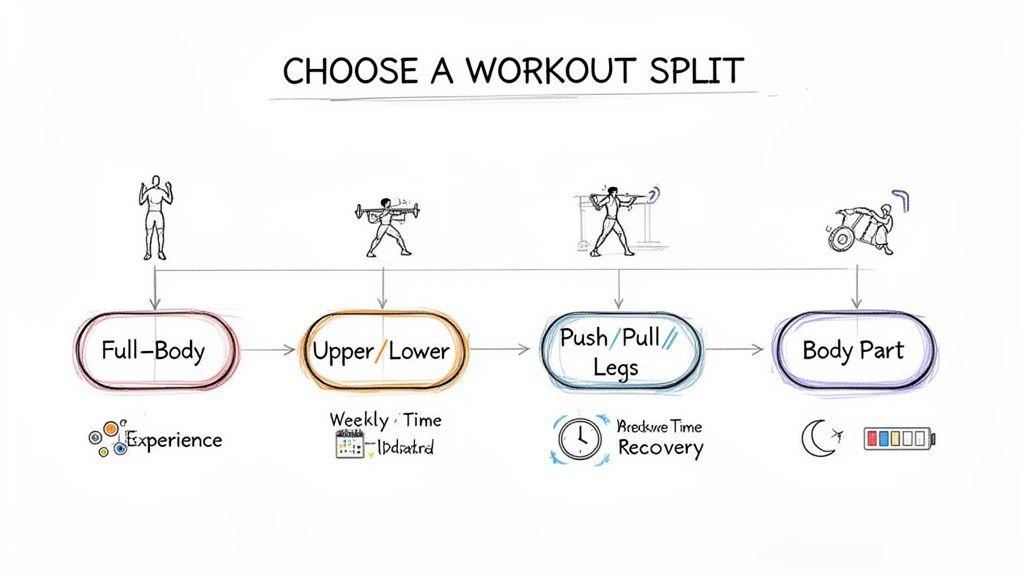
If you're struggling to find a workout plan that delivers consistent muscle growth, you're not alone. The fitness world is noisy, full of conflicting advice that makes it tough to figure out what truly drives results. The secret isn't some magic routine; it's about finding a split that fits your life like a glove.
This guide will cut through that noise. We're zeroing in on the things that actually matter for long-term progress:
- Your Experience Level: What a beginner needs is worlds apart from what an advanced lifter can handle.
- Your Weekly Schedule: Let's be real—how many days can you actually commit to training?
- Your Recovery Ability: The most brutal program on paper is useless if you're constantly sore and run down.
The Four Pillars of Muscle Growth Splits
Let's break down the four most common and effective splits. Think of each one as a different tool in your toolbox—powerful when you know when and how to use it. Understanding their fundamental differences is the first step to choosing the right one for your goals.
| Split Type | Training Frequency | Weekly Sessions | Best Suited For |
|---|---|---|---|
| Full-Body Split | High (3x per week) | 2-3 Days | Beginners or those with limited time. |
| Upper/Lower Split | Moderate (2x per week) | 4 Days | Intermediates seeking balanced volume. |
| Push/Pull/Legs (PPL) | Moderate (1-2x per week) | 3-6 Days | Lifters who enjoy movement-based training. |
| Body Part ("Bro") Split | Low (1x per week) | 4-6 Days | Advanced lifters needing high per-session volume. |
Each of these splits plays with the training variables in a unique way. A full-body routine, for instance, maximizes training frequency—how often you hit a muscle group. Stimulating a muscle three times a week is a potent recipe for growth, especially for newer lifters. If you want to dive deeper into this concept, check out our guide on training frequency for hypertrophy.
On the other end of the spectrum, a body part split has a low frequency but allows for a massive amount of volume in a single session, something an advanced lifter can benefit from. We'll explore these nuances to help you choose confidently and show you how smart tools like the Built Workout app can fine-tune any split by precisely tracking your volume and recovery.
Understanding the Science of Muscle Growth
Before we can pick the "best" workout split, we need to get on the same page about what actually makes a muscle grow. It's surprisingly simple at its core. Hypertrophy is just your body’s adaptation to stress. You challenge your muscles with something they aren't used to, and they rebuild themselves bigger and stronger to be ready for the next time.
This whole process boils down to three key variables you can play with in your training: volume, frequency, and intensity. Think of these as the knobs and levers you turn to signal growth. Every workout split we'll cover is really just a different way of organizing these variables across your week.
But none of it matters without progressive overload. This is the non-negotiable rule of muscle growth. To keep growing, you have to consistently increase the demands you place on your muscles over time. That could mean lifting a little heavier, squeezing out one more rep, or adding an extra set. If you don't give your body a reason to keep adapting, your progress will hit a wall.
Training Volume: The Engine of Hypertrophy
Training volume—often tracked as sets x reps x weight—is arguably the biggest driver of muscle growth. It’s the total amount of work a muscle does. While it's true that more volume generally leads to more growth, there's a definite point where you get diminishing returns. More isn't always better.
A fascinating study from Florida Atlantic University actually put a number on this, coining the term PUOS (Point of Undetectable Outcome Superiority). Researchers found that muscle growth pretty much flatlined after about 11 fractional sets in a single workout, with very little extra benefit beyond that. This tells us that crushing a muscle with 20 sets won't give you double the results of 10 sets; you're mostly just adding fatigue.
Key Insight: The goal isn't to cram in the maximum volume possible. It's to hit the optimal volume—enough high-quality work to spark growth without digging yourself into a recovery hole.
Frequency and Intensity: The Supporting Pillars
If volume is the engine, think of frequency and intensity as the steering wheel and gas pedal. They dictate how you apply that volume.
Frequency: This is simply how often you train a muscle group each week. Hitting a muscle more often (say, 2-3 times per week) can be a great way to keep muscle protein synthesis—the actual rebuilding process—elevated.
Intensity: This refers to how heavy you’re lifting, usually measured as a percentage of your one-rep max (1RM). For building muscle, the sweet spot is typically lifting a weight that pushes you close to failure within the 6-15 rep range.
These two variables are always in a balancing act. If you obliterate a muscle group with tons of volume in one session, your frequency for that muscle has to drop to give it enough time to recover.
Recovery: Where the Growth Actually Happens
Here’s the part everyone forgets: you don't build muscle in the gym. The gym is where you break it down. The real growth happens when you rest, repair, and refuel.
This process depends on a few critical things:
- Sleep: Absolutely crucial for hormone regulation and tissue repair.
- Nutrition: You have to give your body the protein and calories it needs to rebuild.
- Rest Days: Your muscles and your central nervous system need a break.
What you eat right after a workout is just as important as the workout itself. For those looking for plant-based options, this plant-based recovery guide on what to eat after a gym workout has some great ideas. And don't forget, knowing how long to https://www.builtworkout.com/blog/rest-between-sets-for-muscle-growth is key to keeping your intensity high throughout the session.
Comparing the Most Popular Workout Splits
Figuring out the right workout split isn't about uncovering some secret formula. It's about matching a training philosophy to your real life. Every popular split—Full-Body, Upper/Lower, Push/Pull/Legs, and the classic Body Part "bro" split—is really just a different way to organize your total weekly work. The best one is simply the one you can stick with, recover from, and consistently add weight or reps to over time.
Instead of just listing pros and cons, let's put these four splits head-to-head. We'll break them down based on what actually drives long-term muscle growth: how often you train each muscle, your time commitment, recovery demands, and who they’re best suited for.
This decision tree shows how the real engines of muscle growth—volume, frequency, and intensity—all work together.
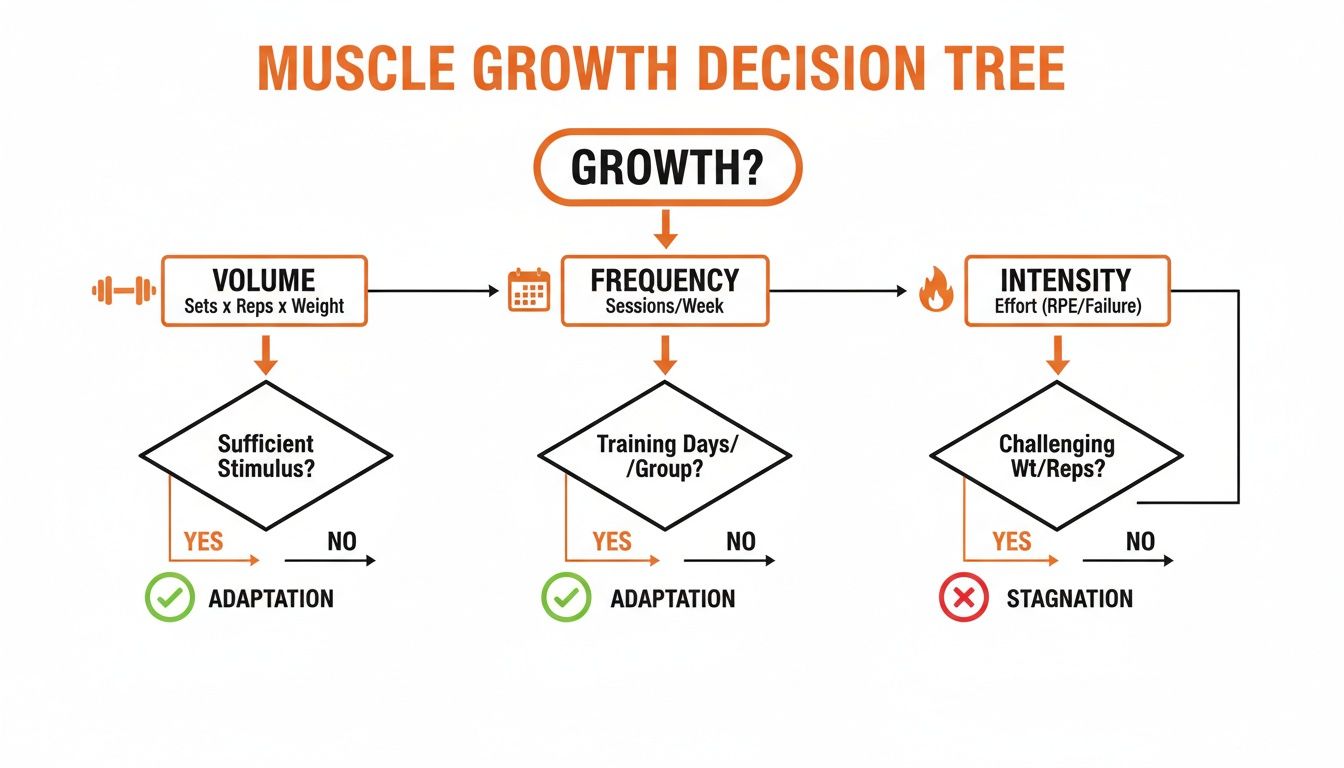
The main takeaway here is that every path to building muscle involves playing with these variables. Your split is just the roadmap you choose to follow.
The Full-Body Split: A High-Frequency Foundation
A full-body split means you’re training all your major muscle groups every time you hit the gym. This is typically done two to three times per week, making it the undisputed king of training frequency.
That high frequency is a massive advantage for beginners. New lifters don't need a ton of volume in one go to spark growth; in fact, too much can just crush their ability to recover. Hitting each muscle with a solid stimulus three times a week keeps muscle protein synthesis humming, creating the perfect environment for building that initial foundation of strength and size.
But as you get more experienced, the cracks in a full-body routine start to show. To keep making progress, you need more volume. Trying to cram enough quality sets for your chest, back, quads, hamstrings, shoulders, and arms into a single workout turns it into a marathon session. Eventually, fatigue sets in, and you end up with "junk volume" where your form and effort fall off a cliff.
A Full-Body Split is Your Go-To For:
- Beginners: The constant repetition helps you master the main lifts much faster, speeding up both skill and muscle gains.
- The Time-Crunched: If you can only get to the gym 2-3 times a week, this split ensures no muscle gets left behind.
- Fat Loss Goals: Full-body workouts are incredibly demanding from a metabolic standpoint, which helps burn more calories each session.
The Upper/Lower Split: A Balanced Workhorse
For a huge range of lifters, the Upper/Lower split is arguably the most versatile and effective routine out there. You divide your training into upper-body days and lower-body days, which lets you train every muscle group twice per week—what many consider the "sweet spot" for hypertrophy.
This split neatly solves the main problem with full-body training. By separating the workouts, you can dedicate much more volume and intensity to each muscle group without the session dragging on forever. You can hammer your upper body with 10-12 sets on Monday, then come back fresh on Thursday to do it all over again.
This structure strikes a perfect balance between getting enough work in and having enough time to recover. Each muscle gets a solid 48-72 hours of rest before you train it again, which is plenty of time for most intermediate lifters to repair and grow stronger.
Why It Works So Well: The Upper/Lower split’s magic is in its balance. You get higher frequency than a bro split but can handle more focused volume than a full-body routine. This makes it a powerful and sustainable choice for consistent, long-term progress.
The Push/Pull/Legs (PPL) Split: A Logical Grouping
The Push/Pull/Legs (PPL) split organizes your workouts based on fundamental movement patterns. It's an incredibly intuitive and efficient way to structure your week.
- Push Day: You train your chest, shoulders, and triceps—all the muscles involved in pushing movements.
- Pull Day: You focus on your back and biceps, the muscles responsible for pulling.
- Legs Day: This one’s simple—quads, hamstrings, glutes, and calves.
This setup is brilliant because it minimizes fatigue between sessions. For example, your triceps get worked hard on push day but are completely fresh for your pull and leg workouts. This allows for great recovery and better performance in every single session.
PPL is also super flexible. You can run it 3-6 days a week. A 3-day PPL hits each muscle once per week, while a 6-day version hits everything twice, effectively doubling your frequency.
For anyone looking for a well-rounded approach, our comprehensive 4-day push-pull workout routine is a great example of how to blend intensity and recovery.
The Body Part Split: A High-Volume Specialist
This is the classic "bro split" you see in bodybuilding magazines, where you dedicate an entire session to just one or two muscle groups (e.g., Chest Day, Back Day, Leg Day). This approach means you have a low training frequency, hitting each muscle just once per week.
The big draw here is the sheer amount of volume you can pack into a single session. When you only have to train your chest, you can absolutely hammer it from every conceivable angle with a dozen or more sets. For very advanced lifters who need an overwhelming stimulus to force new growth, this can be an effective strategy.
For most people, though, this is not the best path. Training a muscle only once every seven days means muscle protein synthesis spikes and then drops off, leaving a lot of "dead time" during the week where you're not growing. Beginners and intermediates will almost always see better results by hitting their muscles more often.
Workout Split Comparison for Muscle Growth
To make it even clearer, here’s a side-by-side look at how these four splits stack up against each other based on the most important factors for building muscle.
| Split Type | Frequency Per Muscle Group | Weekly Sessions | Ideal For | Primary Advantage |
|---|---|---|---|---|
| Full-Body | High (2-3x / week) | 2-3 Days | Beginners & Time-Limited | Maximizes frequency and skill practice. |
| Upper/Lower | Moderate (2x / week) | 4 Days | Intermediates | Excellent balance of volume, frequency, and recovery. |
| Push/Pull/Legs | Flexible (1-2x / week) | 3-6 Days | All Levels | Logical grouping minimizes muscle overlap and fatigue. |
| Body Part Split | Low (1x / week) | 4-6 Days | Advanced Lifters | Allows for extremely high volume per session for specialization. |
Ultimately, the debate over the "best" workout split is a distraction. The real driver of your progress isn't the split itself, but your ability to consistently apply progressive overload within whatever framework you choose. Find the one that fits your life, and get to work.
Actionable Workout Templates for Each Split
Knowing the theory is great, but getting under the bar is where the real growth happens. Think of these templates as solid starting points, not rigid rules. They give you a structured plan you can run with, but feel free to swap exercises based on the equipment you have and what feels best for your body.
The one non-negotiable rule is progressive overload. It’s the engine of all muscle growth. Every week, your mission is to do just a little bit more—add 5 lbs to your squat, grind out one extra rep on your bench press, or tack on another set of pull-ups. That’s how you signal to your body that it needs to adapt and grow stronger.
The Full Body Split Template
Perfect for beginners or anyone hitting the gym three days a week. This approach hammers every muscle group with high frequency, which is a massive stimulus for new growth. The idea is simple: pick one solid compound lift for each major muscle group and focus on mastering your form.
Here’s what a 3-day full-body week could look like:
Day 1: Workout A
- Goblet Squats: 3x8-12
- Dumbbell Bench Press: 3x8-12
- Lat Pulldowns: 3x10-15
- Dumbbell Shoulder Press: 3x10-15
- Plank: 3x30-60 seconds
Day 2: Rest or Active Recovery
Day 3: Workout B
- Romanian Deadlifts: 3x8-12
- Push-Ups: 3xAs Many Reps As Possible (AMRAP)
- Seated Cable Rows: 3x10-15
- Lateral Raises: 3x12-15
- Leg Raises: 3x15-20
Day 4: Rest or Active Recovery
Day 5: Workout A (Your goal is to beat Day 1’s numbers)
- Goblet Squats: 3x8-12
- Dumbbell Bench Press: 3x8-12
- Lat Pulldowns: 3x10-15
- Dumbbell Shoulder Press: 3x10-15
- Plank: 3x30-60 seconds
Day 6 & 7: Rest
The Upper/Lower Split Template
The upper/lower split is a true workhorse, especially for intermediate lifters. It strikes a beautiful balance between volume and frequency. By dedicating whole sessions to just your upper or lower body, you can pile on more quality work for each muscle without spending hours in the gym.
This 4-day template hits everything twice a week, blending strength and hypertrophy focus:
Day 1: Upper Body Strength
- Bench Press: 4x6-8
- Bent-Over Rows: 4x6-8
- Overhead Press: 3x8-10
- Pull-Ups: 3xAMRAP
- Tricep Pushdowns: 3x10-12
Day 2: Lower Body Strength
- Barbell Squats: 4x6-8
- Leg Press: 3x10-12
- Leg Curls: 3x10-12
- Calf Raises: 4x10-15
Day 3: Rest
Day 4: Upper Body Hypertrophy
- Incline Dumbbell Press: 3x10-15
- Seated Cable Rows: 3x10-15
- Lateral Raises: 4x12-15
- Bicep Curls: 3x12-15
- Face Pulls: 3x15-20
Day 5: Lower Body Hypertrophy
- Romanian Deadlifts: 3x10-12
- Lunges: 3x12-15 per leg
- Leg Extensions: 3x15-20
- Seated Calf Raises: 4x15-20
Day 6 & 7: Rest
The Push/Pull/Legs (PPL) Split Template
PPL is my personal favorite for its sheer logic. You organize your training by movement patterns, which just makes sense. This setup brilliantly minimizes muscle group overlap, meaning you walk into each session fresh and ready to perform.
Below is a 6-day PPL routine that blasts each muscle group twice weekly. If you only have 3 days, just run through each workout once per week.
Day 1: Push (Chest, Shoulders, Triceps)
- Flat Barbell Bench Press: 3x6-8
- Seated Dumbbell Shoulder Press: 3x8-12
- Incline Dumbbell Press: 3x10-12
- Cable Crossovers: 2x15-20
- Rope Tricep Pushdowns: 3x12-15
Day 2: Pull (Back, Biceps)
- Deadlifts: 3x5-6 (or Rack Pulls)
- Lat Pulldowns: 3x10-12
- T-Bar Rows: 3x8-12
- Dumbbell Bicep Curls: 3x10-15
- Hammer Curls: 3x12-15
Day 3: Legs (Quads, Hamstrings, Calves)
- Barbell Squats: 3x6-8
- Leg Press: 3x12-15
- Lying Leg Curls: 3x12-15
- Walking Lunges: 3x10-12 per leg
- Standing Calf Raises: 4x15-20
Day 4: Push
Day 5: Pull
Day 6: Legs
Day 7: Rest
The Body Part ("Bro") Split Template
This one is typically reserved for more seasoned lifters. The "bro split" is all about annihilating one or two muscle groups per session with maximum volume. This approach lets you hit a muscle from every conceivable angle, but it demands serious recovery and dialed-in nutrition to work, since you only train each muscle once a week. You'll often see this programmed as a 5-day workout split.
Here's a classic 5-day body part split:
Important Consideration: With a bro split, the total volume in that one weekly session is everything. You have to accumulate enough intense, high-effort sets to trigger a full week's worth of growth.
Day 1: Chest
- Incline Bench Press: 4x8-12
- Flat Dumbbell Press: 4x10-12
- Decline Machine Press: 3x12-15
- Pec Deck Flys: 3x15-20
Day 2: Back
- Weighted Pull-Ups: 4xAMRAP
- Barbell Rows: 4x8-10
- Close Grip Pulldowns: 3x12-15
- Straight Arm Pulldowns: 3x15-20
Day 3: Shoulders
- Seated Overhead Press: 4x8-12
- Dumbbell Lateral Raises: 5x12-15
- Reverse Pec Deck: 4x15-20
- Barbell Shrugs: 4x10-12
Day 4: Legs
- Squats: 5x8-10
- Hack Squat: 4x12-15
- Romanian Deadlifts: 4x10-12
- Leg Curls: 3x15-20
- Calf Raises: 5x15-20
Day 5: Arms
- Close Grip Bench Press: 4x8-12
- Barbell Curls: 4x10-12
- Skull Crushers: 3x12-15
- Preacher Curls: 3x12-15
- Rope Pushdowns: 3x15-20
- Cable Hammer Curls: 3x15-20
Day 6 & 7: Rest
How to Optimize Your Split with Data
Picking a workout split is a great starting point, but it's just that—a start. The templates we've covered are solid blueprints, but real, lasting progress happens when you start tailoring that blueprint to how your body actually responds. This is where data-driven training comes in, moving you from just following a plan to actively steering your own progress.
Instead of guessing if you’re doing "enough," modern tools let you track your training with a level of detail we could only dream of a decade ago. Your workout log stops being a simple list of exercises and becomes a feedback loop, ensuring every single session is a calculated step forward. By keeping an eye on the right numbers, you can make smart adjustments that bust through plateaus and maximize every bit of effort.
Track Volume to Ensure Progressive Overload
The non-negotiable principle for muscle growth is progressive overload. You have to consistently ask your muscles to do more than they're used to. The problem? Trying to manually calculate your total weekly volume (sets x reps x weight) for every muscle group is a headache and ridiculously easy to mess up.
This is where an app like Built Workout just makes life easier. As you log your sessions, it does all the math for you, tracking and visualizing your training volume for each muscle. You can see, at a glance, if you’re actually increasing the workload for your chest, back, quads, or anything else. Are your chest sets trending up week after week? That’s the kind of hard data that tells you your split is working. If you want to dig deeper into logging your training effectively, you can learn more about how to track gym workouts.
Visualize Recovery with Muscle Heatmaps
One of the trickiest parts of any split is managing recovery. Hit a muscle again too soon, and you kill your gains and risk injury. Wait too long, and you're leaving growth on the table. Most of us just go by how sore we feel, but soreness is a notoriously unreliable indicator of whether a muscle is actually ready for more work.
This is where visual feedback changes the game completely. Built uses the volume data it collects to create a dynamic muscle recovery heatmap. It’s basically a color-coded map of your body that shows you which muscles are fresh, which are still feeling the last workout, and which are primed and ready to go.
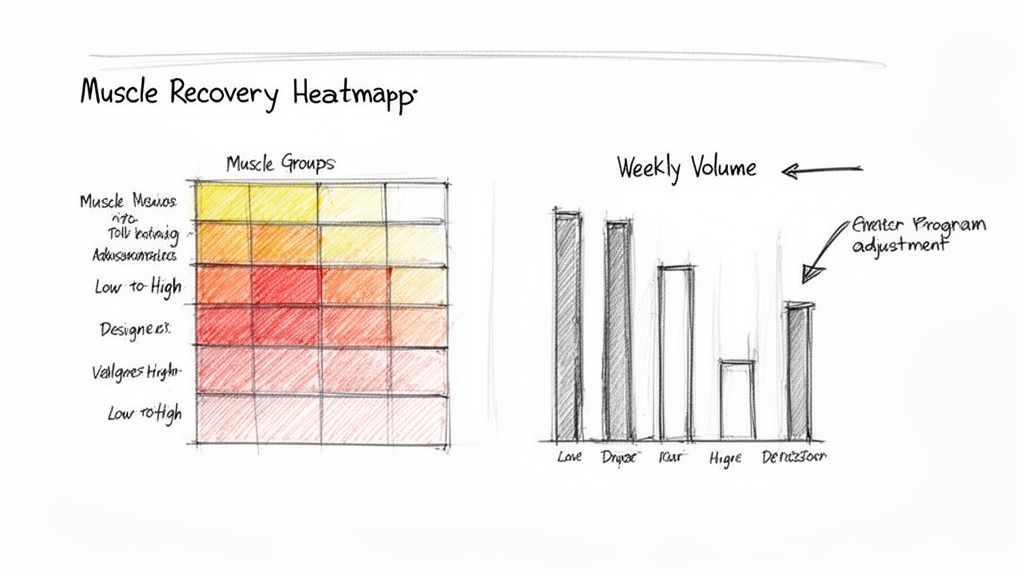
Seeing your recovery laid out like this lets you make smarter calls on the fly. It helps you ensure the split you've chosen is actually lining up with your body's real-world recovery timeline.
Key Takeaway: A muscle recovery heatmap takes the guesswork out of the equation. Instead of wondering if your chest is ready for another bench day, you can just look at the data and train with confidence, knowing you're always working in that sweet spot for growth.
Let AI Adapt Your Split in Real Time
Even the world's best workout split can't predict life. A bad night's sleep, a stressful week at work, or a session that just plain wrecked you can throw your recovery off schedule. A static plan on a spreadsheet can't do anything about that, but an intelligent system can.
The AI coach within Built works like a personal programmer, tweaking your daily workouts based on what your body is telling it. If the heatmap shows your shoulders are still fried from your last push day, the AI might suggest swapping overhead presses for an exercise that hits a fresher muscle group. It learns your unique recovery patterns and helps you auto-regulate your training.
This kind of smart guidance means your workout split for muscle growth is no longer a rigid schedule. It becomes a flexible framework that ebbs and flows with your body's needs, helping you bank high-quality volume while respecting recovery and keeping you on the fastest path to building muscle.
Your Top Questions About Workout Splits, Answered
Picking a workout split is a great first step, but it's natural for more questions to pop up once you get started. I see the same ones all the time, so let's tackle them head-on. This isn't just a list of answers; it's a guide to help you think critically about your training so you can adapt and keep progressing for the long haul.
Let's clear up the confusion so you can feel confident in the plan you're running.
How Often Should I Change My Workout Split?
This is a big one. It's so tempting to jump from program to program, looking for something better. But the truth is, most people switch things up way too often. If your split is working—meaning you're getting stronger and seeing changes—stick with it. Real progress comes from consistency, not novelty.
Give your chosen split a solid 8-12 weeks before you even think about changing it. That’s enough time to actually see if it's effective. The only real reasons to switch are:
- You've hit a hard plateau and can't add weight or reps for weeks on end.
- Your schedule changes, and your current split just doesn't fit your life anymore.
- You're chronically under-recovered, feeling constantly sore, tired, and beaten down.
The secret isn't finding the "perfect" routine. It's mastering the one you have and milking it for every ounce of progress before moving on.
Can I Combine Different Workout Splits?
Absolutely, but this is more of an advanced strategy. Blending splits into a "hybrid" routine can be a fantastic way to customize your week around your specific goals, recovery ability, and personal schedule. It lets you pull the best elements from different systems.
A classic example is mixing an Upper/Lower split with Push/Pull/Legs for a 5-day training week:
- Monday: Upper
- Tuesday: Lower
- Wednesday: Rest
- Thursday: Push
- Friday: Pull
- Saturday: Legs
- Sunday: Rest
This setup gives you a great mix of high frequency and focused volume. Just be warned: it demands that you pay close attention to your recovery. This is best left to lifters who really know their bodies and can tell when they're pushing too hard.
What's the Best Split for Training 3 Days a Week?
If you've only got three days a week to train, a Full-Body routine is almost always your best bet for building muscle. Why? Because it lets you hit every major muscle group three times per week. That repeated stimulus is a powerful signal for your body to keep building new muscle tissue.
This high-frequency approach works especially well for those newer to lifting. In fact, research analysis on training frequency has found that beginners on high-frequency, lower-volume plans grew muscle 77% faster than those training each muscle just once a week. They can simply recover faster between sessions, an advantage that seasoned lifters don't have to the same degree. You can dive deeper into these frequency findings over at StrongerByScience.com.
You could do a 3-day PPL, but that means each muscle only gets trained once a week. For most people, that's just not enough stimulus to drive consistent, optimal growth.
Ready to stop guessing and start building? The Built Workout app takes all these principles and puts them to work for you. You can track your volume, see your recovery status with muscle heatmaps, and let our AI coach make real-time adjustments to your split. Download it today and start training with data-driven confidence.