A 5-day workout split is exactly what it sounds like: a training schedule that has you in the gym for resistance training five times a week. Each workout typically hammers a different muscle group or focuses on a specific movement pattern.
This high-frequency approach allows you to pack in a ton of training volume, which is why it’s a go-to for many intermediate and advanced lifters trying to maximize muscle and strength.
Is a 5-Day Workout Split Right For You?
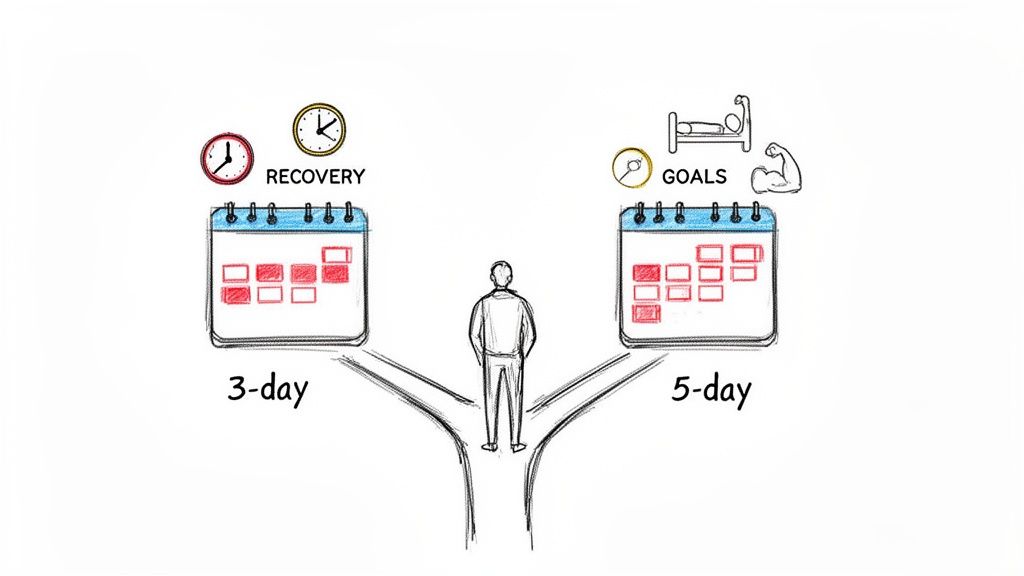
Jumping straight into a 5-day split might feel like the express lane to your goals, but let's be real—it’s a serious commitment that simply isn't for everyone. Before you dive in, you need to take an honest look at your training experience, your lifestyle, and, most importantly, your ability to recover.
This isn't just about carving out the time. It's about having the physical and mental energy to sustain the intensity needed to actually make progress week after week.
Who Truly Benefits From This Approach?
From my experience, a 5-day split works best for people who already have a solid foundation. If you've been lifting consistently for at least a year and your form is dialed in, this kind of structure can provide the extra stimulus you need to bust through a plateau.
This split is a great fit for:
- Intermediate to Advanced Lifters: You’ve already built a good base of strength and muscle, and now you need more volume and frequency to keep the gains coming.
- Bodybuilders and Physique Athletes: Anyone hyper-focused on hypertrophy will use a 5-day split to dedicate entire sessions to isolating specific muscle groups with punishing volume.
- People with Excellent Recovery Habits: If you’re consistently getting 7-9 hours of solid sleep, keeping stress in check, and eating enough quality food, you’re in a much better position to handle the demands of five weekly sessions.
When to Reconsider a 5-Day Split
On the flip side, trying to force a 5-day split when your body or schedule isn't ready for it is a fast track to burnout, injury, and frustration. For a lot of people, fewer, higher-quality sessions actually produce better results.
Think about a different routine if you are:
- A Beginner: If you're new to lifting, you'll see incredible progress with 3-day full-body workouts. They provide plenty of stimulus for growth while giving you more time to recover and perfect your technique.
- Struggling with Recovery: Have a high-stress job, chaotic sleep schedule, or a physically demanding life outside the gym? Five intense workouts can quickly push you into overtraining territory.
- Short on Time: Life gets in the way. If you know you can't realistically hit the gym five days every single week, you'll get far better results from a 3 or 4-day split you can stick to than a 5-day plan you only half-follow.
Key Takeaway: The best workout split is the one you can consistently execute. A perfectly programmed 5-day routine is worthless if you only manage to show up for three of the sessions each week. Be realistic.
Ultimately, it comes down to a gut check. Does the thought of five workouts a week get you excited, or does it just feel like another chore? Your training plan should add to your life, not drain it. If you’re confident in your recovery and ready to embrace the challenge, a 5-day split can be a powerful tool for building the physique you want.
Picking the Right 5 Day Split for Your Goals
Not all 5-day workout routines are built the same. For years, the classic "bro split" was king—one day for chest, one for back, one for legs, and so on. It feels great to completely annihilate a muscle group, but we now know there are smarter ways to train.
The biggest issue with the old-school bro split is training frequency. When you only hit a muscle once every seven days, you're leaving a lot of potential growth on the table.
Think about it: muscle protein synthesis, the engine driving hypertrophy, spikes for only about 24-48 hours after a solid workout. Training a muscle just once a week means it's only in a prime growth state for a couple of days, spending the rest of the time just waiting for the next session.
Why Higher Frequency Unlocks More Growth
This is where modern splits really pull ahead. By arranging your week differently, you can hit each muscle group at least twice. This sends more frequent growth signals without necessarily piling on more total weekly sets. For anyone past the beginner stage, this is a cornerstone of effective programming.
A great example is the Push/Pull/Legs/Upper/Lower (PPLUL) split. It's a powerful hybrid that blends two proven training philosophies into a single week. You get days focused on specific movement patterns (Push, Pull, Legs) and broader days hitting multiple muscle groups (Upper, Lower), making sure every muscle gets attention twice.
Comparing Popular 5 Day Workout Splits
Let's look at how different 5-day structures stack up. Each one has its own strengths and is designed with a specific type of lifter or goal in mind.
| Split Type | Primary Goal | Muscle Frequency | Best For |
|---|---|---|---|
| Traditional Bro Split | Isolation & Pump | Once per week | Bodybuilders who enjoy high single-session volume. |
| PPLUL Hybrid | Hypertrophy | Twice per week | Intermediate to advanced lifters wanting balanced growth. |
| 5-Day Full-Body | Strength & Skill | Five times per week | Athletes or lifters focused on performance and technique. |
Choosing the right one comes down to what you're trying to accomplish in the gym. The best split for a powerlifter is rarely the best one for a bodybuilder.
What the Science Says About Your Split
The evidence consistently points to higher training frequency leading to better gains for trained lifters. A recent analysis that modeled seven popular splits gave a 5-day full-body routine a perfect 10.0 hypertrophy score. That beat out both a traditional bro split (8.8) and a PPLUL hybrid (9.0) when total weekly volume was the same.
Another controlled study on trained men was even more telling. The group hitting muscles five times a week gained nearly twice the triceps thickness and saw more than double the squat strength improvement compared to the lower-frequency group. By intelligently spreading your volume across a 5-day split, you can tap into this higher frequency to accelerate your gains.
Key Insight: The goal isn’t just to work hard; it's to work smart. A 5-day split is the perfect framework for training muscles more often—a proven way to get faster results.
Match the Split to Your Main Goal
So, which one is for you? The "best" split is simply the one that aligns with your primary objective.
Maximum Hypertrophy (Muscle Growth): A PPLUL or an Upper/Lower/Push/Pull/Legs (ULPPL) split is tough to beat. These hybrid models strike a perfect balance between high frequency (hitting muscles twice) and the volume needed to create metabolic stress and spark growth.
Pure Strength: For raw strength, a modified 5-day routine centered on the big lifts works wonders. This often looks like an upper/lower split done twice, with a fifth day used for full-body accessory work or to hammer weak points. The frequency sharpens your technique on the squat, bench, and deadlift.
Athletic Performance: Athletes usually get the most out of a 5-day full-body approach. This structure allows them to practice movements and train qualities like power and speed frequently, but without the localized fatigue that could interfere with their actual sport practice.
Ultimately, choosing the right 5-day workout split means moving beyond outdated models and embracing a structure that puts training frequency to work for you. If you’re moving up from a 4-day schedule, you’ll find that many of the same concepts from a good 4-day push-pull workout routine can be expanded to fit a five-day model, making for a smooth transition to higher volume and frequency.
How to Build Your Own 5-Day Workout Split
Alright, enough with the theory. Let's get our hands dirty and actually build a 5-day split that’s wired for your specific goals. This is where you go from just understanding the concepts to creating a program that will pack on muscle and strength.
My goal here isn't to just hand you a cookie-cutter plan. I want to show you the how and the why behind the programming. By the time we're done, you'll have a rock-solid framework you can use to build—and adjust—your own training for years to come.
First Things First: What's the Main Goal?
Before you even think about which exercises to do, get laser-focused on your number one objective. Are you trying to add 50 pounds to your squat, or are you more concerned with building a bigger chest and arms? Strength and size go hand-in-hand, but the training emphasis for each is slightly different.
Your primary goal is the first fork in the road and dictates the entire structure of your program.
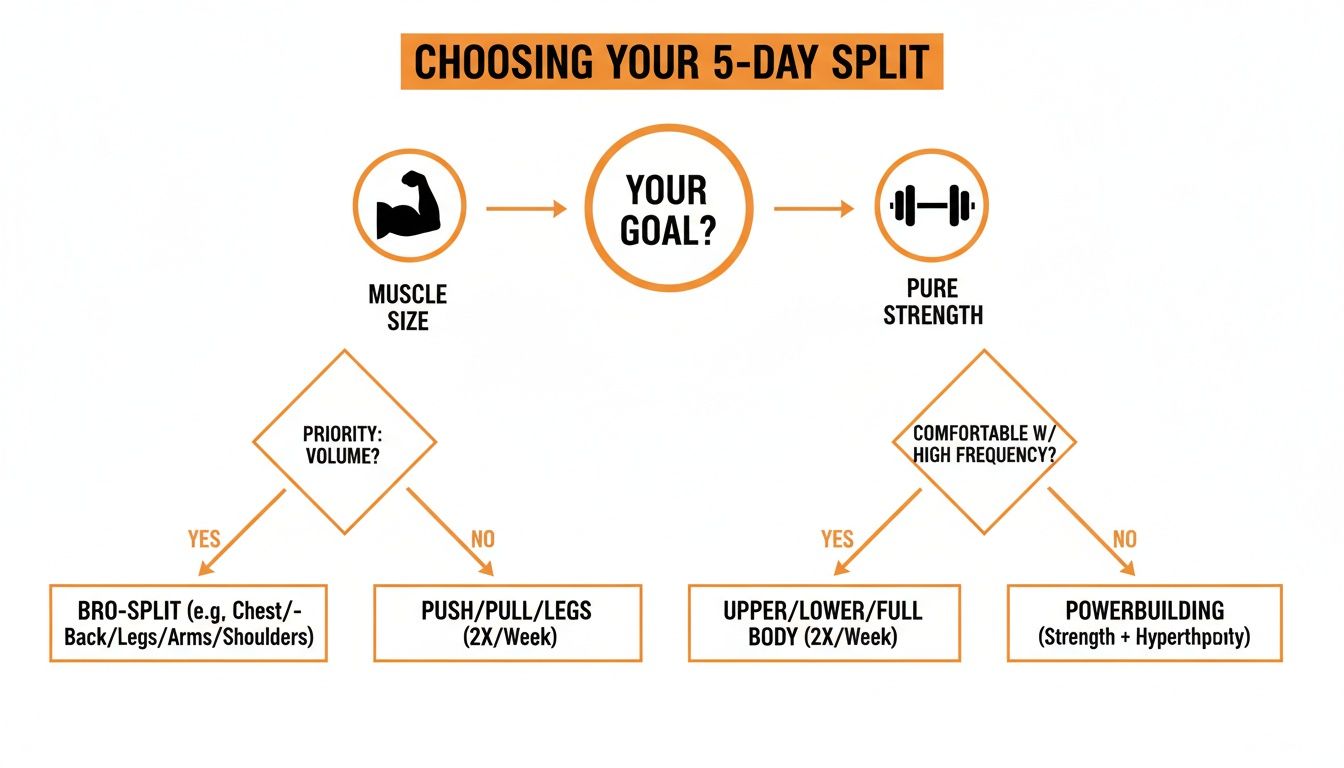
As the chart shows, prioritizing pure strength versus maximizing hypertrophy sends you down two distinct paths, influencing everything from your core lifts to your weekly volume.
Anchor Each Workout with a Big Compound Lift
Every solid training day is built on the foundation of a heavy, multi-joint movement. These are your bread-and-butter lifts—the ones that recruit the most muscle, trigger the biggest hormonal response, and deliver the most bang for your buck.
Consider these the non-negotiable pillars of your week.
- Push Day: Kick things off with a heavy horizontal press. Think Barbell Bench Press or a heavy overhead movement like the Standing Military Press.
- Pull Day: Anchor your session with something that builds serious back thickness and width, like Barbell Rows or heavy Weighted Pull-Ups.
- Leg Day: Nothing builds a powerful lower body like the Barbell Squat. This should be your first exercise, no question.
- Upper Day: This is a great chance to hit the chest from another angle with an Incline Dumbbell Press or add another heavy rowing variation.
- Lower Day: Use your second leg day to focus on a different compound lift that hammers the posterior chain, like Romanian Deadlifts or a heavy Leg Press.
These core exercises always come first. You're freshest at the start of your workout, which means you can move the most weight safely and effectively. This is the key to driving progressive overload.
Layer in Your Accessory and Isolation Work
With the heavy lifting out of the way, it’s time to fill in the gaps with accessory work. This is where you bring up lagging body parts, strengthen weak links in the chain, and add the targeted volume you need for muscle growth. It's how you truly customize the split to your own body.
For instance, if weak triceps are stalling your bench press, you’d add exercises like Skull Crushers or Triceps Pushdowns on your push and upper body days. Want bigger biceps? That means more Curls on your pull and upper days.
Pro Tip: I generally recommend picking 2-4 accessory movements per workout. The focus here shifts from raw strength to creating a strong mind-muscle connection. Control the weight; don't just sling it around.
Figure Out Your Weekly Training Volume
Volume—the total number of hard sets you perform for a muscle group each week—is one of the most important variables for growth. Do too little, and you won’t give your muscles a reason to adapt. Do too much, and you’ll run yourself into the ground.
Here are some battle-tested starting points:
- Intermediate Lifters: Aim for 10-16 total weekly sets per major muscle group. For example, you might hit your chest for 6 sets on Push Day and another 5 sets on Upper Day for a weekly total of 11 sets.
- Advanced Lifters: To keep progressing, you might need to push that to 16-22+ weekly sets. This is exactly why a 5-day split is so valuable for experienced lifters—it gives you more training days to spread out all that volume without destroying yourself in a single session.
Honestly, the best way to manage this is to use an app to track your workouts. Knowing your exact set volume is a game-changer. As you get more advanced, an AI-powered workout app can even auto-regulate your volume based on recovery data, completely removing the guesswork.
Have a Plan for Progressive Overload
If your workouts aren't getting harder over time, your body has no reason to change. This is the principle of progressive overload, and without a plan for it, you're just exercising—not training.
There are a few simple ways to apply this:
- Add Weight: The classic. As soon as you can hit your target reps with good form, add a little more weight to the bar.
- Add Reps: Can't jump up in weight yet? Fight for one more rep than you got last time. That's still progress.
- Add Sets: Increasing your total workload by adding another set is a powerful way to drive new adaptations.
For your main lifts, pick one method and be consistent. Your workout log is your most important tool here. The mission each week is simple: look at what you did last time and find a way to beat it. Even by one single rep.
Sample 5-Day Workout Split Templates
Alright, let's move from theory to action. Knowing what to do is one thing, but getting results comes from putting in the work, week after week. I've laid out three battle-tested 5-day workout split templates below that you can take and run with.
Each one is built for a different goal. Whether you're chasing balanced muscle growth, pure strength, or a physique-focused outcome, you'll find a solid blueprint here. Feel free to use them exactly as they are or tweak them to make them your own.
The Modern Hypertrophy ULPPL Split
For most intermediate lifters I've worked with, this is my top recommendation for building muscle. The Upper/Lower/Push/Pull/Legs (ULPPL) approach hits that sweet spot for hypertrophy, training every muscle group twice a week. It’s a fantastic way to balance training frequency, total volume, and recovery.
Here’s what a week might look like on this plan:
Day 1: Upper Body
- Barbell Bench Press: 3 sets x 6-8 reps
- Bent Over Rows: 3 sets x 8-10 reps
- Seated Dumbbell Shoulder Press: 3 sets x 10-12 reps
- Lat Pulldowns: 3 sets x 10-12 reps
- Dumbbell Bicep Curls: 2 sets x 12-15 reps
- Triceps Pushdowns: 2 sets x 12-15 reps
Day 2: Lower Body
- Barbell Squats: 3 sets x 6-8 reps
- Romanian Deadlifts: 3 sets x 8-10 reps
- Leg Press: 3 sets x 10-12 reps
- Lying Leg Curls: 3 sets x 12-15 reps
- Calf Raises: 4 sets x 15-20 reps
Day 3: Rest
Day 4: Push (Chest, Shoulders, Triceps)
- Incline Dumbbell Press: 3 sets x 8-12 reps
- Overhead Press: 3 sets x 6-10 reps
- Machine Chest Flys: 3 sets x 12-15 reps
- Lateral Raises: 4 sets x 15-20 reps
- Skull Crushers: 3 sets x 10-12 reps
Day 5: Pull (Back, Biceps)
- Weighted Pull-Ups: 3 sets x 5-8 reps
- T-Bar Rows: 3 sets x 8-12 reps
- Single-Arm Dumbbell Rows: 3 sets x 10-12 reps
- Face Pulls: 3 sets x 15-20 reps
- Hammer Curls: 3 sets x 10-12 reps
Day 6: Legs (Glute & Hamstring Focus)
- Deadlifts: 3 sets x 4-6 reps
- Good Mornings: 3 sets x 10-12 reps
- Bulgarian Split Squats: 3 sets x 10-12 reps per leg
- Seated Leg Curls: 3 sets x 12-15 reps
- Hip Thrusts: 3 sets x 8-12 reps
Day 7: Rest
A quick note on progression: For your big compound lifts in that 6-8 rep range, the goal is adding weight to the bar once you can cleanly hit the top of the range. For your other lifts, focus on adding reps or just making each rep look and feel better.
The Strength-Focused Powerbuilding Split
If your main drive is getting brutally strong on the "big three" while still packing on muscle, this is your split. It dedicates specific days to moving heavy weight for low reps on the main lifts, then follows up with higher-rep work to build up the supporting musculature.
The whole schedule is laid out to give you enough recovery time between those demanding lower-body and pressing sessions.
Day 1: Heavy Upper (Bench Focus)
- Bench Press: 4 sets x 3-5 reps
- Close-Grip Bench Press: 3 sets x 6-8 reps
- Weighted Dips: 3 sets x 8-10 reps
- Barbell Rows: 4 sets x 6-8 reps
- Face Pulls: 3 sets x 15-20 reps
Day 2: Heavy Lower (Squat Focus)
- Squats: 4 sets x 3-5 reps
- Pause Squats: 3 sets x 5 reps
- Leg Press: 3 sets x 8-10 reps
- Hamstring Curls: 3 sets x 10-12 reps
- Ab Rollouts: 3 sets to failure
Day 3: Rest
Day 4: Hypertrophy Pull
- Pull-Ups: 4 sets to failure
- Dumbbell Rows: 4 sets x 10-12 reps
- Lat Pulldowns: 3 sets x 12-15 reps
- Barbell Curls: 4 sets x 8-10 reps
- Preacher Curls: 3 sets x 12-15 reps
Day 5: Hypertrophy Push
- Overhead Press: 4 sets x 6-8 reps
- Incline Dumbbell Press: 4 sets x 10-12 reps
- Lateral Raises: 5 sets x 12-15 reps
- Cable Triceps Extensions: 4 sets x 12-15 reps
Day 6: Heavy Lower (Deadlift Focus)
- Deadlifts: 4 sets x 3-5 reps
- Front Squats: 3 sets x 6-8 reps
- Glute-Ham Raises: 3 sets x 8-10 reps
- Hanging Leg Raises: 3 sets to failure
Day 7: Rest
The Classic Bodybuilding "Bro" Split
Dedicating a full day to one muscle group has been a staple for high-level bodybuilders forever, and for good reason. It lets you hammer a body part with an insane amount of volume and focus.
While current thinking often leans toward higher frequency, this approach is how advanced lifters manage 20-30 sets per muscle per week without burning out. This specialization is why, if you look closely, something like 95% of IFBB pros have historically used a version of this split. You can find plenty of discussions among seasoned lifters about why it remains so popular at the elite level.
Just a heads-up: this split is best for advanced lifters whose recovery is dialed in.
Important Takeaway: The name of the game here is volume and mind-muscle connection. Keep rest periods shorter—think 60-90 seconds—to maximize metabolic stress and chase the pump.
Day 1: Chest
- Incline Barbell Press: 4 sets x 8-12 reps
- Flat Dumbbell Press: 4 sets x 8-12 reps
- Decline Machine Press: 3 sets x 10-15 reps
- Cable Crossovers: 4 sets x 12-15 reps
- Push-Ups: 3 sets to failure
Day 2: Back
- Wide-Grip Pull-Ups: 4 sets to failure
- Barbell Rows: 4 sets x 8-10 reps
- Close-Grip Pulldowns: 3 sets x 10-12 reps
- Seated Cable Rows: 3 sets x 10-12 reps
- Dumbbell Pullovers: 3 sets x 12-15 reps
Day 3: Shoulders
- Seated Dumbbell Press: 4 sets x 8-12 reps
- Arnold Press: 3 sets x 10-12 reps
- Lateral Raises: 5 sets x 12-15 reps
- Bent-Over Dumbbell Raises: 4 sets x 12-15 reps
- Barbell Shrugs: 4 sets x 10-12 reps
Day 4: Legs
- Squats: 5 sets x 8-12 reps
- Leg Press: 4 sets x 10-15 reps
- Leg Extensions: 4 sets x 15-20 reps
- Lying Leg Curls: 4 sets x 12-15 reps
- Standing Calf Raises: 5 sets x 15-20 reps
Day 5: Arms
- Barbell Curls: 4 sets x 8-10 reps
- Close-Grip Bench Press: 4 sets x 8-10 reps
- Incline Dumbbell Curls: 3 sets x 10-12 reps
- Skull Crushers: 3 sets x 10-12 reps
- Hammer Curls: 3 sets x 12-15 reps
- Rope Pushdowns: 3 sets x 12-15 reps
Days 6 & 7: Rest
Driving Progress and Managing Recovery
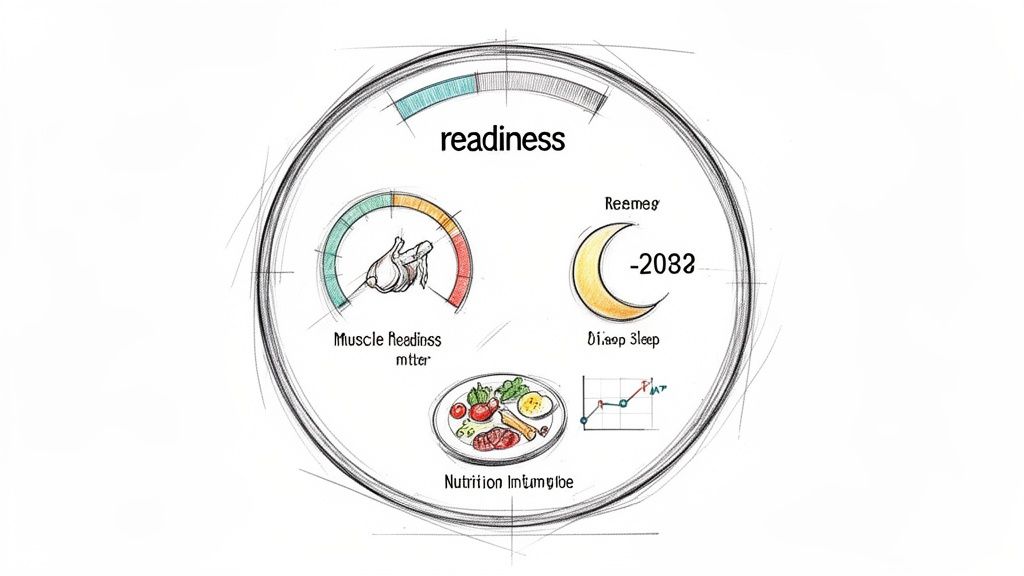
Let's be real: a 5-day workout split is a double-edged sword. That high volume and frequency can deliver incredible results, but it can just as easily run you into the ground if recovery isn't a top priority. Getting enough sleep and nailing your nutrition are the obvious, non-negotiable foundations. But we can go a lot deeper than that.
Instead of just guessing based on how sore you feel, you can now make recovery as data-driven as your training plan. This is about moving past subjective feelings and using objective feedback to make smarter decisions, day in and day out.
Listening to Your Body with Data
Imagine this: you know for a fact that your chest is 80% recovered, but your triceps are still dragging at 40% from Monday's session. That single piece of information changes everything. It's the difference between blindly following your spreadsheet and making an intelligent, real-time adjustment that keeps you progressing without getting hurt.
This is exactly where tools like Built’s muscle recovery heatmaps come in. By tracking every set and rep, the app gives you a visual breakdown of which muscles are primed for more work and which ones are screaming for a break.
With that kind of granular feedback, you can:
- Make intelligent exercise swaps. Triceps are fried but your chest is good to go? Maybe you switch out that close-grip bench press for a machine fly that isolates the pecs and gives your arms a rest.
- Adjust volume on the fly. See your quads are still deep in the red? You could turn that heavy squat day into a lighter, technique-focused session or simply cut back on your total working sets.
- Dodge injuries before they happen. Constantly hammering a muscle that isn't fully recovered is a fast track to strains and nagging pains. Objective data flashes the warning signs before it’s too late.
When your training plan becomes a dynamic system that adapts to your body's actual state of recovery, every session becomes more productive. You're no longer just working hard—you're working smart.
The Power of Frequent Feedback
The very structure of a 5-day split makes it perfect for this data-driven approach. Training five times a week gives you more frequent feedback points to see how your body is actually responding to the plan.
And the research backs this up. Over the last decade, studies have consistently shown that higher training frequencies can lead to better strength gains. One major review found that lower-body compound lifts improved by an average of 2.05% in strength per week, with each additional training day boosting that progress. Another study found a high-frequency group doing a 5-day full-body split saw more than double the squat strength gains and greater muscle growth than a lower-frequency group, even when weekly volume was the same.
What this tells us is that spreading your work across five days likely improves motor learning and the quality of your lifts. For anyone tracking their workouts, this means you get 50–60 exposures to a key lift over a 12-week cycle instead of just 24–30. That's a massive difference in opportunities to refine technique and apply progressive overload based on what your recovery data is telling you.
Making Recovery Actionable
At the end of the day, tracking recovery is pointless if you don't do anything with the information. The goal is to build a sustainable system for long-term progress, not to burn out in a few weeks.
A 5-day split shouldn't feel like a relentless march toward exhaustion. It should be a responsive program that ebbs and flows with your body's real-time capacity. If you want to dive deeper, our guide on training frequency for hypertrophy explores how to balance volume and recovery for muscle growth. By pairing a well-designed plan with smart recovery management, you create the perfect environment to consistently push your limits and get the results you're after.
Common Questions About 5-Day Workout Splits
Even the most perfectly crafted plan can get sideswiped by reality. A 5-day split looks great on paper, but life has a habit of getting in the way. This is where people usually get stuck, overthinking a small hiccup until they fall off the wagon entirely.
Let's tackle the most common questions head-on with some practical, no-nonsense answers. Think of this as your troubleshooting guide to keep you on track, no matter what your week throws at you.
What Should I Do If I Miss a Workout?
First things first: don't panic. One missed day isn't going to kill your progress. You've got a few simple, stress-free options, and the best one just depends on your schedule.
- Just skip it and move on. Life happens. If you miss Tuesday's leg day, just show up on Wednesday ready for your scheduled push day. In a well-designed split, you're hitting everything frequently enough that one miss is just a blip on the radar.
- Push everything back by one day. If your schedule is flexible, this is often the best choice. Your missed Tuesday workout just happens on Wednesday, Wednesday's on Thursday, and so on. Your training "week" just gets a little longer, which is perfectly fine.
- Combine key lifts (but do this sparingly). This is a last resort, not a regular strategy. Say you missed a Push day. You could potentially take your main pressing movement and tack it onto the beginning of your next Upper Body day, but you'd need to cut back on some other volume to avoid a marathon session.
The absolute worst thing you can do is try to cram two full workouts into one day. You'll just accumulate a bunch of junk volume, your performance on every lift will suffer, and you'll jack up your risk of injury. Pick one of the options above and keep moving forward.
How Do I Add Cardio Without Hurting My Gains?
This is a big one. Tacking cardio onto a demanding 5-day split needs some thought. If you just throw it in randomly, it can absolutely interfere with recovery and blunt the signals your body needs to build strength and muscle. The goal is to separate your lifting from your cardio as much as you can.
Ideally, you’ll do your cardio on your rest days. A 20-30 minute session of low-intensity steady-state (LISS) cardio—think incline walking, light cycling, or the elliptical—is a fantastic option. It gets the blood flowing and can actually help you recover without adding much extra fatigue.
If you absolutely have to do cardio on a lifting day, follow these two rules:
- Lift first. Always. Your priority is the heavy compound lifts that drive the most progress, and you need to be fresh for them.
- Keep it short and low-impact. After you lift, a simple 15-20 minute session on a bike or elliptical is plenty. Definitely avoid high-impact stuff like sprints on the same day you train legs.
How Often Should I Change My Workout Routine?
I see this all the time—people get program ADD and feel the need to switch things up every few weeks. It's almost always a mistake. Your body grows by adapting to a consistent stimulus, which means getting progressively stronger at the same core movements over time.
You should only think about changing your routine for a few very specific reasons:
- You've hit a genuine plateau on your main lifts for 3-4 consecutive weeks, even though your nutrition and sleep are on point.
- You're so bored you've started to dread your workouts. If motivation is cratering, a change can help.
- You’re developing nagging aches and pains from a specific movement pattern. This is your body telling you it's time for a break or a swap.
Instead of blowing up your entire split, try making smaller, more surgical changes first. Swap the barbell bench press for a dumbbell version for a while, or switch from back squats to front squats. Often, that's all it takes to break through a sticking point and keep things fresh.
Stop guessing and start knowing. With Built Workout, you can see exactly which muscles are recovered and ready for your next session. Use our data-driven heatmaps and AI coaching to make smarter decisions, prevent overtraining, and build a truly adaptive 5-day split. Download it for free at https://www.builtworkout.com.