Picture this: a personal trainer who knows exactly how tired you are and how ready you are to train before you even pick up a weight. That's the real promise behind an AI-powered workout app. It turns your phone into a hybrid of an elite coach, a sports scientist, and a physical therapist, all rolled into one. This isn't just a small step up from logging sets and reps; it's a giant leap.
Your Personal Trainer Just Got Smarter
For a long time, most fitness apps were basically just digital notebooks. They were great for keeping a record of what you did, but they offered zero guidance on what you should do next. You’d punch in your workouts, keep an eye on your PRs, and follow static, pre-canned programs that couldn't care less about your sleep, stress, or how sore your muscles are. It's a rigid model that often leads straight to a frustrating plateau or, even worse, overtraining and injury.
An AI-powered workout app flips that entire dynamic on its head. Instead of a one-way street where you just log data, it creates a two-way conversation between you and your body. It doesn’t just remember your last session; it analyzes it to figure out what you’re capable of tomorrow.
Beyond Simple Tracking
This new generation of apps goes way beyond generic advice. The fundamental difference is their ability to adapt on the fly, offering guidance that is genuinely personal and reactive. It helps to think of it less as an app and more as a dynamic training partner that’s always in your corner.
This kind of intelligence is built on a few core ideas:
Deep Data Analysis: The app maps every single exercise to the specific muscles it works. It's not just tracking weight and reps, but the total stress that's building up in your body.
Predictive Recovery: Using all that data, it can actually show you which muscle groups are fatigued and which are fresh and ready to go, often using visual tools like an anatomical heatmap.
Adaptive Programming: The AI puts all this information together to suggest the perfect workout for today. It adjusts the exercises, volume, and intensity based on your real, up-to-the-minute readiness.
The goal is no longer just to work hard, but to work smart. An AI coach ensures every single session moves you forward by perfectly matching your effort to your body’s actual ability to perform and recover. With that kind of guidance, consistent progress becomes almost inevitable.
How AI Is Rewriting Your Fitness Playbook
An AI-powered workout app does something a standard logbook can't: it calculates your next best move with incredible precision. It’s not just guessing. This intelligence is built on three core ideas that work together to create a smarter, more responsive training experience. Let's pull back the curtain and see how this actually works, no data science degree required.
This whole process turns simple workout logging into a powerful feedback loop. The AI acts as the brain, processing your workout data to give you insights that help you recover faster and plan your next session better.
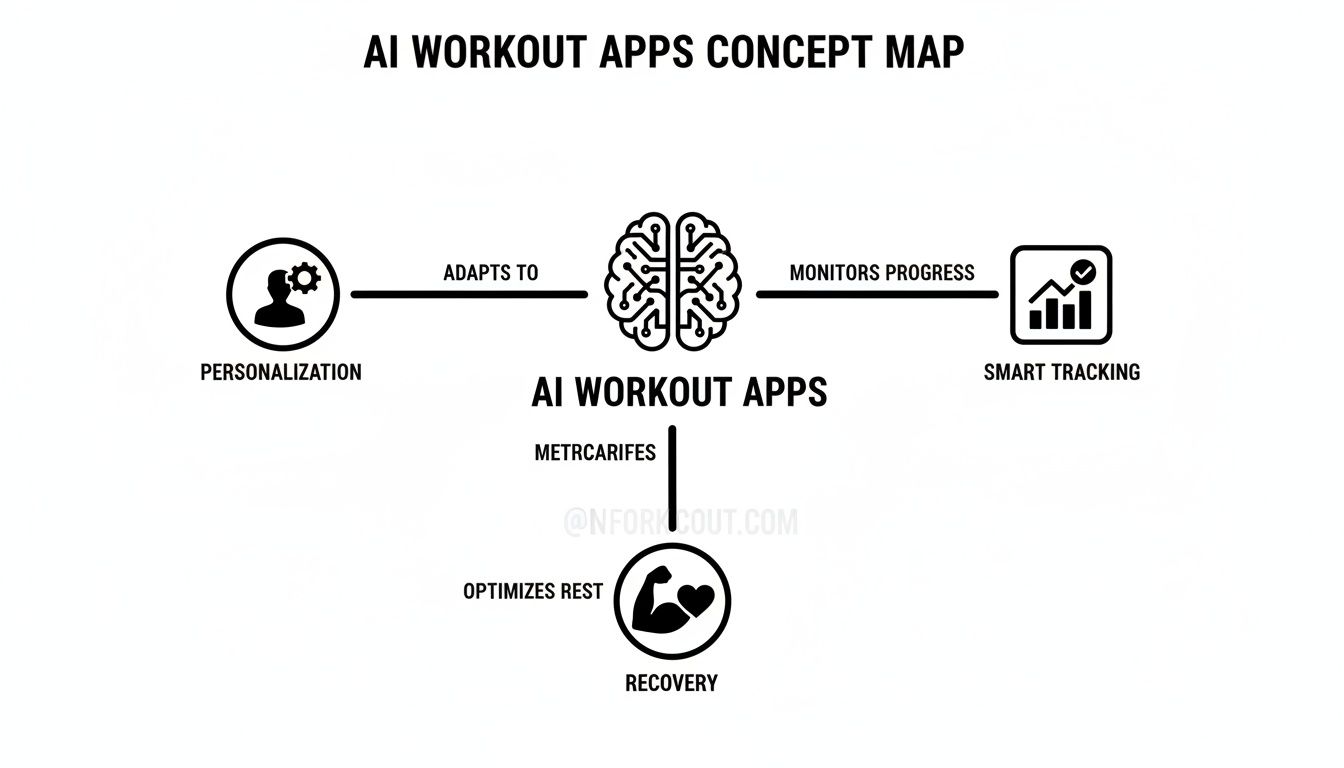
As you can see, everything flows from that central AI engine. It takes your raw workout data and transforms it into personalized recommendations that actually make sense for your body.
Intelligent Tracking: The Foundation of Smart Training
The first piece of the puzzle is intelligent tracking. In a normal app, you might log "Bench Press - 3 sets of 10." An AI system goes deeper. It knows that a bench press primarily hits your pecs, but also your anterior delts and triceps.
It doesn’t just record the exercise; it quantifies the stress you placed on each muscle group. Every rep and every pound lifted adds to a cumulative fatigue score for the muscles involved. This gives you a much richer history of your training load than a simple list of exercises ever could.
Predictive Recovery: Your Muscle Weather Forecast
All that detailed tracking data feeds right into the second pillar: predictive recovery. Think of it like a weather forecast for your muscles. By analyzing the stress you've accumulated, the app can show you exactly how recovered your body is.
This is often visualized with an anatomical heatmap:
Red or Orange: High fatigue. This muscle is still recovering and needs a break.
Yellow or Green: Partially or fully recovered. This muscle is ready for another training session.
This visual feedback is a game-changer. It cuts out all the guesswork. Instead of wondering what you should train, you can see which parts of your body are primed for growth and which ones need more rest to avoid overtraining.
Adaptive Coaching: The AI Personal Trainer
Finally, we have the third pillar where it all comes together: adaptive coaching. The AI takes your tracking data and recovery status and acts as your personal trainer. It looks at your heatmap and builds the most effective workout for you right now.
For example, if your chest is still fried but your back and biceps are fresh, the AI won't just suggest a generic "pull day." It will recommend specific exercises and volume targets that are perfectly aligned with your body's readiness.
This kind of smart adaptation is why the fitness tech space is exploding. The global fitness app market is expected to jump from USD 12.12 billion in 2025 to USD 33.58 billion by 2033, and this growth is being driven by the demand for smarter coaching. You can dig into more of the numbers in the full fitness tech industry report on businesswire.com. This is how an AI-powered workout app helps you train smarter, not just harder.
Who Wins Big with an AI Fitness Coach?
An AI-powered workout app isn't some generic fitness tool; its real power lies in how it serves different people in very specific ways. Whether you're a casual gym-goer trying to stay consistent or an elite athlete hunting for that extra edge, the benefits are tangible and targeted.
To really get the value of this tech, it helps to see who stands to gain the most. It’s not about throwing out what already works. It’s about making it better with smart, data-driven insights for anyone who takes their training seriously. Let’s break down who gets the biggest return from having an AI coach in their pocket.
The Dedicated Gym-Goer
We all know this person. Maybe it is you. You show up, you put in the work, but you feel like you’re spinning your wheels. You’ve been doing the same routine for months, and that frustrating plateau has officially set in. For this exact scenario, an AI coach is the ultimate plateau-buster.
Instead of just guessing what to change up, the app gives you a clear, data-backed roadmap. It looks at your recovery and past performance to intelligently tweak things like your training volume, intensity, or even the exercises you’re doing. This creates just the right amount of new stimulus to kickstart progress again, turning that feeling of stagnation into steady, measurable gains.
Strength Athletes and Bodybuilders
For anyone serious about lifting—powerlifters, bodybuilders, you name it—training is a constant balancing act. Volume and fatigue management are everything. Go too hard, and you risk overtraining or injury. Don't go hard enough, and you're leaving potential gains on the table. This is where an AI coach becomes an absolute game-changer.
The app gives you a detailed, almost microscopic view of your muscular fatigue, often using tools like anatomical heatmaps. This lets athletes:
Maximize Hypertrophy: Hit muscles right when they’re primed for growth, ensuring every single session counts.
Prevent Overtraining: Get an objective signal when a muscle group needs a break, stopping cumulative fatigue before it can derail your progress.
Autoregulate Training: Make smart, on-the-fly adjustments to your program based on how your body actually feels and is ready to perform that day.
An AI-powered workout app takes the emotion and guesswork out of your training. It gives you an objective mirror of your recovery, making sure the work you do in the gym is perfectly synched with your body’s ability to adapt and get stronger.
Personal Trainers and Coaches
Some people worry that AI will replace human coaches, but that's not what's happening. Think of it as a force multiplier instead. For trainers juggling multiple clients, these apps are a powerhouse for client management, delivering deep, actionable insights that were once impossible to track.
Using an AI platform, a coach can see a client’s workout data, check their adherence, and—most importantly—monitor their recovery patterns from anywhere. This allows them to provide expert advice at exactly the right moment, adjust programs with surgical precision, and have far more productive check-ins. It handles the tedious data-gathering, freeing up the coach to focus on what humans do best: strategy, motivation, and building a strong relationship.
The Data-Driven Learner
Finally, there’s a crowd that just loves to learn by seeing what others are doing. For them, an AI-powered workout app like Built Workout offers a huge educational advantage through its social features. It’s like having an open-source library of what actually works in the real world.
Instead of just reading generic advice online, these users can see the complete training logs of friends or even experienced lifters they look up to. They can see exactly how others structure their training, manage their recovery, and push past their own plateaus. This kind of peer-to-peer data provides incredible context that fast-tracks their own learning, helping them build a solid, lasting intuition for training.
How to Choose the Right AI Training Partner
With so many new AI workout apps popping up, picking the right one can feel like a shot in the dark. It’s important to remember that not all "AI" is created equal, and the quality can vary wildly from one platform to another. Your goal is to find a true training partner, not just another digital logbook.
The trick is to look past the marketing hype and focus on the features that will actually make a difference in the gym. Think of it like you're hiring a personal coach. You have to ask the right questions to make sure the app has what it takes to help you hit your goals.
Does It Genuinely Adapt to You?
A truly smart app doesn't just spit out a cookie-cutter plan. Its real power comes from adaptive programming, which means it constantly adjusts your workouts based on how you’re actually performing and recovering. If you walk into the gym and crush a session, the app should see that and push you a little harder next time.
On the flip side, if you’re feeling wiped out or under-recovered, it should know to pull back to keep you from burning out. The best apps will even tell you why they’re making a certain suggestion. That’s how you know the AI is making a smart call, not just running through a pre-set script.
The ultimate test of a smart training app is its ability to answer the question: "What should I do today to get closer to my goals?" A great AI coach provides a clear, data-driven answer every single time you open it.
This is exactly why these apps are becoming so central to people's fitness routines. They are fundamentally changing how we approach training, with nearly half of all fitness enthusiasts now using them for smarter, recovery-first workouts. In fact, a recent industry report found that 49% of consumers use AI-based fitness apps every single day, and another 30% use them weekly. You can dive into more of the data by reading the full 2025 wellness report from ABC Fitness.
Can You Visualize Your Recovery?
Getting a simple recovery score is one thing, but seeing it visually is a total game-changer. The top-tier platforms give you tools that make it incredibly easy to see your recovery status in a single glance.
When you're checking out an app, ask yourself a few key questions:
Does it have muscle heatmaps? Visual tools, like the anatomical heatmaps in Built Workout, are fantastic. They show you exactly which muscle groups are cooked (usually in red) and which ones are fresh and ready to go (in green). This takes all the guesswork out of deciding what to train.
Is the exercise library extensive? An AI is only as good as the data it has to work with. A huge library with clear instructions and videos ensures every movement is tracked correctly, which leads to much better recommendations from the AI.
Is the interface intuitive? Let's be real—you'll be using this app mid-workout. It has to be quick and simple to log your sets, reps, and weights without killing your momentum.
Does it foster a community? Seeing how others train and recover can be a powerful motivator. An app with a social feed or community feature lets you learn from real people, which can seriously speed up your own progress.
Putting Smart Training into Practice
Theory is great, but what does all this look like in the real world? Let's move past the concepts and see how an AI powered workout app actually works day-to-day. We'll walk through a typical training scenario using a platform like Built to show you exactly how raw workout data gets turned into smarter, more effective training.
It all starts the second you finish your last rep. Imagine you’ve just wrapped up a tough chest day. You log your sets, reps, and weights. The app doesn’t just store that info—it immediately gets to work, calculating the precise stress you put on your pecs, front delts, and triceps. This data feeds directly into your personal recovery model, updating it in real-time.
Visualizing Your Recovery in Real-Time
This is where the vague idea of "fatigue" becomes something you can actually see and use. Right after your workout, you can pull up a visual snapshot of your body's current state.
The app presents this complex data in a simple, easy-to-understand format.
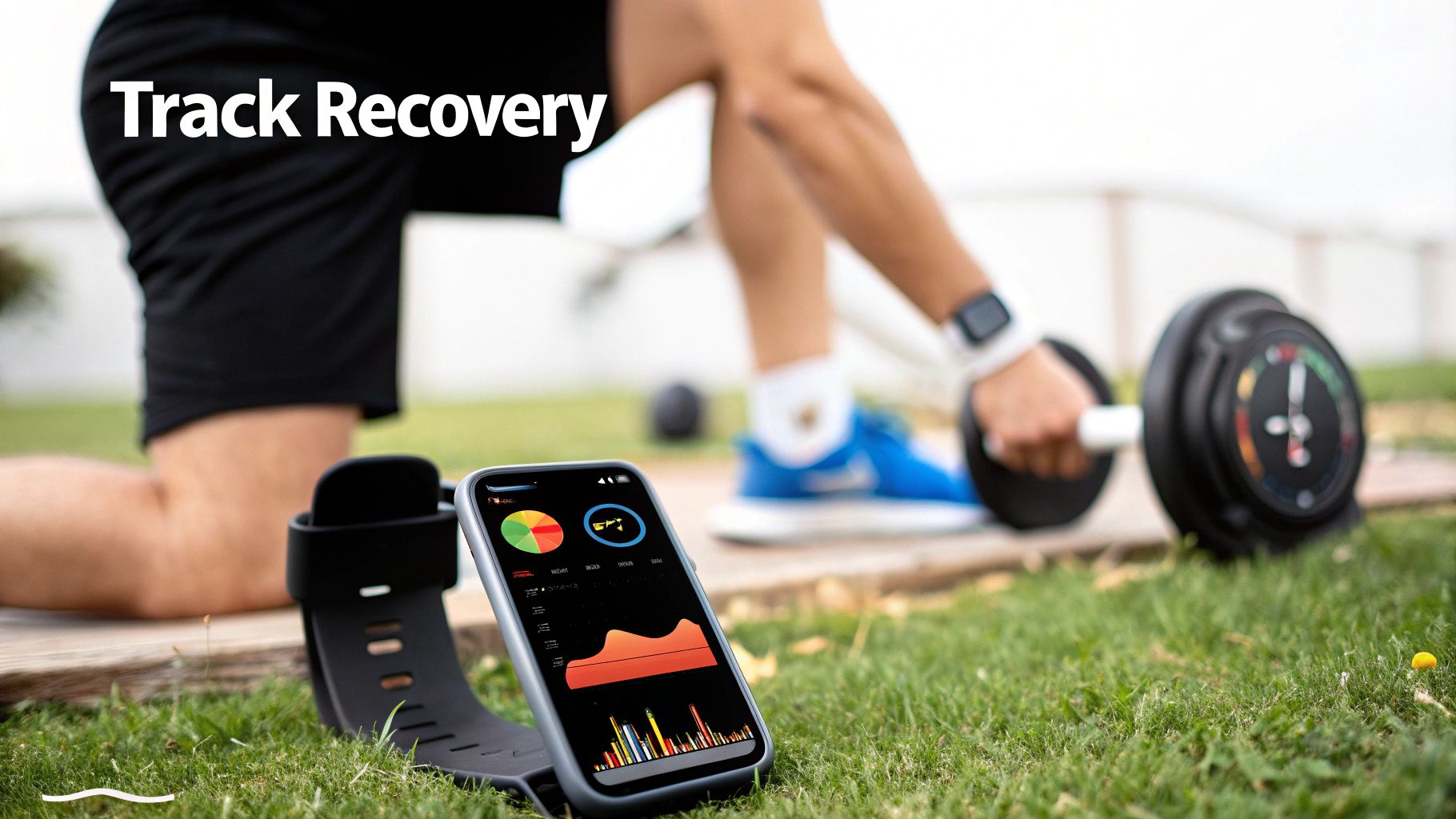
This muscle heatmap uses a straightforward color-coding system—red means high fatigue, while green means fully recovered. It gives you an instant read on which muscles are taxed and which are ready to go. Over the next couple of days, you can literally watch those muscle groups shift from red back toward green as your body recovers.
How the AI Coach Makes Decisions
This visual data is exactly what the AI coach uses to guide your next move. Let's say it's been two days, and you're ready for another upper body session. Instead of just guessing what you should do, you check in with the app. The AI scans your current recovery status and gives you a clear, logical recommendation.
It might look something like this:
Observation: "Your chest is 95% recovered, and your triceps are at 100%."
Recommendation: "Today is a great day to hit the incline dumbbell press to keep driving growth."
Rationale: "These muscles are fresh, so you can push for optimal volume without risking overtraining."
This isn't some pre-canned advice pulled from a template. It's a dynamic decision based entirely on your body's readiness at that specific moment. The AI is effectively having a data-driven conversation with you, making sure every workout is timed perfectly to get the best possible results.
By turning complex recovery data into simple, actionable advice, an AI-powered workout app takes the guesswork out of your training. It ensures you’re not just training hard, but training smart—aligning every session with your body’s actual ability to perform and grow.
This constant feedback loop—log, analyze, visualize, and adapt—is the engine that powers real, consistent progress. You're no longer just blindly following a program; you're running a strategy that evolves right along with you, making every single trip to the gym count.
Answering Your Top AI Workout Questions
It’s completely normal to have a few questions when new technology starts changing how we do things. An AI-powered workout app is a big shift from the old way of training, so let's dig into some of the most common questions people have.
Lots of folks immediately wonder if AI is coming to replace human coaches. The short answer is a definite no. A much better way to think about it is as the ultimate partnership. The AI handles the nitty-gritty, moment-to-moment data analysis—like tracking fatigue, modeling recovery, and suggesting the perfect workout for today.
This actually frees up the human coach to do what they do best: focus on the big picture. A great coach is a master of motivation, long-term strategy, and the psychological side of athletic performance. The AI simply becomes a powerful assistant, feeding that coach objective data they could never hope to gather on their own.
How Can It Know My Recovery Without Sensors?
This is the big one. How on earth can an app know how recovered my muscles are without me being hooked up to a bunch of sensors? It sounds a bit like magic, but the answer is all in sophisticated modeling based on the workout data you feed it.
When you log a workout, the app sees way more than just "Bench Press - 3 sets of 10." It knows that specific exercise places a measurable amount of stress on your chest, front delts, and triceps. Every single pound and every single rep is calculated and mapped to a fatigue score for those specific muscle groups. The AI then applies proven physiological principles to model how those muscles should recover over the next few hours and days.
It's a highly predictive model, not a direct measurement. By consistently tracking your performance—the weight you're lifting and the volume you're handling—the system builds an incredibly accurate forecast of your body's readiness. It gets smarter and more dialed-in with every single workout you log.
Is My Personal Fitness Data Safe?
Data privacy is a huge deal, and it should be. You're trusting an app with personal health information, and you have every right to be concerned. Any reputable platform is built with privacy as a foundational principle, giving you complete control over your own information.
Most modern apps, including Built Workout, let you set the visibility for every single workout you post:
Public: Share your training with the whole community and maybe inspire someone else.
Friends Only: Keep your logs visible just to the people you’ve connected with on the app.
Private: Keep everything completely to yourself.
This kind of granular control means you get all the benefits of the powerful AI analysis while maintaining whatever level of privacy you're comfortable with. Before you jump into any AI-powered workout app, take a minute to review its privacy policy. You need to be sure your data is handled responsibly and that you're always the one in control. It's your data, after all.
Ready to see how a truly smart training partner can change your results? Download Built Workout today and start training with data-driven confidence.