A 4-day push/pull workout routine is one of the most effective and time-efficient ways I've seen to build serious muscle and strength. The concept is simple: you split your training days into pushing movements (think chest, shoulders, and triceps) and pulling movements (back and biceps). This smart setup lets you hit every major muscle group twice a week—a sweet spot for growth that’s backed by years of evidence.
Why This Push/Pull Routine Just Plain Works
The 4-day push/pull split isn't just another trend; it's a battle-tested framework built on solid exercise science. When you group muscles by their function, you create an incredibly efficient system that balances hard work with smart recovery.
Think about it: when you do a bench press, your chest, shoulders, and triceps are all firing together. Same story with a row—your back and biceps do the heavy lifting. By splitting them up, you avoid hammering the same supporting muscles on back-to-back days. This is key.
This structure lets you train with higher frequency without running yourself into the ground. Hitting each muscle group twice a week gives it the consistent signal it needs to grow. It also allows you to have a heavier, strength-focused day and a lighter, hypertrophy-focused day for each movement pattern, covering all your bases.
The Power of an Efficient Split
You don't have to live in the gym six days a week to make incredible progress. The 4-day split is the perfect middle ground between training volume and recovery. In fact, modern research confirms it's one of the most efficient setups for building muscle. It delivers about 85% of the gains you'd get from a 5-day routine but in roughly 30% less time. That kind of efficiency is what keeps you consistent for the long haul.
Let's break down the core benefits:
- Optimal Training Frequency: Hitting your muscles twice a week is a proven formula for maximizing hypertrophy. Our guide on training frequency for hypertrophy dives deep into why this is so effective.
- Smarter Recovery: Since push and pull days work different muscle groups, your chest and triceps get a full 48-72 hours to recover while you're training your back and biceps. It’s a perfect cycle.
- Simple to Plan: The logic is straightforward. No more complicated spreadsheets or wondering what to train. It's either a push day or a pull day.
This routine cuts through the noise. It’s built for anyone who wants a structured, no-nonsense plan to build real strength and muscle without the guesswork. We're focusing on the big compound lifts and proven principles that directly translate your hard work into results you can see and feel.
The Complete 4-Day Push/Pull Workout Program
Alright, this is the core of the entire guide—your complete game plan for the next several weeks. I’ve structured this 4-day push/pull workout routine to hit the two things that matter most: building raw strength and packing on muscle (hypertrophy). You'll see the week is split between two heavy, strength-focused days and two volume-heavy, hypertrophy-focused days.
This dual-focus approach is incredibly effective. It ensures you're constantly getting stronger on your big compound lifts while also accumulating the sheer volume needed to build serious size. We'll always start with the biggest, most demanding lift when you're fresh, then move into accessory work to hit the muscles from all angles for balanced development.
This is the simple, powerful flow we're working with. It's all about separating your training to create the perfect environment for consistent growth and recovery.
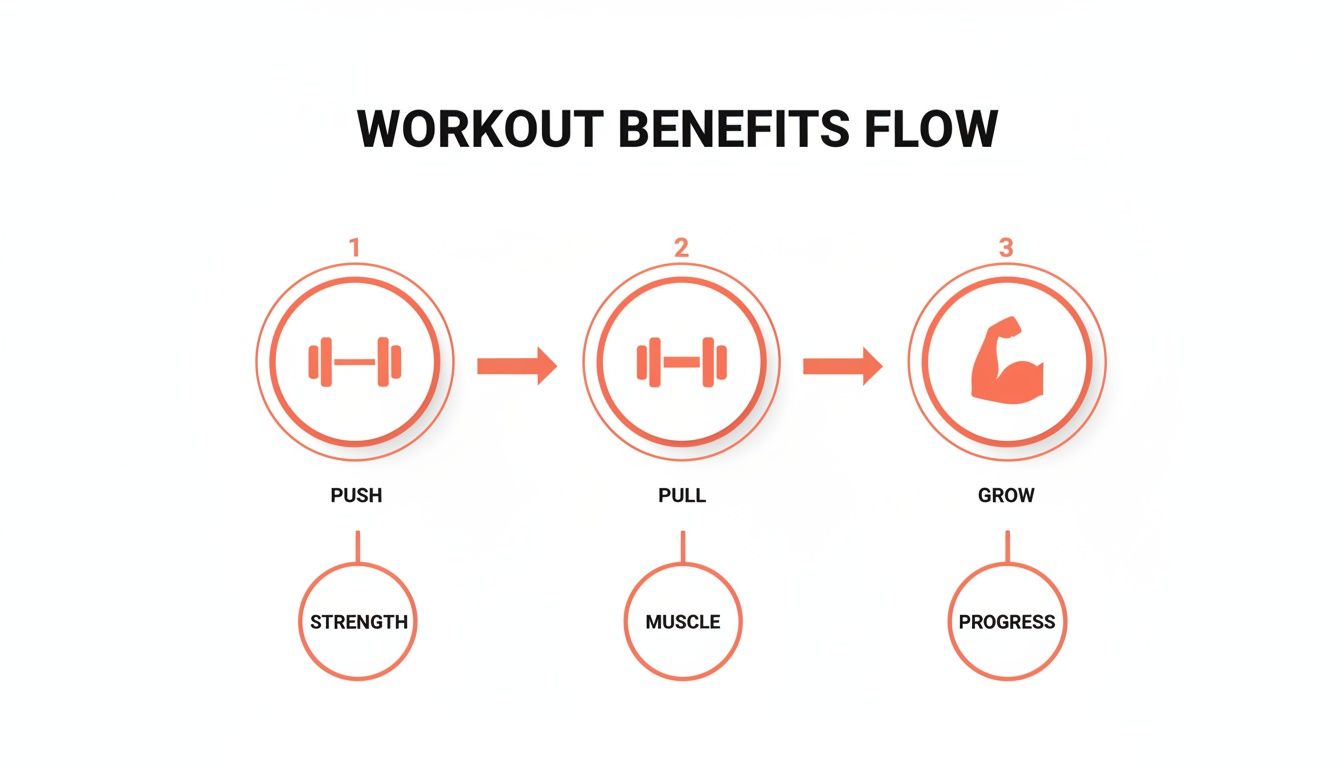
By dedicating days to specific movement patterns, you give each muscle group ample time to recover before you hit it again, which is where the real magic happens.
Why Hitting Muscles Twice a Week Is a Game-Changer
The beauty of a 4-day split is that you train every muscle group twice a week. This isn't just about making your schedule work; it's a scientifically proven way to get results faster. The old-school "bro split" of hitting a muscle once a week has been left in the dust by modern training research.
A massive meta-analysis looked at all the available studies and the conclusion was clear: training a muscle group 2-4 times per week cranked up muscle growth by 6.8%. Compare that to the once-a-week approach, which only produced a 3.7% increase. That's an 84% bigger return on your effort, just by changing how often you train.
This is exactly why routines like this one are so popular among lifters who are serious about making real progress.
Day 1: Strength Push Workout
The first push day is all about one thing: moving heavy iron with perfect form. Our goal here is creating mechanical tension, which is the single most important driver of strength gains. Really focus on controlling the weight on the way down (the eccentric) and then exploding up with power.
Give yourself longer rest periods on this day. Take a full 2-3 minutes between sets on your main lifts so your central nervous system and muscles are fully recovered for the next big push.
| Exercise | Sets | Reps | Rest |
|---|---|---|---|
| Barbell Bench Press | 4 | 4-6 | 2-3 min |
| Overhead Press (Barbell) | 3 | 6-8 | 2 min |
| Incline Dumbbell Press | 3 | 6-8 | 2 min |
| Tricep Dips (Weighted) | 3 | 6-8 | 90 sec |
| Lateral Raises (Heavy) | 3 | 8-10 | 60-90 sec |
Day 2: Strength Pull Workout
Next up, we build a powerful back and strong biceps. Deadlifts are the main event today—a beast of an exercise that develops raw, full-body strength like nothing else.
Form is non-negotiable on a heavy pull day, especially with deadlifts and rows. Always prioritize a straight, neutral spine and controlled movements. Lifting with your ego instead of your head is a fast track to injury.
Pro Tip: When you do heavy barbell rows, don't just yank the bar up to your chest. Instead, think about pulling it back towards your hips. This little cue forces your lats to do the work and takes a lot of stress off your lower back.
| Exercise | Sets | Reps | Rest |
|---|---|---|---|
| Deadlifts | 4 | 4-6 | 3-4 min |
| Weighted Pull-Ups | 3 | 6-8 | 2-3 min |
| Barbell Rows | 3 | 6-8 | 2 min |
| Face Pulls | 3 | 8-10 | 90 sec |
| Barbell Curls | 3 | 6-8 | 90 sec |
Day 3: Hypertrophy Push Workout
After a well-earned rest day, it’s back to pushing. This time, however, we’re shifting our focus from pure strength to hypertrophy (muscle size). That means lighter weights, higher rep ranges (8-15 reps), and shorter rest periods to create a ton of metabolic stress, which is the other key trigger for growth.
Your goal here is simple: chase the pump. By the end of this workout, your chest, shoulders, and triceps should feel completely full and fatigued.
| Exercise | Sets | Reps | Rest |
|---|---|---|---|
| Dumbbell Bench Press | 4 | 8-12 | 90 sec |
| Seated Dumbbell Shoulder Press | 3 | 10-15 | 90 sec |
| Cable Crossover | 3 | 12-15 | 60 sec |
| Tricep Pushdowns (Rope) | 3 | 12-15 | 60 sec |
| Dumbbell Lateral Raises | 4 | 12-15 | 60 sec |
Day 4: Hypertrophy Pull Workout
This is your final workout of the week, a high-volume pull session designed to flood your back and biceps with blood. The name of the game is control. Feel every single rep, focusing on squeezing the target muscle hard at the peak of the contraction.
For instance, on lat pulldowns, don't just let the weight fly back up. Pause for a second at the bottom, actively squeeze your lats like you're trying to crush a walnut between them, and then slowly control the bar on its way up. That mind-muscle connection is what separates a good workout from a great one.
| Exercise | Sets | Reps | Rest |
|---|---|---|---|
| T-Bar Rows | 4 | 8-12 | 90 sec |
| Lat Pulldowns | 3 | 10-15 | 90 sec |
| Seated Cable Rows | 3 | 10-15 | 60 sec |
| Dumbbell Curls | 3 | 12-15 | 60 sec |
| Hammer Curls | 3 | 12-15 | 60 sec |
Setting Yourself Up for Success: Warm-Ups and Cool-Downs
A good warm-up isn't just about avoiding injury; it's about getting your body ready to perform at its peak. Jumping straight into your heavy sets cold is a guaranteed way to limit your strength and sabotage your progress.
Your 10-Minute Pre-Workout Protocol
- Get the Blood Flowing (3-5 minutes): Start with some light cardio to raise your heart rate. A few minutes on the bike, rower, or a brisk walk on the treadmill is perfect.
- Move Your Joints (3-5 minutes): Now, focus on dynamic stretching—active movements that take your joints through their full range of motion. For push days, think arm circles, shoulder pass-throughs, and torso twists. For pull days, things like cat-cows, hip circles, and leg swings are great.
- Prime the Movement (Ramp-Up Sets): Before your first big exercise (like Bench Press or Deadlifts), do a few light sets to wake up the right muscles and groove the movement pattern. It should look something like this:
- Set 1: Empty bar for 10-12 reps.
- Set 2: 50% of your working weight for 8 reps.
- Set 3: 75% of your working weight for 3-4 reps.
After you're done, a simple 5-minute cool-down with some static stretching for the muscles you just hammered can help with flexibility and jump-start your recovery. Hold each stretch for 20-30 seconds—no bouncing!
Making This Routine Your Own
Think of this program as a template, not a rigid prescription. The principles—hitting muscles twice a week, alternating between strength and hypertrophy—are what truly matter. If your gym doesn't have a T-Bar row, swap it for another rowing variation like a chest-supported row. It's all good.
Life can also get in the way. If a 4-day split is too demanding on your schedule, finding a different structure is better than being inconsistent. For those who can only train three times a week, you might want to check out our guide on how to build an effective 3-day workout split. The best routine is always the one you can stick with long enough to see results.
Making Sure You're Actually Getting Stronger: The Art of Progressive Overload
Let's be honest. You can follow the world's best 4-day push/pull workout routine, but if you're lifting the same weights for the same reps month after month, you’re just spinning your wheels. Your muscles aren't going to grow unless you give them a reason to.
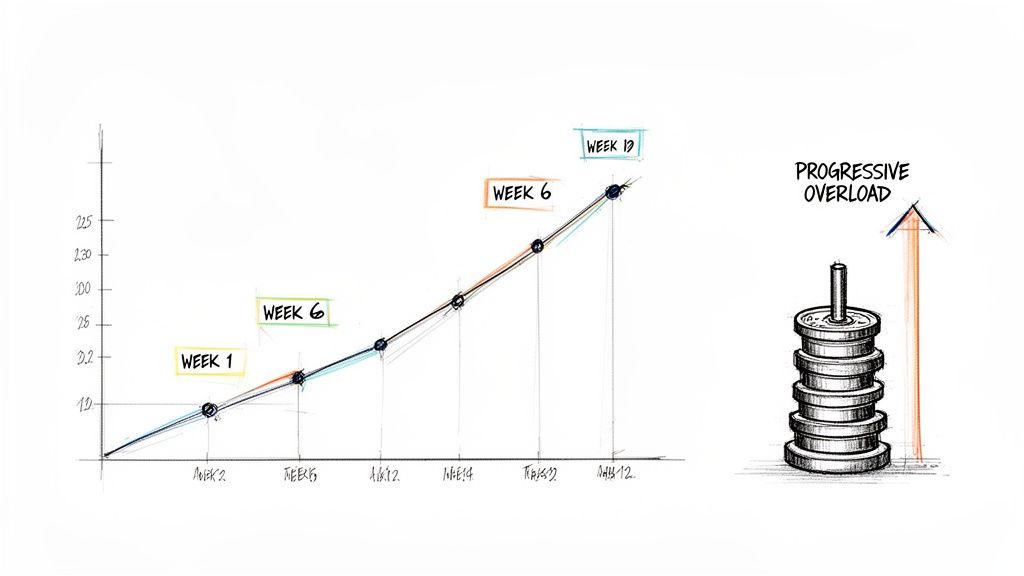
That reason is progressive overload. It's the simple, non-negotiable principle of making your workouts a little bit harder over time. Without it, you’re just exercising. With it, you're training for results. It’s the engine that drives every ounce of long-term strength and muscle gain.
It's Not Just About Adding More Weight
The go-to method for most people is just slapping more plates on the bar. And that works, for a while. But relying on that one trick is a fast track to a plateau, or worse, an injury from your form breaking down.
True progressive overload is more creative than that. Here are a few smarter ways to consistently challenge yourself:
- Do More Reps: If you benched 185 lbs for 6 reps last week, your only goal this week might be to hit 7 or 8 reps with that same weight. Once you can comfortably do 8 reps, then you've earned the right to go up to 190 lbs and start back at 6 reps.
- Add Another Set: Three sets of dumbbell rows feeling manageable? Great. Add a fourth set. Increasing your total volume is a powerful signal for your muscles to grow bigger and stronger to handle the extra work.
- Cut Your Rest Time: This one is sneaky but effective. If you normally rest 90 seconds between sets of lateral raises, try resting for only 75 seconds. The burn will be real, and that increased metabolic stress is a fantastic trigger for muscle growth.
- Master Your Form and Tempo: Lifting a weight with perfect control is way harder than just heaving it around. Try slowing down the lowering part of the lift (the eccentric) to a 3-second count. The tension is incredible and makes the same weight feel significantly heavier.
How This Looks Over a 12-Week Cycle
Let’s map this out for a real-world example, like the bench press on your strength day. The goal is 4 sets of 4-6 reps.
Weeks 1-4: Focus on Reps
You start with a weight you know you can handle for 4 solid reps. Let's say it's 205 lbs.
- Week 1: 205 lbs for 4 sets of 4 reps.
- Week 2: 205 lbs for 4 sets of 5 reps.
- Week 3: 205 lbs for 4 sets of 6 reps.
- Week 4: Stay at 205 lbs and really push to nail 6 reps on every single set.
Weeks 5-8: Time to Add Weight
You've dominated 205 lbs, so now it’s time to level up.
- Week 5: 210 lbs for 4 sets of 4 reps.
- Week 6: 210 lbs for 4 sets of 5 reps.
- Week 7: Keep pushing with 210 lbs, aiming for 5-6 reps.
- Week 8: 210 lbs for 4 sets of 6 reps. That's a new personal record.
Weeks 9-12: Another Jump and a Smart Rest
The pattern continues, building on your momentum.
- Week 9: 215 lbs for 4 sets of 4 reps.
- Week 10: Keep grinding out more reps with 215 lbs.
- Week 11: Fight to hit the top of that 4-6 rep range.
- Week 12: After 11 straight weeks of pushing hard, your body needs a break. This is the perfect time for a deload week to recover before you start the next cycle even stronger.
By meticulously tracking these small wins, you build a clear roadmap for your progress. This methodical approach takes all the guesswork out of training and guarantees you’re always giving your body a compelling reason to improve.
Applying these ideas week in and week out means you have to track your workouts. You can't know what to aim for this week if you don't remember what you lifted last week. This is where technology can seriously help; learning how an AI-powered workout app works can show you how this tracking can be automated, with progressions suggested right to you based on your actual performance and recovery.
How to Optimize Your Recovery and Prevent Plateaus
What you do in the hours after your workout is just as important as the final rep you grind out in the gym. A killer 4 day push pull workout routine is only one half of the muscle-building equation; the other half is a smart recovery strategy that allows your body to repair, rebuild, and come back stronger.
Without it, you’re just spinning your wheels, breaking your muscles down without ever giving them a real chance to grow.
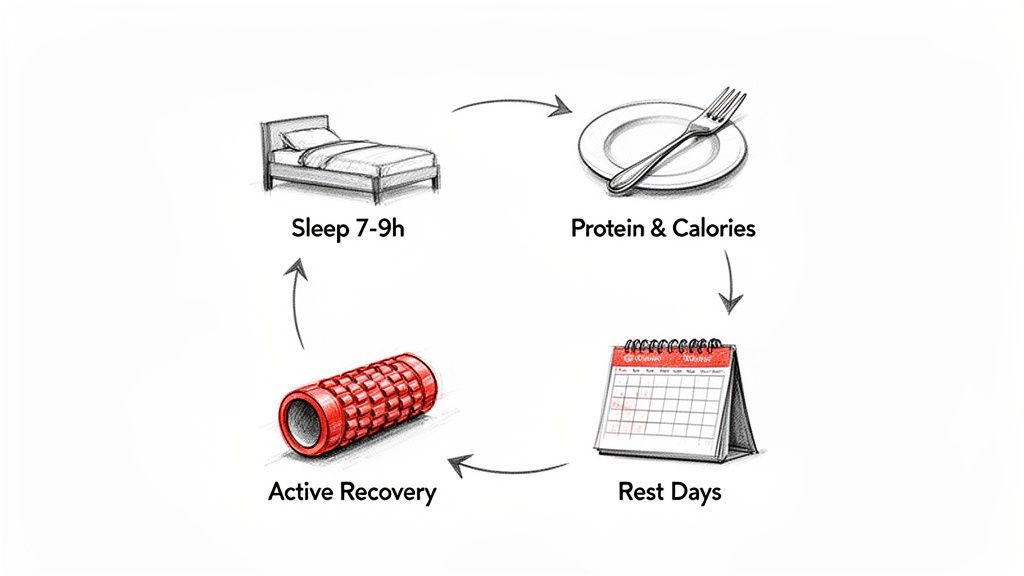
True progress happens when you’re resting, not when you’re lifting. Think of your workouts as sending a signal to your muscles that they need to get stronger. Your nutrition, sleep, and rest days are how your body actually answers that signal and does the hard work of building new tissue. Ignoring recovery is the fastest way to hit a frustrating plateau.
Fueling Your Growth with Smart Nutrition
Let’s get one thing straight: you can’t out-train a bad diet. To build muscle, your body needs the right raw materials, and that all starts with two non-negotiable nutritional pillars.
First up is protein intake. These are literally the building blocks for muscle repair. A solid target to aim for is 0.7-1.0 grams of protein per pound of body weight each day. So, for a 180-pound person, that’s roughly 126-180 grams of protein, ideally spread out across your meals to keep a steady supply of amino acids flowing.
Second, you need to be in a slight calorie surplus. This just means consuming a little more energy than your body burns. A modest surplus of 250-500 calories above your maintenance level is the sweet spot for fueling muscle growth while keeping fat gain to a minimum.
The Underrated Power of Sleep
Sleep is the most potent performance-enhancing tool you have, and it’s completely free. This is when your body gets down to business, releasing crucial growth hormone and focusing its energy on repairing the muscle fibers you tore down during your workout.
Skimping on sleep is a surefire way to sabotage your progress. It spikes cortisol (a stress hormone that breaks down muscle) and tanks your ability to recover. The goal is simple but absolutely critical.
- Aim for 7-9 hours of quality sleep per night.
- Establish a consistent sleep schedule, even on weekends, to regulate your body clock.
- Create a dark, cool, and quiet environment to maximize your sleep quality.
"Many lifters obsess over the perfect pre-workout supplement but completely ignore the most anabolic thing they can do: get a full night's sleep. Think of sleep as the time your body cashes the checks your workouts write. No sleep, no gains."
Active Recovery and Listening to Your Body
Rest days don't have to mean becoming one with your couch. Active recovery—light physical activity on your off days—can actually speed things up. This low-intensity work boosts blood flow to your muscles, helping to flush out metabolic waste and deliver fresh nutrients for repair.
A few great active recovery options include:
- A 20-30 minute walk
- Light cycling or swimming
- Foam rolling and dynamic stretching
Most importantly, learn to listen to your body. Some days you’ll feel energetic and ready to crush it. Other days, you might feel run down, sore, and just plain unmotivated. Pushing through deep fatigue is a recipe for overtraining, not progress. Pay attention to these signals and don’t be afraid to take an extra rest day when you truly need one. Smart recovery isn’t about being lazy; it’s about training intelligently for long-term, sustainable results.
Sidestepping Common Push/Pull Training Pitfalls
Even the best-laid 4 day push pull workout routine can go off the rails if you fall into a few common traps. I've seen these trip up everyone from beginners to seasoned lifters. Think of this as your field guide to making sure every drop of sweat you pour into your training actually builds the strength and muscle you’re after.
The Ego Lift: Your Worst Enemy
First up, the big one: ego lifting. We've all seen it—the person in the gym sacrificing every ounce of good form just to slap another plate on the bar. The number becomes the goal, not the quality of the work.
This is a classic rookie mistake that not only skyrockets your injury risk but completely misses the point. When your form breaks down, the tension shifts off the target muscle and onto your joints and connective tissues. A perfectly controlled set of bench presses at 185 lbs will build infinitely more muscle than a sloppy, half-rep mess at 225 lbs. Always.
Getting Lost in the Weeds: Poor Exercise Selection
Another pitfall is losing sight of the big picture with your exercise choices. It's easy to get caught up in endless bicep curls and tricep pushdowns, but those should be the dessert, not the main course. Your training needs to be anchored by big, heavy, multi-joint compound lifts.
These are your bread and butter—the movements that give you the most bang for your buck. They recruit huge amounts of muscle, trigger a powerful hormonal growth response, and build functional, real-world strength.
- On Push Days: Prioritize a heavy press, like a flat or incline bench press, and a vertical press, like an overhead press.
- On Pull Days: Build your session around deadlifts, pull-ups (or lat pulldowns), and heavy barbell or dumbbell rows.
My rule of thumb: Dedicate the majority of your energy to those foundational lifts first. The isolation work is just for polishing the details after the heavy lifting is done. Build the statue before you start chiseling the fine lines.
Forgetting the Fundamentals: Warm-Ups and Tracking
Seriously, don't be the person who walks into the gym and goes straight for their heaviest set. It's like trying to redline a car engine from a cold start. You're just asking for trouble and leaving performance on the table.
A simple 10-minute warm-up is non-negotiable. It gets the blood flowing, prepares your joints, and fires up the exact muscle fibers you're about to demolish. This small time investment pays off massively in both the quality and safety of your workout.
Finally, the mistake that separates those who make consistent progress from those who spin their wheels: not tracking your workouts. If you can't remember exactly what weight, sets, and reps you did last week, you're just guessing. You're working out, not training.
This is where a solid app like Built Workout becomes your logbook and your coach. Logging every session removes all the guesswork. You have a clear, objective target to beat every time you walk into the gym. Consistent tracking is what turns random gym sessions into a deliberate, goal-driven plan that guarantees you’re always moving forward.
Your Questions About This Workout Routine Answered
Starting any new program, especially a solid 4-day push/pull workout routine, is going to bring up some questions. That's a good thing. It means you're thinking critically about how to make it work for you, not just blindly following a template.
Let's clear up a few of the most common things people ask so you can walk into the gym on day one feeling confident and ready to go.
Probably the biggest question I get is about the schedule. The classic Monday, Tuesday, Thursday, Friday split is popular for a reason, but it's not set in stone. Your life isn't that rigid, so why should your training be?
Adapting Your Training Schedule
The most important rule here is simple: give yourself at least one day of rest between hitting the same muscle groups again. That means you need a day off between your two push workouts and another between your two pull workouts. As long as you honor that, you can shuffle the days around.
Here are a couple of ways I've seen people make it work:
- The "Weekend Warrior": Get your sessions in on Thursday, Friday, Saturday, and Sunday. This is perfect if your weekdays are just too hectic to guarantee gym time.
- The "Split Weekends" Approach: Train on Saturday, Sunday, Tuesday, and Thursday. This breaks up the week nicely and gives you recovery days right when you might need them most.
Ultimately, the best schedule is the one you can actually stick to week after week. Consistency is what drives results.
What About Abs and Legs?
You probably noticed there isn't a dedicated "Leg Day" or "Ab Day" in this split. That's intentional, and it doesn't mean we're skipping them—far from it. We're just integrating them more efficiently.
Think about it: your core and abs are firing like crazy to keep you stable during heavy overhead presses, barbell rows, and especially deadlifts. You're building a rock-solid, functional core just by focusing on good form with those big lifts.
For legs, the heavy deadlifts on your Strength Pull Day are a massive stimulus for your entire posterior chain—glutes, hamstrings, the works. But to really round things out and hit the quads, I recommend tacking on a couple of key exercises.
Try adding these to the end of your pull days:
- Goblet Squats: Pop these in at the end of your Strength Pull Day for 3 sets of 8-12 reps. This will hammer your quads without completely frying your central nervous system.
- Leg Curls: Add 3 sets of 10-15 reps to your Hypertrophy Pull Day. This gives the hamstrings a little extra love and helps build that sweep on the back of your legs.
These small additions give you a much more complete lower-body workout without needing to find a fifth day in your week. It's all about training smarter to maximize the results you get from your 4-day push/pull workout routine.
Stop guessing and start seeing real results. With the Built Workout app, you can track every lift, visualize your muscle recovery with our unique heatmaps, and get AI-powered guidance to ensure you're always making progress. Download it for free and take your training to the next level. Find out more at https://www.builtworkout.com.