A 3-day split is a workout routine where you train three times a week, usually with at least one rest day between sessions. It’s one of the most powerful and sustainable ways to build serious muscle and strength because it perfectly balances intense training with the recovery your body actually needs to grow.
Why Training 3 Days a Week Actually Works
Let's get one thing straight: you do not need to live in the gym to see amazing results. The old-school belief that more is always better is one of the most persistent myths in fitness, but the real science of muscle growth tells a much smarter story.
A well-designed 3-day split isn't a shortcut; it's a highly efficient, science-backed strategy for reaching your goals without burning out.
The magic of this approach comes down to two simple principles: stimulus and recovery. When you lift weights, you’re creating microscopic tears in your muscle fibers. The real growth doesn't happen during the workout—it happens afterward, as your body repairs these fibers to be bigger and stronger than before.
The secret to consistent gains isn't just about how hard you train, but how well you recover. A 3-day split provides the perfect cadence of stress and rest, giving your body the 48-72 hours it often needs to fully repair muscle tissue before you hit it again.
This built-in recovery time is the real game-changer. By training on non-consecutive days (think Monday, Wednesday, and Friday), you ensure you walk into the gym fresh and ready to perform at your peak. This translates to higher-quality workouts, better progressive overload, and a much lower risk of burnout and injury.
The Science Behind "Less Is More"
For decades, bodybuilding culture pushed the idea that you had to train five or six days a week to see results. While that can work for some, it’s far from necessary for most of us.
Modern research consistently shows that training each muscle group 2-3 times per week is more than enough to drive substantial gains in both strength and size, as long as your total weekly volume is dialed in. In fact, a landmark 2018 meta-analysis confirmed this frequency is optimal for strength gains, especially for those newer to lifting. This isn't just theory; it's a proven method for getting results without the grind.
Hitting Your Volume Sweet Spot
At the end of the day, muscle growth is all about hitting your weekly training volume—the total number of hard sets you do for each muscle group. A 3-day split makes this incredibly easy to manage.
You can easily program 10-20 high-quality sets per muscle group across your three weekly sessions, which is widely considered the sweet spot for hypertrophy. To see how volume and frequency work together, check out our complete guide on training frequency for hypertrophy.
This schedule forces you to be efficient. You prioritize the big compound movements that deliver the most bang for your buck and cut out the unproductive "junk volume" that just adds fatigue. It’s all about training smarter, not just longer.
3 Day Split vs 5 Day Bro Split a Quick Comparison
To put things in perspective, let's see how a typical 3-day split stacks up against the classic "bro split," where you train one muscle group per day, five days a week.
| Factor | 3 Day Split | 5 Day Bro Split |
|---|---|---|
| Time Commitment | 3-4 hours per week | 5-7 hours per week |
| Recovery | Excellent. Full day of rest between sessions. | Challenging. Constant training can lead to systemic fatigue. |
| Efficiency | Very high. Focus on compound lifts, hitting muscles 2-3x/week. | Low. Muscles are only hit once a week. |
| Flexibility | High. Easy to schedule around a busy life. | Low. Missing a day throws off the entire week's schedule. |
| Beginner Friendliness | Ideal. Manages fatigue and focuses on fundamental movements. | Not ideal. High frequency and isolation can be overwhelming. |
While a 5-day split has its place for advanced bodybuilders, the 3-day split offers a more balanced and efficient path to gains for the vast majority of people.
Choosing the Right 3-Day Split for Your Goals
Not all 3-day splits are built the same. The best routine for you really comes down to what you're trying to achieve—are you chasing pure muscle size, raw strength, or just a well-balanced, athletic look? Picking the right framework from the get-go is critical. It ensures all the hard work you put in at the gym actually moves you closer to your goals.
Let's walk through the three most common and effective options. Once you understand the "why" behind each one, you can confidently pick the split that fits your experience level and lifestyle, setting yourself up for consistent progress.
The Classic Push/Pull/Legs Split
There's a good reason the Push/Pull/Legs (PPL) split is probably the most famous 3-day split out there. It’s simple, logical, and incredibly effective. The whole system is organized around basic human movement patterns.
Push Day: You hit all your "pushing" muscles—think chest, shoulders, and triceps.
Pull Day: This day is all about the "pulling" muscles, which means your back and biceps get all the attention.
Leg Day: As the name implies, this one’s dedicated to your entire lower body: quads, hamstrings, glutes, and calves.
With this setup, you blast each muscle group with a ton of volume and intensity once per week. It’s a fantastic choice for intermediate lifters whose main goal is building muscle and improving their physique, largely because each muscle gets a full week to recover before you hit it again.
The Efficient Full-Body Split
A full-body routine means you train, well, your full body in each of your three workouts. Instead of splitting things up, you'll perform big compound lifts like squats, deadlifts, bench presses, and rows every single time you're in the gym.
The magic of this approach is frequency. Your muscles get stimulated three times a week instead of just once. For beginners, this is the gold standard because it helps you nail down the technique on the fundamental lifts much faster. For everyone else, that high frequency is a powerful driver for both strength and muscle growth.
A full-body 3-day split keeps the muscle-building signal turned on all week. By hitting muscles more often, even with less volume per session, you create more opportunities for your body to adapt and grow. This is why it's a top choice for both strength and size.
For those who love the science, recent modeling has shown that a 3-day full-body routine often scores higher for hypertrophy potential than a 3-day PPL when the total weekly work is matched. You can explore the full analysis of workout splits here.
The Versatile Upper/Lower/Full Split
What if you want a little of everything? The Upper/Lower/Full split is a brilliant hybrid that gives you the best of both worlds. It blends the focused, high-volume work of a traditional body-part split with the high-frequency benefits of a full-body routine.
Here’s how a week might look:
Upper Body Day: A focused session for your chest, back, shoulders, and arms.
Lower Body Day: All your energy goes into training quads, hamstrings, and glutes.
Full Body Day: You’ll hit all the major muscle groups again, boosting your weekly frequency.
This kind of setup is perfect for anyone who wants to bring up a lagging body part while still getting that full-body stimulus. You can even get creative with that third day. For instance, an AI-powered workout app could analyze your recovery data and suggest exercises for the muscles that are freshest and most ready to work, making that session incredibly productive. It’s a super flexible approach that can be molded to fit almost any goal.
Actionable 3-Day Split Workout Routines
Alright, theory is great, but it's time to get our hands dirty. We've talked about what these splits are, so now let's look at how to actually put them into practice. I’ve put together three solid, ready-to-go routines for you—one for each of the splits we've covered.
These aren't just random lists of exercises. They're built around the big, foundational compound lifts and smart accessory work designed to build a balanced, well-proportioned physique. Each template gives you the specific exercises, sets, and rep ranges you need to hit your weekly volume targets.
Not sure which one is right for you? This decision tree should clear things up.
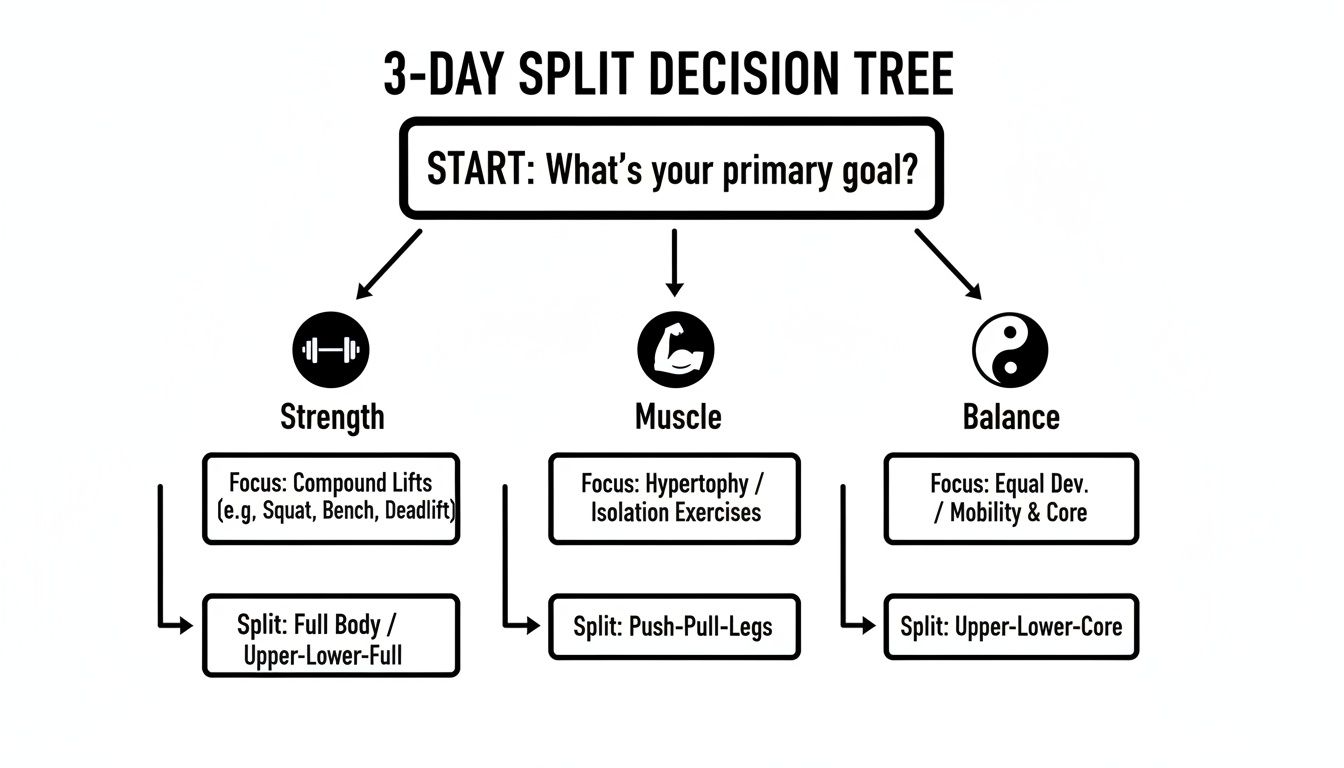
As you can see, when you know what you're trying to achieve, picking the right path becomes pretty simple. Now, let’s get into the nitty-gritty of the workouts.
The Classic Push/Pull/Legs (PPL) Routine
There's a reason PPL is a bodybuilder's go-to split. It lets you absolutely hammer each muscle group with a ton of volume once a week, and then gives it plenty of time to recover and grow. This is an ideal setup for intermediate lifters who are laser-focused on packing on muscle.
Workout A: Push
Barbell Bench Press: 3 sets of 6-8 reps
Incline Dumbbell Press: 3 sets of 8-12 reps
Overhead Press: 3 sets of 8-10 reps
Triceps Pushdowns: 3 sets of 10-15 reps
Lateral Raises: 3 sets of 12-15 reps
Workout B: Pull
Deadlifts: 3 sets of 4-6 reps
Bent-Over Rows: 3 sets of 8-10 reps
Lat Pulldowns: 3 sets of 10-12 reps
Dumbbell Bicep Curls: 3 sets of 10-15 reps
Face Pulls: 3 sets of 15-20 reps
Workout C: Legs
Barbell Squats: 3 sets of 6-8 reps
Romanian Deadlifts: 3 sets of 8-12 reps
Leg Press: 3 sets of 10-15 reps
Leg Curls: 3 sets of 12-15 reps
Calf Raises: 4 sets of 15-20 reps
The High-Frequency Full-Body Routine
For beginners or anyone whose main goal is raw strength, you just can't beat a full-body routine. Hitting your entire body 3 times a week means you're constantly triggering muscle protein synthesis and getting incredibly skilled at the main lifts through sheer practice.
Pro Tip: To keep things fresh and avoid overuse injuries, I like to slightly tweak the main compound lift each session. For instance, you could rotate between back squats on Monday, front squats on Wednesday, and maybe safety bar squats on Friday. It's a small change that makes a big difference.
Here’s a great way to lay out your week:
Workout 1 (Monday)
Squats: 3 sets of 5-8 reps
Bench Press: 3 sets of 5-8 reps
Barbell Rows: 3 sets of 8-12 reps
Overhead Press: 2 sets of 8-12 reps
Bicep Curls: 2 sets of 10-15 reps
Workout 2 (Wednesday)
Deadlifts: 3 sets of 4-6 reps
Incline Dumbbell Press: 3 sets of 8-12 reps
Pull-Ups (or Lat Pulldowns): 3 sets of 8-12 reps
Leg Press: 2 sets of 10-15 reps
Triceps Pushdowns: 2 sets of 10-15 reps
Workout 3 (Friday)
Front Squats: 3 sets of 5-8 reps
Dumbbell Bench Press: 3 sets of 8-12 reps
T-Bar Rows: 3 sets of 8-12 reps
Lateral Raises: 2 sets of 12-15 reps
Face Pulls: 2 sets of 15-20 reps
The Hybrid Upper/Lower Routine
This split is the best of both worlds, giving you a fantastic blend of training frequency and focused volume. It's incredibly versatile. You'll dedicate one day to your upper body, one to your lower body, and then use that third day to your advantage.
That "flex" day is perfect for hammering a weak point, focusing on strength, or just getting in some extra full-body work.
Workout A: Upper Body
Bench Press: 3 sets of 6-8 reps
Pull-Ups: 3 sets to failure
Seated Dumbbell Shoulder Press: 3 sets of 10-12 reps
Seated Cable Rows: 3 sets of 10-12 reps
Skull Crushers: 3 sets of 12-15 reps
Hammer Curls: 3 sets of 12-15 reps
Workout B: Lower Body
Barbell Squats: 3 sets of 6-8 reps
Romanian Deadlifts: 3 sets of 8-12 reps
Walking Lunges: 3 sets of 10-12 reps per leg
Leg Extensions: 3 sets of 15-20 reps
Seated Calf Raises: 4 sets of 15-20 reps
Workout C: Full Body (Strength Focus)
Deadlifts: 3 sets of 4-6 reps
Overhead Press: 3 sets of 6-8 reps
Chest-Supported Rows: 3 sets of 10-12 reps
Goblet Squats: 3 sets of 10-12 reps
Plank: 3 sets, hold for 60 seconds
Driving Progress on a 3-Day Schedule
Having a solid workout plan is a great start, but it's only half the battle. The real secret to making gains on a 3-day split is finding a way to consistently get stronger over time. Just showing up and going through the motions won't get you very far.
You need to give your body a compelling reason to adapt and grow. That's where the principle of progressive overload comes in.
Simply put, you have to find ways to make your workouts a little bit harder over time. If you don't, your body has no incentive to change, and you'll slam right into a plateau. You've got to consistently challenge your muscles beyond what they're already used to.
Applying Double Progression
One of the most battle-tested ways to make this happen is a method called double progression. It’s a dead-simple, two-step process that takes all the guesswork out of getting stronger on your main lifts.
Here’s how it looks in the real world:
First, Focus on Reps: Let's say your plan calls for 3 sets of 8-12 reps on the dumbbell bench press. You're starting with 50-pound dumbbells. Your immediate goal is to hit 12 reps for all three sets. The first week, you might get 12, 10, then 9 reps. You'll stick with those 50s until you can nail all 3 sets for 12 clean, solid reps.
Then, Add Weight: Once you finally hit that goal—3 sets of 12 with the 50s—it’s time to level up. The next time you're in the gym, grab the 55-pound dumbbells. Your reps will naturally drop, maybe down to 9, 8, and 7. Now the cycle starts all over again. You'll stick with the 55s until you can once again hit 3 sets of 12.
This straightforward cycle of adding reps, then adding weight, ensures you’re always pushing forward.
The Critical Role of Recovery
Training provides the spark, but all the actual growth happens when you're resting. A 3-day split is so effective because it automatically builds in plenty of time for your body to repair and rebuild. This isn't just a nice perk; it's a non-negotiable part of the process.
This schedule really hits the sweet spot between training stimulus and recovery, which is absolutely critical for natural lifters. We know from research that muscle protein synthesis—the process that repairs and grows muscle—spikes after a workout and comes back to normal within 24–48 hours for most people.
A 3-day split, especially a full-body or rotating one, lines up perfectly with this biological rhythm. You hit your muscles every 2–3 days and still get four full days off each week to recover. You can read more about how this training frequency supports recovery for natural athletes.
Training is breaking your muscles down. Recovery is building them back up stronger. You can’t have one without the other. That 48-72 hour rest window between hitting the same muscle group is your sweet spot for growth.
Ignoring recovery is the fastest way to kill your progress. Make sure you're getting enough sleep (7-9 hours is a solid target), eating enough protein, and staying hydrated. What you do on your "off days" is just as important as your heaviest lift. Listen to your body and give it the rest it needs—that's what will allow you to come back stronger, week after week.
Using Built Workout to Maximize Your Split
A solid routine is the foundation, but the real secret to unlocking consistent progress is knowing precisely how your body is responding to your training. This is where a bit of smart tech can give you a massive advantage, turning vague feelings of soreness into data you can actually use. An app like Built Workout completely changes the game for managing your 3‑day split by letting you see your recovery status at a glance.
You can take any of the sample routines from this guide, plug them right into the app, and start tracking every single lift. As Built logs your sets, reps, and weight, it translates all that hard work into a muscle fatigue heatmap. Honestly, this feature alone is a game-changer for making smarter training decisions.
Visualize Your Recovery
Let's say you just crushed a tough Leg Day. The app will immediately show your quads, glutes, and hamstrings glowing red, flagging them as heavily fatigued. Fast forward a couple of days, right before your next session is scheduled to start, and you can pull up that same heatmap.
Here’s what that muscle readiness looks like right inside the app.

This kind of immediate, visual feedback takes all the guesswork out of the equation and helps you autoregulate your effort based on how you're really doing, not just how you think you feel.
Maybe the heatmap shows your glutes have bounced back to green, but your quads are still lingering in yellow. Armed with that knowledge, the app's AI coach can give you suggestions in real time. It might recommend leading with a glute-focused exercise like hip thrusts while dialing back the intensity on your squats just a bit, giving your quads the extra recovery time they clearly need.
This data-driven approach means you can fine-tune each workout based on your body’s actual readiness. You're always training productively and dramatically lowering the risk of running yourself into the ground. It’s the closest thing to having a personal coach analyzing your recovery patterns 24/7.
Instead of blindly following a plan, you can make informed adjustments on the fly. You can see exactly how this works by checking out the Built Workout demo and exploring how it can level up your training sessions. This degree of personalized feedback is what truly maximizes every single workout in your 3‑day split.
Got Questions About 3-Day Splits? Let's Clear Things Up.
Switching to a new training style always brings up a few questions. That's completely normal. Before you dive in, let's tackle some of the most common hang-ups people have about training just three days a week.
The biggest one I hear is, "Is three days a week really enough to build muscle?" The answer is an emphatic yes. What drives muscle growth isn't how many days you're in the gym, but the total amount of quality work you put in each week and how hard you push yourself.
As long as you’re hitting each muscle group with enough challenging sets—most research points to a sweet spot of 10-20 sets per week—and you're consistently getting stronger, a 3-day split will absolutely deliver. In fact, the extra recovery time can often lead to better long-term gains than cramming in more sessions and risking burnout.
What to Do If You Miss a Workout
Look, life happens. You're going to miss a workout eventually. The beauty of a 3-day split is its flexibility, which makes this a non-issue. You’ve got a couple of simple ways to handle it:
Option 1: Just push your schedule back. Do the workout you missed on the next day you can train, and shift the rest of the week from there. Easy.
Option 2: Forget about it and move on. If rearranging the schedule feels like a hassle, just skip the session you missed and pick up with your next scheduled workout.
Honestly, for most people, the second option is the way to go. One missed workout in the grand scheme of things means absolutely nothing. Don't sweat it. Just get back to it.
The best training plan is the one you can actually stick with. Don't let one missed day throw you off course. Just show up for the next one.
How to Fit in Cardio
With four "off" days from lifting each week, you have the perfect opportunity to get your cardio in without it interfering with your strength work. This is the ideal setup, as it lets you give 100% to both.
Try to schedule 2-3 sessions of moderate-intensity cardio, like a brisk walk, jog, or bike ride, on your non-lifting days. If you absolutely have to do cardio on a lifting day, always do it after you lift. You want all your energy reserved for the weights, since that's what's going to build strength and muscle.
Ready to stop guessing and start seeing exactly how your body is recovering? The Built Workout app takes the principles of a 3-day split and amplifies them with data-driven insights. Track your workouts, visualize muscle fatigue on a personal heatmap, and get AI-powered coaching to optimize every session. Download it for free at https://www.builtworkout.com.