The line between hitting a plateau and consistently getting stronger often boils down to one simple thing: data. If you want to track gym workouts effectively, you have to log the key variables—exercises, sets, reps, and the weight you’re lifting—every single time you hit the gym. This isn't just about jotting down numbers. It’s about building a story of your training that reveals what’s working, what isn't, and how to make smarter decisions for your next session.
Why Tracking Your Workouts Is a Non-Negotiable for Real Progress
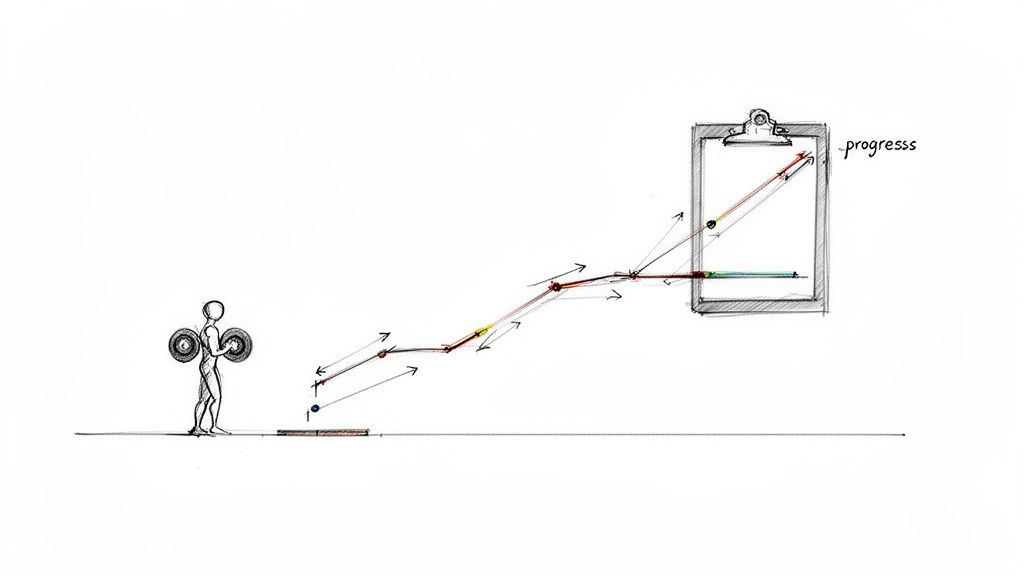
Let's get past the vague "just lift heavy" advice. Tracking is your most powerful tool in the gym, period. Think of it this way: every workout you don’t log is a lost opportunity to learn. You wouldn't try to manage your finances without tracking your spending, so why would you leave your physical progress to chance?
Logging your workouts turns ambiguous feelings into hard facts. It’s the difference between thinking you’re getting stronger and knowing it because the numbers back you up. This data-driven mindset is the bedrock of intelligent, long-term improvement.
The Power of Data in Your Training
The entire fitness world is moving toward data-informed training. This isn't just some fad—it's a fundamental shift, and the numbers show it. The market for fitness apps is expected to blow up, growing from USD 10.87 billion in 2025 to USD 75.67 billion by 2033. That explosion is driven by people just like you who want to track gym workouts to get better, faster results. In fact, research shows that following a tracked program can boost muscle gains by 20-30% compared to just winging it.
Logging your workouts creates a clear roadmap. It eliminates guesswork, keeps you honest, and gives you the objective feedback you need to smash through the plateaus that stall nearly 50% of lifters every single year.
Beyond Numbers: Building Smarter Habits
At the end of the day, this is all about building systems that support your goals for the long haul. The discipline of tracking is crucial for staying consistent with exercise, giving you the structure to keep pushing forward, even on days when you just don't feel like it.
A good log also acts as an incredible diagnostic tool. If you’ve ever wondered, "https://www.builtworkout.com/blog/why-am-i-not-getting-stronger," your workout history has the answers. It can shine a light on problems like inadequate training volume, poor recovery, or inconsistent effort that are nearly impossible to spot otherwise. By turning every session into a data point, you create a powerful feedback loop that makes every workout a productive step forward.
To get started, it helps to know exactly what to track and why. Here's a breakdown of the essentials.
Essential Metrics for Every Workout Log
This table summarizes the key data points you should be recording in every session. Getting these right is the first step toward making your data work for you.
| Metric to Track | Why It's Important | Real-World Example |
|---|---|---|
| Exercise & Order | Tracks which movements you're doing and in what sequence, which impacts fatigue and performance. | Barbell Back Squat, followed by Romanian Deadlifts... |
| Sets & Reps | The fundamental measure of your training volume. The goal is to see these numbers increase over time. | Squat: 3 sets of 5 reps. |
| Load (Weight) | Directly measures strength progression. More weight for the same reps means you're getting stronger. | Squat: 3x5 @ 225 lbs. |
| RPE/RIR | Measures intensity and how close you are to failure. Crucial for managing fatigue and ensuring effort is consistent. | Last set of squats felt like an 8 RPE (2 reps left in the tank). |
Nailing these four metrics consistently will give you a clear, objective picture of your progress and provide all the information you need to make smart adjustments week after week.
The Foundational Metrics You Should Log Every Session
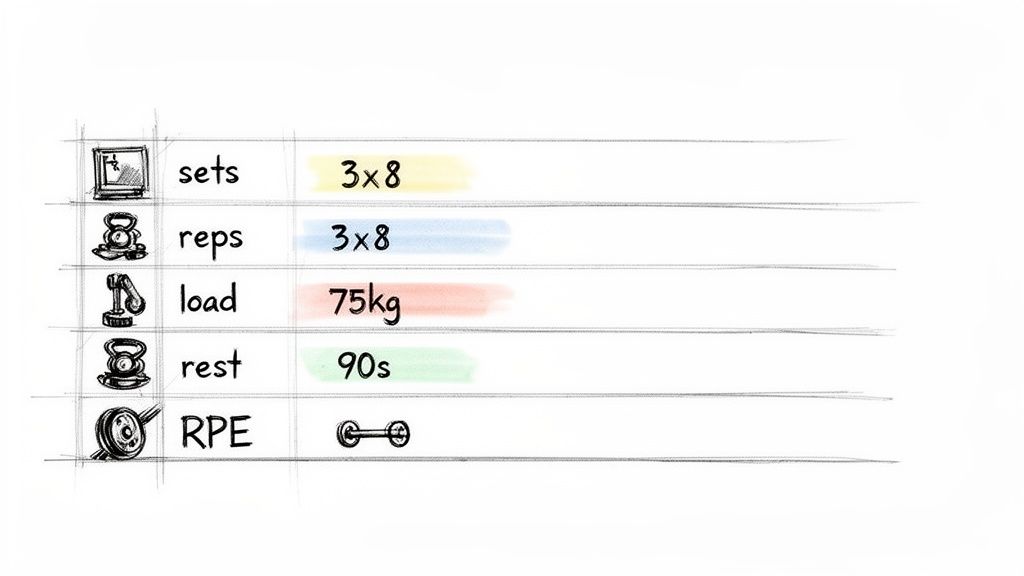
If you're serious about results, you have to go deeper than just scratching a few numbers in a notebook. A good workout log tells a story. It captures the details that actually drive progress and shines a light on the hidden variables that might be holding you back.
Without these foundational metrics, you’re flying blind. You’re just guessing. Each data point is a piece of the puzzle; put them together, and you get a clear picture of your training. This is how you start making smart, data-driven decisions about what comes next. Let’s get into exactly what you should be tracking every time you hit the gym.
Exercise Selection and Order
This one seems obvious, but people mess it up all the time. Simply listing the exercises you did isn't enough—the order you do them in drastically affects your performance.
Think about it. Heavy Barbell Back Squats at the start of your session when you’re fresh is a completely different animal than trying to hit them after you've already burned yourself out on a few other leg exercises. Logging the exact sequence lets you replicate the workout conditions. It’s that consistency that makes week-to-week comparisons meaningful, so you know for sure if you're getting stronger or just had an easy day.
The Big Three: Sets, Reps, and Load
This trio is the bedrock of any serious workout log. These are the primary levers you pull to achieve progressive overload—the core principle of getting stronger by gradually demanding more from your body.
- Sets: How many rounds you do for an exercise. This is your main tool for managing total training volume, which is a massive factor in building muscle.
- Reps: The number of repetitions you complete in a set. Watching your reps climb over time with the same weight is a crystal-clear sign that your strength and muscular endurance are improving.
- Load (Weight): The resistance you’re working against, whether it’s a barbell, a dumbbell, or a pin on a machine. It's your most direct measure of raw strength.
Seeing a drop in reps at the same weight you used last week is a powerful piece of information. It could signal that you're over-fatigued, not recovering well, or that it’s time for a deload. You’d miss that completely without a detailed log. A good gym workout tracker makes keeping an eye on this stuff easy.
Intensity: How Hard Are You Really Working?
Just writing down sets, reps, and weight leaves out the most important part of the story: your effort. Two people could do 3 sets of 10 reps with 100 kg, but if one was fighting for their life on every rep while the other cruised through it, those were two entirely different workouts. This is where tracking intensity becomes a total game-changer.
The two best ways to do this are:
- Rate of Perceived Exertion (RPE): A simple 1-10 scale rating how hard a set felt. RPE 10 means you had nothing left. RPE 7 means you felt like you had about 3 good reps left "in the tank."
- Reps in Reserve (RIR): This is just the flip side of RPE. Instead of rating the difficulty, you estimate how many reps you could have done before failing. An RIR of 2 is the same thing as an RPE of 8.
Logging RPE or RIR adds crucial context. It helps you auto-regulate, ensuring your effort is where it needs to be. If you planned for an RPE 8 set but it felt like a 10, that’s your cue to maybe back off the weight a bit and manage your fatigue.
Rest Periods: The Overlooked Growth Variable
How long you rest between sets has a massive impact on your performance, yet it’s the metric most people ignore. A 60-second rest creates a completely different training stimulus than a 3-minute rest.
Shorter rests are great for building endurance and getting a pump, but they’ll kill your strength on the next set. Longer rests let your energy systems recover, which is what allows you to move heavy weight on your big compound lifts. Tracking your rest times ensures that when you see your numbers go up, it’s because you’re actually stronger—not just because you accidentally took a 5-minute break scrolling Instagram.
By meticulously logging these core metrics, you transform your workout from just "going to the gym" into a data collection process. This data is the raw material for building a stronger, more resilient physique.
This systematic approach is exactly why the fitness app market is exploding. Projections show it growing from USD 12.1 billion in 2025 to USD 45.45 billion by 2035. The data backs it up, too. Research shows that lifters on tracked programs can see 35% faster strength increases because it helps avoid the kind of burnout that sidelines roughly 1 in 3 lifters. This is especially true for the 50 million Apple Watch users in the US, where automated tracking can cut down on manual entry errors by up to 40%.
Picking the Right Tool for the Job
When you get serious about training, your first big decision is how you're going to track it all. For a long time, the only real option was a pen and a crumpled notebook. It's simple, it works, and you never have to worry about a dead battery. But let's be real, it's a bit of a dinosaur.
A classic notebook is definitely better than nothing, but you'll quickly run into its limits. Want to know your total volume for the week? Get out your calculator. Need to see what you benched three weeks ago? Good luck flipping through pages of chicken scratch. It’s a static record of what you did, offering zero help in figuring out what you should do next.
Why Digital Logging is a Game-Changer
This is exactly where a good fitness app completely changes the game. Modern apps automate all the tedious number-crunching and unlock powerful insights a notebook could never dream of. They turn your raw data into genuinely useful advice, making intelligent training accessible to anyone.
It's no surprise this has become the standard. The global fitness app market hit USD 6,097.7 million in revenue in 2024 and is on track to explode to USD 22,276.6 million by 2035. More importantly, it actually works. Studies show that people who consistently log their workouts stick with their routine 42% better than those who don't. Seeing your progress in black and white is a huge motivator. For serious athletes, it can even help prevent the overtraining that sidelines 30-40% of trainees each year. You can dig deeper into the growth of the fitness app market to see the full picture.
Setting Up Your Digital Log for Success
Switching from paper to an app is easy, but the real magic is in creating reusable workout templates. Instead of typing out "Barbell Bench Press, 3 sets of 8-10 reps" every single Monday, you build the workout once. After that, you just show up and fill in the numbers.
Here’s how that usually works:
- Create a New Workout Template: Call it something intuitive like "Push Day A" or "Leg Day - Volume."
- Add Your Exercises: Pull each movement from the app's library and arrange them in order.
- Set Your Target Scheme: For each lift, plug in your goal sets and rep range (e.g., 4 sets of 6-8 reps).
- Save and Go: Now, whenever you start that workout, the entire structure is ready. No more guesswork.
This tiny bit of upfront effort pays off big time, saving you a ton of time in the gym and keeping your data clean and consistent.
The goal isn't just to record data, but to create a system that makes logging effortless. A good app handles the administrative work so you can focus on lifting.
See Your Recovery in Real-Time with a Muscle Heatmap
This is where the best digital tools truly leave notebooks in the dust. Instead of just a list of sets and reps, top-tier apps map every exercise to the specific muscles you worked. Over time, this data builds a dynamic, color-coded picture of your body's recovery status.
The screenshot above shows a muscle heatmap, a core feature in apps like Built. The colors give you an instant, intuitive feel for your readiness to train.
Red or orange areas show muscles that are still beat up and need more time to recover. Green means those muscles are rested and ready for another hard session. This kind of visual feedback is incredibly powerful. It helps you make smarter decisions on the fly, adjusting your workout based on how your body actually feels, not just what the calendar says. If you're looking for the right tool, our guide on the best fitness apps for iOS breaks down some of the top options out there.
Turning Your Workout Data Into Real Gains
Logging your workouts is half the battle. The real magic happens when you actually use that information to make smarter decisions in the gym. If you diligently track everything but never look back at the numbers, you're leaving a ton of progress on the table. Your logbook—whether it’s a dog-eared notebook or a slick app—is a treasure map telling you exactly where to go next to get stronger.
This simple habit turns your training from a collection of random workouts into a cohesive, long-term plan. Instead of just guessing what to do next week, you’ll know.
This flowchart breaks down the thought process for picking a logging tool. It really highlights how your choice influences what you can do with the data later on.
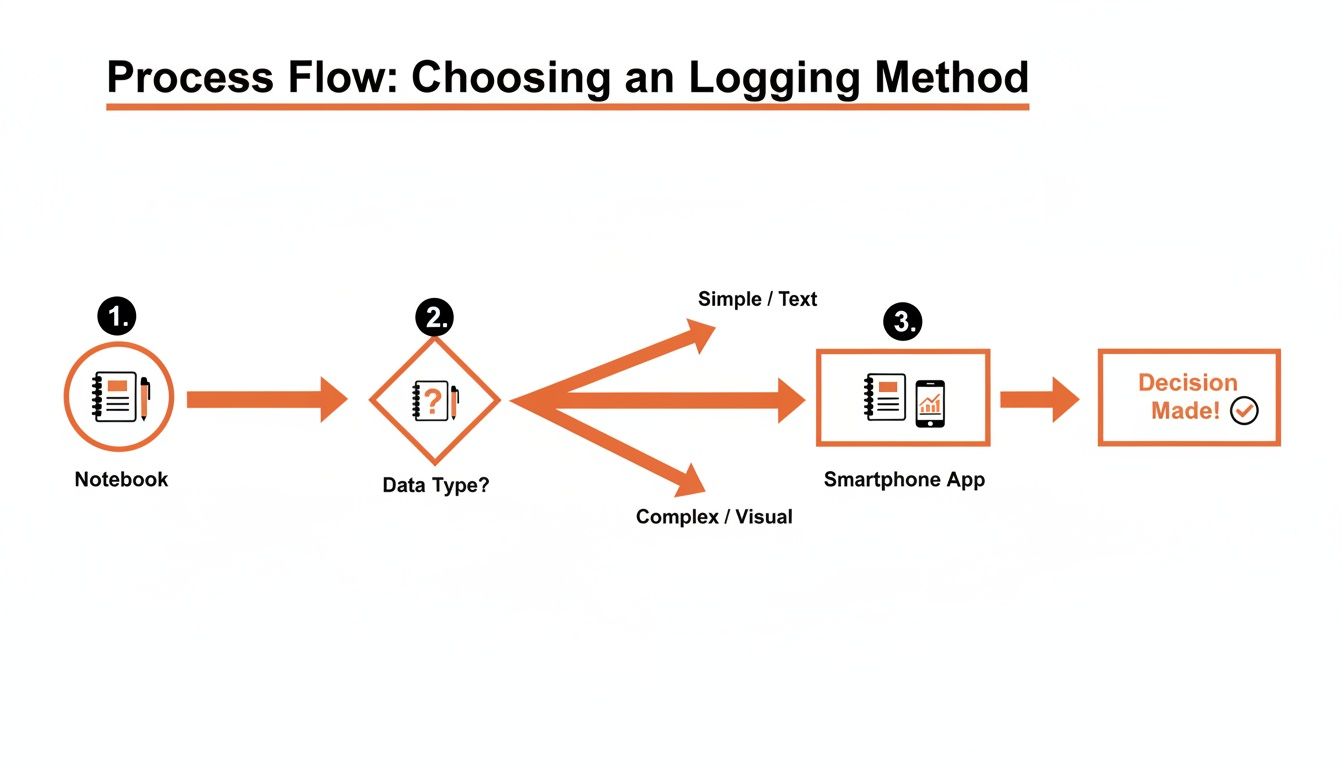
The bottom line? A notebook is great for capturing the basics, but a dedicated app is purpose-built to help you analyze and act on your data without needing a degree in statistics.
Mastering Progressive Overload with Your Data
Progressive overload is the bedrock principle of getting stronger. You have to consistently give your body a reason to adapt by challenging it with more than it's used to. Your workout log is your best tool for applying this with surgical precision.
Don't just walk into the gym and wing it. Look at what you did last time. Did you squat 200 lbs for 3 sets of 8? Great. Your mission for today is clear: aim for 3 sets of 9 with the same weight, or maybe go for 205 lbs for 3 sets of 8.
Your past performance dictates your future targets. This data-driven approach removes emotion and guesswork, ensuring every workout has a clear, productive purpose.
This systematic approach, often called "double progression," is as simple as it is effective. First, you focus on adding reps within a specific range (e.g., 8-12 reps). Once you hit the top of that range on all your sets with good form, you've earned the right to add a little weight.
Analyzing Volume and Intensity Trends
Zooming out, you want to see a general upward trend in your training volume (sets x reps x weight) over weeks and months. It's the most direct indicator that you're creating enough stimulus for growth. Most good workout apps chart this for you automatically, making trends easy to spot.
But progress is rarely a straight line. Volume should undulate—you'll have periods of pushing hard followed by periods of pulling back to recover, known as deloads. Your log is crucial for managing this. If you see your performance dip for two weeks straight—reps are down, or RPE is climbing for the same weight—that’s a data-backed signal that it’s time to ease up.
Let's say your bench press has stalled. A quick look at your weekly volume chart shows you've crept up to 25 total sets for chest and triceps. Your recovery notes mention your triceps feel fried constantly. This isn't a guess; it's a diagnosis. You can then make an informed decision to drop your volume back to 15 sets and see if your bench starts moving again.
Spotting Plateaus Before They Settle In
A plateau isn't just one off day. It's a frustrating pattern of stagnation that can last for weeks. Your workout log makes these patterns impossible to ignore.
If your squat has been stuck at 225 lbs for 3x5 for three straight workouts, you've officially documented a plateau. Without a log, you might just feel like you're spinning your wheels. With the data in front of you, you can take action.
Here's how to use your log to break through:
- Check Volume: Are you doing too much and burning out? Or too little and not creating enough stimulus to adapt?
- Review Intensity: Are you actually pushing? If your RPE for that stalled lift has been a consistent 7, you might just need to dig a little deeper.
- Analyze Exercise Selection: Maybe the squat itself isn't the problem. Your log might reveal that your hamstring and glute volume is lagging, suggesting your supporting muscles are the weak link.
Making Data-Driven Adjustments
Your log allows you to make small, calculated tweaks instead of throwing spaghetti at the wall to see what sticks. Every change becomes a mini-experiment, and the data from your next few workouts provides the results.
Here are a few real-world examples:
- When to Increase Weight: You crushed your deadlifts, hitting the top of your 4-6 rep range on all sets, with the last set feeling like an RPE 8. The data says you're ready for more weight next time.
- When to Add a Set: Your bench is feeling strong, but you notice your weekly chest volume is a bit lower than your back volume. You can confidently add one extra set to your main press to balance things out.
- When to Schedule a Deload: For three weeks, your logged RPE on big lifts is climbing while your reps are dropping. Your notes mention poor sleep. That's a blaring alarm to schedule a deload week and let your body recover.
Learning to read the story your training data is telling is a skill that sharpens over time. While modern tools like an AI fitness coach can certainly fast-track this by spotting trends for you, developing your own understanding is what ultimately builds true training intuition.
Advanced Tracking: Recovery, Motivation, and the Big Picture
Truly smart workout tracking isn’t just about what happens inside the gym. It’s about what happens in the other 23 hours of your day. Factors like sleep, stress, and nutrition are the foundation of your performance, and if you’re not paying attention to them, you’re flying blind.
Think about it: your body doesn’t know the difference between stress from a grueling set of deadlifts and stress from a terrible night's sleep or a nightmare day at work. It all comes out of the same recovery budget. Adding a few subjective notes to your log provides the "why" behind your performance on any given day.
Logging Your Life to Understand Your Lifts
Your gym performance is a mirror reflecting your body's overall state. By tracking a few simple metrics each day, you can start connecting the dots and make much smarter decisions about your training.
It doesn't have to be complicated. Start with these:
- Sleep Quality (1-10): How did you actually sleep? A 9 is when you wake up feeling refreshed and ready to go. A 4 is when you spent the night tossing and turning.
- Daily Stress (1-10): What was your stress level outside the gym? A lazy Sunday might be a 2, but a day with back-to-back deadlines could easily be an 8.
- Nutrition: Were you fueled up? A simple "On Point," "Okay," or "Poor" is often all you need to see a pattern emerge.
- Overall Feeling: Add a quick note. "Feeling energetic," "A bit drained," or "Still sore from last workout" adds crucial color to the numbers.
Now, imagine you log a squat session where a weight that’s normally an RPE 7 felt like an RPE 9. If you look back and see a note that says "Sleep: 3/10," you have your answer instantly. You didn't suddenly get weaker; you were just under-recovered. This simple context prevents you from making panicked, unnecessary changes to your program. Understanding the typical timelines for bouncing back is also key, and a detailed muscle recovery time chart can give you a great frame of reference.
Context is everything. Logging recovery metrics stops you from misinterpreting a bad day as a sign of weakness and instead frames it as a data point in your overall recovery journey.
Beyond Personal Data: The Power of Community
Modern fitness apps offer something an old-school paper notebook never could: a social feed. This isn't about gym selfies. It's about creating a community where you can see the real, unfiltered training logs of people you know and respect.
Seeing the workouts your friends, training partners, or even your coach are doing provides a level of insight that a generic online program just can't match. You get to see their exact exercise choices, the weights they’re lifting, and their notes on how it all felt. This kind of transparency turns every workout into a learning opportunity.
Motivation Through Shared Data
This social layer is more than just a cool feature; it’s a powerful driver for motivation and accountability.
Here’s how it can directly fuel your own training:
- Friendly Competition: Seeing a friend hit a new PR on their bench press might just be the push you need to go for your own.
- Fresh Ideas: You might notice a training partner doing a unique accessory exercise for their triceps that you’ve never tried. This can spark new ideas to break through your own plateaus.
- Accountability: Knowing other people can see your logged workouts creates a subtle but effective form of positive peer pressure. It makes you a little less likely to skip that session you were thinking about blowing off.
At the end of the day, combining deep personal recovery data with the motivational pull of a training community completely changes how you track gym workouts. For those ready to go even deeper, understanding Heart Rate Variability (HRV) and how smartwatches know it can offer incredible insight into your body's readiness to train. This multi-layered approach ensures you’re not just logging numbers—you're building a complete, actionable picture of your entire fitness journey.
Common Questions About Tracking Your Workouts
Even when you're diligently logging every set and rep, questions will inevitably pop up. Learning to interpret your data and react accordingly is a skill, and it's completely normal to hit a few confusing spots along the way. Let's dig into some of the most common hurdles people face when they start getting serious about tracking their gym workouts.
Moving beyond simply recording numbers and starting to have a real conversation with your body—using your log as the translator—is what separates long-term, successful training from just spinning your wheels.
How Often Should I Increase the Weight?
This is the million-dollar question, and the answer should always come from your logbook, not your ego. The most reliable and time-tested method is called "double progression." It’s a simple two-part system that ensures you’ve genuinely earned the right to add more weight to the bar.
First, you focus on adding reps. Let’s say your program calls for 3 sets of 8-10 reps on the bench press. Your goal is to hit 10 reps for all three of those sets with clean, consistent form. Once your log shows you’ve nailed that, you’ve checked the first box.
Only then do you earn the right to increase the weight. In your next session, you’d add a small amount—maybe 5 lbs—and start the process over again, working your way back up through that 8-10 rep range. This data-driven approach takes all the guesswork out of the equation.
What If I Miss a Workout or Just Have a Bad Day?
Life happens. You’ll get sick, work will get hectic, and some days you’ll just walk into the gym feeling completely flat. The most important thing is to log it honestly. One bad day is just a single data point, not a catastrophe.
Jot down a quick note in your log to add context. Did you get terrible sleep? Stressed out at work? Skipping meals? This kind of information is invaluable. If you start seeing a pattern of bad days emerging, your log will help you diagnose the root cause—maybe you’re pushing too hard and on the verge of overtraining.
If you miss a session entirely, don't try to cram two workouts into one to "make up for it." Just pick up where you left off. The real goal is long-term consistency, not short-term perfection. A single missed workout is statistically meaningless over the course of a year.
Is It Better to Use a Phone App or a Notebook?
While a classic paper notebook is a decent start and certainly better than nothing, a dedicated fitness app gives you a massive advantage if you're serious about making progress. A notebook is a static record; a good app is a dynamic analytical tool.
An app does the heavy lifting for you. It automatically calculates your total training volume, graphs your strength progression over time, and can pull out insights you’d have to spend hours calculating by hand.
The best apps go even further by baking recovery tracking right into the experience. Features like a muscle fatigue heatmap can show you which parts of your body are ready to go and which need more time to rest. This turns your workout data into actionable advice, helping you make smarter choices about what to train next.
How Can I Track Workouts with an Inconsistent Schedule?
This is where tracking becomes even more critical. A rigid, calendar-based program (“Monday is chest day, Tuesday is back day…”) is fragile and breaks the second life gets in the way. A flexible, data-driven approach, on the other hand, is far more resilient.
Recovery-focused tracking really shines here. Instead of being chained to a specific day of the week, you’re guided by your body's actual readiness to perform. An app with a muscle heatmap is perfect for this.
Let’s imagine you unexpectedly have time to train on a Wednesday. You just open the app, check your recovery status, and see that your legs are green (fully recovered) while your chest and shoulders are still yellow (partially recovered). The decision is made for you: it’s a great day to train legs. This method ensures that no matter when you get to the gym, your session will be a productive one.
Ready to stop guessing and start building? Built Workout turns your training data into a clear roadmap for success. With our muscle recovery heatmaps, AI-powered coaching, and a social feed to learn from others, you’ll have all the tools you need to make smarter, data-driven decisions in the gym. Download Built for free and see what intelligent training feels like. Learn more about Built Workout's features.