Think of an AI fitness coach as a smart, digital trainer that adjusts your workout plan on the fly. It looks at your performance, how tired you feel, and how well you’re recovering to make real-time decisions. You're no longer stuck with a static program; you get a dynamic guide that knows when to push you and when to tell you to ease off.
This is what makes every single session personal. It’s a direct solution to the classic problems of generic workout plans, like hitting a plateau or getting sidelined by overtraining.
What an AI Fitness Coach Actually Does
At its heart, an AI fitness coach swaps out the guesswork of old-school training for data-driven precision. It’s like the difference between following a recipe card and having a chef in your kitchen who tweaks the ingredients based on your mood and what’s fresh that day. This tech does more than just log your workouts—it becomes an active partner in your fitness journey.
Imagine a typical workout plan as a paper map. It shows you one route to your destination, but it can't react to traffic jams, road closures, or the fact that you're just not feeling it today. If you're exhausted, the map doesn't care; it still tells you to go the full distance.
An AI coach is your GPS. It’s constantly crunching real-time data—how you did on your last set, how you slept, and which muscles are fried—to find the quickest, smartest route to your goals. It knows when to suggest a detour (like a deload day) or when it's time to hit the gas and go for a new PR.
Beyond Static Plans to Adaptive Training
The real magic of an AI fitness coach is its ability to deliver adaptive training. This means your workout plan doesn't just change week to week; it can change from one exercise to the next.
A true AI coach doesn't just tell you what to do. It uses your own performance to explain why a certain exercise or weight makes sense for you right now. It helps you build intuition by connecting the dots between your effort and your results.
This directly tackles the biggest weaknesses of one-size-fits-all programs. Instead of blindly following a plan that might be a terrible fit for your body, the AI keeps your training perfectly synced with your current capabilities.
This solves a few key problems:
- Preventing Overtraining: The system spots when a muscle group is getting overworked and will suggest rest or a different exercise, which dramatically lowers your risk of injury.
- Breaking Through Plateaus: When you get stuck, the AI digs into your history to pinpoint weaknesses. It then intelligently adjusts your volume, intensity, or exercise selection to kickstart new progress.
- Maintaining Motivation: The AI keeps workouts challenging but achievable, so you’re less likely to get bored or feel completely overwhelmed.
To see just how big of a leap this is, let's compare a traditional plan with an AI coach.
Traditional Workout Plan vs AI Fitness Coach
This table breaks down the core differences in a nutshell:
| Feature | Traditional Workout Plan | AI Fitness Coach |
|---|---|---|
| Adaptability | Static; changes are manual and infrequent | Dynamic; adapts daily or even mid-workout |
| Personalization | Generic; based on averages or templates | Hyper-personalized; based on your live data |
| Progression | Pre-determined; "Add 5 lbs next week" | Data-driven; adjusts based on performance |
| Feedback | None; you guess if you're doing too much | Instant; flags fatigue and readiness to push |
| Plateau-Busting | Relies on manual program-hopping | Identifies and corrects stalls automatically |
| Injury Risk | Higher risk of overtraining or poor loading | Lower risk due to built-in fatigue management |
Ultimately, the AI coach makes professional-level guidance accessible to everyone.
To truly appreciate these advancements, it helps to understand what a traditional fitness trainer does. A great trainer brings deep experience and intuition. An AI coach automates the heavy lifting of data analysis, giving you that same level of personalization at a scale that was never possible before. It’s not about replacing human experts, but rather giving you a powerful tool for smarter, safer, and more effective training.
How AI Turns Workout Data into Smarter Training
An AI fitness coach isn't just spitting out random workouts. It’s making highly informed decisions by constantly analyzing your personal performance data. Think of it like a seasoned detective, gathering clues from every lift, rep, and rest period to build a complete profile of your unique strength and endurance. This process is what turns a bunch of abstract numbers into a clear, actionable training strategy that actually works for you.
The system's intelligence all starts with the information you feed it. Every single time you log a workout, the AI is learning. It's not just about noting that you benched three sets of ten; it’s about understanding the entire context behind that performance. This is where the real magic of an AI fitness coach happens.
From Raw Numbers to Personal Insights
To build your plan, the AI meticulously tracks several key data points during each session. These inputs are the essential building blocks for its personalized recommendations.
- Volume and Intensity: It logs the weight you lift, the number of reps you complete, and how many sets you perform for every single exercise.
- Perceived Exertion: Many apps also incorporate your own feedback, like how tough a set felt. This helps the AI understand your effort level beyond just the raw numbers.
- Rest Periods: The time you take between sets is another crucial metric, giving clues about how quickly you recover and prepare for the next push.
All this data gets crunched by machine learning algorithms. These complex systems are designed to recognize patterns over time, much like a human coach who, after months of working with you, starts to intuitively understand your limits and potential. The big difference? The AI can spot these patterns with far greater speed and precision, identifying subtle trends that might otherwise go completely unnoticed. This is why using a dedicated gym workout tracker is so important—it provides the clean, consistent data the AI needs to learn effectively.
The diagram below shows how an AI fitness coach processes your workout data to deliver personalized guidance on performance, recovery, and your overall plan.
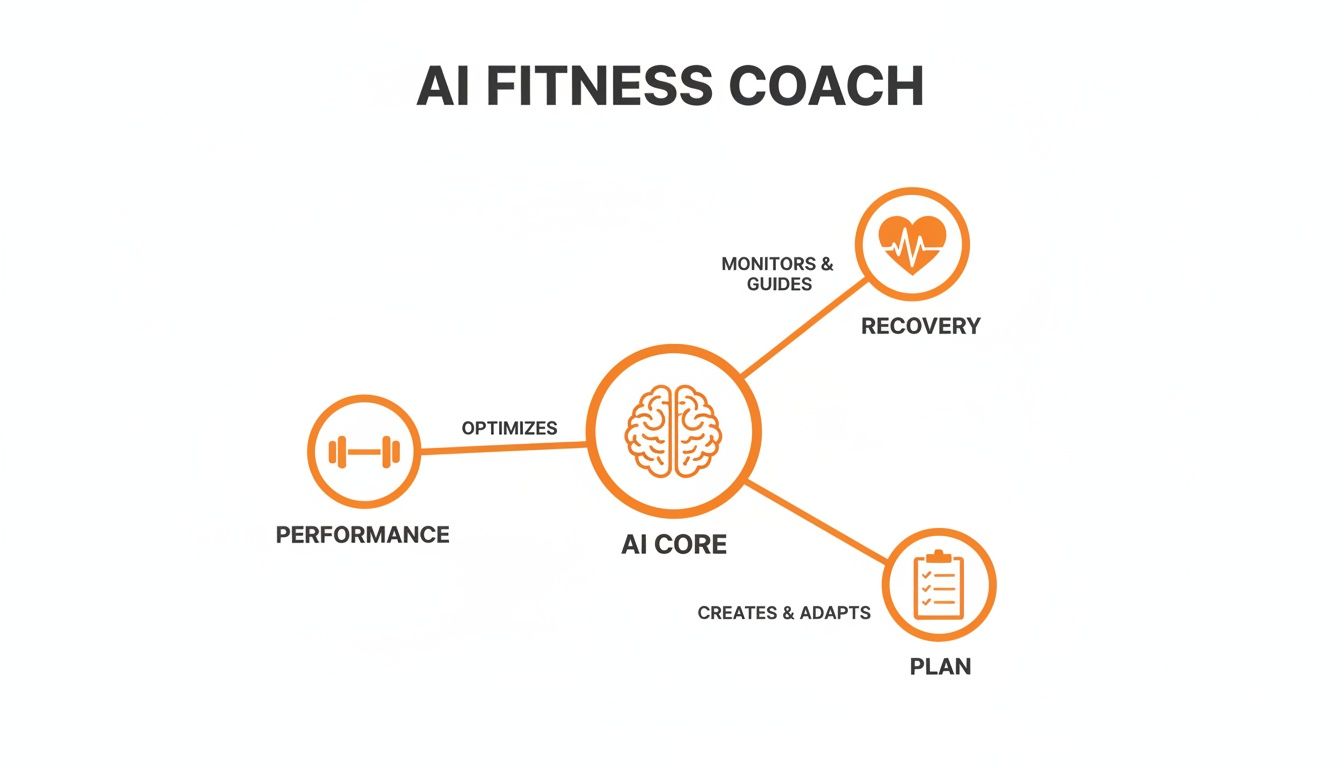
This really brings to life the continuous feedback loop where your actions in the gym directly shape the AI's future recommendations, ensuring your training plan evolves right alongside you.
Visualizing Your Recovery and Readiness
One of the most useful applications of this tech is its ability to map out your physical strain. By analyzing which exercises you performed and at what intensity, an AI fitness coach can calculate the stress placed on specific muscle groups.
This isn't just about avoiding soreness. It's about scientifically managing fatigue to ensure you train muscles when they are optimally recovered and ready to grow, not when they are still broken down.
Let's say you had a heavy chest day. The AI doesn't just know you're tired; it can actually quantify that fatigue. In an app like Built Workout, this is shown visually through recovery heatmaps. These are color-coded diagrams of your body that show which muscles are fully recovered (green), a bit fatigued (yellow), or in need of more rest (red).
This kind of visual feedback completely changes how you make training decisions. Instead of just guessing whether your triceps have recovered from your last push day, you can see their exact status. This data-driven clarity helps you choose the right exercises for the day, confidently avoiding overtraining while maximizing your potential for strength gains. It builds a ton of trust because you can see that the AI’s suggestions aren't random—they're deeply rooted in your personal training history.
This level of detail can extend way beyond the gym floor. Some AI systems can even analyze individual metrics to help you develop a truly personalized nutrition plan, moving beyond generic advice to support your unique fitness goals. By connecting performance data with recovery and nutrition, the AI provides a complete, 360-degree approach to your fitness.
Real-World Benefits for Every Type of Lifter
An AI fitness coach is more than just a collection of algorithms; it's a practical tool that delivers real results for everyone, from the weekend warrior to the elite athlete. Its true power is in translating complex performance data into simple, actionable guidance that meets you exactly where you are. Whether you’re just trying to build a consistent habit, chasing a new personal record, or managing clients, an AI coach gives you a serious advantage.
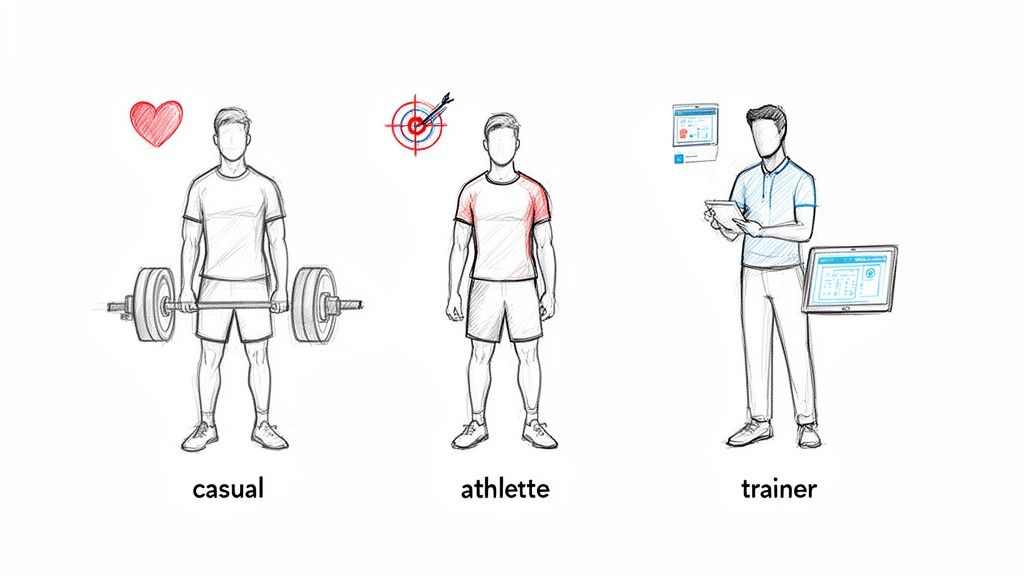
The tech inside these apps moves beyond generic advice to provide specific, personalized support. Let's dig into how this actually plays out for different kinds of lifters.
For the Everyday Gym-Goer
If you're just starting out or simply aiming for consistency, the biggest hurdles are usually motivation and the fear of doing things wrong. An AI fitness coach acts as your go-to guide, building both confidence and structure into every workout. It completely removes the guesswork of "what should I do today?"
- Building Consistency: The AI gives you a clear, daily plan based on your recovery, making it so much easier to just show up and train.
- Preventing Common Injuries: By intelligently managing your workload, the coach helps you steer clear of the classic "too much, too soon" mistakes that lead to strains and setbacks.
- Creating Motivation: Seeing your progress tracked and visualized—from strength gains to better recovery—creates a powerful feedback loop that keeps you coming back for more.
Think of it as a smart spotter in your pocket, always making sure you're training in a way that’s both productive and safe.
For the Serious Athlete and Bodybuilder
For competitive athletes and dedicated bodybuilders, training happens on the razor's edge of performance. Every little detail matters. For this group, an AI fitness coach becomes an indispensable tool for dialing in precision and optimization. It’s not just about training hard; it’s about training smart.
This is where the granular data analysis of an AI system really shines. It allows athletes to manage variables that are nearly impossible to track by hand, completely changing their approach to volume, intensity, and recovery.
For an athlete, fatigue isn't the enemy—it's a resource to be managed. An AI coach provides the data needed to push limits for maximum adaptation while strategically pulling back to ensure you peak at just the right time.
Imagine a bodybuilder deep into a prep cycle. They can use a feature like Built Workout’s recovery heatmaps to make crucial calls. If the heatmap shows their chest is still fried from the last session, they know to train legs instead. This prevents overtraining and makes sure every single workout contributes to growth, not burnout. You can learn more about how to prevent overtraining in our detailed guide. This kind of objective data takes emotion and guesswork out of the equation.
For the Modern Personal Trainer
An AI fitness coach doesn't replace a human trainer; it supercharges them. It works like a digital assistant, automating the tedious parts of coaching so trainers can focus on what they do best: connecting with and motivating their clients.
- Deep Client Insights: Trainers can see a client's entire workout history, performance trends, and recovery status at a glance, leading to much more informed and effective check-ins.
- Automated Progress Tracking: The system handles the heavy lifting of logging workouts and charting progress, freeing up a ton of valuable time.
- Data-Driven Programming: A trainer can use the AI's suggestions as a solid baseline, then add their own expertise on top to build truly customized programs for clients.
Personalization is really the secret sauce here. Studies have found that AI-driven adaptive workouts can lead to 25% higher program completion rates compared to static, one-size-fits-all plans. For instance, the Built AI coach analyzes your exercise data, maps out muscle fatigue, and adjusts your programming on the fly with form cues and rest advice—all while explaining the "why" behind its suggestions to help you build your own training intuition. This mirrors findings where AI computer vision for form correction cut perceived injury risk by 50%, making people feel safer and more confident in the gym.
A Day in the Life with Your AI Fitness Coach
Let's move past the technical stuff and see what this actually looks like in practice. To really get a feel for how an AI fitness coach works, let's walk through a typical training day.
Imagine it’s Monday—your push day. The old you might have wandered into the gym and defaulted to the same flat bench routine you’ve done for years. But today is different. Your workout is guided by smart, data-driven insights from the moment you wake up.
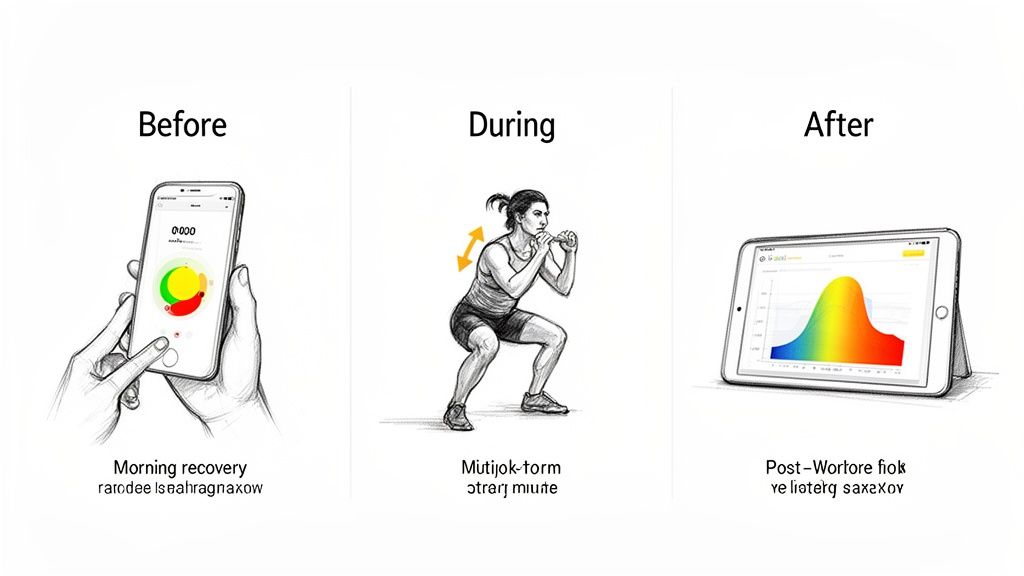
This little narrative shows how an AI coach weaves itself into your routine. It’s not just about the workout itself; it’s about making the time before, during, and after your session smarter and more effective.
The Pre-Workout Readiness Check
Your journey doesn't start at the squat rack; it begins on your phone. Before you even think about grabbing your gym bag, you open your fitness app to check your readiness. Instead of a generic "Go crush it!" motivational quote, you get a detailed, personalized status report.
This is where a feature like the recovery heatmap in the Built Workout app really shines. You see a simple visual of your body, with different muscle groups colored based on how recovered they are. Your legs and back are green—fully rested and good to go. But your chest and triceps? They’re shaded yellow, a clear sign they’re still feeling the effects of your last heavy session.
This simple visual check immediately answers the most important question of the day: "What is my body actually prepared to do?" It replaces guesswork and ego with objective data, setting the foundation for a productive and safe workout.
Based on this, the AI instantly adjusts your planned workout for the day. It knows that hitting a heavy bench press would be counterproductive, so it modifies your session on the fly. Maybe it prioritizes shoulders and suggests lighter, higher-rep work for your chest to encourage active recovery. This isn't some pre-canned workout; it's a dynamic plan tailored to your body's exact condition right now.
Navigating the Workout with Real-Time Guidance
Once you hit the gym floor, the AI coach switches roles from a planner to an in-the-moment guide. As you kick off your first exercise, maybe dumbbell shoulder presses, the app gives you a clear target: 4 sets of 8-10 reps. You log your first set—10 reps with 50-pound dumbbells—and note that it felt challenging but you handled it well.
The AI crunches this input instantly. For your next set, it might suggest sticking with the same weight to make sure your form stays crisp. But what if you had logged that first set as "easy"? The coach would nudge you to go up in weight. This is adaptive training in action, making tiny adjustments from one set to the next.
Let's say later in the workout, you move on to squats. The AI coach is there with more than just numbers; it's providing essential technique reminders.
- Form Cues: You might see a tip pop up: "Focus on keeping your chest up and driving through your heels," helping you stay locked in, especially as you start to get tired.
- Performance Monitoring: If your rep speed slows way down on your last set, the system picks up on this drop in performance. It might then suggest ending the exercise there to avoid sloppy, high-risk reps or recommend a longer rest before your next movement.
This constant feedback loop makes every rep count. You’re no longer just going through the motions; you're working with a system that learns from you and guides you toward better results in real-time.
The Post-Workout Analysis and Future Planning
The session is over, but the AI's job isn't done. The moment you log your final set, the system starts analyzing the data. It calculates your total training volume and pinpoints the exact stress placed on each muscle you worked—deltoids, triceps, and upper chest.
This fresh data immediately updates your recovery heatmap. The yellow shading on your chest might deepen a bit, while your shoulders shift from green to yellow, reflecting the work you just put in. You now have an up-to-the-minute snapshot of your body's state, which will be the starting point for planning your next training day.
All this workout data is also logged in your history, feeding the AI's long-term understanding of your strength progression and work capacity. When you check in tomorrow, the AI will have an even sharper picture of where you stand. This daily cycle of prepare, execute, and analyze is what makes an AI fitness coach such a powerful tool for reaching your goals.
How to Choose the Right AI Fitness Coach
The fitness app market is crowded, and it seems like every other app is now powered by "AI." But a true AI fitness coach is more than just a fancy set and rep counter—it's supposed to be a dynamic training partner. To find one that will actually help you make progress, you have to know what to look for and which questions to ask.
There’s a reason this space is exploding, with the market hitting an estimated $1.6 billion in 2023 and growing fast. Lifters want personalized workouts that adapt on the fly, not some cookie-cutter plan anyone can download. Platforms like Built, for example, use AI to track every lift and then show you exactly which muscles are recovered with a color-coded heatmap. This approach works. According to a detailed online fitness course industry analysis, AI-driven programs have 25% higher completion rates for multi-week plans because they push you without burning you out.
Evaluate the Core Coaching Features
When you're comparing different apps, look past the slick marketing and focus on the intelligence that powers the programming. A flashy interface is nice, but the real value is in how the AI "thinks" and reacts to what you do in the gym. A great AI coach should feel like it actually gets how your body works.
Start by asking these questions about any app you're considering:
- How does it show me my recovery? You need clear, actionable feedback. A simple percentage just doesn’t cut it. Look for visual tools, like muscle heatmaps, that give you an instant read on which body parts are good to go and which need another day off.
- Does it adjust my workout in real-time? The best AI coaches adapt during your session. If you’re grinding out a final rep and your form starts to slip, the app should suggest dropping the weight or cutting the set short—not just blindly tell you to keep going.
- What kind of form feedback does it offer? Nothing replaces a great human coach, but some apps provide helpful text or video cues to keep your technique sharp and reduce your risk of injury.
- Does it explain why it's making suggestions? A truly smart AI coach doesn't just bark orders; it teaches. When a platform explains why it's recommending a certain exercise or a longer rest period, it helps you build your own intuition as a lifter.
Look Beyond the Workout Itself
A complete coaching experience doesn't end when you leave the gym. The right app should fit into your life and give you total control over your experience and your data. It’s the little details that support your journey in the long run.
The goal is to find a platform that feels less like a rigid drill sergeant and more like an expert advisor. It should provide structure when you need it but also offer the flexibility to make your own informed decisions based on its data.
Before you commit, make sure the app nails these essentials:
- Data Privacy and User Control: Your training data is personal. Look for an app with a transparent privacy policy that spells out exactly how your information is handled. You should always have the option to keep your workouts private or share them only when you want to.
- Community and Social Learning: Seeing how other people train can be a huge motivator. Apps like Built include a social feed where you can see real workouts from friends and experienced lifters, turning their success into your inspiration.
- Intuitive Interface and Logging: Let's be honest—if logging your workout is a pain, you're not going to do it for long. The app should make it dead simple to track your exercises, sets, reps, and weight. A clean, fast user experience isn't a luxury; it's a necessity.
Finding the right AI fitness coach is about telling the difference between a simple digital logbook and a true training partner. For more ideas on how to organize your training, check out our guide on finding the right gym workout planner app.
Got Questions About AI Fitness Coaches? Let’s Clear Things Up.
Jumping into anything new, especially when it comes to your training, is bound to bring up some questions. It's totally normal to wonder about accuracy, how your data is handled, and if a tool like this is actually right for you.
Let's tackle the big questions head-on. My goal is to give you clear, straightforward answers so you can feel confident about using AI to train smarter.
How Accurate Is an AI Fitness Coach Compared to a Human Trainer?
This is easily the most common question I hear, and the answer isn't about which one is "better." It’s about understanding their unique strengths. Think of it like having two different specialists on your team.
An AI fitness coach is a data-crunching machine. It can analyze thousands of your past workouts without getting tired or having a bad day, spotting subtle performance trends that even the most dedicated human coach might miss. Its superpower is its ability to calculate things like optimal training volume and manage recovery with almost perfect mathematical precision.
AI shines at objective, data-driven programming and recognizing patterns on a huge scale. A human coach brings the motivation, accountability, and real-world expertise that builds a personal bond.
A human trainer, on the other hand, brings something invaluable to the table: real-world intuition, motivation, and accountability. They can see your form in person, offer immediate hands-on feedback, and connect with you on a psychological level. A great coach knows when to push you and when a simple pep talk will do more good than adjusting the numbers.
The two aren't really competitors; they’re complementary. In fact, many trainers are now using AI tools behind the scenes to handle their clients' programming, which frees them up to focus on the deeply human side of coaching.
Is My Personal Fitness Data Safe with an AI Coach?
Handing over your health and performance data requires trust, so this is a completely valid concern. Reputable fitness apps take this seriously—your data is their lifeblood. They follow standard tech industry privacy practices to keep your workout history, biometrics, and personal details locked down.
When you're looking at an AI fitness coach, you want to see a company that's transparent and puts you in control. Here's what to look for:
- A Clear Privacy Policy: The app should have a policy that’s easy to find and read, explaining exactly what data they collect and how they use it.
- You're in the Driver's Seat: You should have full control. For example, in an app like Built Workout, you can keep every session private or choose to share a specific workout with your friends. The choice should always be yours.
- Solid Security: The platform should be using encryption and other standard security measures to protect your information from anyone who shouldn't see it.
At the end of the day, your data is what fuels the AI's personalized recommendations. By picking an app that’s serious about privacy, you get all the benefits of smart coaching without having to worry.
Can an AI Coach Help if I'm a Complete Beginner?
Absolutely. In a lot of ways, an AI coach is the perfect partner for someone just starting out. Beginners usually run into two main roadblocks: they don't know what to do, and they're afraid of getting hurt. An AI coach tackles both of these head-on.
For someone new to the gym, that structured guidance is a game-changer. Instead of wandering around feeling lost, you get a clear, step-by-step plan for every single session. The AI makes sure you’re using progressive overload—the core principle of getting stronger—in a safe, sustainable way. This builds a solid foundation and helps you avoid the classic "too much, too soon" mistakes that lead to injury or burnout.
Plus, many AI coaches offer form cues and technique tips for different exercises. This helps you learn how to move correctly from day one, which builds confidence and dramatically reduces your risk of injury. It takes all the guesswork out of training so you can just focus on building great habits.
What Happens If the AI's Suggestions Just Don't Feel Right?
This is a fantastic question, and it’s what separates a truly smart AI from a rigid algorithm. Your body isn't a spreadsheet. Some days you're stressed, didn't sleep well, or the weights just feel heavy for no reason. A quality AI fitness coach is built for exactly that.
A good system will always let you override its suggestions and give feedback. Let’s say the AI suggests a certain weight, but it feels way too heavy today. You can lower it, finish your set, and then log that it still felt challenging. The AI learns from that.
This feedback loop is what makes the whole thing work. It ensures the system adapts not just to the objective numbers (sets, reps, weight) but also to how you feel—your soreness, energy levels, and overall readiness. Over time, this feedback makes the AI’s recommendations even more dialed in to your body's unique signals. It’s a partnership where the AI learns to trust your intuition.
Ready to see how an AI fitness coach can change the way you train? Built Workout combines precise workout tracking, visual recovery heatmaps, and an intelligent AI coach that adapts to you. Download the app to start training smarter, not just harder.