Preventing overtraining is all about walking a tightrope between stress and recovery. It’s a constant conversation with your body, where you learn to interpret its signals and adjust your training volume, intensity, and even your nutrition to match. The goal isn't to stop pushing your limits—it's to push them intelligently.
This way, the stress you put your body under actually builds you up, instead of tearing you down.
The Fine Line Between Peak Fitness and Burnout
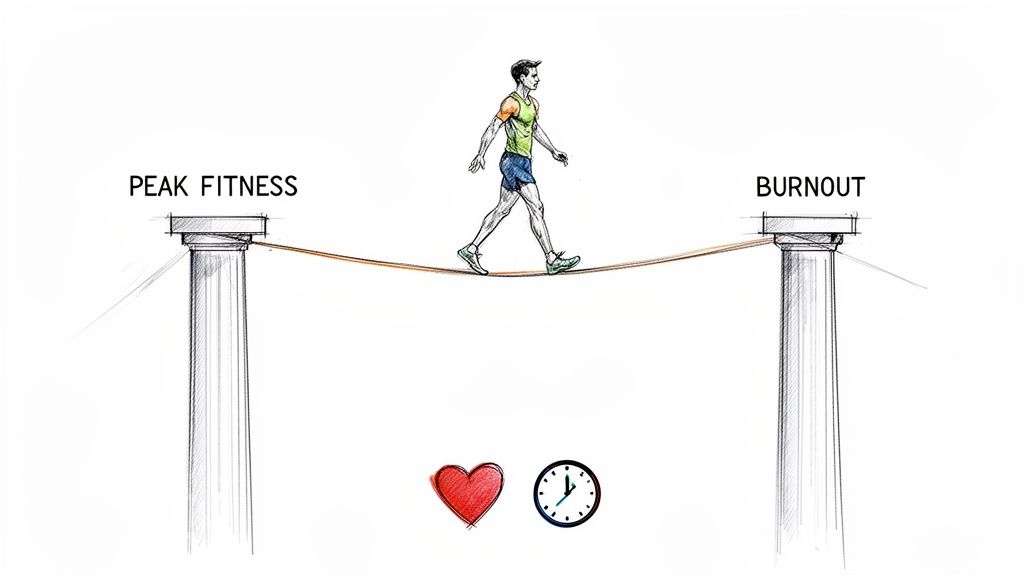
Anyone who's serious about their fitness wants to go harder and see better results. I get it. But there’s a razor-thin edge between productive, challenging training and the kind of fatigue that sends you backward. It’s a hidden threat that doesn't just stalk elite athletes; it can creep up on any dedicated gym-goer who consistently adds that extra set or grinds out one more rep.
The classic advice to "just rest more" is too simple. It misses the point.
True prevention is about reframing the problem. Think of it as a mismatch between your total stress—from your workouts, your job, your life—and your recovery. Once you start seeing it that way, you can build a sustainable, burnout-proof approach to fitness.
The Three Stages of Training Stress
Before you can prevent overtraining, you have to know where you stand on the stress-recovery spectrum. Your body’s response isn't a simple on/off switch; it’s more like a progression through a few distinct stages.
Functional Overreaching: This is the magic zone for growth. You deliberately apply more stress than your body is used to, which causes some temporary fatigue and a short-term dip in performance. But with good rest, you bounce back even stronger. That's the whole point of progressive overload.
Non-Functional Overreaching (NFO): This is the red flag zone. You've been pushing too hard for too long without enough recovery, and now your performance is stuck or even declining. This can last for weeks. You might feel constantly tired, unmotivated, and achy.
Overtraining Syndrome (OTS): This is the real deal—a serious state of burnout marked by a long-term drop in performance, hormonal imbalances, and psychological exhaustion. Full recovery can take months, sometimes even years.
The key is to strategically dip into functional overreaching for short, planned periods and then pull back to recover. The most common mistake I see is people mistaking the warning signs of NFO for just being tired, which pushes them straight toward OTS.
To help you tell the difference, I've put together a quick guide to what each stage actually feels like.
Understanding Your Training Stress Levels
This table is a quick-reference guide to help you distinguish between productive training stress and the early warnings of overtraining.
| Stage | What It Feels Like | Recovery Timeframe | Performance Impact |
|---|---|---|---|
| Functional Overreaching | Tired but accomplished. Muscles are sore but you feel motivated. | A few days to a week | Temporary dip, followed by a noticeable improvement (supercompensation). |
| Non-Functional Overreaching | Persistent fatigue, low motivation, irritability, and nagging aches. | Several weeks | Stagnation or decline in performance that doesn't improve with a few rest days. |
| Overtraining Syndrome | Exhaustion, depression, sleep disturbances, hormonal issues, and a significant, long-lasting performance drop. | Months to years | Severe and prolonged decrease in athletic ability. |
Learning to recognize these signs in your own body is the most critical skill for long-term progress.
Why It Matters More Than You Think
The risk of tipping from productive stress into a damaging state is higher than most people realize. The stats are pretty sobering. Research shows that 7% to 20% of athletes deal with overtraining symptoms in any given season.
But the lifetime impact is what really stands out: around 65% of all athletes will experience overtraining symptoms at some point in their careers. And once it happens, the chance of it happening again skyrockets—an athlete diagnosed with overtraining syndrome faces a 90% chance of a repeat diagnosis. You can dig into the research on overtraining syndrome recurrence if you want to see the data for yourself.
This guide is designed to move you past vague advice and give you a practical, data-driven system. You'll learn exactly how to monitor your body, adjust your programming on the fly, and optimize your recovery so every single session moves you forward.
Let Data Tell You What Your Body Needs
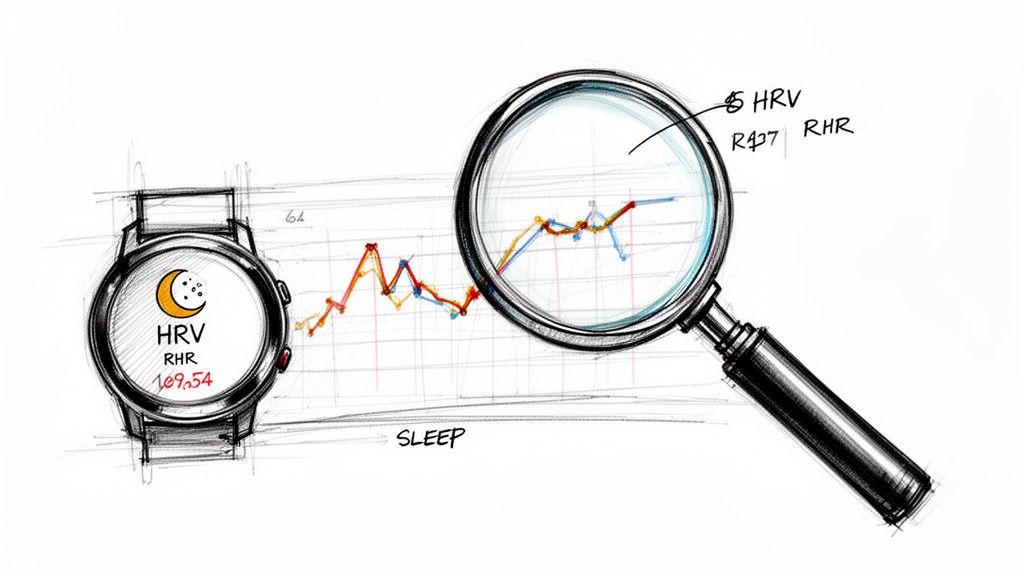
It’s one thing to feel tired after a tough session. That's normal. But it’s another thing entirely to know the difference between productive fatigue and the first whisper of burnout. Honing this skill is what separates sustainable, long-term progress from a frustrating cycle of setbacks.
While going by feel has its place, hard data gives you undeniable evidence to make smarter training decisions. This is where you put on your detective hat. To truly understand what your body is going through, you have to look past feelings and embrace objective measurement in rehabilitation. By tracking just a few key metrics, you get a direct look at how your body is really handling the stress you're throwing at it.
Decode Your Nervous System with HRV
If you're going to track one thing, make it Heart Rate Variability, or HRV. It’s one of the most powerful tools we have for gauging recovery. In simple terms, HRV measures the tiny, millisecond-level variations in time between your heartbeats. A higher HRV is a good sign—it suggests your "rest-and-digest" system is in the driver's seat, meaning you're recovered and ready to take on stress.
On the flip side, a consistently low or downward-trending HRV is a red flag. It shows your "fight-or-flight" response is running the show, a clear indicator that your body is under significant stress and hasn't bounced back from your training. Think of your HRV as a fuel gauge for your nervous system. When the tank is full (high HRV), you’re good to go. When it's low, pushing hard is just asking for a breakdown.
The Old-School Power of Resting Heart Rate
Long before smartwatches, seasoned athletes were using Resting Heart Rate (RHR) to keep tabs on their recovery, and it's still just as effective today. All you have to do is measure your heart rate first thing in the morning, before you even get out of bed, to find your baseline.
A morning RHR that’s 5-10 beats per minute higher than your normal average is a classic sign of accumulated fatigue. It means your body is already working in overdrive just to maintain homeostasis, leaving very little in the tank for a hard workout.
Pro Tip: Don't freak out over one high reading. A single spike could be from a bad night's sleep or a stressful day. You're looking for trends. Three or more days in a row of elevated RHR is a much stronger signal that it's time to back off.
What Your Sleep Data Really Means
Everyone knows you need 7-9 hours of sleep, but the quality of that sleep is just as critical as the quantity. Most wearables now track your sleep stages, giving you a peek behind the curtain at how restorative your rest actually is.
- Deep Sleep: This is prime time for physical repair. Your body releases growth hormone to mend muscle tissue. If your deep sleep is consistently low, your physical recovery is going to suffer.
- REM Sleep: This is all about mental recovery, cementing memories, and locking in new skills. Feeling mentally foggy or unmotivated? A lack of quality REM sleep could easily be the reason.
Tracking this isn't just about collecting numbers; it's about connecting the dots. A good gym workout tracker can bring all this information together, helping you see how your sleep quality impacts your readiness scores and, ultimately, your performance. Seeing the whole picture is what turns data into a real strategy.
By keeping an eye on your HRV, RHR, and sleep quality, you shift from guesswork to an evidence-based approach. These numbers don't lie. They’re your body’s early warning system, giving you the objective feedback you need to sidestep overtraining and make sure every workout moves you forward.
Building a Burnout-Proof Training Program
The best way to deal with overtraining is to never let it get a foothold in the first place. While listening to your body's daily feedback is non-negotiable, the very foundation of your training program is your first and most powerful line of defense. A well-designed program doesn't just chase fatigue—it manages it proactively.
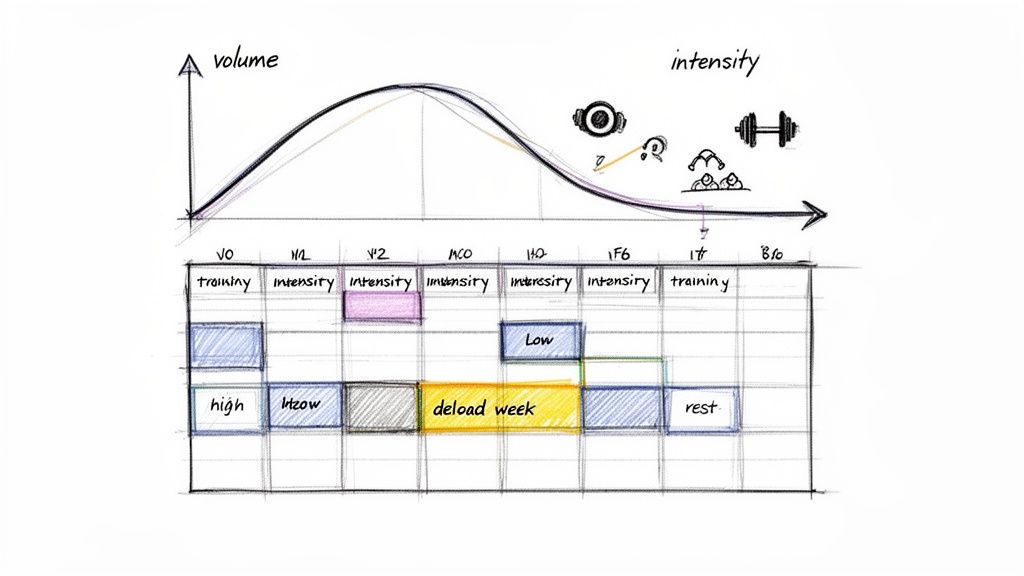
This is all about moving away from a random collection of workouts and embracing a deliberate, periodized plan. It boils down to understanding the three main dials you can turn—volume, intensity, and frequency—and using them to carefully control the stress you place on your body.
Fine-Tuning Your Training Volume
Volume is just a fancy word for the total amount of work you're doing, usually calculated as sets x reps x weight. Progressive overload is the name of the game, which means this number has to go up over time. But the classic rookie mistake is cranking that dial up way too fast. That's a one-way ticket to burnout.
The secret is a slow, steady, and sustainable climb. Most sound training principles recommend increasing your total volume by no more than 5-10% each week. This gradual bump gives your body—your muscles, tendons, and central nervous system—the time it needs to adapt without getting buried.
So, if your total squat volume last week was 5,000 lbs (say, 5 sets of 5 at 200 lbs), this week you'd aim for somewhere between 5,250 and 5,500 lbs. Anything more than that is just asking for trouble. Solid research confirms that careful load management is one of the most effective prevention tools we have.
Managing Intensity and Frequency
Intensity is all about how heavy you're lifting, often talked about as a percentage of your one-rep max (1RM). Frequency, on the other hand, is how often you're hitting a muscle group. These two work hand-in-glove with volume.
You can't max out all three at once. It just doesn't work.
If you’re in a high-volume block, your intensity should probably be dialed back a bit. If you’re pushing seriously heavy weight (high intensity), then your total volume and maybe even frequency should come down to make room for recovery.
- High-Volume Block: Think more sets and reps with lighter weight, somewhere in the 60-75% of 1RM range.
- High-Intensity Block: This is where you focus on fewer, heavier sets with plenty of rest, pushing into the 85-95% of 1RM territory.
Your training frequency is another huge piece of this puzzle. Smashing a muscle group before it’s had a chance to fully recover is a direct cause of overreaching. If you want to get granular on this, we've got a whole guide on finding the right training frequency for hypertrophy.
It's a game of give and take. You can train hard, heavy, or long, but you can't do all three for very long. Your program needs to reflect this reality.
The Power of the Deload Week
A deload is not a week off on the couch. It’s a planned, strategic reduction in training stress that allows your body to catch up, repair, and come back stronger. Think of it as a pit stop during a long race—it’s essential for finishing strong.
Penciling in a deload every 4-6 weeks is a rock-solid practice for long-term gains. You'll still hit the gym, but the entire goal is to back off and let your system fully recover.
How to Run a Smart Deload:
- Slash Your Volume: Cut your total sets in half. Normally do 4 sets? This week, you’re doing 2.
- Lower the Intensity: Drop the weight on the bar by 40-50% of what you were using for your working sets last week.
- Stay Far from Failure: Every set should feel easy. You should finish feeling like you could have cranked out several more reps. The goal here is stimulation, not annihilation.
A properly executed deload helps all that built-up fatigue melt away, lets nagging aches and pains finally heal, and gives you a much-needed mental break. When you come back to your regular training, you’ll often find you can smash right through old plateaus. It's a must-have tool for anyone serious about this for the long haul.
Fueling Your Recovery Beyond the Gym
What you do in the 23 hours outside the gym is just as crucial—if not more so—than the hour you spend lifting. Real progress isn't just forged under the barbell; it's solidified through deep, meaningful recovery. When we talk about sidestepping overtraining, the conversation has to go beyond training volume and deloads. It needs to zero in on the two absolute pillars of recovery: nutrition and sleep.
Thinking you can out-train a poor diet or chronic sleep deprivation is a fast track to burnout. These aren't just nice-to-haves. They are the non-negotiable raw materials your body needs to repair, adapt, and actually get stronger from the stress you put it through in your workouts.
Your Nutritional Blueprint for Repair
Food is fuel, sure, but it's also the collection of building blocks for every single physiological process that drives recovery. Just "eating clean" isn't going to cut it when you're training hard. You need a targeted nutritional game plan that supports the intense demands you're placing on your body.
Pay close attention to these three areas:
- Sufficient Calories: Intense training torches a serious number of calories. If you're running on fumes in a steep deficit, your body simply won't have the energy to repair damaged muscle tissue, which leads straight to chronic under-recovery.
- Strategic Carbohydrates: Carbs have gotten a bad rap, but for anyone training with intensity, they are your best friend. They're the body's preferred energy source and are absolutely essential for replenishing muscle glycogen—the fuel stored directly in your muscles.
- Optimized Protein Intake: Protein provides the amino acids necessary to repair and rebuild muscle fibers broken down during your sessions. A consistent and adequate protein intake is the bedrock of adaptation and strength gains.
This isn't just bro-science; it has real-world consequences. Low muscle glycogen levels, for example, have been directly linked as a cause of overtraining in athletes. This makes getting enough carbs and overall calories a critical part of any prevention plan.
The Unspoken Hero of Recovery: Sleep
Look, you can have a perfect training program and a dialed-in diet, but if your sleep is garbage, you will eventually hit a wall. Period. Sleep is when the real magic of recovery happens. During deep sleep, your body releases growth hormone, dials down inflammation, and gets to work repairing tissues. It’s the ultimate reset button for both your body and your mind.
Aiming for 7-9 hours of quality sleep per night isn't a friendly suggestion; it's a hard requirement for anyone serious about their performance and longevity in the gym. Sleep deprivation is a major, yet often ignored, driver of overtraining. It creates a nasty feedback loop: not enough sleep accelerates burnout, and that burnout then tanks your sleep quality.
Actionable Tip: Don't just track the hours you're in bed. Pay attention to how you feel when you wake up. If you consistently feel groggy and unrefreshed, that’s a clear sign you need to improve your sleep hygiene, even if the clock says you hit your 8-hour target.
Improving your sleep doesn't have to be some monumental task. Small, consistent habits make all the difference.
- Get to bed and wake up around the same time, even on weekends.
- Make your bedroom a cave: dark, cool, and quiet.
- Put away the phone, tablet, or TV at least an hour before bed.
- Cut off the caffeine and avoid huge meals late in the evening.
These simple practices help regulate your circadian rhythm, making it easier to fall asleep and stay asleep. This directly powers up your body's ability to recover from training stress.
Pairing quality sleep with other restorative practices can be a game-changer. Consider incorporating things like sauna sessions to really boost your recovery. There are some significant benefits of sauna after a workout that can help with muscle repair and relaxation. Ultimately, what you do on your off days—including whether you should do any cardio on rest days—plays a massive role in your big-picture recovery strategy.
Your Action Plan for Smarter Training
Knowing the theory behind overtraining is one thing, but making the right call in the heat of the moment is where progress is truly made. This is your playbook for turning those metrics, feelings, and data points into smart, decisive action. It’s all about building the confidence to know when to push, when to pull back, and when to pivot.
Let's get practical. How you react to your body’s feedback day-to-day is what separates stalled progress from long-term gains.
On-the-Fly Training Adjustments
Picture this: you walk into the gym for a heavy squat session. You tossed and turned all night, your morning HRV was in the tank, and honestly, you’d rather be anywhere else. The program calls for five heavy sets of five, but your body is screaming a different story. This is exactly where blindly "sticking to the plan" goes wrong.
Instead of grinding through a session that could set you back, you have a few smarter options:
- Dial back the intensity. You can still get the work in. Keep the same sets and reps, but drop the weight on the bar by 10-20%. This lets you groove the movement pattern and accumulate volume without piling stress onto an already fried system.
- Cut the volume. Maybe the weight feels manageable, but you just don't have the gas for a long session. Stick with your planned heavy weight, but slice the sets. Do two or three high-quality sets and call it a day.
- Swap the exercise. If heavy back squats feel like they’re going to snap you in half, don’t force it. Sub in a less neurologically taxing variation like goblet squats, a leg press, or lunges. You’re still hitting the target muscles, just with far less systemic fatigue.
The real skill here is flexibility. One workout is just a single dot on the map of your entire training journey. Making a smart audible today ensures you can come back stronger tomorrow, which is always a better trade-off than risking burnout for the sake of one session.
This simple decision tree gets to the heart of that first crucial choice: are you drained, or are you just in need of fuel?
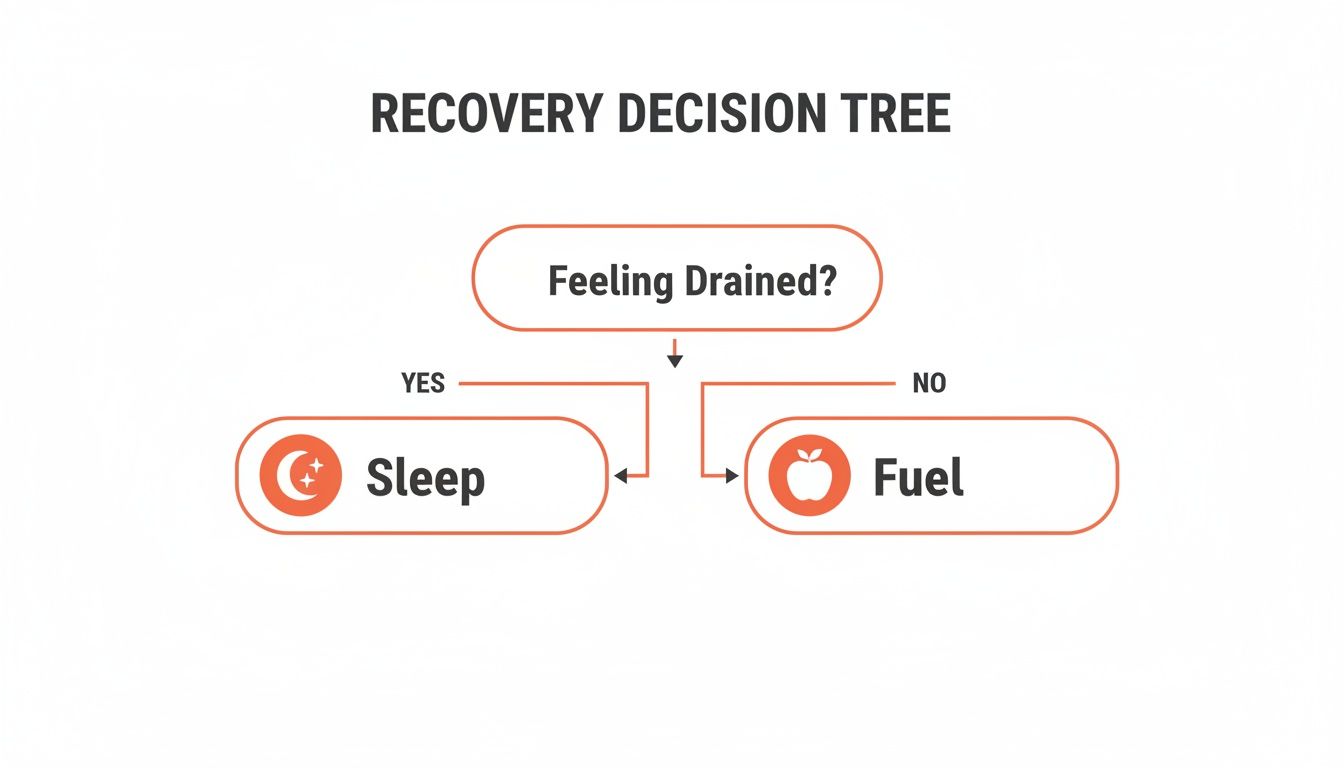
Before you even think about adding training stress, this visual reminds you to check in on the absolute fundamentals—sleep and nutrition. Get those right first.
When to Call an Emergency Deload
Sometimes, one bad day turns into a string of them. That’s your cue to spot a negative trend and intervene before you dig yourself into a recovery hole you can't escape. A planned deload is smart. An unplanned deload can be a career-saver.
Don’t look at an impromptu deload as a failure. It’s a strategic retreat. It's an advanced, proactive move that proves you're listening to your body and prioritizing long-term progress over short-term ego.
Here are the undeniable signals that it’s time to hit the brakes, no matter what your program says:
- Performance is cratering. Has your strength on key lifts taken a nosedive for two or more sessions in a row? That's a huge red flag.
- Recovery metrics are in a freefall. If your HRV is trending down while your resting heart rate is creeping up for three or more consecutive days, your nervous system is waving a white flag.
- Aches and pains won't quit. That nagging joint pain or muscle soreness that just hangs around is your body telling you that damage is outpacing repair.
- Motivation has vanished. When the thought of training feels like a heavy chore for several days, your mind and body are telling you they need a real break.
If you’re nodding along to two or more of these, it's time to pull the plug. Start a deload week immediately. As we covered before, that means slashing your volume in half and reducing intensity by 40-50%.
Your Overtraining Prevention Decision Matrix
To make this dead simple, I've put together a matrix to guide your daily decisions. Think of it as a cheat sheet connecting specific warning signs to immediate, concrete actions.
| Warning Sign or Metric | What to Do Today | How to Adjust Your Week |
|---|---|---|
| One bad night of sleep, low motivation | Reduce intensity by 10-20% or shorten the workout. | Prioritize an earlier bedtime tonight. |
| HRV drops for 2 days, RHR is slightly elevated | Switch to an active recovery session (e.g., light cardio, mobility). | Ensure nutrition and hydration are perfect. Monitor metrics closely. |
| Strength is down, joints are achy | Take a complete rest day. Focus on nutrition and light stretching. | Evaluate if it's time for a deload week. |
| 3+ days of poor metrics, no motivation | Start an immediate deload week. Do not pass go. | Re-evaluate your entire program's volume and intensity for the next block. |
This framework removes the guesswork, giving you a clear path forward based on how you actually feel and perform.
Platforms like Built Workout can automate a lot of this for you. The app’s recovery heatmaps give you a visual on which muscles are fatigued, helping you make smarter exercise swaps on the fly. Better yet, when the AI coach detects your recovery is dipping, it can proactively suggest these kinds of modifications in real-time. This is how you turn hard work into smart work.
Your Overtraining Questions, Answered
Pushing your limits is part of the game, but how do you know when you're crossing the line from productive effort into burnout territory? It’s a fine balance, and a lot of common questions pop up along the way. Let's get into the nitty-gritty of what you need to know to train hard and smart.
Tired or Overtrained?
"How do I know if I'm just tired from a tough workout or actually starting to overtrain?"
This is probably the single most important question an athlete can ask. Learning this distinction is a skill. The good news is, there are clear differences once you know what to look for.
The normal fatigue you feel after a great session—what we often call DOMS (Delayed Onset Muscle Soreness)—is localized. Your legs feel like jelly after squat day, or your back is tender after heavy deadlifts. This feeling usually fades within 48-72 hours, and it doesn't really touch your overall energy or desire to train again.
Overtraining, or its early warning stage known as non-functional overreaching, feels entirely different. It’s a deep, system-wide exhaustion that goes far beyond sore muscles.
Think of it as the difference between a tired body and a depleted system. You might be hitting overtraining territory if you notice:
- Your performance in the gym has hit a wall or is actively getting worse for over a week.
- You feel drained all the time, and a full night's sleep doesn't seem to make a dent.
- Your resting heart rate is higher than normal when you wake up.
- You're losing interest in training or other things you usually love.
- You find yourself more irritable, moody, or anxious for no apparent reason.
Deload vs. Time Off
"What's the difference between a deload week and just taking a full week off?"
Great question—they are not the same thing and each has its place. Taking a full week off means zero training. It can be a fantastic mental break and is sometimes necessary, but it can also lead to a slight step back in performance when you return.
A deload week, on the other hand, is a planned, strategic reduction in training stress. You're still in the gym, still moving, but you dial everything back. The goal is to drop your total volume (sets/reps) and intensity (the weight on the bar) by about 40-60%.
This concept of "active recovery" is incredibly effective. It gives your muscles, joints, and central nervous system the breathing room they need to fully repair and adapt. You maintain your momentum and habits, often coming back the next week feeling stronger and more explosive than before.
Can I Prevent Overtraining Without Tech?
"Do I really need a fancy app or wearable to avoid overtraining?"
Absolutely not. For decades, athletes have managed their recovery using one of the most powerful tools available: a simple training journal. It's a low-tech but highly effective way to connect the dots between your training and how you feel.
All you have to do is log your workouts—every set, rep, and weight—and then jot down a few notes each day about how you're feeling.
- Sleep: How did you sleep? Did you wake up feeling refreshed or still tired?
- Mood: Were you excited to train or was it a total drag?
- Energy: How were your energy levels throughout the day?
- Heart Rate: A classic bio-marker. Just take your pulse for 60 seconds every morning before you get out of bed and log the number.
The real advantage of modern tools is that they automate this process and provide an objective layer of analysis. An app can spot a negative trend in your heart rate variability that you might otherwise brush off as "just an off day." It takes the emotion out of the equation and gives you hard data to back up what your body is trying to tell you.
Ready to stop guessing and start knowing exactly when to push and when to pull back? Built Workout combines precise tracking with AI coaching to give you a clear picture of your recovery. Its muscle heatmaps show you what's fatigued and what's ready to go, so you can train smarter, not just harder. Download the app and build a truly burnout-proof program today at https://www.builtworkout.com.