A gym workout tracker is so much more than a digital notepad. It's a tool that takes the raw data from your exercises, sets, reps, and weights and turns it into real, actionable feedback that can seriously speed up your progress. Think of it less like a simple notebook and more like a personal data scientist, analyzing your performance to help you smash through plateaus and train smarter.
What Is a Gym Workout Tracker
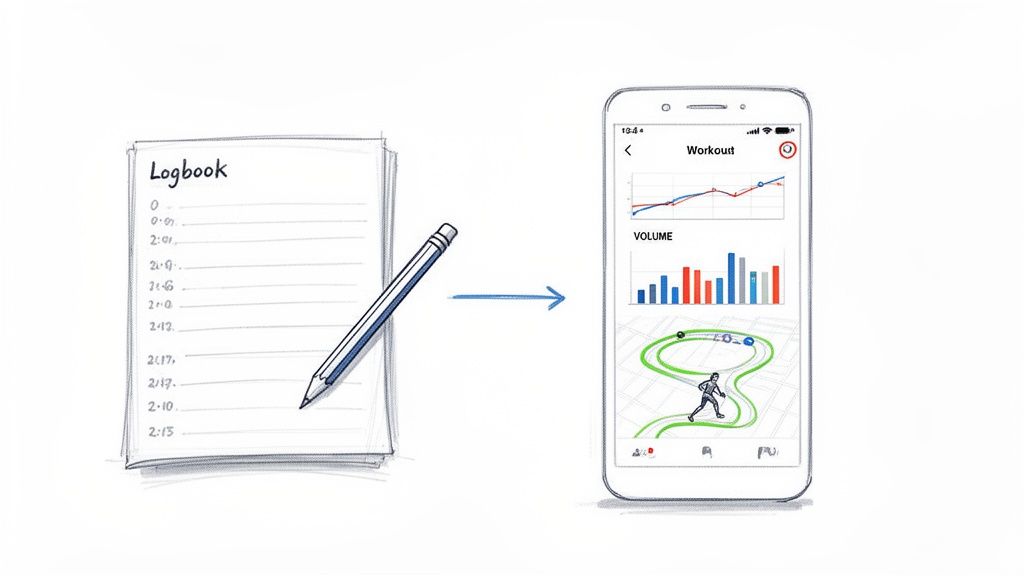
Let's get past the idea of a workout tracker as just a replacement for your pen and paper. A modern gym tracker is a dedicated training partner, one that logs every last detail of your sessions to show you patterns you’d never spot on your own.
A traditional logbook is like a paper map. It shows you where you’ve been, sure, but it doesn't offer much guidance on the best way to get where you're going. It’s just a static record of what you’ve done.
An advanced tracker, on the other hand, is like a GPS with live traffic updates. It doesn’t just log your journey; it helps you steer around common training roadblocks like overtraining, muscle imbalances, and those frustrating strength plateaus we all hit.
Moving from Logging to Learning
At its heart, any tracker's job is to log data. But where the real magic happens is in what it does with that information. Instead of just giving you a list of sets you've completed, it crunches the numbers to calculate key metrics like your total training volume, one-rep max estimates, and progress over time. This simple shift moves your mindset from just "getting a workout in" to strategic, intentional training.
This data-driven approach isn't just for elite athletes anymore. The global fitness apps market, which includes powerful tools like the Built Workout app, has exploded. The market was valued at USD 6,097.7 million, jumped to an estimated USD 6,860 million the next year, and is projected to hit a massive USD 22,276.6 million by 2035. This points to a huge shift toward intelligent, data-informed training for everyday people. You can dig into these fitness app market trends for more insights.
Uncovering Hidden Patterns in Your Performance
A great gym workout tracker helps you connect the dots between your effort in the gym and the results you see. It finally gives you answers to the questions that even seasoned lifters ask themselves:
- Why has my bench press stalled? The tracker might show you that your triceps volume has been accidentally dropping for the past six weeks.
- Am I recovering enough between leg days? By visualizing fatigue, it can flag if you’re hitting your quads before they’re fully recovered, which could be sabotaging your gains.
- Is my training volume actually going up? It automatically calculates your weekly volume, giving you objective proof that you're applying progressive overload.
By translating raw numbers into clear, visual feedback, a workout tracker makes elite-level, data-driven training principles accessible to anyone who is serious about their fitness goals.
Ultimately, this tool lets you stop guessing and start knowing. It provides the hard data you need to make smarter decisions, ensuring every single session is a deliberate step toward your goals.
The Real Benefits of Data-Driven Workouts
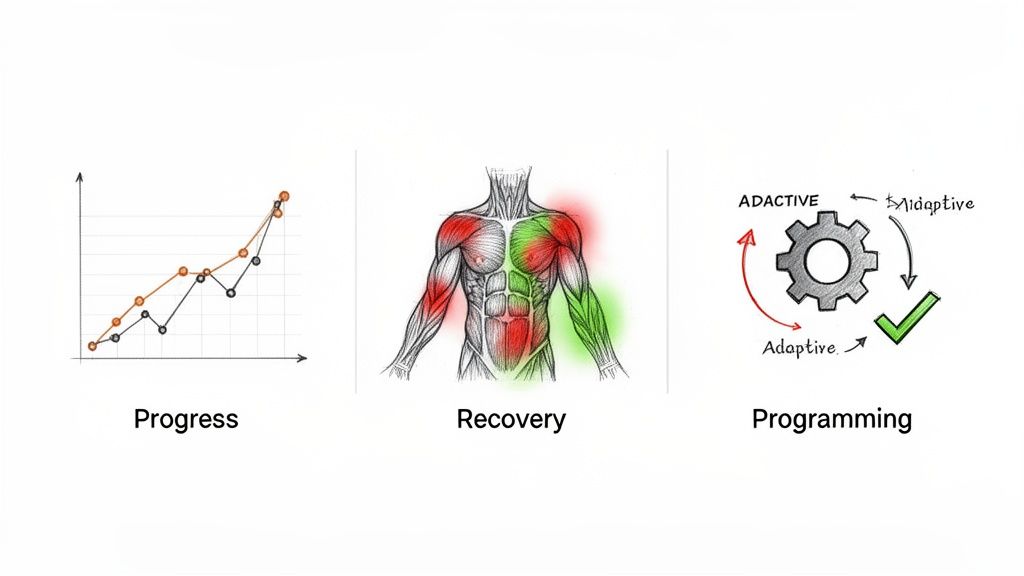
Let's move past just logging sets and reps. The real magic of a good gym workout tracker is how it turns all those numbers into a serious competitive edge. This is the moment your training evolves from pure guesswork into a smart, data-backed strategy. It all comes down to three game-changing pillars: seeing your progress, managing recovery, and building smarter workout programs.
Think about it this way: training without data is like trying to build a house without a blueprint. You might stack some bricks and hope it turns into something solid, but you're leaving a lot to chance. A tracker is your blueprint. It makes sure every single lift, every set, and every rep contributes directly to a stronger, more resilient you.
It gives you a brutally honest look at your hard work, stripping away the emotion and subjectivity that can cloud your judgment. You’ll know exactly what’s working and what’s not, transforming every gym session into a source of valuable feedback.
Turn Progress into Powerful Motivation
One of the first things you'll notice is how clearly you can see your progress over time. A tracker automatically charts everything—your strength gains, total volume, and even your one-rep max estimates. Suddenly, you have undeniable proof that you're getting better. This isn't just about feeding your ego; it's about building motivation that lasts.
Seeing a line graph of your deadlift steadily climbing for three months is infinitely more powerful than trying to remember what you lifted last month. This objective feedback is crucial for staying consistent, especially on those days when the couch is calling your name. It's no surprise that research shows tracking is a key habit for people who stick with fitness for the long haul.
This visual proof creates a powerful feedback loop:
- Objective Feedback: You can see with your own eyes that your training volume is increasing, confirming you're actually applying progressive overload.
- Motivational Fuel: When you smash a personal record, the tracker saves it. You’re building a library of wins to look back on when you need a boost.
- Informed Adjustments: If your bench press stalls, the charts make it obvious. This prompts you to rethink your approach instead of just trying to force it.
Master Your Recovery to Prevent Overtraining
This might be the single biggest advantage of an advanced tracker: truly understanding and managing your recovery. Overtraining is the silent killer of progress. It sneaks up on you, and you often don't notice it until you're burned out, plateaued, or worse, injured. A smart gym workout tracker acts as your personal early-warning system.
Tools like muscle recovery heatmaps are a complete game-changer here. As you log exercises, the app intelligently maps the stress to specific muscles, creating a simple color-coded diagram of your body. If a muscle is "red," it's screaming for a break. If it's "green," it's fresh and ready to go.
This isn't just cool data; it's your road map for the next workout. If your chest and triceps are glowing red after a monster push day, you know it's time to train legs or back. This data-driven approach allows you to train harder and more often without flying too close to the sun.
Unlock Intelligent and Adaptive Programming
Finally, all this data unlocks a smarter, more flexible way to train. Let's be honest, traditional workout plans are rigid. They don't care if you had a terrible night's sleep, a stressful day at work, or if you feel like you could lift a car. A gym workout tracker allows your program to adapt to you in real-time.
Imagine your plan calls for a heavy squat session, but your tracker shows your quads are still fried from your last workout. A smart system, like the one inside the Built Workout app, might suggest lowering the intensity or swapping in an exercise that won't push you over the edge. It helps you have a productive session instead of a destructive one.
This concept, known as autoregulation, was once a luxury reserved for elite athletes with a team of coaches. Now, that power is in your hands. You're no longer a slave to a spreadsheet; you're an informed athlete making smart decisions based on how your body actually feels. That, right there, is the secret to long-term, sustainable results.
Key Features of a Modern Gym Workout Tracker
Not all workout trackers are built the same. A basic app might let you jot down your sets and reps, but a truly modern gym workout tracker is more like an intelligent training partner. It goes way beyond simple data entry to give you insights that actively shape your training, helping you make smarter moves in the gym and out.
Think of it like this: a simple logbook is a basic calculator, while a smart tracker is a full-blown financial modeling spreadsheet. Both handle numbers, but only one gives you the deep analysis you need to make real, strategic decisions. A great tracker doesn’t just record what you did; it helps you understand why it worked and what to do next.
Let's break down the must-have features that separate a simple digital notebook from a powerful, AI-driven training system.
Seamless Exercise and Intensity Logging
First things first, the foundation of any good tracker is making it dead simple to log your work. If entering your workout feels like a chore, you're just not going to stick with it. A modern app needs a massive exercise library with clear instructions, letting you quickly plug in your sets, reps, and weight. But it also has to capture how hard you actually worked.
This is where metrics like RPE (Rate of Perceived Exertion) or RIR (Reps in Reserve) come in. Logging that a set of squats felt like a 9/10 effort (or that you only had one rep left in the tank) adds crucial context that the weight on the bar just can't provide. This is the data that fuels all the smart analytics later on, giving the app a true picture of the stress you put your body through.
Advanced Muscle and Recovery Analytics
Now we're getting to the good stuff. This is where a top-tier gym workout tracker really sets itself apart. Instead of just saying you had a "leg day," it maps every single exercise to the specific muscles you hit. After a tough session of squats, lunges, and leg presses, it doesn't just see a workout; it sees the total stress piled onto your quads, glutes, and hamstrings.
A truly effective tracker visualizes this data, often with a color-coded muscle heatmap. This lets you see, at a glance, which muscles are fresh and ready to go (green) versus those that are still beat up and recovering (yellow or red). This feature alone is a game-changer for avoiding overtraining and building a smarter training split that keeps you progressing.
AI-Driven Coaching and Adjustments
The most advanced trackers use artificial intelligence to basically act as a coach in your pocket. Using all the data you've logged and your current recovery status, the AI can give you real-time suggestions to get the most out of your workout.
- Smart Suggestions: Is your chest still wrecked from your last session? The AI might suggest pulling back on the volume for your bench press today.
- Progressive Overload Guidance: It can spot trends in your performance and nudge you when it's time to add more weight or reps, making sure you're always pushing forward.
- Technique Cues: Some apps even offer form tips and reminders for the exercises you're doing, helping you keep your technique on point.
This isn't about replacing your gut feeling; it's about backing it up with hard data. The blend of AI and recovery tracking is making a huge impact on the $90+ billion global fitness center market. These digital tools give gym-goers precise stats on muscle readiness, and it turns out that users who log every set see 40% higher consistency, especially with features like real-time rest timers. You can dive deeper into these 2025 global fitness trends to see where the industry is headed.
Social Integration and Privacy Controls
Let's be real, a little bit of community goes a long way for motivation. The best trackers build in a social feed that's more than just gym selfies. Think of it like Strava, but for lifting. You can actually see your friends' workouts—the exact exercises, sets, reps, and weight they're hitting. It’s a fantastic source of inspiration and a concrete way to learn from what others are doing.
Of course, whenever you add a social element, privacy has to be a top priority. A great app gives you total control over what you share. You should be able to make certain workouts private, share only with a small group of friends, or post publicly if you want to. This balance lets you tap into the community for a boost while keeping your training data as secure as you want it to be. To get a better feel for how these features fit into the bigger picture, it’s worth checking out guides on choosing the best online personal training platforms, as they often lead the charge with these kinds of innovations.
Gym Workout Tracker Features Comparison
To really see the difference, let's put a basic digital logbook head-to-head with an advanced AI tracker like Built. The gap is pretty clear.
| Feature | Basic Logbook | Advanced AI Tracker (Built) |
|---|---|---|
| Exercise Logging | Manual entry, limited exercise library. | Quick-add from a vast library, video demos, tracks sets/reps/weight. |
| Intensity Tracking | None, or basic notes field. | Integrated RPE/RIR logging to measure true effort. |
| Muscle Mapping | None. Tracks "leg day" or "chest day." | Maps every exercise to primary and secondary muscles. |
| Recovery Analytics | Doesn't exist. | Visualizes muscle-level recovery with a color-coded heatmap (green, yellow, red). |
| AI Coaching | Nope. It's just a digital notebook. | Provides AI-driven suggestions to adjust volume, intensity, and exercise selection in real-time. |
| Social & Community | Limited or non-existent. | Integrated social feed to share workouts with friends, plus robust privacy controls. |
| Progress Tracking | Shows basic lift history. | Advanced charts and analytics for PRs, volume, and performance trends over time. |
The right mix of these features can turn a simple logging tool into one of the most valuable assets in your fitness journey. And if you're also looking to structure your training, we have a helpful guide on the best gym workout planner app for you.
How to Use Your Tracker for Maximum Impact
Owning a great gym workout tracker is the easy part. The real magic happens when you learn to weave it into your daily training, transforming it from a simple digital logbook into a co-pilot for your fitness journey. It’s all about moving from just collecting data to actually using that data to make smarter decisions in and out of the gym.
This simple workflow—Log, Analyze, Progress—is the secret sauce. It’s a powerful feedback loop that fuels continuous improvement.
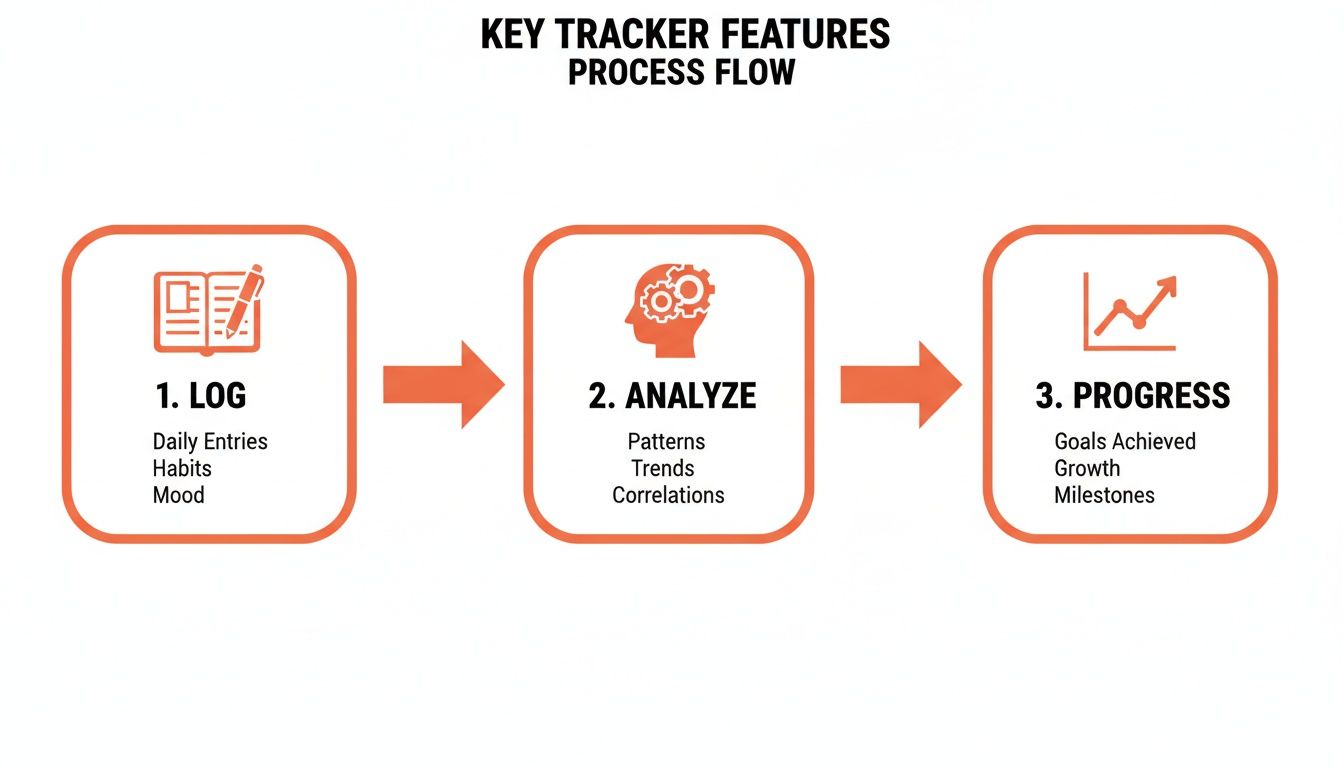
This cycle makes sure every rep you log contributes to a smarter plan for your next session.
Setting Up for Success
First things first, you need to give your tracker some good info to work with. Think of it like calibrating a high-tech instrument; the more accurate your starting data, the more precise its guidance will be down the line.
Start by plugging in your basic stats—age, weight, height—and most importantly, what you’re trying to achieve. Are you aiming to build muscle, chase new PRs, or just get into better overall shape? Nailing this down helps the app tailor its feedback to what actually matters to you.
And be honest about your current fitness level. Seriously, leave your ego at the door. An accurate starting point ensures the app’s recommendations are challenging enough to drive progress but realistic enough to keep you from burning out.
Mastering Your In-Session Workflow
Once you're in the gym, the goal is to log your work quickly and accurately without it becoming a distraction. A good tracker makes this feel effortless, almost like a reflex. The key isn't just tracking what you did, but also how hard it felt.
Here’s a simple flow that works for any exercise:
- Pick Your Exercise: Pull it up in the app’s library in seconds.
- Do Your Set: Give it your full focus—form over everything.
- Log It Immediately: While you’re catching your breath, punch in the reps and weight.
- Rate the Effort: This is a big one. Use the RPE (Rate of Perceived Exertion) or RIR (Reps in Reserve) scale to record the set's difficulty. This bit of context is what separates decent data from great data, especially for recovery tracking.
This whole process should take just a few seconds, keeping your data clean and your workout flowing. And if you're using a wearable, remember that even small details like your Garmin watch strap can make a difference, impacting both comfort and the accuracy of the data you're collecting.
Interpreting Your Recovery Heatmap
The real analysis starts after your workout is done. For many, the muscle recovery heatmap is the most powerful tool in a modern gym workout tracker. It takes all your complex training data—your volume, your intensity, your RPE—and boils it down into a simple, color-coded visual of your body.
Think of the heatmap as your body's personal dashboard. It takes the guesswork completely out of the equation, telling you exactly what's ready to work and what needs a break.
Here’s a quick guide to reading the colors:
- Green: That muscle is fresh, recovered, and good to go. You can hit it hard without worrying about lingering fatigue.
- Yellow: It's partially recovered. You can still train it, but maybe dial back the volume or intensity a bit for that session.
- Red: This muscle is cooked and needs more time to repair. Hitting it again would likely do more harm than good and could even increase your risk of injury.
So, if you wake up and see your chest and triceps are glowing red after a monster push day, that’s your cue to train legs or back instead. This data-driven approach is how you can train frequently and with high intensity without running yourself into the ground. It can even help you decide if some light cardio on rest days would be beneficial active recovery or just added stress.
Real-World Scenarios for Athletes and Trainers
All the theory in the world doesn't mean much until you see how it works in the gym. So, let’s move past the feature lists and dive into two real-world stories. These scenarios show how a smart gym workout tracker helps solve frustrating, everyday problems for both dedicated athletes and busy trainers.
We’ll look at a lifter who’s completely stalled out and a coach trying to manage a full client load. Their stories perfectly illustrate the jump from just logging workouts to using intelligent data to unlock new levels of performance.
Alex the Athlete Breaks a Plateau
First, meet Alex. Alex is a serious strength athlete who has been stuck trying to hit a new deadlift PR for months. They’ve tried everything—more volume, less volume, different accessory lifts—but the bar just isn't moving. Their logbook shows consistent effort, but it offers zero clues as to why they're stuck.
Frustrated, Alex starts using an advanced tracker with muscle recovery heatmaps.
Within two weeks of logging workouts and rating the intensity of each set (RPE), a pattern jumps out. On paper, Alex’s training split looks solid. But the heatmap tells a different story: their lower back and hamstrings, the entire posterior chain, are constantly under-recovered. The muscles are still lit up in yellow or red right before their next heavy deadlift day.
It hits Alex all at once—the problem isn’t a lack of effort, it’s a lack of recovery. The accessory work on other days was creating just enough fatigue that their key deadlift muscles never got back to a fresh, "green" state.
With this insight, Alex makes one simple change. They rearrange their split to give their posterior chain an extra 48 hours to recover before their big pulling sessions. Just two weeks later, feeling stronger and more refreshed than they have in months, Alex walks up to the bar and pulls a new personal record. The plateau is history.
Maria the Trainer Delivers Elite Results
Now, let's look at Maria, a personal trainer with 15 different clients. Juggling everyone's progress, fatigue levels, and weekly check-ins used to be a nightmare of spreadsheets and text messages. She constantly worried that she wouldn't spot the signs of overtraining until a client was already burned out.
Maria switches her business over to a gym workout tracker with a dedicated coaching dashboard. Suddenly, she has a live command center for every single client. She sees more than just completed workouts; she sees how hard each set felt and which muscles are most fatigued.
One morning, she logs in and sees a client's muscle heatmap is glowing red. They mentioned having a stressful week with bad sleep, and the data confirms their recovery tanked. Instead of having them grind through a scheduled high-intensity session, Maria adjusts their plan on the fly to a lighter, recovery-focused workout.
This kind of proactive coaching is a game-changer. For trainers who focus on recovery, a good gym workout tracker is indispensable. In fact, some data suggests that lifters who consistently log and adjust their volume based on fatigue can see strength gains of 15-20% over six months. For trainers like Maria, the analytics make it easy to spot overtraining before it ever becomes a problem, a key element highlighted in some 2025 global fitness trends on corehandf.com.
By using data, Maria can now offer a level of personalization that was impossible before. Her clients get better results, stay healthier, and feel more supported. She can even use the data to perfectly dial in how often a client should train a muscle group, a concept we explore in our guide on training frequency for hypertrophy.
Got Questions About Gym Workout Trackers?
Diving into a more data-driven approach to your training is smart, but it's bound to bring up a few questions. It’s totally normal to wonder if a gym workout tracker is just another gadget to complicate things or if it can actually move the needle on your results. Let's clear the air and tackle some of the most common questions head-on.
A lot of people ask if an app can really understand their body better than their own intuition. It’s a great point—you live in your body, after all. But the goal of a great tracker isn't to replace your instincts. It's to arm them with objective data, giving you a powerful one-two punch of gut feeling and hard evidence to guide every decision you make in the gym.
Is a Gym Workout Tracker Really Better Than a Notebook?
Look, the classic pen-and-paper logbook has been a loyal companion to lifters for decades, and for good reason. But a modern gym workout tracker brings a level of insight to the table that a notebook just can't compete with. Think of a notebook as a static record; it holds your data, but it can't do anything with it. You're left to manually crunch the numbers for training volume, guess at your one-rep maxes, and squint at the pages to spot progress.
A smart tracker, on the other hand, does all that heavy lifting for you—and then some. It instantly charts your progress, making it easy to see strength gains or pinpoint where you’re stalling. But where it really levels up is in its ability to map your effort directly to your muscles, calculate their recovery status, and then give you real-time advice based on that data.
It comes down to this: A notebook tells you what you’ve done. A smart tracker tells you what you’ve done, what it actually means for your body, and what you should do next to keep moving forward without burning out.
This frees up your brainpower so you can focus on what really matters during your workout: executing each rep with perfect form and intensity.
How Exactly Does a Tracker Improve Muscle Recovery?
This is where a truly sophisticated tracker separates itself from the pack. Instead of just going by how sore you feel, it quantifies the actual stress you put on your body, session by session. It’s the difference between saying, "My legs feel smoked," and knowing your quads are at 40% recovery while your hamstrings are already back at 85%.
Here's a look under the hood:
- It Logs Everything: The app diligently records every exercise, set, rep, and weight, plus your perceived intensity (like RPE).
- It Maps the Stress: It then intelligently assigns that workload to the specific muscles—both primary and secondary movers—involved in each lift. A bench press hits your pecs, front delts, and triceps, and the app logs that impact for each one.
- It Visualizes Fatigue: All that data gets crunched into a simple recovery score for every muscle group, often shown as a color-coded heatmap of your body.
This visual feedback is a game-changer. You can see at a glance which muscles are green and good to go, which are yellow and need a bit more time, and which are red and need a rest day. It’s the key to training hard while sidestepping injury and overtraining.
Will I Lose My Training Intuition by Relying on an App?
This is a huge concern for experienced lifters, but the reality is actually the opposite. A well-designed AI coach doesn't replace your intuition; it sharpens it. It acts as an educator, showing you the "why" behind every suggestion so you become a smarter, more self-sufficient athlete. It’s not about blindly following orders; it's about learning the principles of smart fatigue management firsthand.
For instance, if the AI suggests backing off the weight on your squats, it won’t just bark an order at you. It will show you that the recommendation is based on your quads and glutes still being in the yellow from your last leg day. It connects the dots for you: here’s the data, and here’s the logical action to take because of it.
When you see this cause-and-effect relationship play out over and over again, you start to internalize the concepts. You develop a much sharper feel for how different workouts affect your recovery and how to adjust on the fly. Over time, you’re building your own expert intuition on a rock-solid foundation of data, making you a far more capable lifter in the long run.
Ready to stop guessing and start seeing real, data-driven results? The Built Workout app combines all these powerful features—muscle recovery heatmaps, AI-driven coaching, and a social feed for inspiration—to help you train smarter than ever before.
Download Built for free and unlock your true potential: https://www.builtworkout.com