Yes, you absolutely can—and often should—do cardio on your rest days. The secret, however, is to think of it as active recovery, not just another workout. It's less like another training session and more like a gentle tune-up for your body's recovery engine.
Why Your Rest Days Need a Rethink
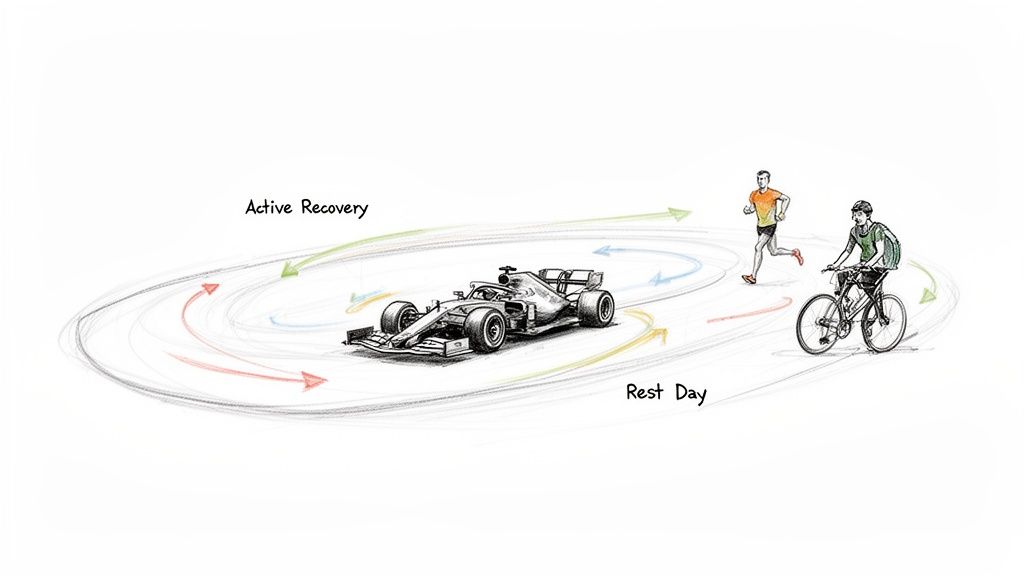
The phrase "rest day" usually brings one image to mind: sinking into the couch for a day of total inactivity. While there's a time and place for that kind of passive recovery, treating every day off as a complete standstill is a missed opportunity. It creates a rigid, all-or-nothing mindset where you're either going at 100% effort or doing nothing at all.
This black-and-white approach overlooks a much more effective strategy: active recovery. Instead of just hitting the brakes, you're giving your body the tools it needs to repair itself more efficiently.
Embracing Active Recovery
This is where low-intensity cardio on rest days comes into play. Think of your sore, tired muscles as a busy construction site at the end of a long shift. You've got metabolic waste products that need clearing out, and fresh materials—nutrients and oxygen—that need to be delivered for the rebuilding process to start.
A complete rest day is like shutting down the construction site entirely. An active recovery day, on the other hand, is like bringing in a small cleanup crew. They quietly clear away the debris and organize the new materials so the real work can get started faster the next day.
That "cleanup crew" is your circulatory system, and light cardio is what puts it to work. By gently getting your heart rate up, you boost blood flow, which does two critical things for recovery:
- Better Nutrient Delivery: More blood flow means more oxygen and essential nutrients are ferried to your damaged muscle tissues, giving them the raw materials they need to repair and grow stronger.
- Faster Waste Removal: It also helps flush out metabolic byproducts, like lactate and hydrogen ions, that build up during tough workouts and contribute to that all-too-familiar muscle soreness.
The True Goal of Rest Day Cardio
It's crucial to remember that the goal here isn't to burn a ton of calories, chase a new personal best, or push through fatigue. Trying to do that would just pile more stress on a body that's already trying to heal, completely defeating the purpose.
The one and only goal is restoration. You're simply trying to ease stiffness, reduce the sting of delayed onset muscle soreness (DOMS), and get your body and mind ready for the next hard training session. It’s not about adding another workout to your week; it’s about making your recovery an active, productive part of your training plan.
To make sure you're helping, not hurting, your recovery, here's a quick guide to keep in mind.
Rest Day Cardio Quick Guide: Do's and Don'ts
| Guideline | The Smart Approach (Do) | The Common Mistake (Don't) |
|---|---|---|
| Intensity | Keep it low and conversational. Aim for 50-60% of your max heart rate. You should be able to easily hold a conversation. | Pushing into moderate or high-intensity zones that create more fatigue and muscle damage. |
| Duration | Stick to a short 20-30 minute session. The goal is to stimulate, not annihilate. | Going for an hour or more, turning your recovery session into another draining endurance workout. |
| Type | Choose low-impact activities like walking, light cycling, swimming, or using an elliptical. | Picking high-impact or technically demanding exercises that stress your joints and central nervous system. |
| Mindset | Focus on how you feel. It should feel restorative and energizing, not like a chore. | "No pain, no gain." Pushing through soreness or fatigue, which only digs a deeper recovery hole. |
By following these simple rules, you can transform your day off from a passive pause into a powerful tool for progress.
The Science Behind Active Recovery
To really get why doing cardio on rest days is such a game-changer, we need to peek under the hood and see what’s actually happening inside your body after a tough workout. Active recovery isn’t just about "feeling better"—it’s a smart strategy to work with your body’s natural repair cycle, not against it.
Imagine your muscles after a heavy lifting session are like a construction site after a long day of work. There's debris scattered everywhere (metabolic byproducts), and the workers need a fresh shipment of materials (nutrients) to start rebuilding. A total rest day is like shutting down the site completely, hoping everything gets sorted out on its own. Active recovery, on the other hand, is like opening up a dedicated access road for the cleanup crew and supply trucks to get in and out efficiently.
Boosting Blood Flow: The Cleanup and Delivery Crew
The biggest win from light cardio is what it does for your circulation. Gentle, low-intensity movement gets your heart rate up just enough to seriously boost blood flow, especially to those sore, hard-worked muscles.
This isn't just a small bump in circulation; it’s a powerful two-for-one deal for recovery:
- Waste Removal: It helps clear out the metabolic junk left over from intense exercise, like lactate and hydrogen ions. While lactate isn't the villain that causes muscle soreness, its presence signals that your muscles worked hard. Flushing these byproducts helps your cells get back to normal much faster.
- Nutrient Delivery: This is the big one. Increased blood flow is like an express delivery service, rushing oxygen and crucial nutrients like amino acids and glucose right where they need to go—your muscle cells. These are the literal building blocks for repairing micro-tears and sparking growth.
You’re essentially creating the ideal internal environment for muscle protein synthesis—the actual process of rebuilding muscle—to happen more effectively.
Giving Your Nervous System a Break
Recovery isn't just about your muscles; your central nervous system (CNS) needs a breather, too. Your CNS, made up of your brain and spinal cord, takes a serious hit from heavy, high-intensity training. A brutal squat session, for example, creates a massive wave of fatigue that goes far beyond just your legs.
Intense training is a high-stress alarm for your body. Light, restorative cardio is the opposite—it's a low-stress signal. It tells your nervous system it’s okay to shift out of "fight or flight" and into "rest and digest" mode, which is where real recovery happens.
Low-intensity cardio doesn't tax your CNS. In fact, it can feel restorative. An easy spin on the bike or a relaxed swim is a world away from a set of heavy deadlifts. One is a demanding scream for adaptation, while the other is a gentle nudge that encourages repair. To see this in action, you can dig deeper into what a recovery run is and how it perfectly fits this low-stress model.
Understanding Recovery Timelines
Your body doesn’t work on your schedule; it has its own biological clock. Giving it enough time to repair isn't optional if you want to make progress. That's why figuring out how training frequency impacts hypertrophy is so critical for planning your week. Active recovery simply helps you make the most of that built-in downtime.
For example, studies on strength performance have shown that proper rest is non-negotiable. One study found that when athletes tested their 10-rep max, their performance tanked with only 24 or 36 hours of rest. But after 48 hours, their strength was back to baseline. This suggests there's a minimum time your neuromuscular system needs to fully recharge.
By adding light cardio on your off days, you aren't trying to magically shorten that crucial 48-hour window. Instead, you're making the recovery that happens during that time much more efficient. You're actively helping the processes that get you back to 100%, so when you walk into the gym for your next session, you're truly ready to go.
So, you're sold on the idea of light cardio for rest days, but what does that actually look like in practice? It's easy to get this wrong and end up doing more harm than good.
To bridge the gap between knowing why and knowing how, we can lean on a tried-and-true framework used by coaches everywhere: the FITT principle.
This simple acronym—Frequency, Intensity, Time, and Type—acts as your guide. It helps you design a perfect active recovery session that speeds up your progress instead of slowing it down. By dialing in each of these four variables, you take the guesswork out of the equation and make sure your rest day cardio is always doing its job.
Before we dive into FITT, it's helpful to remember that real recovery is a two-pronged attack. You need to address both the physical muscles and the central nervous system.
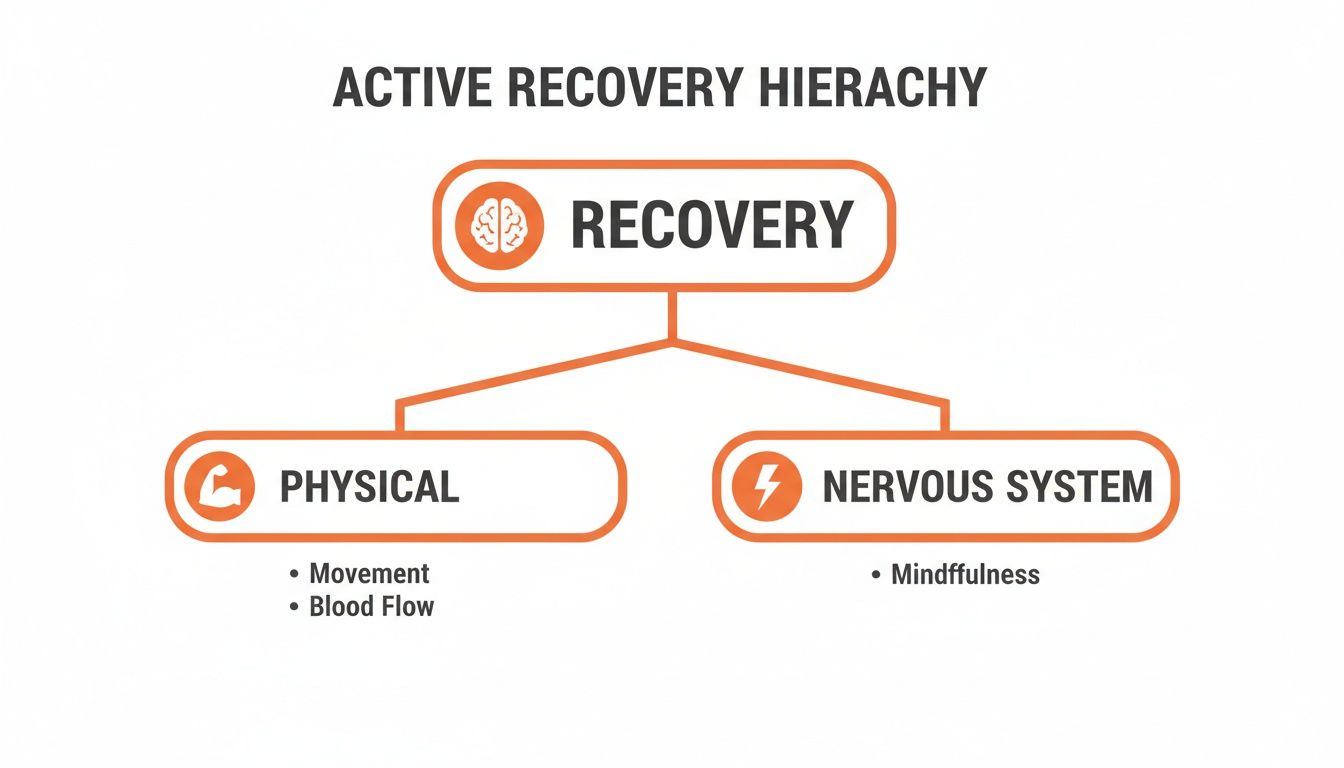
As this chart shows, getting back to 100% means giving both your muscles and your brain a break. Smart active recovery helps with both.
Frequency: How Often To Do It
First up is frequency, which is just a fancy way of asking how often you should be doing this. The answer really depends on your training schedule and, most importantly, how you feel.
There's no single right answer, but a solid starting point is to sync it up with your rest days.
- For most people: If your training split gives you two or three rest days, shooting for light cardio on 1-2 of them is a great target.
- Listen to your body: If you're feeling completely wiped out—mentally drained or systemically tired—then a day of pure, couch-bound rest is probably the smarter move.
This approach helps you aid recovery without making every day off feel like another scheduled workout, which is a fast track to burnout. The way you’ve structured your week, like if you're following a specific 5-day workout split, will naturally show you the best days to slot this in.
Intensity: The Make-or-Break Factor
Pay close attention here, because intensity is the most critical piece of the puzzle. If you go too hard, you’re not recovering anymore—you're just piling on more stress. The entire goal is to keep your effort low and restorative.
Here are a few dead-simple ways to make sure you're in the right zone:
- The Talk Test: This is the easiest and most reliable method. You should be able to carry on a normal conversation without huffing and puffing. If you're struggling to get more than a few words out, you need to back off.
- Heart Rate Monitoring: If you use a heart rate monitor, aim to keep it in the 50-60% range of your max heart rate. This is usually called Zone 1 or the very bottom of Zone 2—the sweet spot for recovery.
- Nasal Breathing: A great biofeedback trick is to try breathing only through your nose. The second you feel the need to open your mouth to gasp for air, that's your body's signal that the intensity is creeping up too high.
The biggest mistake people make is letting their ego take over. A recovery walk turns into a power walk, or an easy spin on the bike becomes a sweat-fest. Rest day cardio should feel easy. Almost ridiculously so.
Time: How Long To Go
When it comes to duration, more is not better. In fact, it's worse. The whole point of rest-day cardio is gentle stimulation, not building endurance. Pushing for too long can start to eat into your energy stores (glycogen) and get in the way of muscle repair.
The sweet spot for duration is probably shorter than you think. Research and expert consensus point to 20-60 minutes of low-intensity movement. Sessions in this time frame give you all the blood flow and recovery benefits you're after without creating extra fatigue that could hurt your gains.
Type: The Best Kinds of Cardio
Finally, what kind of cardio should you do? The key is to pick activities that are low-impact. Your joints and healing muscles don't need any more pounding.
Some of the best choices for rest day cardio are:
- Walking: It’s simple, you can do it anywhere, and it’s incredibly easy on your body.
- Cycling: Hopping on a stationary bike or going for a flat, easy ride outdoors is a fantastic low-impact choice.
- Swimming: The water's buoyancy makes swimming a zero-impact activity that gets blood flowing everywhere.
- Elliptical or Rower: These machines offer a smooth, full-body workout that you can easily keep at a conversational pace.
On the flip side, there are things you absolutely want to avoid. Stay away from anything high-impact or high-intensity. That means no HIIT, no sprints, no heavy sled pushes, and no intense running. Those activities create a huge stress response, which is the exact opposite of what you want on a recovery day.
To put it all together, here's a simple table summarizing the FITT principle for your rest days.
FITT Principle for Rest Day Cardio
| Principle | Recommendation | Rationale |
|---|---|---|
| Frequency | 1-2 times per week on non-training days. | Provides recovery benefits without risking overtraining or burnout. |
| Intensity | 50-60% of max heart rate (Zone 1-2). Must pass the "talk test." | Ensures the activity remains restorative and doesn't add more training stress. |
| Time | 20-60 minutes per session. | Long enough to boost blood flow but short enough to avoid depleting energy stores. |
| Type | Low-impact activities like walking, cycling, or swimming. | Minimizes stress on joints and muscles that are in the process of repairing. |
Think of this table as your cheat sheet. Stick to these guidelines, and your active recovery days will become a powerful tool for building more strength and muscle over the long haul.
How to Personalize Rest Day Cardio With Built Workout
Knowing the principles behind rest day cardio is one thing. Actually applying them to your own body is a completely different ballgame. We’ve all heard the advice to “listen to your body,” but what does that really mean? Is the deep ache in your quads a sign you need to be a couch potato, or is it the exact kind of soreness that a light bike ride would flush out?
This is where the guesswork usually comes in. But the Built Workout app helps take that guesswork out of the equation, giving you a clear, visual report card on your muscle recovery. It turns those vague feelings of soreness into hard data, so you can make smarter decisions about your cardio on rest days. Instead of hoping you’re doing the right thing, you get a personalized roadmap based on how your body is actually responding to your training.
Using Muscle Recovery Heatmaps
Think of it like having a pair of X-ray glasses that show you exactly which muscles are still rebuilding and which are fresh. That’s pretty much what Built Workout’s muscle recovery heatmaps do. The app tracks every set and rep from your workouts, mapping the stress onto specific muscle groups to create a color-coded chart of your body.
- Red Zones: These are your most fatigued muscles, deep in the repair process. They took a beating and need to be handled with care.
- Yellow Zones: These muscles are on their way back but aren't quite 100% yet. They can handle some light movement, but you don't want to push them.
- Green Zones: These muscles are fully recovered, rested, and ready to go.
This kind of visual feedback is a huge advantage when planning your active recovery. You can see the state of your body’s recovery at a single glance.
Here’s a look at what these recovery insights look like inside the app.
You can see this person has some serious fatigue in their lower body—the quads and glutes are lit up in red—while their upper body is mostly green and good to go.
Let AI Be Your Recovery Coach
But the real magic happens when the app's AI coaching engine interprets all this data for you. It doesn't just show you a problem; it gives you the solution. By analyzing your heatmaps in real-time, the app provides smart, personalized suggestions for your rest day, turning generic advice into a data-driven plan built just for you.
Let’s walk through a real-world example:
Scenario: You just destroyed a heavy leg day on Monday. It’s Tuesday, your rest day, and you open the Built Workout app. You see your quads, glutes, and hamstrings are glowing bright red on the heatmap, but your upper body is completely green.
Based on this specific data, the AI coach might suggest:
- Low-Impact Cardio: It will point you toward activities that won't put any more strain on your legs. A 30-minute swim or a light session on an air bike (focusing on using your arms) would be perfect for getting the blood flowing without taxing that sore lower body.
- Avoid High-Impact Options: The AI would also tell you what not to do. It would flag jogging or even steep incline walking as bad ideas, since they would just add more stress to your leg muscles and slow down their repair.
- Specific Duration and Intensity: The app can even recommend the ideal time and heart rate zone for your session, making sure your cardio stays purely restorative and doesn’t turn into another workout.
This level of detail is a massive leap forward from just winging it. An AI-powered workout app like Built acts as your personal recovery coach, making sure your rest day cardio helps your progress, never hurts it. By turning your body's own recovery data into actionable advice, it ensures your active recovery is always precise, effective, and perfectly tuned to what you need.
Here is the rewritten section, designed to sound completely human-written and natural.
Common Rest Day Cardio Mistakes to Avoid
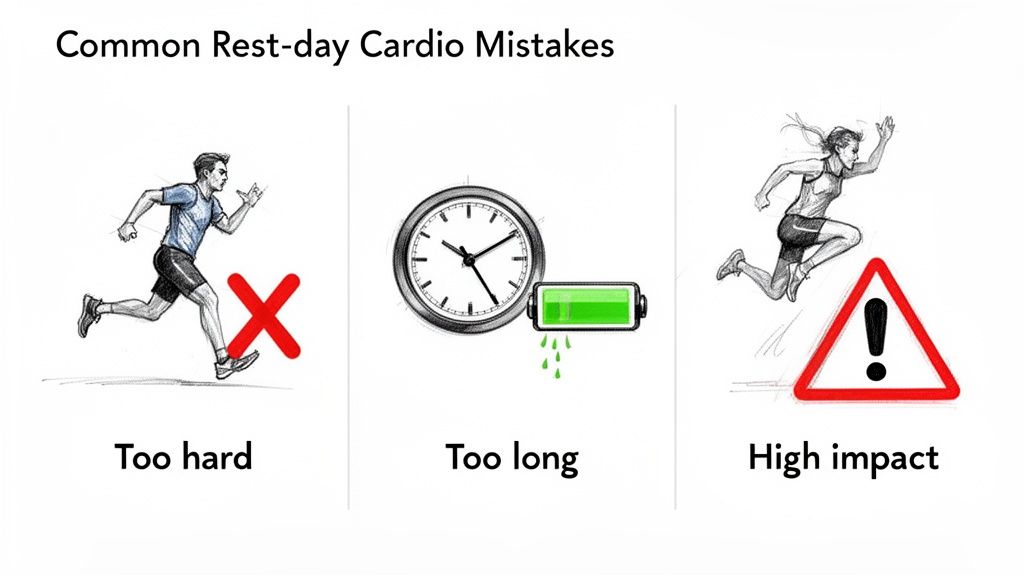
While cardio on rest days can be a game-changer for recovery, it's a tool that can easily backfire. The line between helping and hurting your progress is surprisingly thin. Get it right, and you’ll feel fantastic for your next big workout. Get it wrong, and you can turn a restorative session into just another source of stress.
You have to sidestep the common pitfalls. These mistakes don't just cancel out the benefits of active recovery—they can actively stall your strength gains, leave you feeling drained, and dig you into an even deeper recovery hole. Let's break down where most people go wrong.
Going Too Hard and Too Fast
This is, without a doubt, the number one mistake I see. It’s almost always driven by that "no pain, no gain" mindset that has absolutely no place on a rest day. You might start out with good intentions for a light walk, but then your ego kicks in. That walk turns into a power walk, then a jog, and before you know it, you're gasping for air and sweating through your shirt.
The second your intensity creeps up, you're no longer in a recovery state. You're just creating more muscle damage and placing new stress on your central nervous system—the very things your rest day is supposed to be healing.
- The Consequence: This adds training stress instead of relieving it. It can interfere with muscle protein synthesis and leave you feeling wiped out for your next real workout.
- The Simple Fix: Just use the talk test. If you can't hold a full conversation without huffing and puffing, you're going too hard. Keep the effort light and conversational.
Going Way Too Long
The next biggest recovery killer is duration. It’s easy to fall into the trap of thinking, "If 30 minutes is good, 90 minutes must be three times better, right?" Wrong. Rest day cardio follows a law of diminishing returns, and pushing past the sweet spot quickly becomes a problem.
An overly long session can torch your muscle glycogen stores, which is the exact fuel you need for your next heavy lifting session. Think of your energy reserves like a phone battery. A short, light session is like plugging it in for a quick top-up. A long, grueling one is like trying to watch movies on your phone while it's charging—you'll end up with less power than when you started.
The whole philosophy behind rest day cardio is different from a primary training session. The goal is recovery, not grinding through another workout. The moment you lose sight of that, you lose all the benefits.
Choosing High-Impact Activities
The type of cardio you choose matters immensely. A rest day is not the time for pounding the pavement with sprints or jumping into a high-impact HIIT class. Your joints, tendons, and connective tissues are also in repair mode from your strength training.
Opting for high-impact exercises adds a ton of unnecessary jarring and mechanical stress to a system that's actively trying to rebuild itself. It's like trying to fix a cracked foundation by shaking it.
Examples of Poor Choices:
- Sprinting or running on concrete
- Box jumps or other plyometrics
- High-Intensity Interval Training (HIIT)
Smarter, Low-Impact Alternatives:
- Gentle cycling on a stationary bike
- Swimming or water aerobics
- Using an elliptical machine
- A relaxed walk on a flat surface
Ignoring Your Body’s Signals
Finally, the most subtle but damaging mistake is simply not listening to what your body is telling you. Some days, even the lightest activity is too much. If you feel totally exhausted, mentally foggy, or have zero motivation to even get off the couch, forcing an active recovery session can do more harm than good.
This is where objective data can be so powerful. For instance, insights from WHOOP’s user data show a massive difference in recovery when intensity is managed properly. Members who performed low-strain activities on a poor recovery day were 2.3 times less likely to have another one. In contrast, those who pushed too hard had a 46% chance of waking up with poor recovery again.
The Built Workout app gives you a similar edge by visualizing your specific muscle fatigue. If your heatmaps are glowing deep red across multiple large muscle groups, that's a crystal-clear signal that your body is screaming for passive rest, not more activity. Ignoring those signs is a fast track to overtraining. Your body knows what it needs; your job is to pay attention.
Your Questions on Rest Day Cardio, Answered
Alright, let's get into the nitty-gritty. Even with the best plan, you're bound to have questions when you start adding cardio to your rest days. It's totally normal to wonder if you're doing it right or, worse, undoing all your hard work. This section tackles the most common questions I hear, giving you clear, straightforward answers so you can feel confident in your recovery strategy.
Think of this as your go-to guide for navigating the finer points. We’ll cover everything from the fear of burning precious muscle to figuring out when you just need to put your feet up and do nothing at all.
Does Cardio on Rest Days Burn Muscle?
This is the big one, right? It’s a huge concern for anyone serious about building strength or size, and for good reason. But here’s the short answer: no, it won’t burn muscle—if you do it right.
The real risk of muscle loss, known as catabolism, comes from cardio that’s too long, too intense, or when you’re in a massive calorie deficit. Your body isn't going to start breaking down muscle tissue for a 30-minute walk or a gentle bike ride. Instead, that light activity boosts blood flow, which is exactly what your sore muscles are crying out for. It helps deliver nutrients and clears out metabolic waste, which actually supports the repair process.
The point of rest day cardio isn't to torch calories; it's to nudge your body's recovery systems into a higher gear. By keeping the effort light, you're helping muscle protein synthesis, not hurting it.
So, as long as you keep it easy and you’re eating enough to support your goals, your gains are perfectly safe.
How Do I Know if I Should Do Cardio or Take a Full Rest Day?
This is where you have to learn to be a good detective. The best approach is to listen to what your body is telling you and pair that with some objective data.
Ask yourself a few honest questions:
- How do I feel overall? Is it just your quads that are sore, or do you feel a deep, whole-body exhaustion and mental fog?
- What's my motivation like? Does a light walk sound genuinely nice, or does the very thought of putting on shoes make you groan?
- Are my joints aching? Sore muscles are one thing—that's the sign of work well done. But achy, cranky joints are a warning sign to back off and let your connective tissues heal.
If you feel systemically drained or your joints are barking at you, a complete, do-nothing rest day is the only smart move. This is where a tool like the Built Workout app can be a game-changer. When its recovery heatmaps show deep red across multiple large muscle groups, you have data-driven proof that your body is screaming for a real break.
But if you feel pretty good overall and it's just your legs that are stiff from yesterday's squats, then some low-impact swimming or light rowing would be perfect.
Can I Do HIIT or Other Intense Cardio on a Rest Day?
Let me be crystal clear: absolutely not. This is a hard-and-fast rule. High-Intensity Interval Training (HIIT) is a workout, not a recovery session. It puts a massive demand on your muscles and your central nervous system—the very things you're supposed to be resting.
Doing HIIT on a rest day is like trying to put out a fire with a can of gasoline. It completely misses the point of recovery and will fast-track you to overtraining, tank your performance in your real workouts, and jack up your risk of injury. A "rest day" is for restoration; HIIT is for adaptation. Don't ever mix them up.
What's the Best Time of Day to Do Rest Day Cardio?
Honestly? The best time is whenever you can get it done without adding more stress to your day. There isn't some magic physiological window where the benefits are suddenly doubled. The most important variables are consistency and keeping the intensity low, not the time on the clock.
That being said, different times of day offer slightly different perks:
- Morning: A light walk or spin first thing can be great for working out the stiffness from yesterday’s session and waking up your system for the day ahead.
- Post-Meal: A casual 15-20 minute stroll after a meal is fantastic for aiding digestion and managing blood sugar. It's a small habit with big health benefits.
- Evening: A relaxing walk in the evening can be a perfect way to clear your head, de-stress from the day, and wind down for bed, which might even help you sleep better.
The key is to pick a time that fits your life and feels good. Don't overthink it. Just keep it easy, keep it consistent, and you'll be golden.
Ready to take the guesswork out of your recovery? The Built Workout app uses AI and personalized muscle heatmaps to tell you exactly what your body needs, transforming vague feelings of soreness into actionable advice. Stop wondering if you’re recovering correctly and start knowing.
Download Built Workout and train smarter today: https://www.builtworkout.com