A gym workout planner app is essentially a digital training partner living in your pocket. It helps you build, follow, and fine-tune your fitness plan, turning vague goals into a concrete, data-backed roadmap. It's far more than just a digital notebook; it’s a smart system designed to make every single workout count.
Your Personal GPS for Fitness Goals
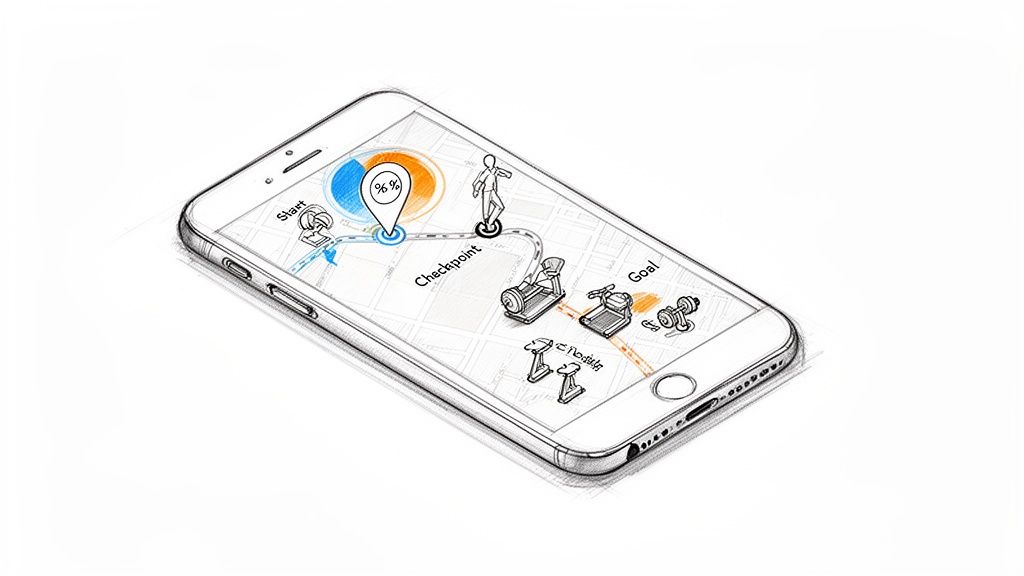
Think about trying to drive to a new destination in a big city without a map or GPS. You'd likely make a few wrong turns, get stuck in traffic, and maybe never even arrive. Hitting the gym without a solid plan is a lot like that. You show up, drift from machine to machine, and just hope for the best. This often leads to wasted time and stalled progress.
A gym workout planner app is your personal GPS. It takes an abstract goal like "get stronger" and translates it into a clear, step-by-step plan you can actually follow. No more guessing games about which exercises to do or how much weight to lift.
This shift toward smarter training is huge. The global fitness app market was valued at USD 2.1 billion in 2019 and is on track to hit USD 10.5 billion by 2026. This isn't just a trend; it's a clear signal that people are looking for better, more effective ways to train. You can explore more about the fitness app market growth on kbvresearch.com.
From Paper Logs to Intelligent Partners
For years, serious lifters carried around beat-up paper notebooks to log their workouts. It was the only way to track progress, but it had serious drawbacks. A piece of paper can’t analyze your performance, alert you to signs of overtraining, or automatically adjust your next session based on how you felt today.
Today's apps have completely changed the game. They've gone from being passive recorders of what you did to active partners in your training. They crunch the numbers on every set, rep, and pound lifted to give you insights that a notebook never could.
A great workout planner doesn't just tell you what you did. It uses that data to tell you what you should do next to keep progressing safely and efficiently.
This leap from a static logbook to a dynamic, intelligent system is what makes modern gym planners so powerful.
Modern App vs Traditional Logbook
The jump from paper to a smart app is a big one. Here’s a quick look at how they stack up.
| Feature | Traditional Logbook | Modern Planner App |
|---|---|---|
| Data Input | Manual, tedious handwriting. | Quick, tap-based entry. |
| Progress Tracking | You have to flip through pages to see your history. | Instant charts and graphs showing your progress. |
| Workout Planning | You have to create the plan yourself, from scratch. | AI-suggested workouts and progressive overload. |
| Feedback & Analysis | None. It's just a record. | Real-time insights on volume, intensity, and recovery. |
| Accessibility | Can be lost, damaged, or left at home. | Always on your phone, backed up to the cloud. |
In short, a modern app takes the core principle of the old-school logbook—tracking—and supercharges it with technology. It helps you nail the fundamentals, like progressive overload, by taking the guesswork out of the equation. By remembering your entire training history and suggesting what comes next, it makes consistent progress the new normal.
What Really Makes a Great Workout Planner?
Let's be honest, not all workout apps are built the same. Some are little more than digital notebooks where you can scribble down your exercises. But a truly great gym workout planner app is something different. It’s an active partner in your fitness journey, helping you get stronger, train smarter, and stay on track.
Think of it like this: a basic app is a simple calculator, but a great one is your personal financial advisor for fitness. The best apps are built on a handful of core features that work together to give you the full picture, turning raw numbers into real-world progress.
Precision Exercise Logging
First things first: any good planner needs to nail the basics of logging. But "good" logging goes way beyond just writing down an exercise and the weight you used. It’s about capturing the details that actually measure your effort and intensity, creating a rich history of your performance.
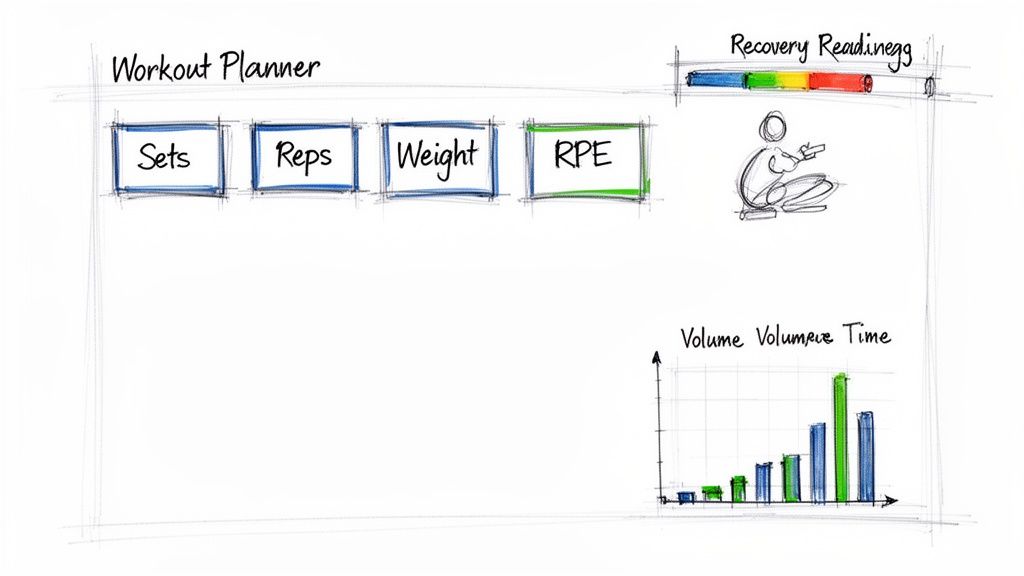
A top-tier app should let you track:
- Sets and Reps: The absolute foundation of any strength program.
- Weight Lifted: This is your primary way to see progressive overload in action over weeks and months.
- RPE (Rate of Perceived Exertion): A game-changer. This 1-10 scale measures how hard a set felt, adding critical context that weight alone misses. A breezy set of 8 reps is worlds apart from a grinder where you barely finish the last rep.
- Rest Times: Tracking your rest is key to maintaining consistent performance and ensuring you’re recovered enough for your next big set.
This isn't just about being meticulous. This depth of detail is what separates just going through the motions from truly strategic training.
Intelligent Programming and Analytics
A great planner doesn't just store your data—it helps you understand it. It should take your workout history and turn it into smart suggestions and deep analysis. This is where the app truly starts working for you, not the other way around.
For example, instead of just showing you a calendar of workouts, it should be able to analyze your total training volume (sets x reps x weight). This is one of the most important drivers of muscle growth. The app should show you clear charts, making it obvious if your volume for, say, your chest or back is trending up, stagnating, or even dropping off.
A powerful gym workout planner app transforms your workout history from a simple diary into a predictive tool. It uses past performance to guide future decisions, helping you apply progressive overload systematically rather than by accident.
This kind of analytical horsepower is what helps you know if you’re doing enough to grow without accidentally pushing yourself into overtraining.
Muscle Recovery Visualization
This might be one of the most useful features to emerge in modern fitness apps. Muscle recovery visualization isn't a gimmick; it’s a critical tool for preventing injuries and making sure every workout counts. After all, you don't get stronger in the gym—you get stronger when you recover from it.
An advanced app, like Built Workout, tracks the work you do for every muscle group. It then crunches the numbers to create a simple, visual map of your body—often color-coded—that shows which muscles are fatigued and which are fresh and ready to go.
This gives you an instant, data-backed answer to the age-old question, "What should I train today?" If your chest is lit up in the "red zone" from Monday's bench press, the app can steer you toward hitting back or legs. It’s a smarter way to train that aligns your effort with your body's actual readiness to perform. For a deeper dive on how to structure this, check out our guide on the ideal training frequency for hypertrophy.
How AI Coaching Transforms Your Training
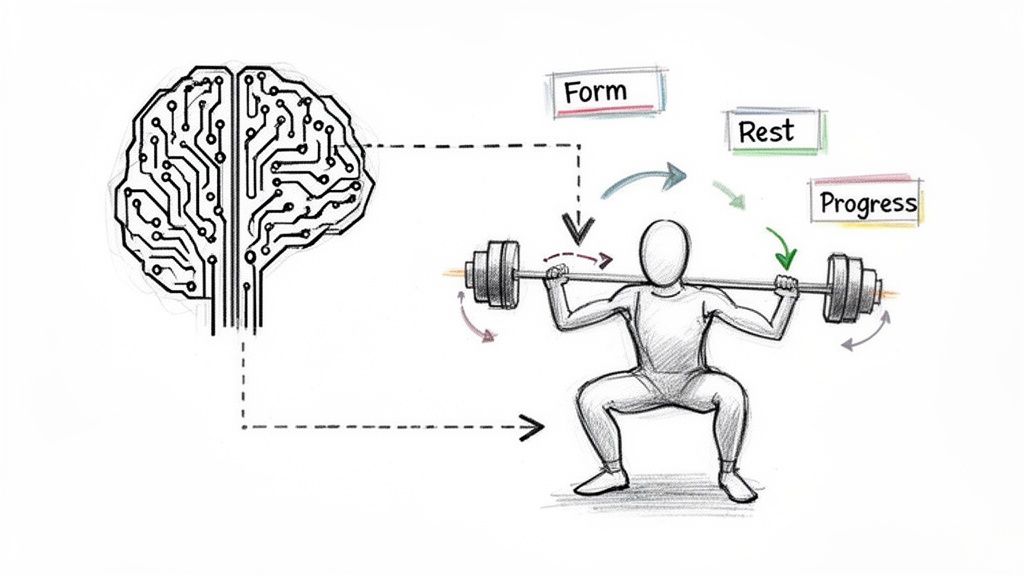
If recovery visualization is the heart of a modern gym workout planner app, then the AI coach is its brain. This isn't about some generic algorithm spitting out cookie-cutter workouts. Think of it as a personal trainer that lives in your phone, constantly learning and adapting to how you perform in real-time.
It takes every bit of data you log—each set, rep, and RPE score—and uses it to make personalized suggestions that grow with you. This constant feedback loop is what makes AI coaching so incredibly effective. It turns raw workout data into smart, actionable guidance.
People are catching on. The U.S. fitness app market is expected to hit USD 12.55 billion by 2034, and a huge part of that growth is coming from users who want structured, intelligent programs that actually listen to their bodies.
Your Personal Training Co-Pilot
Let’s get practical. Imagine you just crushed a tough set of squats. An AI coach, like the one in Built Workout, doesn't just register the numbers. It sees the bigger picture. Based on your RPE and how you’ve performed on squats in the past, it might nudge you to take an extra 30 seconds of rest to make sure your next set is just as powerful.
Or maybe you’re consistently blowing past your rep targets on an exercise. The AI will flag this and suggest it’s time to add more weight. This keeps you in the sweet spot of progressive overload, which is the fundamental key to getting stronger. It's a smart system built to push you just enough, but not too much.
An AI coach doesn't just tell you what to do; it explains why. By providing the logic behind its suggestions, it helps you build a deeper understanding of training principles, empowering you to make smarter decisions on your own.
This educational piece is a game-changer. It turns the app from a simple logbook into a true learning tool, helping you develop real, lasting intuition about your training.
Building Smarter Training Habits
The real magic of AI coaching is its ability to see the forest for the trees. It connects what you’re doing right now in the gym with your long-term goals and recovery status, helping you sidestep common training mistakes before they even happen.
For example, a good AI coach can:
- Adjust volume based on recovery: Is your chest still sore from your last session? The AI will see that on your recovery map and might scale back the number of pressing sets for today.
- Provide technique reminders: It can offer cues and tips on exercises where your form tends to break down after a few tough sets.
- Recommend accessory work: By spotting weak points in your main lifts, it can suggest specific exercises to shore up those supporting muscles.
While AI delivers a powerful, personalized plan, it's also helpful to consider the insights from human gym trainers, which can add another valuable layer to your fitness journey. At the end of the day, a great AI coach makes you a smarter, more effective athlete. You can dive deeper into how this all works in our guide to the AI-powered workout app.
Finding Your Tribe and Protecting Your Privacy
Let's be real: fitness can feel like a solo grind. But sharing the journey—the wins, the struggles, and the "aha" moments—can be a game-changer for staying motivated. We're seeing a huge shift toward "social fitness," where people want more than just a digital logbook. They're looking for a community to share their progress with and learn from others who are walking the same path.
This isn't just about snapping a filtered gym selfie for the 'gram. A truly great gym workout planner app weaves community into its fabric in a way that actually helps you train better. Think of a feed where you can see the real training sessions of your friends, lifting partners, or even elite-level coaches you admire. It's a transparent look at what consistent, hard work actually looks like behind the scenes.
How Social Fitness Should Work
A well-designed social feature gets down to the details that matter. Instead of a vague "John Doe worked out" notification, you see the specifics: the exact exercises, the sets, the reps, the weight on the bar, and maybe even their recovery status afterward.
Suddenly, the social feed becomes a powerful learning tool.
- Discover New Lifts: See a cool exercise in a friend's log you've never heard of? You can tap it and add it right into your own routine.
- Borrow Programming Ideas: Get inspired by how others structure their training splits or manage their volume across the week.
- Keep Yourself Honest: Knowing your training partners will see your log creates a subtle, effective layer of accountability. It makes you just a little more likely to show up and get it done.
This turns the whole social element from a vanity project into a practical, educational resource.
Your Data, Your Rules
Of course, whenever you talk about sharing, privacy has to be part of the conversation. Your training data is deeply personal, and you should have absolute control over who gets to see it. The best apps build their entire platform on a foundation of trust, giving you granular privacy settings that put you firmly in control.
Think of your workout planner as a digital training journal with optional sharing. You get to decide if an entry is for your eyes only, for your coach to review, or for your public feed.
This isn't a "nice-to-have"; it's a must. Top-tier apps like Built Workout let you set a default privacy level and then easily change it for any single workout. You can keep your entire training history locked down, share a specific session with your trainer for feedback, or post that new PR you just hit to celebrate with your crew. It's the perfect balance—you get all the benefits of community without ever compromising on your privacy.
Choosing the Right Gym Workout Planner App
Picking the right gym workout planner app is a lot like finding the perfect training partner. The best one gets you—it understands your goals, knows your limits, and pushes you just the right amount. A generic, one-size-fits-all app just doesn't cut it because everyone walks into the gym with a different mission. The whole point is to find an app that syncs up with your specific training style.
This isn't a niche market, either. The global fitness app scene is on track to hit a staggering US$9.22 billion in 2026. What’s driving that growth? Personalization. A full 70% of users want their apps to connect with wearables, which tells you people are hungry for detailed data and real, actionable insights.
To get started, this simple flowchart can help you decide what you value most.
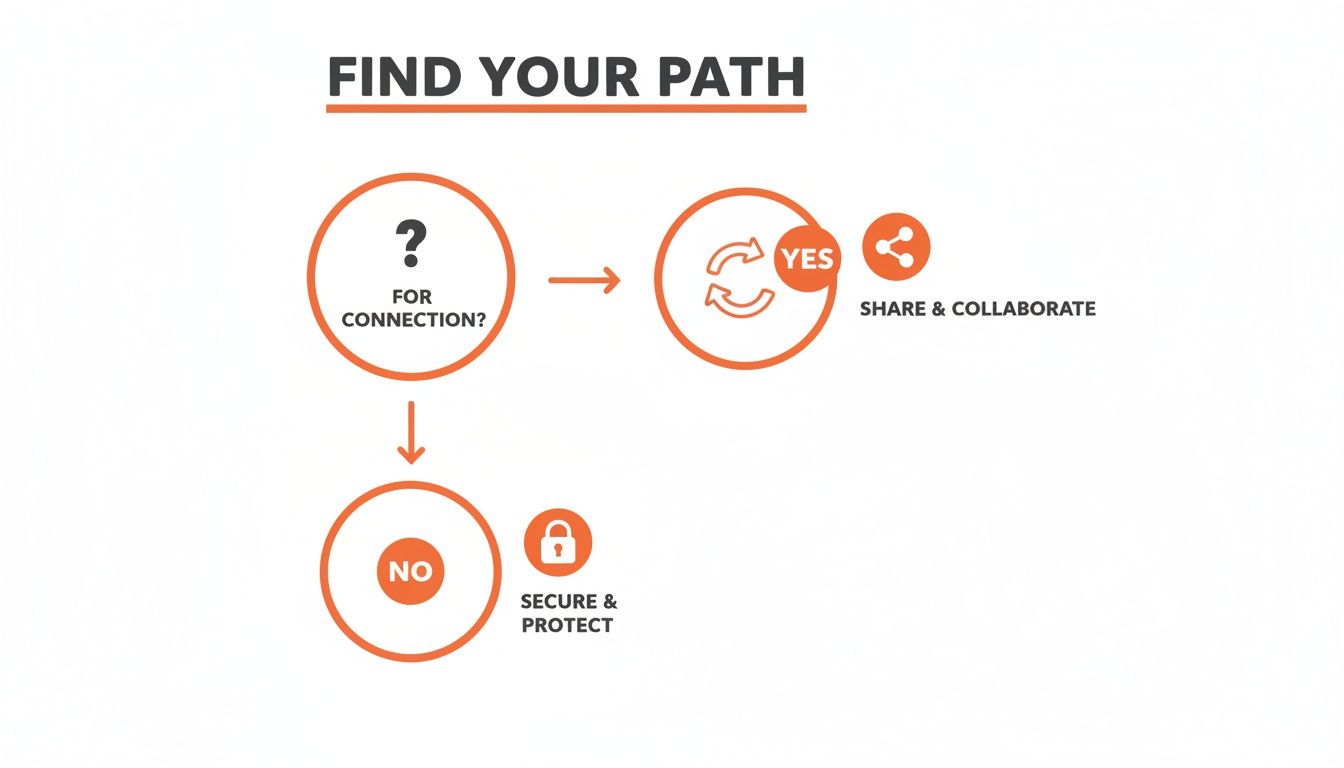
It boils down to a fundamental choice: are you training for the community and connection, or is your focus on private, personal data security? Answering that one question can immediately point you toward the features that matter most to you, whether it's a social feed or airtight privacy settings.
Feature Checklist for Different User Types
Everyone's needs are different. This quick checklist helps match your training style to the app features that will actually make a difference in your workouts.
| Feature | Strength Athlete | Casual Gym-Goer | Personal Trainer |
|---|---|---|---|
| Exercise Programming | Essential for custom splits and periodization | Nice-to-have for guided plans | Critical for building and assigning client workouts |
| Advanced Analytics | Must-have for tracking volume and 1RM | Not a priority; basic progress charts are fine | Essential for monitoring client progress |
| Recovery Visualization | Critical for managing fatigue and overtraining | Low priority | Helpful for advising clients on rest |
| Social/Sharing | Optional; depends on personal preference | Highly valuable for motivation and accountability | Important for community building and client engagement |
| Privacy Controls | High priority for protecting performance data | Moderate priority | High priority for protecting client confidentiality |
Ultimately, the best app is the one that feels like it was designed just for you.
For the Serious Strength Athlete
If your entire world revolves around progressive overload, you need an app that takes data as seriously as you do. Forget the generic workout libraries; you need granular analytics that track every ounce of effort.
Your non-negotiables should include:
- Advanced Volume Tracking: The app absolutely must calculate and chart your total tonnage—sets x reps x weight—for each muscle group, week after week. This is the bedrock of ensuring you’re actually doing enough work to grow.
- Muscle Recovery Visualization: This isn't a gimmick; it's a vital tool. You need a clear, visual breakdown of which muscles are recovered and which are still fried. This lets you fine-tune your training split on the fly to avoid overtraining and maximize every session.
- Custom Exercise Creation: Let's be honest, your program has some unique movements. The app has to let you add your own custom exercises and track them just as meticulously as the standard ones.
For the Casual Gym-Goer
You're all about building consistency and getting a solid, structured workout without the headache. You aren’t chasing a new one-rep max every week, but you want to feel confident, stay motivated, and see real progress.
Your ideal app should focus on:
- Guided Workouts and Programs: The last thing you need is guesswork. Look for pre-built routines that tell you exactly what to do each day you hit the gym.
- Simple, Clear Progress Charts: Nothing beats the motivation of seeing a chart go up and to the right. Visual proof that you're lifting more or doing more reps is a powerful way to keep coming back.
- Engaging Social Features: A little accountability goes a long way. Seeing your friends log their workouts can be the perfect nudge you need to stay on track.
For the Personal Trainer
You're a business owner, a coach, and a motivator all in one. You’re juggling multiple clients, each with their own unique goals. Your app needs to be a command center that boosts your efficiency and helps you deliver a top-tier experience.
Look for these key features designed for professionals:
- Client Management Dashboard: You need one central hub where you can see every client's logs, check their progress at a glance, and manage all their programming without jumping between spreadsheets.
- Easy Program Sharing: The ability to build a workout template once and then assign it to multiple clients—making small tweaks for each—is an absolute game-changer for saving time.
- In-App Communication: Direct feedback is crucial. A feature that lets you comment on client workouts and answer questions right in the app keeps them engaged, accountable, and on the right path.
As you weigh your options, don't forget to check out resources tailored to specific training styles, like roundups of the best interval timer apps for HIIT and CrossFit.
No matter who you are, the right app should feel like a natural part of your fitness journey. If you want to see how these different features come together in one powerful platform, you can explore a demo of Built Workout.
Frequently Asked Questions
Jumping into the world of data-driven training usually brings up a few questions. Deciding to use a gym workout planner app is a big step toward smarter, more effective workouts, so it's only natural to want to know how it all fits together. We've gathered the most common questions here to give you the clarity and confidence to get started.
We'll cover how these apps stack up against a traditional coach, dig into data privacy, and talk about what you can expect to pay. Think of this as the final once-over before you commit to a more structured and personalized path to your fitness goals.
Can a Workout Planner App Replace a Personal Trainer?
Not entirely, but it's the next best thing. While an app can't replicate the hands-on, in-person feel of a human coach, an advanced AI-powered app is an incredibly powerful tool. For a lot of people who can't justify the cost of a full-time trainer, it’s the perfect solution.
It gives you personalized programs, helps with form, and offers advice on how to progress based on your actual performance data. In a way, it’s like having a data-savvy coach in your pocket, making it the ideal bridge between going it alone and hiring a pro.
A great gym workout planner app gives you the kind of data and insights a personal trainer uses to build your program. It makes elite-level training principles accessible to everyone.
This approach gives you a huge advantage over just winging it at the gym. It makes sure every ounce of effort you put in is actually moving you forward.
Is My Workout Data Safe and Private?
Absolutely. Any reputable fitness app is built on a foundation of user trust, and that means putting your privacy first. The best platforms have robust privacy controls that give you complete command over who sees what.
You get to decide the visibility of every single session.
- Keep it Private: Make your entire workout log for your eyes only.
- Share with a Coach: Send specific sessions to a trainer for feedback.
- Post Publicly: Show off a new personal record with your friends or followers.
It's always a good idea to check an app's privacy policy, but you can rest assured that top-tier apps are designed to protect your personal information. You should never have to trade security for the perks of a fitness community.
How Much Do These Apps Typically Cost?
Many of the best gym workout planner apps run on a "freemium" model, which is perfect for getting your feet wet without pulling out your wallet. This lets you download the app and use all its core features—like logging your workouts and tracking basic progress—for free.
Often, the free version is more than enough to help you get organized and stay consistent. The more advanced features, like in-depth recovery analytics or unlimited AI coaching, are usually part of a premium subscription. This lets you scale up your investment as your training gets more serious.
How Quickly Will I See Results Using a Planner App?
You'll feel the difference on day one. Having a clear plan removes all the guesswork, which instantly makes your time in the gym more focused and productive.
When it comes to measurable physical results, like getting stronger or seeing changes in the mirror, consistency is what really counts. Most people who stick with their plan start seeing tangible progress within 4-6 weeks. The app's job is to make sure the work you're putting in is smart and sustainable, which helps speed up those results.
Ready to stop guessing and start training with intention? The Built Workout app brings together precision tracking, muscle recovery visualization, and a powerful AI coach to guide you every step of the way. Download it for free and see what the future of fitness planning feels like. https://www.builtworkout.com