
You’re putting in the work, week in and week out, but the weight on the bar just won't budge. If you’ve been asking yourself, "Why am I not getting stronger?" the answer probably isn't about adding more reps or another training day. More often than not, the real bottleneck is what happens after you leave the gym.
Progress isn’t always about intensity. It’s about recovery.
The Hidden Culprit Stalling Your Strength Gains
It’s one of the most maddening feelings in the world. You’re doing everything you think is right—training hard, staying consistent—but you've hit a wall. Your first instinct might be to push even harder, but that can dig you into an even deeper hole. The breakthrough you’re looking for often comes from shifting your focus from the gym to the other 23 hours of your day.
Strength isn't built when you’re grinding out that last, shaky rep. That's just the signal—the stimulus that tells your body it needs to adapt. The real magic, the actual process of getting stronger, happens when you’re resting, fueled by good food and solid sleep.
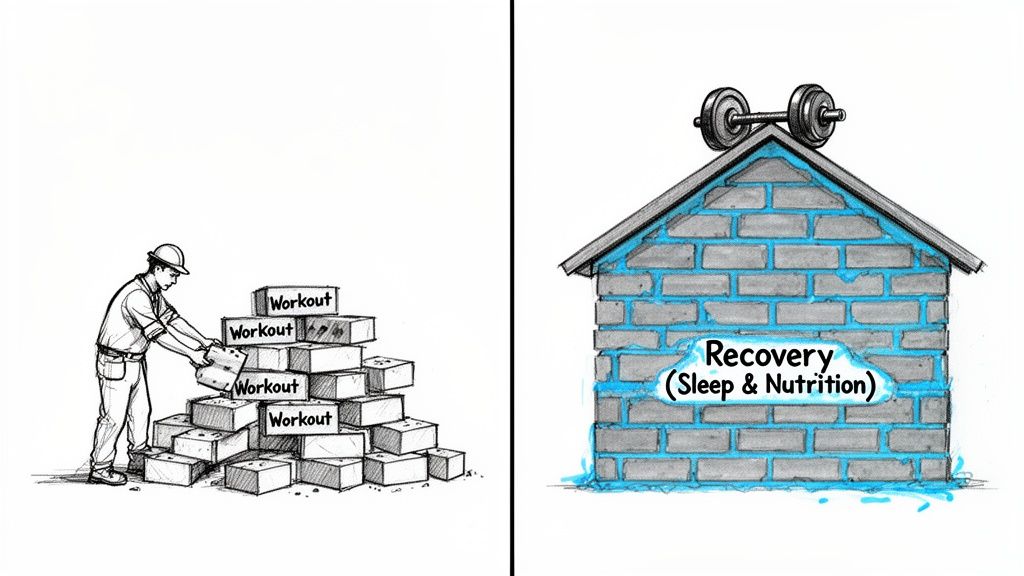
Think of it like building a house. Your workouts are the crew, laying the bricks. But recovery—your sleep and nutrition—is the mortar that holds everything together. Without enough mortar, you’re just stacking loose bricks. The wall never gets any taller or stronger, no matter how hard the crew works.
Why More Is Not Always Better
Constantly pushing your limits without letting your body heal is like redlining an engine without ever changing the oil. Sooner or later, something is going to break down. This state is often called overtraining, and it’s a primary reason people stop making progress. In fact, one of the biggest mistakes is hammering away without any real way of tracking recovery—a trap that up to 70% of gym-goers fall into.
Data shows that chronic overtraining can stall strength gains in 60-80% of intermediate lifters in as little as 12 weeks. Stress hormones spike, muscle-building signals get scrambled, and your progress flatlines.
The biggest myth in strength training is that effort is all that matters. The truth is, progress is a simple equation: Stress (training) + Recovery = Adaptation (strength). If you neglect the recovery part, the whole thing falls apart.
To break out of this cycle, you have to start valuing rest as much as you value your work in the gym. This means ditching the guesswork and using real data to understand how your body is actually handling the load you're placing on it. For a much deeper dive, check out our guide on how to prevent overtraining.
For instance, Built Workout's recovery heatmap gives you an at-a-glance look at which muscles are ready to go and which ones are screaming for a break.
This kind of visual feedback is a game-changer. It instantly tells you that even though your chest and triceps might be green-lit for another session, your back and biceps are still deep in the red. Suddenly, your training becomes a strategic decision instead of just a blind guess.
Are You Really Applying Progressive Overload?
If your progress has ground to a halt, the answer to "why am I not getting stronger?" almost always comes back to the single most important rule in the weight room: progressive overload. This principle is the foundation of every ounce of strength you'll ever build, but it's surprisingly easy to get wrong.
At its heart, it just means making your workouts a little bit harder over time. This consistent, incremental challenge is what forces your muscles to adapt and, you guessed it, get stronger.
Think about it like learning an instrument. You don’t jump from "Twinkle, Twinkle, Little Star" to a complex sonata in one go. You master the basic scales, then chords, and gradually build your ability to play more difficult pieces. Your muscles work the exact same way. Just showing up and going through the motions with the same weights and reps is like playing the same simple tune over and over again and expecting to become a virtuoso. It won't happen.
The real problem is that many lifters either get stuck in a comfortable routine or apply the principle incorrectly. They might slap on too much weight too soon, which just leads to sloppy form and burnout. Or they forget there are other ways to progress entirely.
More Than Just Adding Plates to the Bar
Putting more weight on the bar is the most obvious way to apply progressive overload, but it's definitely not the only tool in your toolbox. When you can’t bump up the load, you have several other ways to keep the gains coming and signal to your body that it needs to keep adapting.
Here are a few effective methods to keep in your back pocket:
- More Reps: If you benched 185 lbs for 6 reps last week, hitting 7 or 8 reps with that same weight this week is undeniable progress.
- More Sets: Moving from 3 sets of an exercise to 4 sets is a fantastic way to increase your total training volume, creating a powerful new stimulus for growth.
- Better Technique: Lifting the same weight but with cleaner, more controlled form is a huge win. It means your target muscles are doing more of the work, which is a very real form of strength gain.
- Less Rest: Shaving 15-30 seconds off your rest periods between sets makes your workout denser. This challenges your muscular endurance and recovery in a whole new way.
Focusing only on adding weight is a one-dimensional strategy that almost always leads straight to a plateau. A much smarter approach is to use a mix of these methods to keep your body guessing.
Why Guessing Is Costing You Gains
Without a clear plan, it's all too easy to let your ego take the driver's seat or, worse, just spin your wheels. Study after study shows that failing to properly program for progressive overload is a primary reason lifters get stuck. In fact, mismatched programs are thought to be behind a staggering 50% of all training plateaus.
Research suggests that only 30-40% of gym-goers consistently apply this principle. This often leads to stalled gains after just 4-6 weeks, right when those easy "newbie" adaptations wear off. To keep moving forward, you need a structured plan aiming for a 2.5-5% weekly increase in either load or overall volume.
A workout without progressive overload is just exercise. A workout with progressive overload is training. The first helps you maintain where you are; the second forces you to grow.
Your training has to be intentional. If you find your current setup is limiting your ability to add small increments of weight or volume, you might consider exploring versatile portable fitness equipment to open up new ways to challenge yourself.
But above all, you have to track your workouts. Using a dedicated gym workout tracker is non-negotiable. It shows you exactly what you lifted last time so you can make a smart, calculated decision on how to beat it in your next session. This is where a tool like Built Workout shines. It doesn't just log your history; its AI coach can actually suggest specific progressions for you based on your performance, completely taking the guesswork out of getting stronger.
Is Your Training Volume Holding You Back?
Think of your training volume—the total amount of work you do—as the dosage of a prescription. How heavy you lift is critical, but if the total dosage is off, you’ll either get no effect or create more problems than you solve. If you're stuck wondering, "Why am I not getting stronger?" it's often because your volume is mismatched with your goals and recovery.
Finding the right amount of training is like hitting a "just right" sweet spot. Too little volume, and you're not giving your muscles a compelling reason to adapt and grow stronger. It’s like trying to get someone’s attention by whispering in a loud room—the message just won’t land.
But there’s a flip side: doing too much. This leads to what coaches call junk volume. These are the extra sets and reps that feel productive but only pile on fatigue without adding any real benefit. You hit a point of diminishing returns, digging yourself into a recovery hole that makes it impossible to come back stronger.
Finding Your Productive Volume Range
So, where’s that sweet spot? A solid starting point for most lifters chasing strength is somewhere between 10-20 hard sets per muscle group per week. If you’re just starting, you can see amazing progress on the lower end of that range. More seasoned lifters might need to push closer to the top end to keep the needle moving.
But remember, that’s just a guideline. Your ideal volume is unique to you and depends on things like:
- Training Experience: The newer you are, the less volume you need to grow. Your body is highly responsive.
- Recovery Capacity: How much you can handle is directly tied to your sleep, nutrition, and life stress.
- Exercise Selection: Let’s be real—twenty sets of heavy squats will wreck you in a way that twenty sets of leg extensions never could.
The best way to figure it out is to listen to your body. Are you constantly feeling beat down, sore for days on end, and watching your numbers drop? You’re probably doing too much. On the other hand, if you always feel fresh and your lifts haven’t budged in weeks, it might be time to slowly add a little more work.
For a deeper dive into how volume works with your weekly schedule, check out our guide on optimizing training frequency for hypertrophy.
The Dangers of Junk Volume
Junk volume is a trap. It feels like you're being productive—you’re working hard, you’re getting a pump—but in reality, you're putting the brakes on your long-term progress.
Let's say your chest grows best with 12 hard sets a week. Pushing it to 18 sets doesn't magically build more muscle. It just adds 50% more fatigue that your body has to waste precious resources recovering from.
Productive volume is the work that signals your body to get stronger. Junk volume is just extra work that digs you into a recovery deficit, making it harder to show up strong for your next workout.
This pile-up of fatigue can actually mask your true strength, making you weaker in your next session. This can kick off a vicious cycle where you think the solution is to work even harder, so you add more volume, and the problem gets worse.
We've pulled together a quick-reference table to help you pinpoint what might be going on when your progress stalls.
Diagnosing Your Strength Plateau: Common Causes and Fixes
| Symptom You Feel | Potential Cause | Data-Driven Solution |
|---|---|---|
| "I feel weak, tired, and my joints are always achy." | Too much volume (Junk Volume) or Poor Recovery | Track weekly sets per muscle group. If they're consistently over 20, dial it back. Check your recovery heatmap for red flags in sleep or stress. |
| "I feel great, but my lifts haven't gone up in weeks." | Too little volume or Stagnant Progression | Gradually increase weekly sets by 1-2 for the lagging muscle group. Ensure you're applying progressive overload on your main lifts. |
| "My squat is stuck, but my other lifts are going up." | Poor Technique or Weak Supporting Muscles | Record your lifts and analyze your form. Check the volume on accessory movements that support the squat (e.g., quads, glutes, core). |
| "Some days I'm strong, other days I can't lift anything." | Inconsistent Recovery or High Life Stress | Correlate your performance chart with your recovery data. Look for patterns between bad workouts and poor sleep or high-stress days. |
This table is a great starting point, but the real power comes from having the right data at your fingertips.
A smart training app helps you sidestep these traps entirely. By tracking your total sets for each muscle group, Built Workout gives you a clear, objective view of your weekly volume. Its AI can even give you a heads-up when you’re creeping into junk volume territory based on your performance trends. This makes sure every set you do is a productive step forward, not a step back into a recovery ditch.
How Poor Technique Is Sabotaging Your Lifts
Let's be blunt: strength is a skill. Sure, raw power is part of the equation, but true strength in the gym is about moving a heavy load efficiently from point A to point B. If you're constantly stuck wondering, "Why am I not getting stronger?" the answer might not be in your program, but in how you're actually performing each rep.
Think of it like driving a sports car with a bad alignment. You can slam the gas pedal to the floor, and the engine will roar, but a huge chunk of that energy is wasted just fighting the car's own inefficiency. You’ll move, but it will be a slow, jerky ride that burns a ton of fuel and puts you at high risk of a breakdown. In lifting, this translates directly to leaked force, limited muscle activation, and a much, much higher chance of getting hurt.
Every exercise is designed to challenge specific muscles through a very particular range of motion. The moment your form breaks down, you're essentially cheating the movement. Other muscles jump in to compensate, stealing the stimulus from the very ones you're trying to build.
The Invisible Barrier of Inefficient Movement
Take the deadlift, for example. A solid rep is a symphony of coordinated power from your glutes, hamstrings, and back, all firing in sequence to move the weight. But if your hips shoot up too early, the entire load suddenly shifts to your lower back. In an instant, you've turned one of the world's best full-body strength builders into a risky back exercise, and your glutes and hamstrings barely got the memo to grow.
This is precisely why two people can lift the exact same weight, but only one of them actually gets stronger. The one with clean, intentional technique is directing all that stress exactly where it needs to go. The other person is just surviving the lift, often relying on smaller, weaker muscles that were never meant to handle that kind of load.
Flawed technique doesn't just stall progress; it actively works against it. You're teaching your body inefficient movement patterns, which become harder to correct over time while simultaneously increasing your risk of injury.
This simple decision tree shows how mismatched training variables, including poor technique, can bring muscle growth to a screeching halt.
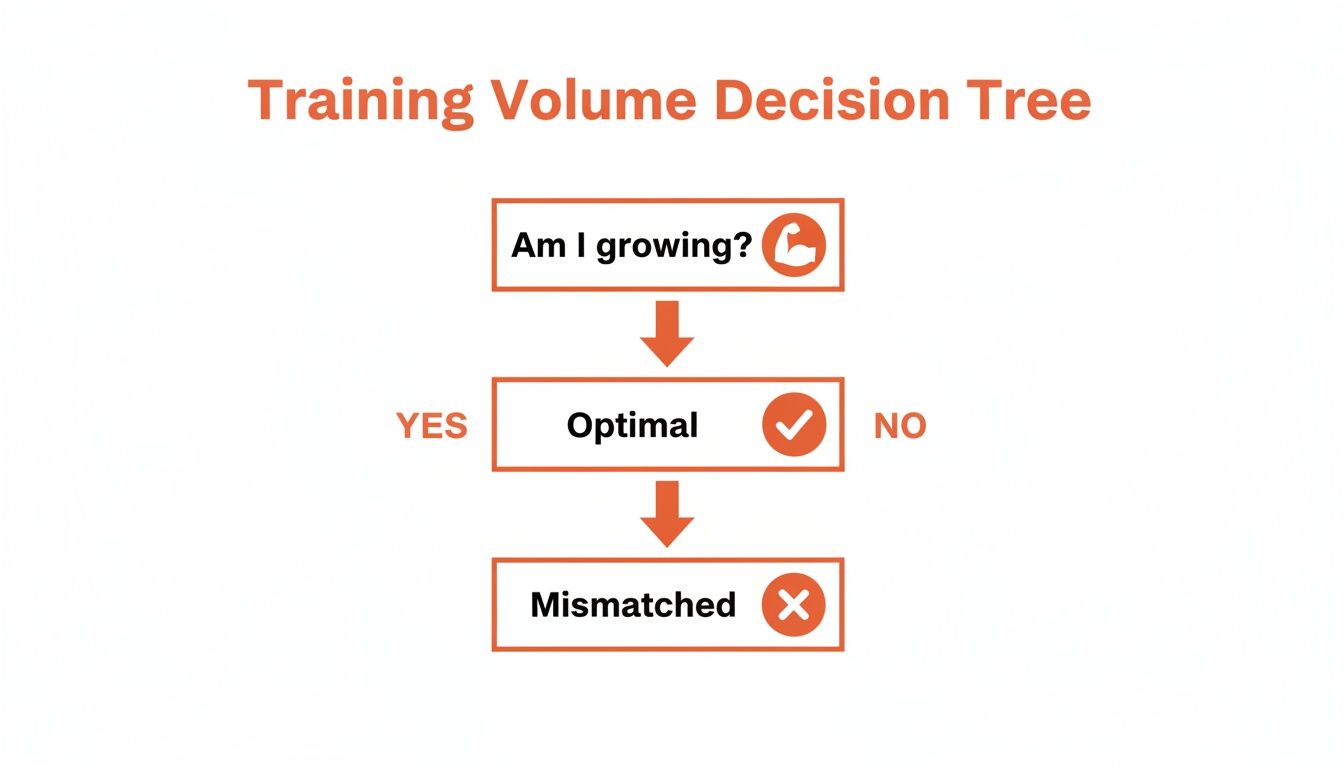
The flowchart lays it out clearly: if you aren't growing, a mismatch in your training is a likely culprit. Flawed form is one of the most common mismatches there is.
How to Diagnose and Fix Your Form
Learning to be your own technique coach is one of the most valuable skills you can possibly develop as a lifter. This isn't about chasing some "textbook-perfect" ideal on every single rep. It's about understanding the core principles of a lift and making consistency your goal.
Here are a few things you can do right now to get on the right track:
- Record Your Lifts: This is non-negotiable. Set up your phone and film your main compound lifts from a side angle. What you feel like you’re doing and what you’re actually doing are often two completely different things.
- Focus on Core Principles: Don't get lost in the weeds. For the big lifts, just nail these fundamentals:
- Bracing Your Core: Is your midsection locked down and stable, or is your lower back arching all over the place?
- Maintaining a Neutral Spine: Is your back rounding or overextending at any point? A strong, straight line from your head to your hips is key.
- Controlling the Eccentric: Are you lowering the weight with purpose, or just letting gravity win? That lowering phase is a massive driver of muscle growth.
- Lower the Weight: Check your ego at the door. If you can't perform a lift with clean form, the weight is simply too heavy. Strip some plates off the bar, master the movement, and then you can start chasing bigger numbers again.
When your form is dialed in, every rep becomes productive. You ensure the right muscles are doing the work, and that is the most direct path to getting undeniably stronger.
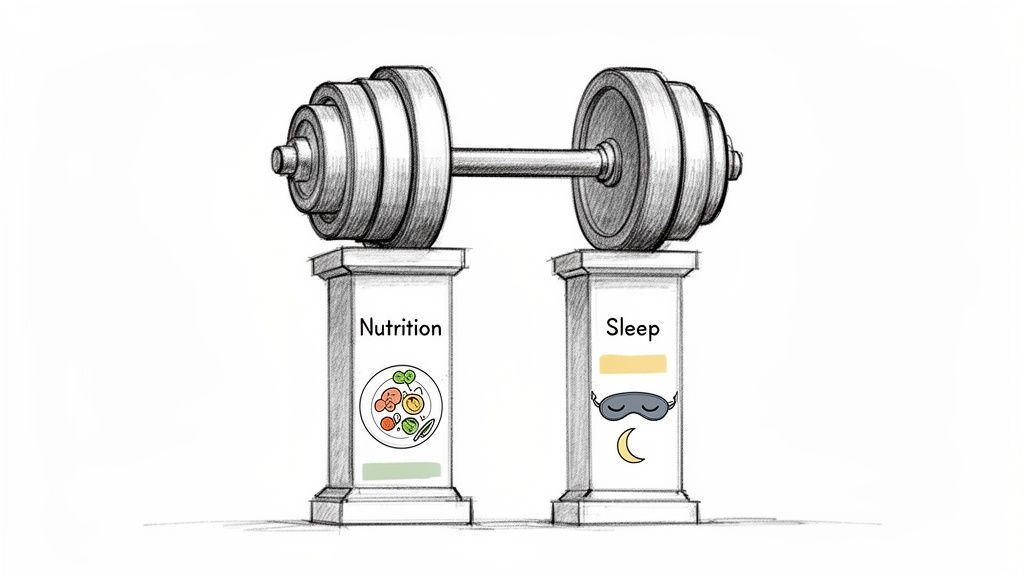
Neglecting Your Two Recovery Pillars: Nutrition and Sleep
You can have the most perfectly designed training program on the planet, but it won’t mean a thing if you’re not fueling your body and getting enough rest. It's a hard truth: if you're wondering why you're not getting stronger, the answer is often found in the kitchen and the bedroom, not the weight room.
Think of it this way: your workouts are the signal you send your body to get stronger. You create microscopic tears in your muscle fibers, which tells your body it’s time to rebuild. But your body can't actually do that rebuilding if the warehouse—your nutrition and sleep—is empty.
Fueling the Machine: Your Nutrition Strategy
Let's start with the obvious one: protein. Protein provides the amino acids that are the literal building blocks for repairing that muscle tissue you worked so hard to break down. Without enough of it, you’re basically asking a construction crew to build a skyscraper without giving them any steel or concrete. Progress will crawl to a halt.
For anyone serious about getting stronger, a solid target is 0.7–1.0 grams of protein per pound of body weight. So, if you weigh 180 pounds, you're looking at somewhere between 126 and 180 grams every day.
But don't forget about carbs. They are your body's primary fuel source, refilling the glycogen you torch during those tough sessions. Skimp on carbs, and you’ll feel sluggish and weak, which directly sabotages your ability to push hard enough for progressive overload. A smart post-workout strategy is key, and exploring the best supplements for muscle recovery and growth can also make a real difference.
Rebuilding During Rest: The Power of Sleep
Sleep is where the real magic happens. It’s not just about feeling rested; it's when your body gets down to business. During deep sleep, your system releases crucial hormones like human growth hormone (HGH) and testosterone, both essential for muscle repair. This is primetime for your internal construction crew.
Even one bad night of sleep can throw your hormones and performance out of whack. Research shows that sleep restriction can slash testosterone levels and torpedo muscle protein synthesis—the very process that makes you stronger.
Your body doesn't get stronger in the gym; it gets stronger while you sleep. Neglecting sleep is like paying for a gym membership you never use—you're leaving all your potential gains on the table.
Consistently getting less than 7-9 hours of quality sleep is one of the fastest ways to hit a wall. You’ll feel weaker in the gym, your focus will be shot, and your body simply won't have the time or hormonal support it needs to recover and adapt. You can see how this all fits together in a detailed muscle recovery time chart.
To get your recovery dialed in, focus on these simple steps:
- Prioritize Protein: Make sure every meal has a solid protein source. This gives your muscles a steady supply of building blocks throughout the day.
- Don't Fear Carbs: Fuel your workouts properly. Use complex carbs to power your training and replenish your energy stores afterward.
- Establish a Sleep Routine: Try to go to bed and wake up around the same time each day—even on weekends. This helps regulate your body's internal clock.
- Create a Restful Environment: Your bedroom should be cool, dark, and quiet. Ditch the screens for at least an hour before bed to improve your sleep quality.
When you start treating your nutrition and sleep with the same seriousness as your training, you finally give your body everything it needs to turn hard work into real strength.
Using Data to See What's Really Happening (and Break Through)
Feeling strong after a workout is a great feeling, but it’s a terrible way to measure actual progress. If you’re serious about figuring out "why am I not getting stronger," you have to stop guessing. How you feel is unreliable; hard data is the only real truth-teller here.
Let’s be honest, the human mind is awful at remembering details. Can you recall the exact weight, reps, and sets you did for every single exercise three weeks ago? Probably not. This is exactly why so many people get stuck—they operate on vibes, which can be thrown off by your mood, your energy levels, or even the playlist blasting through your headphones.
Data, on the other hand, doesn't have an opinion. It tells you the unvarnished story of your performance over time.
The Metrics That Actually Matter
When you switch from training by feel to training by the numbers, you become the architect of your own progress. Instead of just showing up and hoping for the best, you start making calculated decisions based on what the data is telling you. This is how you engineer a breakthrough.
The most powerful metrics to track aren't complicated, but together they paint a complete picture.
- Total Volume: This is the bedrock of strength tracking (Sets x Reps x Weight). If your total volume for a lift or muscle group is trending up over weeks, that's the clearest sign you’re getting stronger. It’s progressive overload in its purest form.
- Estimated 1-Rep Max (e1RM): You don't need to risk injury by maxing out every week. Your e1RM gives you a solid estimate of your top-end strength based on your performance with higher reps. It's the perfect way to track peak power safely.
- Performance Trends: Are your numbers on your main lifts going up, staying flat, or even dipping? Charting this tells you instantly if your program is working or if it's time for a change.
These metrics turn your training log from a simple diary into a powerful diagnostic tool.
Relying on how you feel to gauge progress is like navigating a ship without a compass. You might feel like you're moving, but you have no idea if you're heading in the right direction. Data is your compass—it gives you the objective direction you need to get where you want to go.
Turning Data Into Smarter Action
Just writing down your workouts is only half the battle. The magic happens when you use that information to make smarter decisions for your next session. This is where you connect the dots between what you do in the gym, how you recover, and the results you see.
For instance, you might notice your bench press e1RM has been stuck for three weeks straight. Instead of just trying to "push harder," you can look at the data. Maybe you see that your total weekly volume for your chest and triceps has actually dropped without you even realizing it. The solution becomes obvious: add another set to your main pressing movements.
This is the difference between lifters who consistently get stronger and those who are always stuck. You stop reacting to plateaus after they’ve already happened and start preventing them before they even begin.
The key is to look for trends, not fixate on single workouts. Everyone has a bad day. But a three-week downward trend is a massive red flag that something in your training, nutrition, or recovery needs to change.
With a tool like Built Workout, this analysis is done for you. The app automatically calculates your total volume and e1RM for every session and charts it all visually. Even better, you can see how an AI fitness coach can interpret this data for you, giving you specific, actionable advice. The app might suggest bumping up your reps on squats next week because your e1RM is trending up, or it might recommend a deload because your performance has dipped while your recovery scores are low. This is how you finally take control and smash through those plateaus.
Got Questions About Strength Plateaus? We've Got Answers.
Even with the best plan in the world, hitting a wall can leave you with a lot of questions. Let's tackle some of the most common ones we hear from lifters who are stuck in a rut and need a clear path forward.
How Long Before I Call It a Plateau?
So, you had a bad workout. Or even a bad week. Is it a plateau? Not yet.
A true strength plateau is when your progress on key lifts has completely flatlined for at least three to four weeks, even though you're still putting in the work. One off-session is just noise; a month of stagnation is a signal.
If your numbers haven't budged for that long, it's time to stop pushing against a locked door. Something in your approach needs to change, and waiting longer often just digs the hole deeper, risking burnout or injury.
Can I Just Eat My Way Through a Plateau?
If only it were that simple! While being in a calorie deficit to lose weight can definitely halt your strength gains, simply shoveling in more food isn't the silver bullet. Quality trumps quantity here.
Think of it like putting fuel in a car. You don't just need more gas; you need the right kind.
For lifters, this means dialing in two things:
- Protein is Your Priority: Are you getting enough? Aim for 0.7-1.0 grams per pound of body weight. This gives your muscles the actual building blocks they need to recover and grow stronger.
- Carbs are Your Fuel: Make sure you're eating enough carbohydrates, especially around your training sessions, to power you through tough workouts. A calorie surplus filled with junk won't build muscle.
Here’s the equation that matters: Training Stress + Quality Fuel + Real Rest = Getting Stronger. If one part of that formula is missing, you can't just fix it by cranking up one of the others.
Is It Time for a Deload Week?
Absolutely. A deload is one of the most powerful and underutilized tools for smashing through a plateau. If you've been grinding away for months on end, your body is likely screaming for a break. That fatigue builds up and masks your true strength potential.
A deload isn't a week on the couch—it's a strategic reduction in stress. The goal is to let your body super-compensate. An easy way to do it is to stick to your normal routine but slash your working weights by 40-50%.
This gives your joints, muscles, and nervous system a chance to fully recover. You’ll walk back into the gym the following week feeling refreshed, powerful, and ready to set new records.
Stop guessing why you're stuck and start getting real answers from your own performance data. Built Workout takes the guesswork out of progress. With recovery heatmaps and AI-guided programming, it shows you exactly when to push, when to pull back, and what to change to keep getting stronger. Download the app and turn your plateaus into PRs.