Most lifters are surprised to learn that the sweet spot for muscle growth often means resting longer than they think. We're talking 2-5 minutes for heavy compound lifts and a solid 60-120 seconds for smaller isolation exercises. While shorter rests can give you a killer pump, they often sabotage your ability to lift heavy—the key driver for muscle growth.
Why Rest Between Sets Is A Critical Growth Variable
In the 'go-go-go' fitness culture, resting between sets can almost feel like cheating. We're conditioned to believe that if you're not moving, you're not working. But what if that couldn't be further from the truth? What if the time you spend on the bench catching your breath is just as important as the time you spend under the bar?
This brings us to a simple but crucial question: how long should you really be resting to maximize muscle growth? The answer might surprise you and goes against a lot of old-school gym wisdom.
Your Muscles Need a Pit Stop
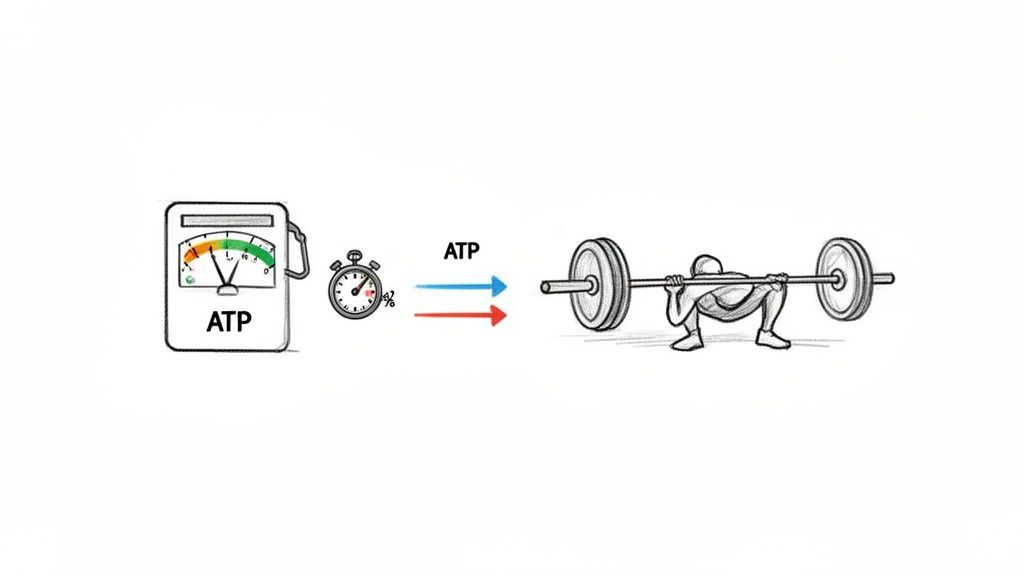
Think of your muscles as a high-performance engine. Each intense set is like flooring it for a full lap, burning through your most immediate, high-octane fuel. That rest period isn't just downtime; it's the pit stop.
During this critical window, your body is working furiously behind the scenes to:
- Replenish Fuel: Your muscles scramble to restore their primary energy source, adenosine triphosphate (ATP), so you can hit the next set with the same power and intensity.
- Clear Out Waste: Lactic acid and other metabolic byproducts that create that "burn" and cause fatigue are flushed out, resetting your muscles for more high-quality reps.
- Reset Your Nervous System: Your central nervous system, the command center for every lift, gets a much-needed break. This allows it to recover and fire on all cylinders for the next set, keeping your form tight and your lifts strong.
If you cut that pit stop short, you're starting the next lap on fumes with an engine that's already overheating. Your performance will tank. You’ll manage fewer reps, use lighter weight, or both.
The real secret to stimulating muscle growth isn't how breathless you are; it's the total amount of high-quality work you accumulate. Longer, strategic rest periods directly support this by allowing you to perform more effective volume throughout your entire workout.
This guide is your science-backed roadmap to optimizing rest periods for muscle growth. You’ll learn to view rest as a strategic weapon, not just a break. Fine-tuning your rest, along with knowing how to speed up muscle recovery in general, is a total game-changer for your progress. We'll dive into the science, compare different protocols, and give you practical tools to make every moment in the gym—lifting and resting—count.
To structure your entire week for optimal gains, check out our guide on https://www.builtworkout.com/blog/training-frequency-for-hypertrophy.
The Science of How Your Muscles Recharge Between Sets
To really get why rest between sets is so critical for muscle growth, we need to pop the hood and see what’s actually happening inside your muscles. It's not just about catching your breath; it's a high-speed refueling process that directly determines how well you can perform on your next set.
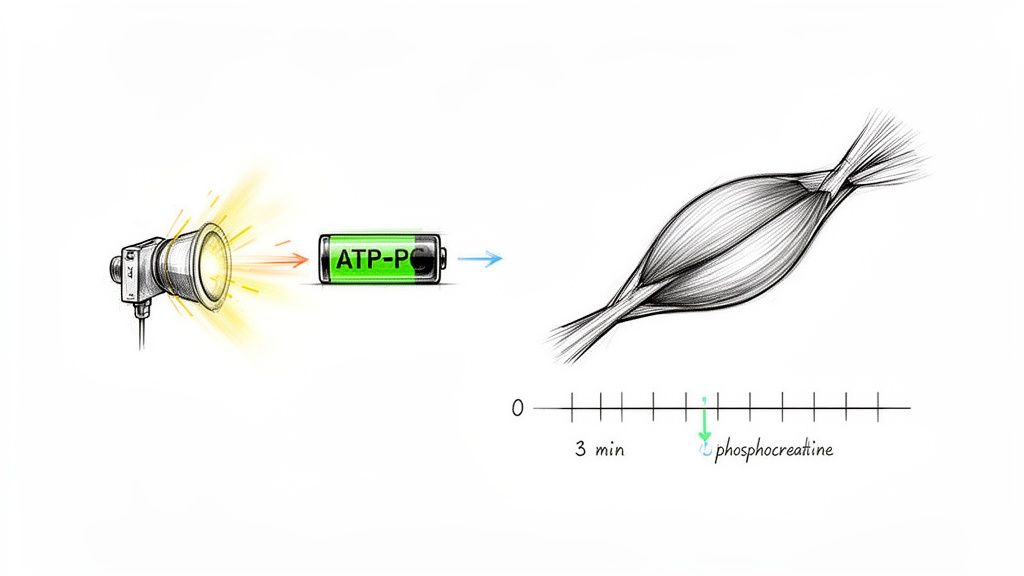
When you lift something heavy, your muscles tap into an immediate, high-octane fuel source called the adenosine triphosphate-phosphocreatine (ATP-PC) system. A great analogy is a camera's flash: it gives you an incredibly powerful burst of light for a split second, but it's completely useless until it has time to recharge.
That powerful burst of energy from your ATP-PC system only lasts a few seconds. Once it's drained, your body has to work fast to rebuild its phosphocreatine stores. This process is time-sensitive and has a massive impact on how much strength you have in the very next set.
The Three-Minute Recharge Window
Your body is amazingly efficient, but this particular energy system needs a few minutes to get back to full strength. Here’s a quick timeline of how your phosphocreatine stores fill back up while you're resting:
- After 30 seconds: You’ve got about 50% of your energy back.
- After 60 seconds: You’ve recovered roughly 75-80% of your capacity.
- After 3 minutes: Your ATP-PC system is nearly 100% recharged and ready for another all-out effort.
This is exactly why rushing your rest on a heavy set of squats feels like hitting a wall. If you only wait a minute, you're essentially starting your next set with a battery that's only three-quarters full. Longer rest ensures you can bring maximum power to every single set, not just the first one.
Clearing Out Performance-Killing Byproducts
Rest periods are about more than just refueling; they're also a crucial clean-up phase. Intense sets create metabolic byproducts, like hydrogen ions, that build up in your muscle tissue. This accumulation gets in the way of muscle contractions and is what causes that familiar burning sensation we call metabolic fatigue.
Your rest interval gives your circulatory system the time it needs to flush these byproducts out of the muscle cells. A longer rest means a more thorough cleaning, which helps your muscles contract forcefully again and lets you maintain solid form and rep quality. For a bigger picture on recovery, learning how to recover faster from workouts can be a game-changer for long-term progress.
The old-school belief that short rests are better for hypertrophy because they spike hormones has been largely debunked. That temporary jump in things like growth hormone doesn't really move the needle on muscle gains. The real driver of growth is total effective training volume.
Volume Over Hormones: The Modern View
For years, many trainers pushed for very short rests (think 30-60 seconds) to create a huge hormonal response. The theory was that spiking growth hormone would directly lead to more muscle. Modern research, however, tells a different story.
One key meta-analysis that looked at nine different studies found that resting at least 60 seconds between sets actually led to slightly better muscle growth compared to shorter rests. This really challenged the old guidelines that chased temporary hormone spikes instead of focusing on performance. At the end of the day, those fleeting hormonal changes have a minimal effect on long-term muscle growth.
The key takeaway is simple: your ability to consistently perform high-quality reps with challenging weight is what tells your muscles to grow. Proper rest is the tool that makes that happen. To see how this fits into your overall recovery strategy, take a look at our complete muscle recovery time chart.
Long Rests vs. Short Rests: What the Science Actually Says
For years, the debate has raged in weight rooms everywhere: should you take short, breathless rests to chase the pump, or longer, more deliberate breaks to maximize strength? It’s one of the most fundamental questions in lifting, and thankfully, the science gives us a surprisingly clear answer.
The entire conversation really boils down to one crucial factor: total training volume. This is the fundamental equation for muscle growth, calculated as sets x reps x weight. If a training strategy helps you consistently increase this number over time, it’s the one that will make you bigger and stronger. Period.
Short rest periods, think 60 seconds or less, generate a ton of metabolic fatigue. This is what gives you that satisfying, tight feeling of "the pump," but it comes at a steep price—it torpedoes your performance on the sets that follow. When you don't give your primary energy system (the ATP-PC system) enough time to recharge, you’re forced to either drop the weight or fail a few reps short. Both outcomes directly slash your total training volume.
The Power of Patient Recovery
Longer rest periods, on the other hand, are all about preserving performance across all your sets. By waiting two to three minutes or even longer, especially on heavy compound lifts like squats or deadlifts, you allow your muscles and nervous system to get damn near a full recovery.
This patient approach means you can hit your second, third, and fourth sets with almost the same power and intensity as your first. You’re able to maintain the same heavy weight for all your target reps, which keeps your total volume high. You might not feel as gassed, but the mechanical tension you’re putting on your muscles—the primary driver of growth—is significantly higher.
A landmark 2015 study put this to the test. Researchers took 21 trained men and, over eight weeks, had one group rest for one minute and the other for three minutes between sets. The results were decisive. The three-minute rest group saw dramatically greater increases in both muscle size and strength. They packed on up to 25-30% more maximal strength gains on the bench press and squat, and ultrasound confirmed their quads got visibly thicker. You can read more about the findings of this influential study yourself.
The bottom line is clear: while short rests feel intense and deliver a great temporary pump, they consistently sabotage your performance and limit your total training volume. For long-term muscle growth and strength, longer rests are simply the superior strategy.
Why the Pump Can Be Deceiving
So what about that tight, swollen feeling we all know as "the pump"? It’s caused by metabolic byproducts flooding the muscle, and it absolutely feels like you’re doing something productive. Many lifters chase it, thinking it’s the ultimate sign of a great workout.
But it’s critical to understand the difference between a temporary feeling and the actual stimulus that triggers long-term growth. When you consistently sacrifice reps and weight just to feel a better pump, you're choosing the sensation of work over the effectiveness of the work. This is a classic reason people hit plateaus, and if this sounds familiar, it's worth exploring other reasons why you might not be getting stronger.
Here’s a simple way to think about it:
- Short Rests: Imagine building a brick wall, but you only give your mason 30 seconds to mix a new batch of mortar before laying the next row. The pace is frantic, but the wall ends up weak and unstable.
- Long Rests: Now, imagine giving that same mason a full three minutes. They can mix a perfect batch of mortar every single time, making each row strong and secure. The work is slower, but the final structure is far more impressive.
Your muscles grow the same way. The quality of your sets—your ability to lift heavy with solid form—is what matters most. Longer rests are the tool that ensures every "brick" you lay is a high-quality one, leading to bigger, stronger muscles over the long haul.
How to Find Your Optimal Rest Window in the Gym
Forget the old one-size-fits-all rules. Putting the science of rest into practice means ditching the stopwatch and starting to listen to your body. Your ideal rest window isn't a fixed number; it's a moving target that shifts with every exercise and every ounce of effort you put in. Nailing this is the real secret to unlocking consistent muscle growth.
Think of it this way: your body's energy is like a car battery. A massive, draining compound lift like a heavy squat is like trying to start the engine on a freezing morning. It sucks a huge amount of power and needs a while to recharge.
On the other hand, a small isolation exercise like a bicep curl is more like turning on the radio. It barely makes a dent in the battery, which bounces back almost instantly.
Matching Rest to the Movement
The easiest way to apply this is by grouping exercises based on how demanding they are. This simple framework will guide your rest periods for just about any workout you can dream up.
Heavy Compound Lifts (2-5 Minutes): We're talking about the big dogs: squats, deadlifts, bench presses, and overhead presses. These lifts recruit tons of muscle and put a heavy tax on your central nervous system. Resting for 2-5 minutes is non-negotiable here. It gives your muscles and your brain the time they need to recover so you can maintain strength and solid form on your next set.
Isolation Exercises (60-90 Seconds): These are your smaller, single-joint moves like leg extensions, bicep curls, and tricep pushdowns. Since they target smaller muscles and create far less system-wide fatigue, you can get away with much shorter breaks. A rest of 60-90 seconds is usually plenty of time to clear out the junk and get ready for the next round without hurting your performance.
This flowchart breaks down the decision-making process based on what you're trying to achieve.
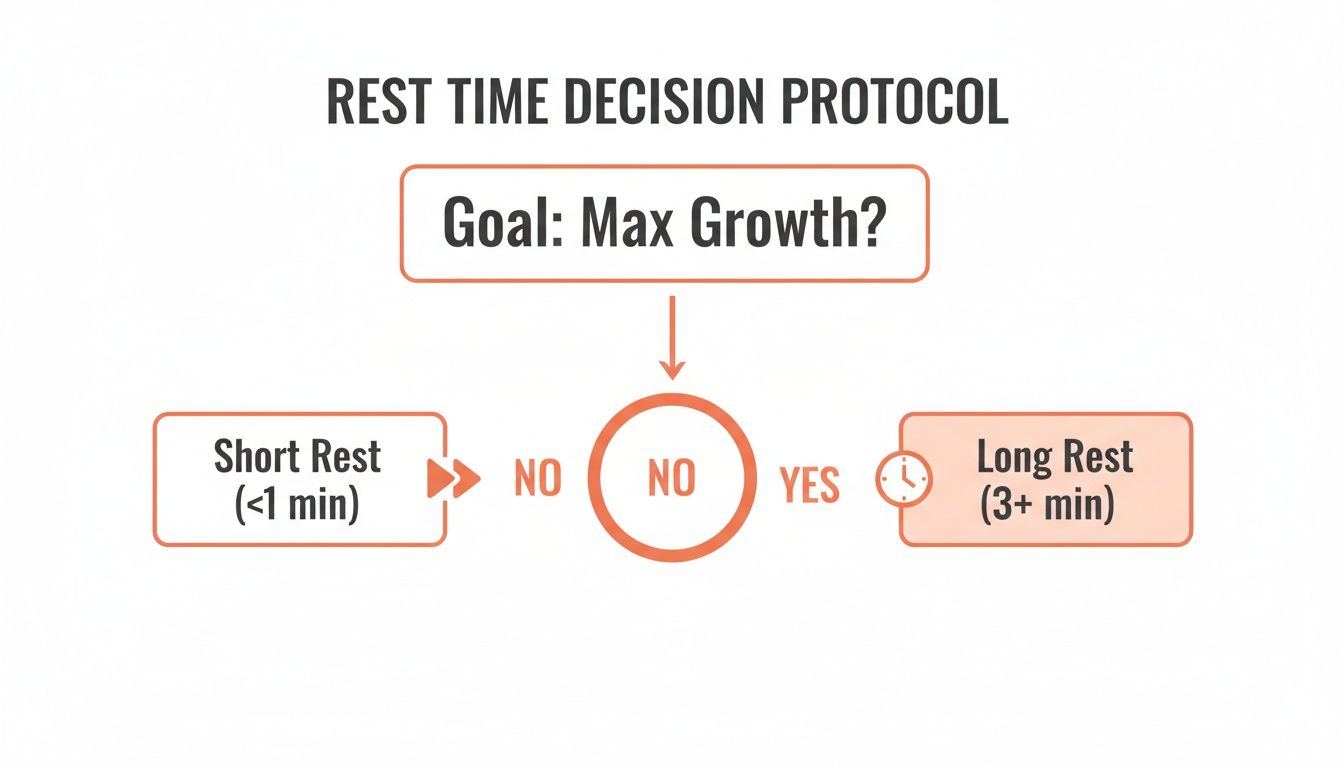
As you can see, if your main goal is piling on as much muscle as possible, longer rest periods are your best friend. They let you perform higher-quality work, set after set.
The Impact of Proximity to Failure
The next layer to consider is how hard you’re actually pushing. Taking a set to the absolute limit—where you physically can't squeeze out one more rep—creates way more fatigue than leaving a couple of reps in the tank. This concept is often called Reps in Reserve (RIR).
A set taken to 0 RIR (total failure) is going to demand a lot more recovery than a set where you stop with 2-3 RIR. If you're grinding out a final, all-out set on squats, you’ll probably need to lean toward the higher end of that 2-5 minute window. But if you’re stopping an isolation curl with a few reps to spare, you can probably stick closer to that 60-second mark.
Your rest period is a direct response to the effort you just gave. The harder you push a set, the more time you need to earn back your strength for the next one.
This flexible approach is backed by a recent Bayesian meta-analysis. It found that while resting less than 60 seconds hurt muscle growth, the benefits were pretty much the same whether people rested 1-2 minutes, 2-3 minutes, or even 3+ minutes. This just reinforces the idea of using at least a minute or two as a baseline and then adding more time for those gut-busting compound lifts or sets taken to failure. You can check out the full research findings on rest intervals and hypertrophy if you want to geek out.
By combining these two factors—the type of exercise and how close you get to failure—you can finally move beyond blindly following a timer. This is about making smart, in-the-moment decisions that make every single set count. And if you want to take the guesswork out of it completely, a smart gym workout tracker can automate the process based on how you're actually performing.
Using Advanced Rest Protocols for Targeted Results
Once you've got the hang of matching your rest times to the exercise, you can start playing with them to get very specific results. This is where you graduate from simply watching the clock and begin to use rest as a strategic tool to smash through a plateau or just get more work done in less time.
It all starts with autoregulation. Instead of being a slave to the stopwatch, you start listening to what your body is telling you. Are you still gasping for air? Is your mind wandering, or are you ready to attack the next set with everything you've got? When your breathing has calmed down and you feel mentally dialed in, you’re good to go. That might be 90 seconds, or it might be three full minutes.
This approach is all about ensuring true recovery between efforts, which is the secret to maintaining high-quality performance and getting the most out of the rest between sets for muscle growth.
Strategic Intensity Techniques
Beyond just listening to your body, you can intentionally shorten your rest periods with some classic intensity techniques. These are designed to crank up the training density and metabolic stress. You wouldn't use these for your heavy squats or deadlifts, but they are absolutely killer for accessory movements or as a finisher to leave you with nothing left in the tank.
Here are a few of my favorites:
Rest-Pause Sets: Take a set to or very near failure. Take a quick breather—literally just 15-20 seconds—and then immediately grind out a few more reps with the same weight. You can repeat this a couple of times. It’s a brutal way to squeeze a massive amount of high-quality volume into what feels like a single, extended set.
Drop Sets: Once you hit failure, don't just rack the weight. Immediately drop the load by 20-30% and keep repping until you fail again. This technique pushes your muscles way past their normal stopping point, creating a powerful growth stimulus by recruiting muscle fibers you might not have hit otherwise.
Supersets: This involves pairing two exercises back-to-back with almost no rest. For building muscle, the best approach is to pair opposing muscle groups, like bicep curls followed immediately by tricep pushdowns. This lets one muscle group recover while the other is working hard.
What makes these techniques so effective is how they manipulate the rest between sets for muscle growth to create a unique physiological response. They’re a fantastic way to shock the system and trigger new adaptations.
Knowing When to Use These Tools
It’s really important to remember that these are specialized techniques, not your bread and butter. Think of them like a turbo button in a racing game—incredibly effective at the right moment, but if you hold it down the whole race, you’ll just burn out your engine.
Use advanced rest protocols to bust through a stubborn training plateau or as a finisher on your smaller, isolation exercises. If you try to use them on your main compound lifts all the time, you’ll just accumulate a ton of fatigue, mess up your recovery, and stall your long-term strength gains.
By mastering autoregulation for your big lifts and strategically sprinkling in these intensity techniques for your accessory work, you gain total control over your training stimulus. It makes your workouts more intuitive, adaptable, and ultimately, way more effective. Using the Built app, you can easily log these advanced sets, see how they affect your recovery, and let the AI help you figure out the perfect time to deploy them for maximum impact.
Got Questions About Rest Periods? Let's Clear Them Up.
Even with the science explained, you probably still have a few questions rolling around in your head. Let's tackle the most common ones to make sure your rest periods are dialed in for the best possible muscle growth.
Does Resting Too Long Between Sets Kill My Gains?
This is one of the most stubborn myths in the gym, but for building muscle, it’s just not true. In fact, resting longer—especially 2-5 minutes on your big, heavy compound lifts—is actually better for growth.
Think about it this way: that extra time lets your body’s main energy systems recharge. When you step back up to the bar, you’re stronger and can push more total reps across all your sets. This drives up your total training volume, which is the number one driver for building muscle. That feeling of “losing your pump” or "getting cold" doesn't matter nearly as much as your actual performance, which gets better with proper rest.
Should I Use the Same Rest Period for Every Exercise?
Definitely not. The right rest period completely depends on the exercise you’re doing. Big, multi-joint movements like squats, deadlifts, and bench presses are incredibly taxing on your entire body. They demand longer rest periods, somewhere in the 2-5 minute range, to recover properly.
On the other hand, smaller isolation exercises like dumbbell curls or leg extensions hit a single muscle group and don't create nearly as much fatigue. For those, a shorter rest of 60-90 seconds is usually perfect. It keeps the intensity high without hurting your performance on the next set.
How Do I Know if I’m Resting Long Enough?
Your performance is the only metric that matters here. Let's say you hit 10 reps on your first set of squats, but on the second set with the same weight, you can only grind out 6. That's a huge red flag that you didn't rest long enough.
A good rule of thumb is to wait until your breathing is mostly back to normal and you feel mentally ready to attack the next set with good form and full effort. Losing a rep or two on later sets is normal, but a massive drop-off means you need more recovery time.
This is a critical part of managing fatigue, which we cover in-depth in our guide on how to prevent overtraining.
Are Supersets Good for Building Muscle?
Supersets are a great tool, but you have to use them wisely. They’re designed to increase the density of your workout and create a lot of metabolic stress. The trade-off is that minimizing rest will almost always reduce your strength on the second exercise of the pair.
They work best when used for:
- Opposing Muscle Groups: Think pairing bicep curls with tricep pushdowns—a classic combo.
- Workout Finishers: Tacking them onto the end of your session is a great way to get a final pump.
Trying to superset your main heavy lifts, like squats and deadlifts? That’s usually a bad move. It’s a surefire way to tank your total volume and stall your long-term strength and size gains.
Stop guessing and start knowing. The Built app can take all the guesswork out of your rest and recovery. Our AI coach watches your performance to tell you exactly how long to rest, and our muscle recovery heatmaps show you which muscles are primed and ready for your next session. Download Built at https://www.builtworkout.com and start training smarter.