So, what does it actually mean to "train to failure"?
In the simplest terms, it’s pushing yourself on an exercise until you physically cannot squeeze out one more repetition with good form. It's that moment of truth when your muscles are so thoroughly exhausted they just can't produce the force needed to move the weight again.
Decoding Training to Failure
At its heart, training to failure is about reaching the absolute peak of muscular effort in a set.
Imagine your muscle's energy is like the fuel in a car's gas tank. Every rep you perform—whether it's a bicep curl or a leg press—burns a little bit of that fuel. After enough reps, the tank finally runs dry. The engine, which is your muscle in this case, just sputters out. No matter how much you will it, you simply can't lift the weight for another rep.
This all-out approach has been a staple in bodybuilding circles for a long time. It was famously championed by legends like Arnold Schwarzenegger in his 1985 book, The New Encyclopedia of Modern Bodybuilding, which cemented its reputation as a non-negotiable key to unlocking serious muscle growth. You can dive deeper into the history and science of this technique and see how our understanding has changed since the 1970s.
But here's a crucial point: not all "failure" is the same. We need to draw a clear line between two very different concepts.
Muscular Failure vs. Technical Failure
These two terms might sound interchangeable, but understanding the difference is absolutely vital for making progress safely.
Muscular Failure: This is the real deal. It’s the physiological point of no return where your muscle fibers are so fatigued they can no longer contract hard enough to move the load. This is true, productive failure.
Technical Failure: This is what happens right before muscular failure. You can still physically move the weight, but your form starts to break down to do it. You might start using a little body English, swinging the weight, or cutting the range of motion short.
For your training to be both safe and effective, the goal is to stop your set at, or just before, technical failure. Pushing past that point is a recipe for disaster. It dramatically increases your injury risk and shifts the stress from your muscles to your joints and tendons—all without adding much, if any, extra benefit.
Measuring Proximity to Failure with RIR
To get more precise than just "going all out," experienced lifters use a concept called Reps in Reserve (RIR).
RIR is simply your best guess at how many more reps you could have completed with perfect form when you decided to end the set. Training to absolute failure is just a 0 on the RIR scale.
A set taken to true muscular failure means you have zero reps in reserve (RIR 0). If you think you could have squeezed out two more good reps, that's an RIR 2.
This simple scale turns a vague feeling into a practical tool. It allows you to program your workouts with much more control, helping you manage fatigue and dial in the perfect amount of intensity for consistent gains.
The Science Behind Muscle Growth and Failure
To really get why training to failure is so powerful, we have to look at what's happening inside your muscles. Building muscle, a process called hypertrophy, isn't just about throwing weights around. It's about sending a very specific, very loud signal to your body that it needs to get bigger and stronger to handle the stress you're putting it through.
That signal is delivered through three key mechanisms that all work together. When you push a set to its absolute limit, you're cranking the dial to max on all three.
- Mechanical Tension: This is the big one. It's the sheer force your muscle fibers experience as they stretch and contract under a heavy load.
- Metabolic Stress: You know that deep burn and tight "pump" you feel? That's metabolic stress—a buildup of byproducts like lactate inside the muscle cells as they scramble to produce energy.
- Muscle Damage: These are the tiny micro-tears in muscle fibers that happen during really intense contractions. This damage kicks off the body's natural repair and growth cycle.
Waking Up Your Strongest Muscle Fibers
The real secret sauce of training to failure lies in how it communicates with your nervous system through a process called motor unit recruitment.
Think of your muscle fibers as a workforce. You've got your everyday, smaller workers who handle the easy stuff, and then you've got your elite special forces—the big, powerful fibers with the most potential for growth. At the beginning of a set, when the weight feels light, your brain only calls up the smaller guys. It's just more efficient.
But as the reps get harder and you start to struggle, your body has no choice but to deploy the elite squad: the high-threshold motor units. These are the largest, strongest fibers you have. By pushing a set all the way to, or very close to, failure, you guarantee that these MVPs are called into action and stimulated to grow. If you stop the set too soon, they never even get the message to punch in.
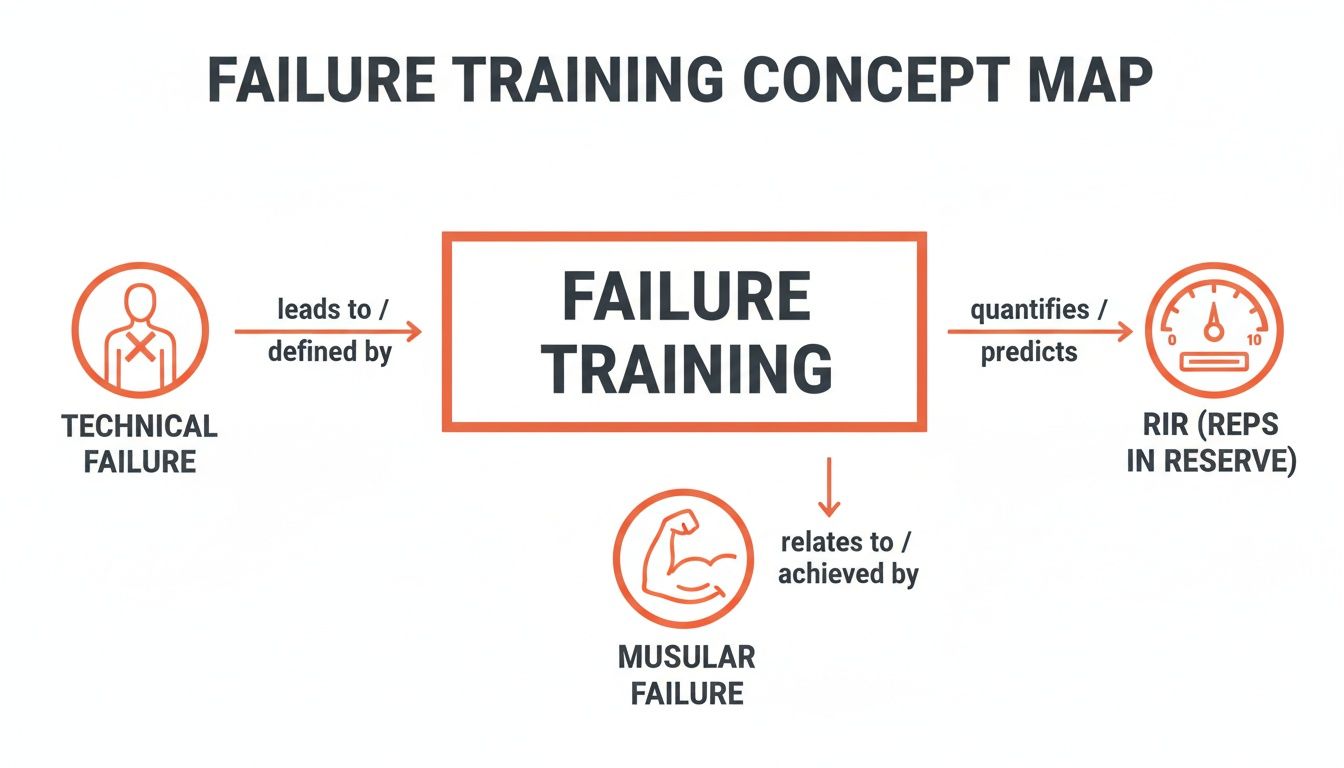
This map shows how we can think about failure. While muscular failure (RIR 0) is the absolute endpoint, stopping at technical failure—the last rep with good form—is the smart play for maximizing growth without unnecessary risk.
How Close Is Close Enough?
So, do you have to grind out that final, ugly rep every single time? The latest science gives us a surprisingly clear picture. The stimulus for muscle growth works more like a dimmer switch than an on/off button—the closer you get to failure, the brighter the growth signal becomes.
A massive 2023 meta-analysis, which crunched the numbers from 214 separate studies, confirmed this "dose-dependent" relationship. It found that stopping with 5 reps still left in the tank (RIR 5) only delivers about 75% of the potential muscle gain from that set. But for every rep you push closer to failure from there, the growth stimulus jumps by about 5%.
This means by pushing to just 1-2 reps shy of failure, you're capturing 90-95% of the possible gains. That's a huge return on your effort.
Training to failure isn't an on/off switch for muscle growth; it's a dimmer dial. The closer you get to RIR 0, the brighter you turn up the signal for hypertrophy.
This is a game-changer for smart training. It tells us that while going to absolute failure provides the biggest possible signal, you can get almost all of the benefit by stopping just short. This simple shift can make a world of difference in managing your overall fatigue and recovery.
Of course, pushing your body this hard means recovery is non-negotiable. Intense training and proper repair go hand-in-hand, which is where things like sleep, nutrition, and even targeted muscle recovery supplements come into play. Getting this balance right is what allows you to hit your muscles hard and often enough to grow, which directly impacts your training frequency for hypertrophy.
Does Training to Failure Build Strength?
When we shift the conversation from building as much muscle as possible to gaining pure, raw strength, the role of training to failure changes completely. There's a persistent myth in the gym that you have to grind out every set to its absolute limit to get stronger. The reality? For strength, the most important thing is lifting heavy, not necessarily lifting until you can't move the bar another inch.
It all boils down to a fundamental concept in training: the principle of specificity. Getting strong isn't just a byproduct of having big muscles; it's a specific skill. A powerlifter's entire goal is to master the skill of generating maximum force for one single, explosive rep. That requires crisp, powerful movements with perfect technique.
Grinding out those last few shaky, slow-motion reps at the end of a set taken to failure simply doesn't practice this skill. In fact, it does the opposite. It trains your body to be slow and inefficient under a heavy load. When it comes to strength, the quality of each rep is far more important than the quantity.
Why Leaving Reps in the Tank Is Better for Strength
For building strength, stopping a set while you still have a little left in the tank—usually in the 2-4 Reps in Reserve (RIR) range—is almost always the better choice. This strategy allows you to lift heavier weights with better form, and that is the real engine of strength adaptation.
Think about it this way: if you take a heavy set of squats to absolute failure, you've just created a massive amount of fatigue. Your nervous system is taxed, and your form probably got ugly on that last rep. As a result, your next heavy set is going to suffer, and your recovery for your next squat session is already compromised.
By stopping a few reps short, you unlock a few key advantages:
- Higher Quality Reps: Every single rep is done with good technique and maximum power, which is exactly what reinforces the neural pathways for getting stronger.
- Smarter Fatigue Management: You sidestep the excessive central nervous system (CNS) fatigue that comes with true failure. This means you recover faster between sets and between workouts.
- More High-Quality Volume: Because you’re not so drained, you can handle more total heavy sets over the course of a week, which is a massive factor for long-term strength gains.
This approach lets you consistently practice the skill of lifting heavy, which is what leads to steady, sustainable progress.
What the Science Says About Strength and Failure
This isn't just old-school gym wisdom; modern research overwhelmingly supports this idea. While training to failure is a potent tool for muscle growth, it's just not necessary for strength. The science is pretty clear on this.
A massive 2023 meta-analysis, which looked at data from 214 separate studies, found no significant link between how close someone trained to failure and how much strength they gained. As long as the weight was heavy enough, it didn't really matter if lifters pushed to their limit or stopped early—their strength gains were statistically the same. You can dig into these findings on how training intensity impacts strength and muscle growth.
The big takeaway here is that for strength, the stimulus comes from the heavy load on the bar, not from the exhaustion at the end of the set. Pushing to failure doesn't provide some magic strength-building signal that a heavy, non-failure set doesn't already deliver.
This should be liberating for anyone whose main goal is getting stronger. It means you can focus on perfect, powerful reps and smart recovery without worrying that you're leaving gains on the table. Your focus should be on progressive overload—methodically adding weight to the bar over time—while keeping your form locked in.
The Hidden Costs of Training to Failure
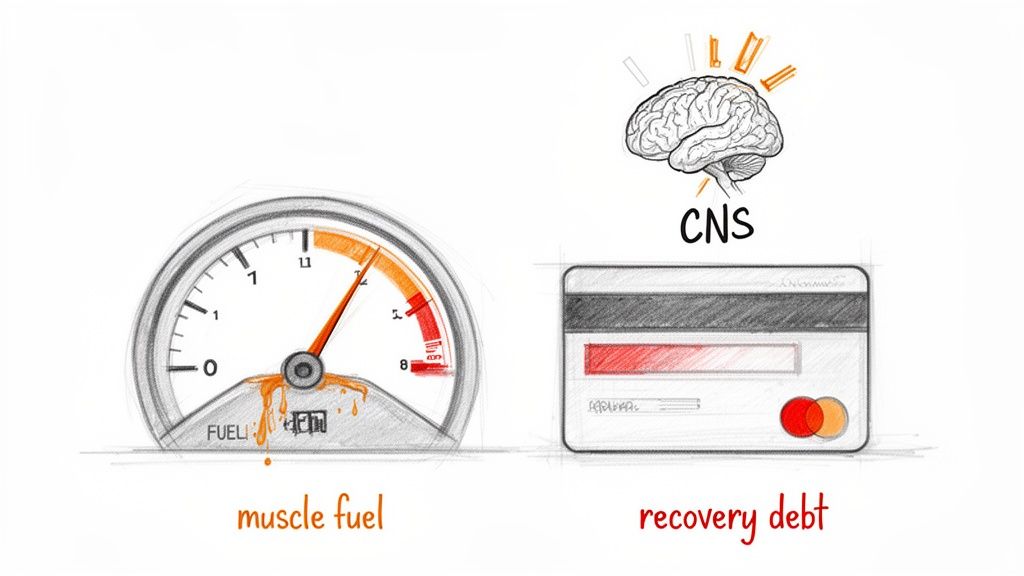
While pushing every set to its absolute limit feels like the fastest way to get stronger, training to failure isn't a free lunch. Every time you grind out that final, all-or-nothing rep, you're making a huge withdrawal from your body's recovery bank account. Do this too often, and you'll find yourself in a state of physiological debt that's incredibly hard to climb out of.
Think of your recovery capacity like a credit card with a pretty strict limit. A tough workout is a normal purchase, but a set taken to true muscular failure is like a cash advance with a sky-high interest rate. You get a powerful stimulus right away, but the payback is steep. It comes in the form of deep, systemic fatigue that sticks around long after you've left the gym.
This isn't just about being sore. The real cost is the profound stress you place on your Central Nervous System (CNS)—the command center that runs everything from muscle contractions to hormone regulation. Pushing to failure constantly is like redlining your car's engine every time you drive. Eventually, something is going to break.
The CNS Fatigue Factor
When you push to failure, especially on big, demanding lifts like squats or deadlifts, you generate a massive amount of CNS fatigue compared to just stopping a rep or two short. This isn't just a local feeling in the muscle; it's a neurological exhaustion that impacts your entire system.
The fallout from this built-up fatigue is serious and can quietly sabotage your progress in a few ways:
- Reduced Performance in Future Workouts: The fatigue from a failure-heavy leg day on Monday can still be weighing you down during your chest press on Wednesday, forcing you to use less weight or get fewer reps.
- Decreased Total Weekly Volume: Over time, this systemic drain means you just can't train as hard or as often. You might do fewer quality sets over the course of a week, which is a major driver of long-term muscle growth.
- Elevated Injury Risk: A tired nervous system leads to shaky motor control and sloppy form. That's a recipe for injury.
Consistently ignoring these costs is a fast track to a much bigger problem. This is why knowing how to prevent overtraining is a non-negotiable skill for anyone serious about lifting. It's all about balancing that intense effort with smart recovery.
Is the Extra Stimulus Worth the Cost?
This brings us to the million-dollar question: does the extra muscle-building signal from that last-ditch rep justify the massive recovery cost? For years, everyone just assumed the answer was "yes." But modern research paints a much more complicated picture.
A revealing 2020 study directly compared groups training to failure (RT-F) against those who stopped just short (RT-NF). The result? Both groups experienced equal muscle growth. It turns out that training very close to failure already recruits the maximum number of muscle fibers, all without the huge systemic stress and cortisol spike that comes with total exhaustion. You can dig into the findings on recovery and muscle activation for yourself.
This suggests that for most people, the tiny extra benefit of true failure is completely outweighed by the massive recovery debt it creates. You can get almost all of the gains by leaving one or two good reps in the tank.
But this doesn't mean failure is useless. One 2023 meta-analysis did find that training to failure could provide a slight edge, but only in very low-volume training plans (around 10 sets per muscle group per week). It came with a big catch, though: this benefit vanished and turned into a negative as weekly training volume increased, simply because the recovery demands became too much.
This highlights the most important takeaway: training to failure is a precision tool, not a sledgehammer you swing on every set. The real art of smart training is knowing exactly when to use it for maximum impact and when to hold back so you can keep training hard, week after week.
How to Implement Failure Training Safely
Knowing the theory behind training to failure is one thing, but putting it into practice without getting hurt is a whole different ballgame. If you just go all-out on every single exercise, you're on a fast track to burnout and injury.
The trick is to be smart and surgical with it. Think of failure as a high-precision tool in your toolbox, not a sledgehammer you swing wildly. It’s all about being strategic—choosing the right exercises, knowing how often to push the limits, and understanding when to back off. Get this right, and you can turn this intense technique into a powerful catalyst for growth.
Choose Your Exercises Wisely
This is the single most important rule. Seriously. Not all exercises are created equal when it comes to safely pushing your limits. The risk of your form completely breaking down is way higher on some lifts compared to others.
Imagine a spectrum of risk. At one end, you have stable, predictable movements where the chance of a catastrophic mistake is almost zero. At the other end, you have highly technical lifts where one sloppy rep can spell disaster.
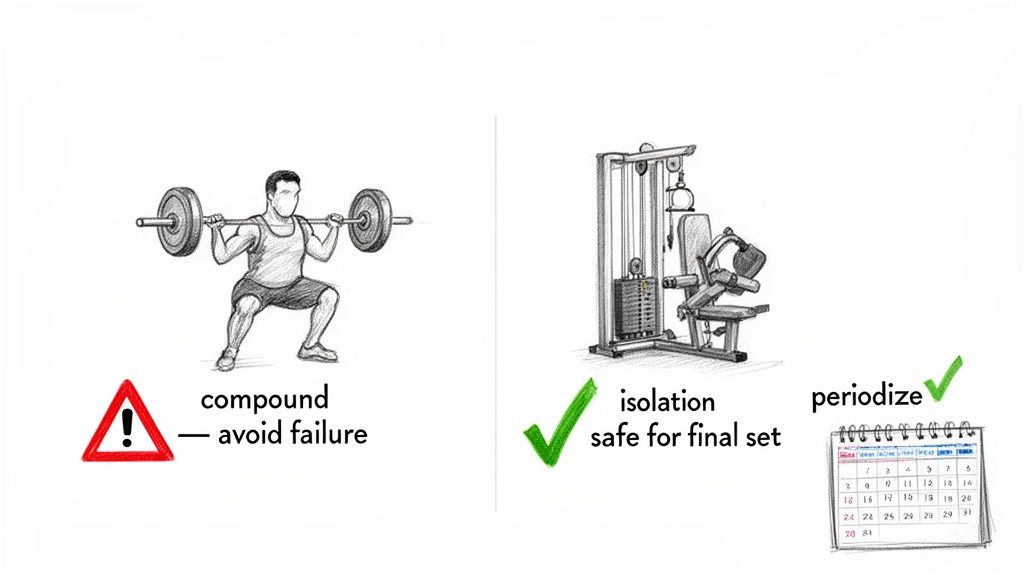
- Low-Risk (Good for Failure): Think machine-based exercises or single-joint isolation movements. The machine stabilizes the weight for you, so all you have to do is focus on pushing the muscle. Simple.
- Examples: Machine chest press, leg extensions, bicep curls, lateral raises, hamstring curls.
- High-Risk (Avoid Failure): These are your big, free-weight compound lifts—the ones that demand total-body stability and perfect technique. Pushing a heavy squat to the point where you physically can’t stand up is just asking for trouble.
- Examples: Barbell squats, deadlifts, overhead presses, barbell rows.
The golden rule is simple: take muscles to failure, not movements. When your bicep fails on a curl, the dumbbell just drops. When your form fails on a heavy deadlift, your entire system is at risk.
Use the Final Set Rule
Even if you pick the safest exercises, going to failure on every single set is a bad idea. It just generates a mountain of fatigue that crushes the rest of your workout, meaning you end up doing less quality work overall.
A much smarter, more sustainable approach is the "final set only" rule. For a given exercise, do your first set or two stopping just shy of failure—leaving 1-2 good reps in the tank. This lets you rack up quality volume while you're still fresh. Then, on that very last set, you earn the right to go for broke and push to true technical failure.
This method gives you that powerful growth signal from failure without the massive recovery hangover. It’s the best of both worlds: you get plenty of effective volume plus a peak intensity stimulus.
Periodize Your Approach to Failure
Finally, a smart lifter always looks at the big picture. Training to failure shouldn't be a constant fixture in your program. It’s a dial you turn up or down depending on your goals and how your body is feeling. We call this periodization.
Think about how your use of failure training should change throughout the year.
- Muscle-Building (Hypertrophy) Phase: This is prime time to sprinkle in more failure sets. Your goal is maximum muscle growth, and this is a powerful tool to help you get there.
- Strength Phase: When your main goal is getting stronger, you need to pull way back on failure training. The priority here is moving heavy weight with perfect, crisp form, which is impossible when you're completely gassed.
- Deload or Recovery Week: During a deload, training to failure is completely off-limits. The whole point is to let your body and nervous system recover from all the accumulated stress.
Proper Workout Recovery is just as crucial as the training itself, especially after intense failure sets. To map all this out, it helps to understand recovery timelines. A good muscle recovery time chart can help you align your training effort with your body's real-world ability to adapt and grow stronger.
Train Smarter, Not Just Harder
The big takeaway here? Training to failure is a powerful tool in your toolbox, but it's not a golden hammer you should use on every single set. Real, long-term progress is all about using this intensity intelligently, not just throwing it around indiscriminately. It’s about knowing when to floor it and when to pull back and let your body recover.
Let’s quickly revisit the core ideas we've covered.
The Right Tool for the Right Job
Training to failure really shines when your main goal is building muscle. Pushing to that absolute limit is an undeniable signal for hypertrophy because it forces your body to recruit every last muscle fiber. But when it comes to building pure, raw strength, its usefulness drops off. Strength is a skill, honed with heavy, clean reps—not by grinding yourself into exhaustion.
The ultimate goal is to find that sweet spot between pushing your limits to grow and managing fatigue for long-term success. Stop guessing and start training with intention.
On top of that, this kind of intensity has a high recovery cost. Every set you take to failure taxes your central nervous system, and if you don't manage it, you'll feel it in your next workout. This is exactly why it's best saved for safer, single-joint movements and, more often than not, just for the final set of an exercise.
Once you get a handle on when and how to go to failure, you can finally break free from that "more is always better" trap. Using a quality gym workout tracker gives you the hard data to see how training closer to failure actually affects your performance over weeks and months, helping you dial in that perfect balance. This strategic approach is what separates just training hard from truly training smart—and it’s your ticket to consistent, injury-free gains.
Frequently Asked Questions About Training to Failure
Even after you've got the basics down, it’s natural to have questions when you start using an intense technique like training to failure. Let's tackle some of the most common ones so you can use this tool safely and get the results you're after.
Should I Train to Failure on Every Set?
Absolutely not. That’s a one-way ticket to burnout. Pushing every single set to the absolute limit generates a massive amount of systemic fatigue. This exhaustion doesn't just crush your performance on the next set—it can spill over and wreck your next few workouts, effectively killing your total training volume for the week.
A much smarter approach is to save it for the final set of an exercise. This works best for isolation movements or machine exercises where the risk of getting hurt is low. You get that powerful muscle-building signal without accumulating the kind of recovery debt that stalls your progress.
Is Training to Failure Safe for Beginners?
Beginners need to be extremely careful here. If you're new to lifting, your number one job is to master proper form and build a solid foundation of strength. Jumping into failure training too soon almost always leads to a breakdown in technique, and that’s when injuries happen.
Instead of chasing failure, beginners should focus on consistent progressive overload, leaving 2-3 good reps in the tank (an RIR of 2-3). Once your form is locked in and you've got some experience under your belt, you can start strategically adding failure sets into your program.
What's the Difference Between Muscular and Technical Failure?
This is a crucial distinction, and getting it right is key to staying safe.
- Technical Failure: This is the moment you can no longer complete another rep with perfect form. Maybe you have to start using a little body English or momentum to get the weight up. This is your cue to stop.
- Muscular Failure: This is when the target muscle itself is completely tapped out. It physically cannot contract hard enough to move the weight, no matter how much you try to cheat.
For the sake of both safety and effectiveness, your goal should always be to stop at or just before technical failure. Pushing past this point offers almost no extra benefit for muscle growth but dramatically increases your risk of injury while reinforcing bad habits.
Can I Train to Failure with Squats and Deadlifts?
Technically, yes, but it's a terrible idea for almost everyone. Taking heavy, complex lifts like barbell squats, deadlifts, or the overhead press to absolute failure is highly discouraged.
When you fail on one of these big lifts, the risk of serious injury is incredibly high as your form completely disintegrates under a heavy load. It also fries your central nervous system. It's far safer and more productive to use failure training on single-joint exercises like bicep curls and leg extensions, or on machines that provide a controlled path of motion. For more on balancing this kind of intensity with your overall training schedule, check out our guide on working out twice a day.