
So, can you work out twice in one day? The short answer is yes, absolutely. But the real question is, should you?
This isn't a strategy for the faint of heart or those new to the gym. It's an advanced tool, and if you don't wield it correctly, you're more likely to burn out than build up. For seasoned lifters and athletes, however, it can be a game-changer.
The Truth About Working Out Twice a Day
Training twice a day—what many of us call "two-a-days"—isn't about just doing the same workout twice. That’s a recipe for disaster. It’s about intelligently splitting your training volume into two distinct, focused sessions.
Think of it this way: instead of one long, grueling workout where your energy and form start to fade by the end, you’re hitting two shorter, more intense sessions. This allows you to bring a higher level of quality and focus to each one, with several hours of rest and a meal in between. The whole point is to increase your total weekly training volume—a key driver for muscle and strength gains—without sacrificing the quality of your reps.
Is This Advanced Method Right for You?
Jumping into a twice-a-day routine depends entirely on your training history, your specific goals, and, frankly, your life outside the gym. If you're just starting out, stick to one solid workout a day. The risk of injury and overtraining is just too high otherwise.
But if you're an experienced lifter trying to push past a stubborn plateau, or an athlete gearing up for a competition, this approach can provide the stimulus you need.
Before you even consider it, you need to be honest with yourself about a few things:
- What's the goal? Are you peaking for a powerlifting meet, trying to pack on size for a specific deadline, or seriously upping your conditioning? General fitness doesn't require this.
- What's your training age? Have you been training consistently and with good form for at least a year? Your body needs that foundation to handle the extra stress.
- Can you actually recover? This is the big one. Your lifestyle has to support the extra work. That means nailing your sleep, nutrition, and stress management.
This flowchart gives you a great visual gut-check on whether your goals and recovery habits are ready for a twice-daily schedule.
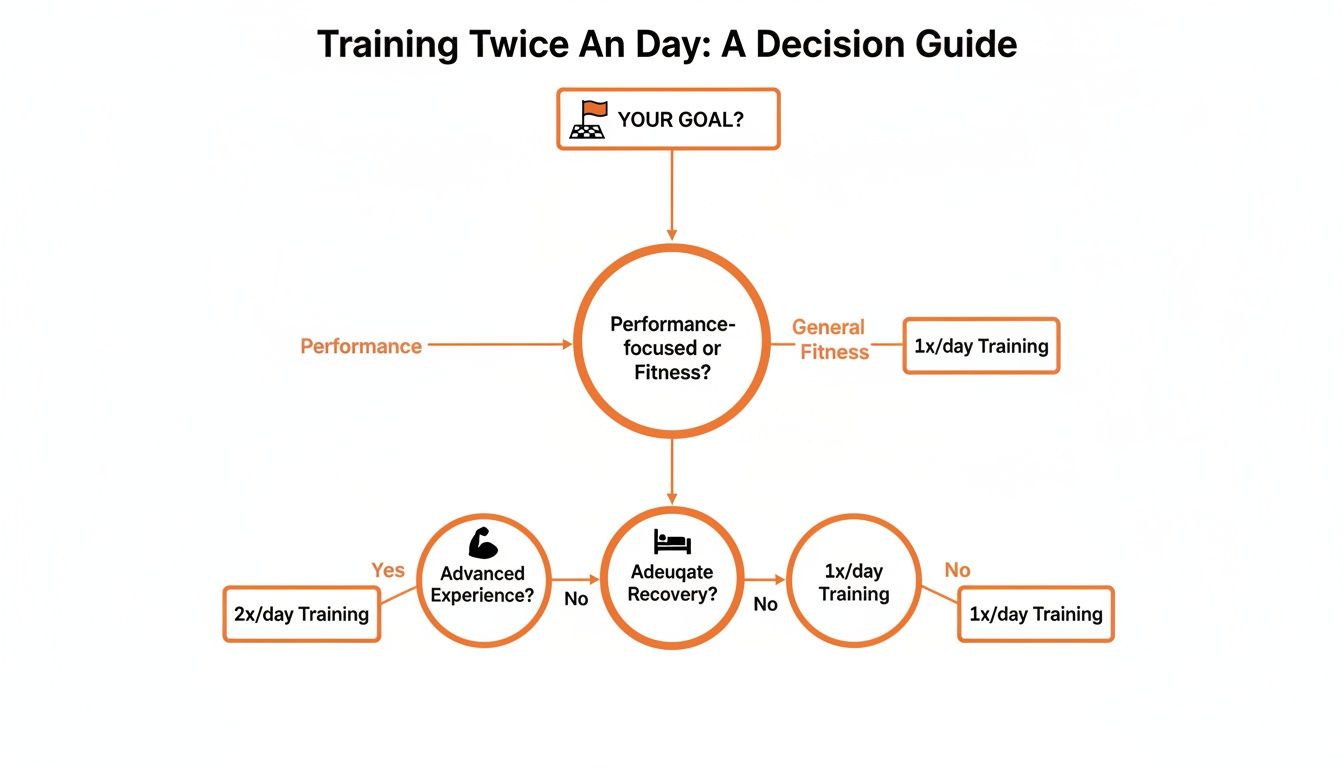
As you can see, this path is really reserved for people with clear performance goals, a solid base of training, and a life that allows for serious recovery.
Quick Assessment: Is Two-a-Day Training Right for You?
Still on the fence? Use this table for a quick, honest evaluation of where you stand. It's a simple way to see if this demanding protocol aligns with your current fitness journey before you dive in.
| Factor | Consider It If... | Be Cautious If... |
|---|---|---|
| Experience | You have 1+ years of consistent, structured training under your belt. | You're a beginner or have been training seriously for less than a year. |
| Primary Goal | You're an athlete prepping for an event or trying to smash a specific performance plateau. | Your goal is general health, and you're still seeing good progress with one workout a day. |
| Recovery | You consistently lock in 7-9 hours of quality sleep and have your nutrition and stress dialed in. | Your sleep is hit-or-miss, your diet isn't supporting your training, or you're under a lot of life stress. |
| Time | Your schedule allows for two separate workouts with at least a 4-6 hour gap to rest and refuel. | You're already struggling to find time, and squeezing in two sessions would be a stressful nightmare. |
This isn't about ego. It's about training smart. If your answers fall more into the "Be Cautious" column, that's okay! Master the fundamentals with single daily sessions first. The iron will still be there when you're ready.
The Science Behind Splitting Your Workouts
To really get why two-a-days can be so effective, you need to look past the "more is better" mindset. The real magic isn't just about cramming more work into your day; it’s about strategically manipulating your body's natural cycle of stress and recovery to your advantage.
Think about it like building a house. You could pull a single, grueling 10-hour shift, but you know that by hour eight, you'll be dragging. Your focus will be shot, mistakes will creep in, and the quality of your work will plummet. The alternative? Two focused 5-hour shifts with a solid break for lunch and rest in between. The total work time is the same, but the quality and precision in that second shift are worlds apart.
That’s exactly what happens when you split your workouts. You get to attack both sessions with high energy and sharp mental focus—something that’s nearly impossible to sustain in a single marathon session that drags on past 90 minutes.
Supercompensation: Your Body’s Adaptive Secret Weapon
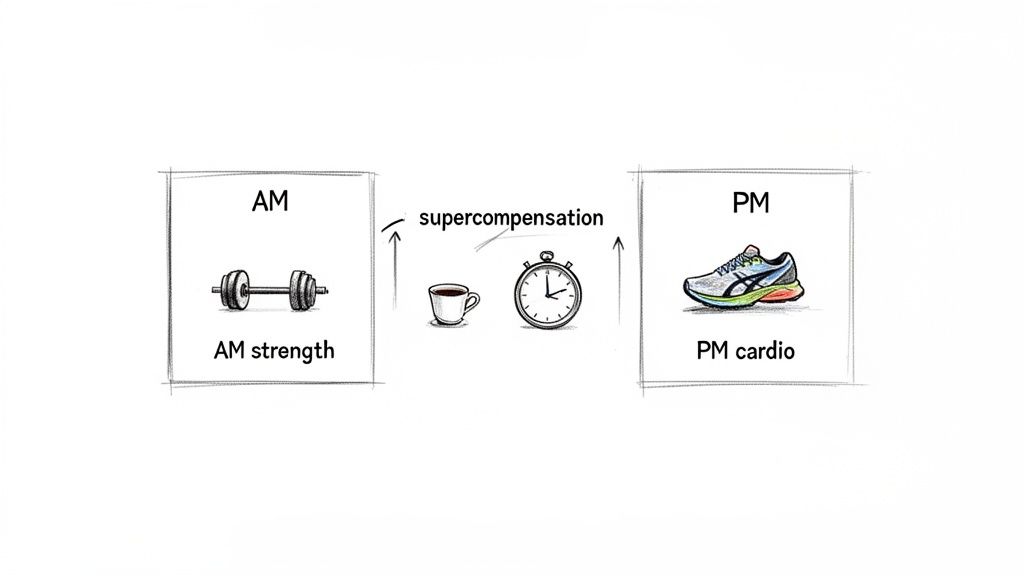
Every time you hit the gym, you're introducing a stressor that temporarily leaves you a little weaker. That’s fatigue setting in. In response, your body doesn’t just repair itself back to its starting point; it rebuilds itself to be slightly stronger and more resilient than before. This "overshoot" effect is a fundamental process called supercompensation.
A smartly planned two-a-day schedule lets you introduce a second workout right when your body is starting to enter this super-charged adaptive state. This doesn't mean you should hammer the same muscles twice. Instead, you're training different qualities or muscle groups, essentially piggybacking on the recovery from the first session without overdoing it.
Supercompensation is the body's post-training adaptation, where it doesn't just repair to its original state but builds itself up stronger. Smart two-a-day schedules layer training stimuli to take advantage of this process for accelerated gains.
A classic example is hitting a heavy, neurologically taxing strength workout in the morning. After a 6-8 hour break to refuel and recover, your system is primed and ready for a second, less intense session. This could be some hypertrophy work for a different muscle group or even some light cardio.
Managing the Volume vs. Intensity Equation
At the end of the day, a huge driver of long-term muscle and strength gains is your total weekly training volume (your sets x reps x weight). Working out twice a day is one of the most powerful tools for cranking up that volume without making any single workout a miserable slog.
- Improved Session Quality: When workouts are shorter, you can maintain better form and higher intensity from start to finish. This is non-negotiable for maximizing muscle activation and keeping injuries at bay.
- Increased Hormonal Response: Hitting the gym twice can trigger two separate spikes in muscle-building hormones and post-exercise oxygen consumption (EPOC), which can boost your metabolism and protein synthesis throughout the day. You can dive deeper into how training frequency impacts muscle growth in our detailed guide.
But there’s a catch: you have to manage your Central Nervous System (CNS). Think of your CNS as your body's command center. Heavy squats, deadlifts, and complex lifts put a massive strain on it. Trying to double up on these high-intensity sessions without enough recovery is a one-way ticket to CNS fatigue, which shows up as burnout, stalled progress, and terrible sleep.
This is precisely why the structure of your two-a-days is everything. It's a delicate balancing act between high-intensity and low-intensity work, making sure your two sessions complement each other instead of clashing. Get it right, and you can push your limits and drive progress far faster than you ever could with a single daily workout.
What Are the Real Benefits of Two-a-Day Training?
When you plan them right, working out twice a day is more than just cramming in extra volume. It’s a strategic way to speed up your progress by tapping into physiological benefits you just can’t get from a single marathon session.
The biggest win is the quality of each workout. Think about it: instead of slogging through the back half of a two-hour workout, energy tanking and form getting sloppy, you get to hit two shorter sessions with full intensity. That higher quality of work is what really drives adaptation and growth.
Supercharge Your Strength Gains
If you're serious about getting stronger, especially on the big compound lifts, two-a-days can be a game-changer. By hitting your heavy, low-rep strength work in the morning, you’re training your central nervous system when it's fresh and ready to fire on all cylinders. That means better performance and, ultimately, heavier lifts.
This isn't just bro-science. A 2021 study on trained men looked at this exact scenario, splitting their resistance training into two daily sessions. The results for lower-body strength were eye-opening: the group training twice a day boosted their back squat 1-rep max by 16.1%. That completely overshadowed the single-session group, which only saw a 7.8% improvement. You can dig into the full study on twice-daily resistance training to see the data for yourself.
It’s clear proof that for pure strength, two focused sessions can be far more powerful than one long one.
Sharpen Your Skills and Conditioning
The advantages don't stop with lifting heavy. If you're an athlete in a technical sport—think martial arts, gymnastics, or Olympic weightlifting—splitting your sessions lets you practice your skills without fatigue getting in the way.
- Morning Session: This is your time for the most complex skills or technical lifts. Your mind is sharp, your coordination is at its best, and you can really focus on ingraining perfect movement patterns.
- Evening Session: Use this workout for the supporting cast: strength and conditioning work, accessory exercises, or dedicated mobility drills that complement your main goal.
This approach keeps physical exhaustion from messing with your technique, helping you get better, faster. It also lets you build in cardio or conditioning without draining the energy you need for your main strength session.
By separating different training goals—like strength in the morning and conditioning in the evening—you give yourself the chance to perform each one at a higher quality. You get better overall development without one goal compromising the other.
Kickstart Your Metabolism Twice
Every intense workout triggers something called Excess Post-exercise Oxygen Consumption (EPOC), better known as the "afterburn effect." It’s a period where your body keeps burning calories at a higher-than-normal rate as it works to recover.
When you train twice in one day, you get to ignite that afterburn effect twice.
You're essentially getting two separate waves of elevated calorie burn. The first workout revs up your metabolism, and just as it starts to settle down, the second session fires it right back up. For anyone focused on fat loss or improving body composition, this sustained metabolic boost can significantly increase your total daily energy expenditure. And by checking your recovery data in an app like Built, you can confidently hit that second session, knowing you're ready to go without pushing already tired muscles too far.
Recognizing the Risks of Overtraining
Jumping into a twice-a-day workout schedule can feel like a fast track to your goals, but it comes with a major catch. Without respecting your body's limits, it's like flooring the gas pedal on a performance car without checking the brakes. More training isn't always better, and pushing past your recovery capacity can slam your progress into reverse, leading straight to Overtraining Syndrome (OTS).
This isn't just about feeling wiped out after a tough workout. OTS is a serious physiological hole you can dig for yourself, where the accumulated stress from training completely overwhelms your body's ability to repair and rebuild. It can sideline you for weeks—or even months—leaving you frustrated, burned out, and watching your hard-earned gains disappear.
The best defense is a good offense, and that means learning to spot the early warning signs.
Differentiating Fatigue from Overtraining
It's absolutely critical to know the difference between productive training fatigue and the persistent, body-wide exhaustion that signals you’re heading for trouble. One is a sign you’re doing things right; the other is a blaring red flag.
Normal fatigue is temporary. You feel sore and tired after a killer session, but a good night’s sleep and a solid meal have you feeling recovered and ready for the next one. Overtraining, on the other hand, is a deep, relentless drain that sticks around no matter how much you try to rest. If you want to dig deeper into this topic, our guide on how to prevent overtraining is a great resource.
It can be tough to tell the difference when you're in the thick of it. The key is to pay attention to how your body responds over time, not just in the hours after a workout.
Overtraining Signs vs Normal Training Fatigue
This table helps you learn to differentiate between the productive fatigue that leads to growth and the harmful symptoms of overtraining.
| Symptom | Normal Fatigue (Responds to Rest) | Overtraining Sign (Persists or Worsens) |
|---|---|---|
| Performance | A temporary dip, but you bounce back stronger for the next session. | Stalled or declining lifts for over a week; familiar weights feel impossibly heavy. |
| Mood | You feel accomplished, maybe a bit tired but generally energized. | Persistent irritability, low motivation, anxiety, or feeling constantly "on edge." |
| Sleep | Sleep quality is generally good and might even improve with hard training. | Trouble falling asleep, restless nights, or waking up feeling just as exhausted. |
| Soreness | Expected muscle soreness (DOMS) that fades in a day or two. | Lingering, deep muscle aches and joint pain that never seem to go away. |
Knowing these distinctions is the first step. The next is to stay vigilant and be honest with yourself about what your body is telling you.
Physiological and Psychological Red Flags
Think of these signs as your body's "check engine" light. Ignoring them is a recipe for a total breakdown.
Physiological Alarms:
- Elevated Resting Heart Rate: This is one of the most reliable red flags. If your morning heart rate is 5-10 beats per minute higher than your baseline, it’s a clear sign your system is under major stress.
- Getting Sick More Often: Overtraining hammers your immune system, leaving you vulnerable to every cold and bug going around.
- Loss of Appetite: A sudden drop in your desire to eat often points to hormonal imbalances caused by excessive stress.
Psychological Alarms:
- Mood Swings: Finding yourself unusually irritable, anxious, or just completely apathetic about training is a huge warning.
- Brain Fog: Overtraining doesn’t just tax your muscles; it hits your central nervous system, leading to poor concentration in and out of the gym.
Overtraining is a state of systemic breakdown where performance stagnates or declines despite increased training. It's marked by persistent fatigue, mood changes, and physiological stress that rest alone can't fix quickly.
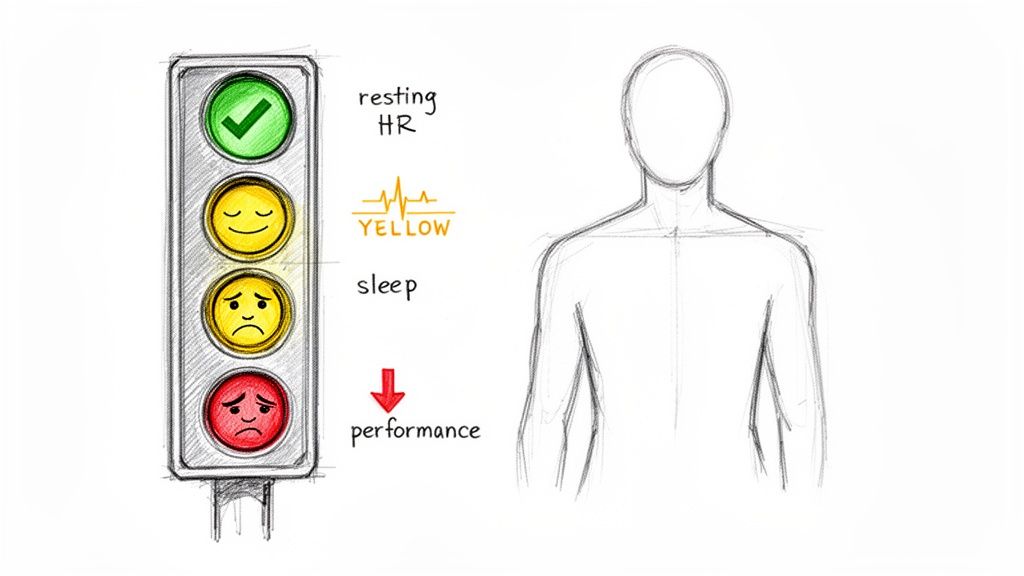
The smartest approach is to be proactive, not reactive. Instead of guessing how you feel, you can use objective data to make better decisions. This is where modern tools shine. Tracking your muscle recovery with an app like Built works like a traffic light for your body: green means you're recovered and good to go, yellow suggests caution and a need to adjust volume, and red is a hard stop, telling you to prioritize rest.
This data-driven approach empowers you to self-regulate, ensuring you get all the benefits of twice-a-day training while skilfully avoiding the pitfalls of overtraining.
How to Fuel and Recover for Twice-a-Day Workouts
If you're asking whether it's okay to work out twice a day, the answer hinges almost entirely on what you do between those sessions. The gym is where you create the stimulus for growth, but the real magic happens during recovery. Doubling your training without also upgrading your recovery strategy is a one-way ticket to burnout, not progress.
Success with two-a-days is built on two non-negotiable pillars: smart nutrition and high-quality sleep. These aren't just helpful add-ons; they are the absolute foundation that makes this advanced training style work. Without them, you’re just digging a deeper and deeper hole of fatigue.
Dialing in Your Nutrition for Double Sessions
When you double your workouts, you have to get serious about your fueling strategy. Your body's demand for energy and the raw materials for repair goes through the roof. This is non-negotiable, so it’s worth consulting a detailed guide to pre and post-workout nutrition for maximum results to get it right.
Here’s where to focus your efforts:
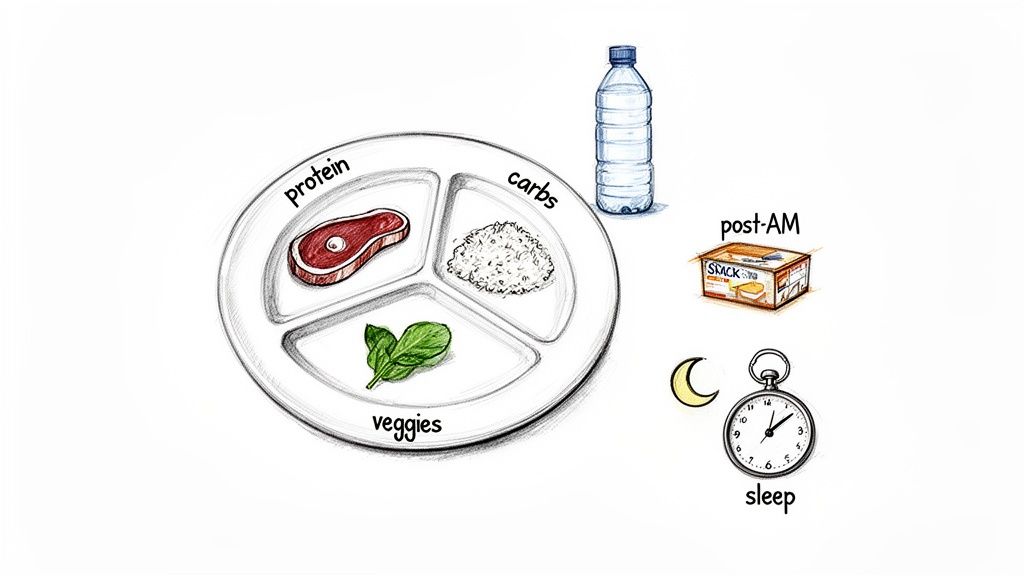
- Carbohydrates Are Your Best Friend: Your body stores carbs as glycogen, which is the high-octane fuel for intense exercise. Your morning session will drain those stores, and you have a limited window to top them off before your evening workout. Focus on easily digestible carbs right after you train.
- Protein Pacing is Key: Protein provides the amino acids needed to patch up damaged muscle fibers. Spreading your protein intake throughout the day—especially in the meals after each workout—ensures a steady supply is always available for repair and growth.
- Hydration is Crucial: It's easy to forget that you lose a ton of fluids and electrolytes during two intense sessions. Dehydration can absolutely crush your performance and slow down recovery, so make a habit of sipping water consistently all day long.
Think of the time between your workouts like a pit stop in a race. Your goal is to refuel, rehydrate, and make quick repairs so you're ready for the next lap. A solid meal with both protein and carbs within 1-2 hours of your first session is a perfect start. For a deeper dive, check out our complete breakdown of the muscle recovery time chart.
The Overlooked Power of Sleep
You can have the perfect training plan and a flawless diet, but if your sleep is garbage, you simply won't recover from two-a-days. Period. Sleep is when your body gets down to the serious hormonal business of muscle growth and repair.
During deep sleep, your body releases a surge of Human Growth Hormone (HGH), a powerful hormone that's critical for fixing tissue. On the flip side, poor sleep can lead to elevated levels of cortisol, a stress hormone that actively breaks down muscle tissue and gets in the way of recovery.
Sleep isn't a passive activity; it’s your body’s most powerful recovery tool. Prioritizing 7-9 hours of quality sleep is just as important as any set or rep you perform in the gym.
While training more might seem like the fastest way to get results, a massive 30-year study showed that the health benefits are significant. It found that individuals who performed 2-4 times the minimum recommended exercise had a 26-31% lower risk of all-cause mortality—a volume that often requires more frequent workouts. Read the full research about these exercise findings.
This data shows the incredible potential of higher training volumes, but it only works if your recovery can keep up. Treat your sleep and nutrition with the same seriousness as your training, and you’ll unlock the true potential of working out twice a day.
Building Your Two-a-Day Workout Schedule
Knowing the why behind two-a-days is one thing, but figuring out how to actually structure them is where the real magic happens. A smart twice-a-day plan isn’t just about doing more work; it’s about strategically pairing different kinds of workouts to maximize your results while keeping burnout at bay.
The whole game is about making your sessions complementary, not conflicting. You wouldn’t deadlift for a new one-rep max in the morning and then come back to do the exact same thing that night. Instead, you pair a high-intensity, neurologically taxing workout with a lower-intensity session that targets a different goal or muscle group.
Let's break down what that looks like for a few common goals.
Maximizing Pure Strength
When getting brutally strong is the mission, your heavy compound lifts are king. These movements put a massive strain on your Central Nervous System (CNS), so they need to be done when you’re fresh and firing on all cylinders. That makes them perfect for your morning workout.
The evening session then becomes your support crew. The goal here is to build up the smaller, stabilizing muscles and add some quality volume without further torching your CNS.
- AM Session (High CNS Demand): This is where you attack your primary compound lift—think squats, bench press, or deadlifts. You’ll be working in low rep ranges, around 3-5 reps, with heavy weight to build that top-end strength.
- PM Session (Low CNS Demand): This workout is all about accessory movements. We’re talking pull-ups, rows, triceps extensions, and core work. The intensity is moderate, and the focus is on feeling the muscle work, not just moving weight.
For pure strength, the rule is simple: Lift heavy and neurologically demanding in the morning; build and support with lighter accessory work in the evening. This approach lets you go all-out on your main lifts without wrecking your recovery for the next day's heavy session.
It's well-known that hitting muscles more often can fast-track strength gains. For example, a study in the British Journal of Sports Medicine showed that older adults training twice a week saw a 40% jump in their 1-rep max strength in just nine weeks, blowing past the 30% gain seen by those training only once a week. You can dig into the specifics of how training frequency impacts strength gains in their findings.
Building Muscle with Hypertrophy Training
If your goal is building muscle, it’s all about maximizing training volume and metabolic stress to trigger growth. This gives you a lot more flexibility with your schedule, and a common strategy is to split sessions by muscle group, often pairing a large muscle group with a smaller one.
This setup lets you hammer each muscle with high volume while it's fresh, leading to better muscle fiber recruitment and a bigger pump. If you need some ideas on structuring your week, check out our guide on designing a 5-day workout split.
Here’s a look at a classic hypertrophy-focused two-a-day split:
| Day | AM Session (Primary Focus) | PM Session (Secondary Focus) |
|---|---|---|
| Monday | Chest & Triceps | Light Cardio & Core |
| Tuesday | Back & Biceps | Calves & Forearms |
| Wednesday | Active Recovery or Rest | Active Recovery or Rest |
| Thursday | Legs (Quads & Glutes) | Shoulders (Lateral/Rear) |
| Friday | Shoulders (Presses) | Hamstrings & Calves |
Improving General Fitness and Conditioning
For those of us chasing overall fitness, two-a-days are a fantastic way to balance strength training and cardio without one sabotaging the other. We’ve all been there—trying to go for a hard run after a heavy leg day is a recipe for a terrible performance in both.
By splitting them up, you can give each one your full, undivided energy.
- Morning Session: This is usually the best slot for your strength workout. Your glycogen stores are topped off from the night before, and you've got the mental focus for quality lifts.
- Evening Session: Use this time for your cardio. It could be anything from a steady-state jog to a high-intensity interval training (HIIT) blast, all depending on your goals and how you're feeling.
This separation is what allows you to really push the needle on both fronts. Your strength work builds a more powerful engine, and your conditioning makes sure that engine is efficient and can go the distance. The most important thing is to listen to your body and scale the intensity of that second workout based on how you feel.
Common Questions About Working Out Twice a Day
So, you're thinking about tackling two-a-days. It's a big step, and naturally, you've probably got some questions running through your mind. Let's clear up a few of the most common ones so you can approach this advanced technique the right way.
How Long Should I Wait Between Two Workouts?
The magic number here is a minimum of 4-6 hours between your first and second sessions. This isn't just an arbitrary number; it's the time your body needs to start refilling its muscle glycogen (your primary fuel source) and give your central nervous system a break from the first round of stress.
Now, if your morning session was an all-out war with heavy squats or deadlifts, you'd be wise to push that rest window to 6-8 hours. Think of that time as an active part of your training—get a solid meal in, rehydrate, and if you can squeeze in a quick nap, even better. It’ll make a world of difference for your second workout.
Can Beginners Try Working Out Twice a Day?
In a word: no. I can't stress this enough. If you're new to the gym, your entire focus should be on building a solid foundation. That means nailing your exercise form, showing up consistently, and letting your body adapt to the demands of a single daily workout.
Jumping into two-a-days as a beginner is a surefire recipe for injury, burnout, and ingrained bad habits. It’s like trying to sprint before you can walk.
For anyone new to lifting, consistency with one great workout beats the pants off two mediocre ones. Master the basics first.
Should My Second Workout Be Less Intense?
Absolutely. The best way to structure your day is to hit your most demanding, neurologically taxing workout first thing in the morning when your energy and focus are at their peak. This is usually your heavy strength session. Using a good gym workout tracker can really help you see where you're pushing hardest.
Your second session should complement the first, not compete with it. Make it lighter. Think accessory work for smaller muscle groups, some low-intensity cardio, or focused mobility and stretching. This smart approach helps you manage your overall fatigue and keeps you from spiraling into overtraining.
Ready to train smarter, not just harder? The Built Workout app visualizes your muscle recovery with anatomical heatmaps, so you always know what’s ready to train and what needs rest. Let our AI coach guide your two-a-day schedule and adapt it based on your real-time recovery data. Download Built for free at https://www.builtworkout.com and take the guesswork out of your training.