Knowing the difference between a good ache and bad pain is one of the most important skills you can develop in your fitness journey. At its core, the distinction is straightforward: muscle soreness is a sign of adaptation, while pain is a warning signal.
Soreness is that familiar, dull ache that creeps in a day or two after you’ve pushed yourself. In contrast, true pain is often sharp, specific, and can show up immediately. Getting this right is absolutely fundamental to making long-term progress without getting sidelined.
Good Ache or Bad Pain: The Post-Workout Dilemma
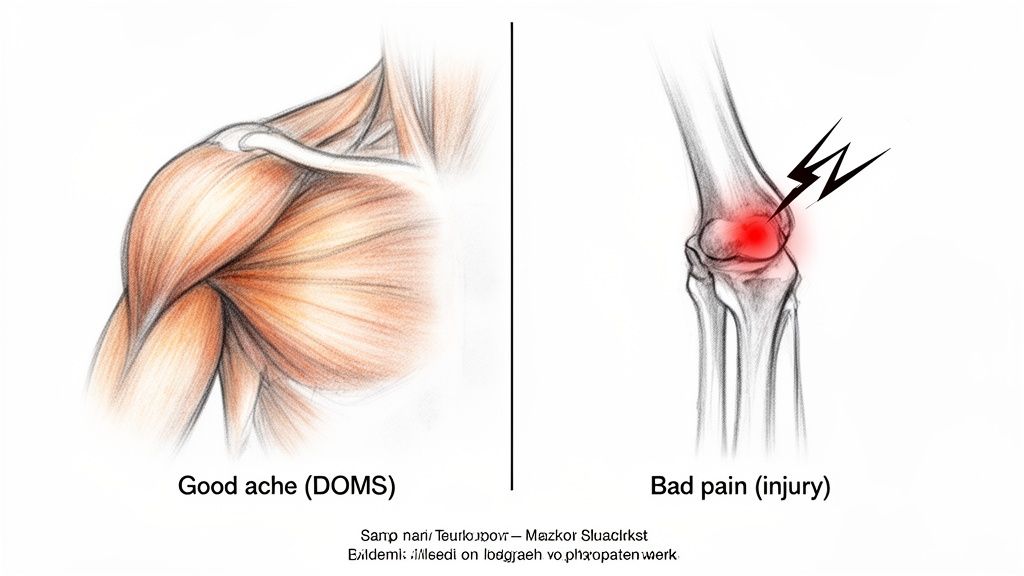
It’s a feeling every athlete knows. Is this ache the satisfying byproduct of a great workout—what we call Delayed Onset Muscle Soreness (DOMS)—or is it the first sign of an injury? This gray area can lead to bad calls, like training through a real problem or, conversely, taking unnecessary rest days.
Learning to interpret your body’s signals is crucial. In fact, a meta-analysis covering 26 studies found that up to 70% of runners mistake DOMS for an actual injury. A good rule of thumb is that soreness feels like a widespread ache that actually gets a little better with some light movement, while pain is sharp, gets worse when you put weight on it, and can linger even when you're resting.
When you're trying to figure out what your body is telling you, it helps to know your recovery options. These can range from simple active recovery and smart nutrition to more advanced treatments like MLS laser therapy for post-workout recovery.
Differentiators at a Glance
Let's break it down even further. DOMS comes from the microscopic tears in muscle fibers caused by intense or new exercises—this is a normal and necessary part of building strength. Injury, on the other hand, is the result of pushing tissues past their breaking point. You can dive deeper into this topic in our guide on the essentials of muscle recovery after a workout.
The goal isn’t to avoid soreness altogether. It’s about listening to its message. If you’re constantly so sore you can barely move, your training is probably outpacing your recovery. But if you feel a sharp pain, that's your body telling you to stop, now.
Quick Guide: Muscle Soreness vs. Injury Pain at a Glance
To help you quickly assess what you're feeling, here's a side-by-side comparison. Use this table as a mental checklist the next time you're unsure if you're dealing with productive soreness or a potential injury.
| Characteristic | Normal Muscle Soreness (DOMS) | Potential Injury Pain |
|---|---|---|
| Sensation | Dull, aching, tender to the touch | Sharp, stabbing, shooting, or burning |
| Timing | Peaks 24-72 hours after exercise | Often felt immediately during the activity |
| Location | Diffuse ache across a muscle group | Localized to a specific point or joint |
| Symmetry | Usually affects both sides (e.g., both quads) | Often one-sided (e.g., only the right knee) |
| Effect of Movement | Tends to lessen with light activity or warm-up | Worsens with movement or bearing weight |
| Associated Signs | Mild stiffness and temporary tightness | Swelling, bruising, or loss of function |
This simple check can be the difference between making consistent gains and finding yourself on the sidelines. Being able to read these signals accurately is what separates smart, sustainable training from a cycle of progress and setbacks.
Understanding Delayed Onset Muscle Soreness
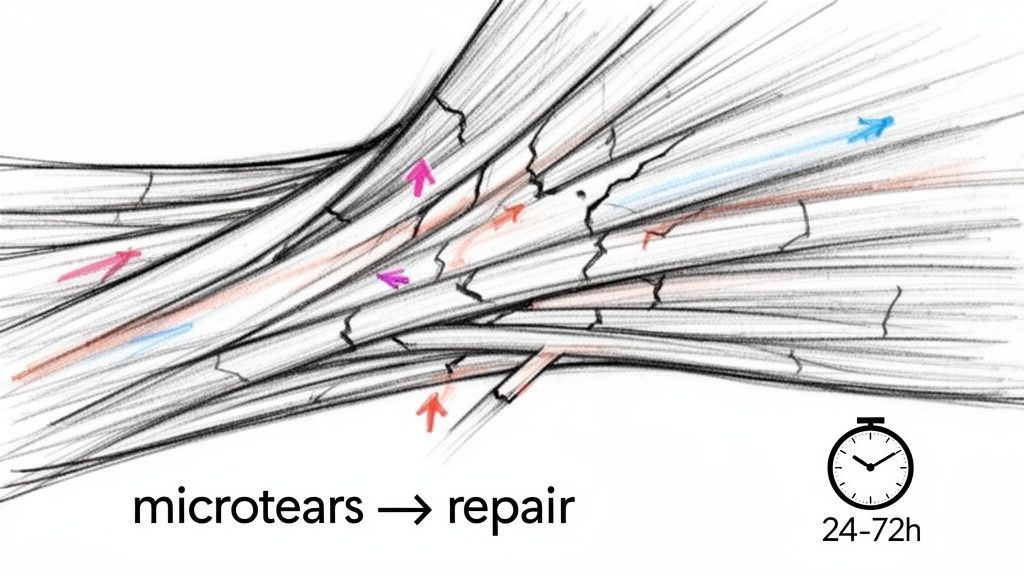
If you've ever woken up a day or two after a tough workout feeling like you’ve been hit by a truck, you're well-acquainted with Delayed Onset Muscle Soreness (DOMS). This isn't an injury; it's a completely normal part of your body's adaptation process. When you challenge your muscles with new exercises or greater intensity, you create microscopic tears in the muscle fibers.
This sounds a lot worse than it is. In reality, this micro-damage is the trigger for muscle growth. Your body responds by launching an inflammatory repair process, sending fluid and immune cells to the area to clean up and start rebuilding those muscle fibers stronger than they were before.
That signature stiffness and tenderness you feel? That's the repair crew at work. It's your body's way of saying, "Message received. We're building back stronger."
The Science Behind the Ache
The real driver behind a serious case of DOMS is often the eccentric phase of an exercise. This is the part of the movement where your muscle lengthens while under load—think about slowly lowering a heavy dumbbell during a bicep curl or controlling your descent into a squat.
These lengthening contractions put way more stress on muscle fibers than concentric (shortening) contractions do, which means more micro-damage. It’s why a long day of hiking downhill can leave your quads absolutely screaming, even if the hike itself didn't feel that strenuous. That constant braking action is pure eccentric overload.
Knowing this helps you predict which workouts are going to leave you feeling it the next day. Any time you introduce new movements with a heavy eccentric focus, you can pretty much guarantee DOMS will follow. You can learn more about the factors that influence healing in our muscle recovery time chart.
DOMS is a temporary discomfort that signals long-term progress. Viewing it as a positive feedback mechanism—rather than a setback—is a key mental shift for anyone serious about training.
The intensity and timing of DOMS can also vary depending on the type of workout. For instance, a 1999 study on DOMS timelines found that 45% of participants doing bench-stepping (a very eccentric-heavy exercise) reported their soreness peaked at 36-48 hours. In contrast, only 14% of a running group experienced their peak soreness in that same window.
Differentiating DOMS from Other Sensations
It’s critical to learn the difference between the dull, widespread ache of DOMS and other sensations. The discomfort from DOMS is almost always spread across the entire muscle you worked, not focused on a single, sharp point.
Here are the key characteristics of classic DOMS:
- Sensation: A general ache, tenderness when you touch the muscle, and a feeling of stiffness.
- Location: Spread out over a broad muscle area, like your whole chest or both hamstrings.
- Timeline: Kicks in about 12-24 hours after your workout and usually peaks somewhere between 24-72 hours.
- Movement Effect: The muscle might feel incredibly tight right when you wake up, but the stiffness often eases up a bit with some light movement and blood flow.
If what you're feeling lines up with these points, you’re almost certainly experiencing a normal, healthy response to a solid training session. It's just your body adapting and setting the stage for more strength. Anything that falls outside these descriptions—like sharp, immediate pain or discomfort centered on a joint—is a signal to pay closer attention.
Recognizing the Red Flags of Injury
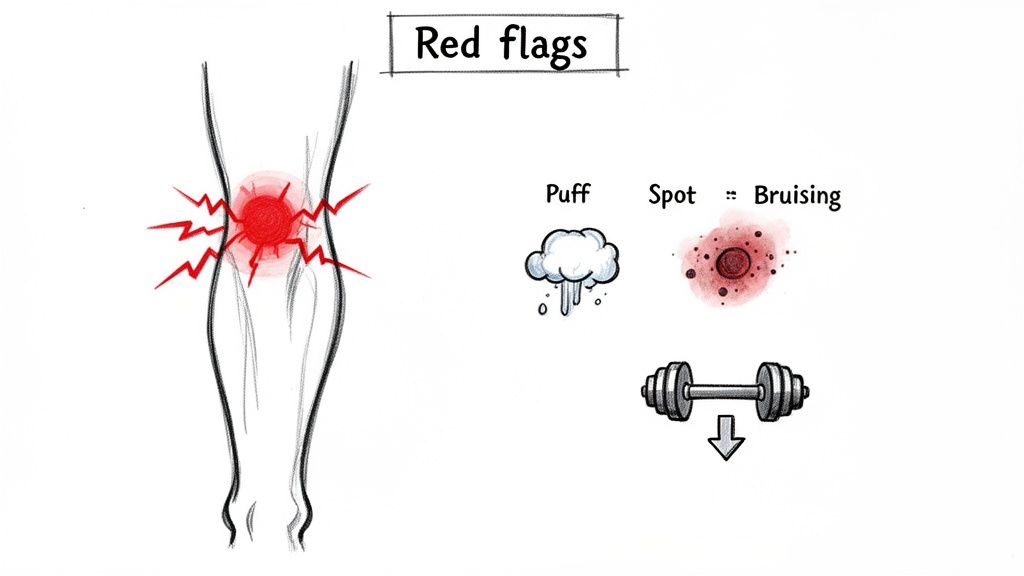
While the satisfying, diffuse ache of DOMS is a sign you put in the work, there are times when your body sends a much more urgent message. True injury pain feels fundamentally different—it's a clear stop signal, not a simple nod to a tough session. Learning to spot these warning signs is absolutely critical for distinguishing between muscle soreness vs pain and keeping minor issues from turning into major setbacks.
Unlike the broad tenderness of DOMS, injury pain is often sharp, specific, and highly localized. Think of it this way: it’s the difference between your entire quad muscles feeling generally achy after a heavy squat day versus a specific, stabbing sensation deep in your knee joint during the movement itself.
That kind of pain demands your immediate attention. It’s a sign that a structure—a muscle, tendon, ligament, or joint—has been pushed past its breaking point. Ignoring that signal is one of the fastest ways to get sidelined from your training for weeks, or even months.
The Anatomy of an Alarm Bell
When your body signals an injury, it uses a very distinct language. The sensations are far more intense and specific than the dull throb of post-workout fatigue. Knowing how to interpret these signals allows you to make smarter, safer decisions in the moment.
Here are the key red flags of a potential injury:
- Sharp, stabbing, or shooting sensations: This type of pain is immediate and often feels electric or piercing. It’s your nervous system’s way of screaming "stop."
- Pain localized to a single point: If you can point to the exact spot that hurts, especially if it’s near a joint, it’s far more likely to be an injury than generalized soreness.
- Pain that worsens with movement: DOMS often feels a bit better after a light warm-up. Injury pain, on the other hand, typically gets worse when you try to use the affected area.
- Pain that lingers at rest: Sore muscles usually feel better when you’re not moving them. Pain from an injury can persist, or even throb, while you're just sitting still.
- Visible signs of trauma: Swelling, bruising, or a noticeable loss of strength are unmistakable indicators that you’re dealing with more than just muscle fatigue.
When you’re trying to decide between benign muscle soreness and a more serious injury, understanding specific pain signals is crucial. Recognizing the causes and inherent red flags of pain can help guide your recovery and let you know when it's time to see a professional.
Contextual Clues in Your Training
The context in which you feel the discomfort gives you critical clues. DOMS follows a predictable pattern—it shows up after a challenging or new workout. Injury pain, however, often appears suddenly and can be traced back to a specific moment or movement that went wrong.
A critical distinction in the muscle soreness vs pain debate is timing. DOMS is delayed, peaking 24-72 hours later. Injury pain is often immediate, happening the instant a tissue is compromised.
Let's take a common scenario: barbell rows. If your lats feel tender and tired the next day, that’s classic DOMS. But if you feel a sudden, sharp pinch in your lower back during a heavy rep, that’s an alarm bell. That immediate, specific feedback is your body telling you that your form broke down or the load was too great, causing a tissue strain. This type of acute pain is a clear signal to stop the exercise immediately and assess the situation. Failing to do so can make the damage much worse, and it underscores why it's so important to know how to prevent overtraining and burnout.
When Discomfort Signals Something Deeper
Sometimes, persistent pain isn’t from a single, acute event but rather an underlying issue. For example, in children and adolescents, significant back pain isn’t a typical symptom of mild scoliosis and should always prompt a medical evaluation. The pain is often from muscle imbalances and fatigue, as muscles on one side of a spinal curve work much harder to compensate. This can lead to aches and postural strain, especially after activity.
While most of these cases are mild, pain described as sharp, worsening, or paired with neurological symptoms like numbness is not normal. This highlights a universal principle: any pain that is persistent, severe, or seems way out of proportion to your activity level warrants a professional medical evaluation. Your body is an incredible machine, but listening to its warning signals is your responsibility.
Using Data to Interpret Your Body's Signals
Feeling the aftermath of a workout is one thing; truly understanding what it means is another. The whole "good soreness vs. bad pain" debate can feel like a guessing game, leaving you wondering if you’re actually ready for your next session. But what if you could turn those feelings into objective data you can actually use? That’s exactly what modern fitness tools are designed to do—they help you move from guesswork to informed decisions.
When you track the details of your workouts—every exercise, every pound lifted, every rep—you’re building a precise picture of your training stress. This data is the key to finally getting a handle on your body's recovery cycle. Instead of just feeling sore, you can see exactly which muscles you hit and just how hard you hit them.
This data-driven approach starts to clear away the fog. It lets you draw a straight line between your training and how your body responds, helping you make much smarter calls on when to push, when to pull back, and when to just rest.
Visualizing Your Muscle Recovery
One of the best ways to make sense of your body’s signals is to see them laid out visually. Tools like the Built Workout app take the data from your logged sessions and generate a muscle recovery heatmap. Think of it as a color-coded map of your body that gives you an instant, at-a-glance snapshot of your recovery status.
This heatmap below shows which muscle groups are running on empty and which ones are fresh and ready to go.
A muscle group glowing deep red means it’s highly fatigued and likely dealing with some serious DOMS. On the other hand, a muscle in green is fully recovered and good to go. This kind of visual feedback makes it incredibly easy to connect what you’re feeling with what the data is showing, sharpening your ability to tell the difference between productive soreness and something worse.
This goes way beyond just confirming that your chest is sore after a heavy bench day. It’s about putting a number on that soreness and using that info to plan your next move with real confidence. If you're looking for more ways to fine-tune your training, check out our guide on using a gym workout tracker to its full potential.
Your body gives you the raw sensation; data provides the context. A heatmap turns a vague feeling of "my legs are tired" into a crystal-clear picture showing your quads are at 90% fatigue while your hamstrings are only at 40%. That allows for much more specific, intelligent training decisions.
This level of detail moves the conversation past a simple "sore vs. pain" debate. It introduces nuance, helping you understand that recovery is a spectrum, not just an on-or-off switch.
Spotting Red Flags Before They Become Injuries
The real magic of tracking your data consistently is its power to show you patterns—and outliers—over time. Sure, a bright red heatmap on your quads is totally normal the day after a monster leg session. But what if that red spot is still there a few days later? This is where your data becomes an early warning system.
A persistent hotspot on your heatmap, especially if it’s pinned to a specific area like your lower back or a single shoulder, can be a huge red flag. It’s a sign that a particular muscle group isn't bouncing back properly, which could be due to overtraining, a flaw in your form, or a hidden imbalance.
Here’s a simple workflow for putting this data to use:
- Log Your Workout: Be meticulous. Record every exercise, set, rep, and weight.
- Review Your Heatmap: The next day, pull up your muscle recovery map. See if the red zones line up with the DOMS you expected from the session.
- Monitor Recovery Over Time: Keep an eye on how quickly those red zones fade back to green. Normal DOMS should die down significantly within 48-72 hours.
- Identify Anomalies: If a muscle stays in the red or orange for days, or if the soreness feels sharp and localized instead of dull and achy, it’s time to pay closer attention. That lingering fatigue is a strong signal of an overuse issue that could easily snowball into a real injury if you ignore it.
By using data as your guide, you can catch these problems before they escalate. It allows you to make smart adjustments—like cutting back on volume, drilling down on your form, or programming an extra rest day—before a minor ache turns into a major setback that benches you completely. It's how you train hard and stay in the game for the long haul.
When to Push, When to Pivot, and When to Rest
Alright, so you can tell the difference between good soreness and bad pain. That's step one. The real challenge hits when you’re standing on the gym floor, trying to decide what to do right now. This is where a solid decision-making framework becomes your best training partner, helping you turn those confusing signals from your body into smart, confident choices.
Let's walk through some all-too-common scenarios. You've just survived a brutal leg day, and now every staircase looks like a personal Everest. Is it heroic to push through your next planned workout, or just a fast track to injury? By combining how you feel with hard data from a tool like the Built Workout app, you can make a strategic call instead of just guessing.
Scenario 1: The Post-Leg Day Debacle
The Situation: It’s been two days since you went all-out on squats, and your quads and glutes are screaming. It's that deep, widespread ache you know all too well—classic DOMS. Your schedule says it’s time for another lower-body day, but you're seriously questioning if your legs can even function.
You feel that satisfying ache that confirms you put in the work, but movement is stiff and uncomfortable. There’s no sharp, specific pain, just a general "I’m cooked" feeling. You pull up your Built Workout app, and the heatmap says it all: your quads and glutes are glowing bright red, confirming they are highly fatigued and still in the middle of a major repair job.
This is the perfect example of your intuition and data telling the same story. The intense, widespread ache is textbook DOMS, and the heatmap gives you the objective proof that those muscles need a break. Hitting them hard again would do more harm than good.
The Decision: This is a time to pivot, not push. Instead of another punishing leg session, you’ve got much smarter options:
- Active Recovery: Hop on a bike or go for a brisk walk. Light, low-impact cardio will get the blood flowing, which can actually help ease the soreness. Learning about cardio on rest days can be a real game-changer.
- Train Another Muscle Group: Your heatmap shows your upper body is green and good to go. Take advantage of it and have a killer chest or back workout.
- Full Rest: If you’re feeling wiped out overall, don’t underestimate the power of a complete rest day. Sometimes, that’s the most productive thing you can do.
Scenario 2: The Twinge of Uncertainty
The Situation: You're halfway through a set of overhead presses when you feel a sudden, sharp twinge in your right shoulder. It doesn't drop you to your knees, but it’s definitely not the good kind of burn. The pain is focused in one specific spot.
You rack the weight immediately. The sharp pain fades to a dull ache, but you feel it again when you try to lift your arm overhead. A quick look at your Built app shows your shoulders were only moderately fatigued (yellow) before the workout, so this isn't just a sign of overtraining.
The flowchart below gives you a clear path for using both your intuition and data to figure out what to do next.
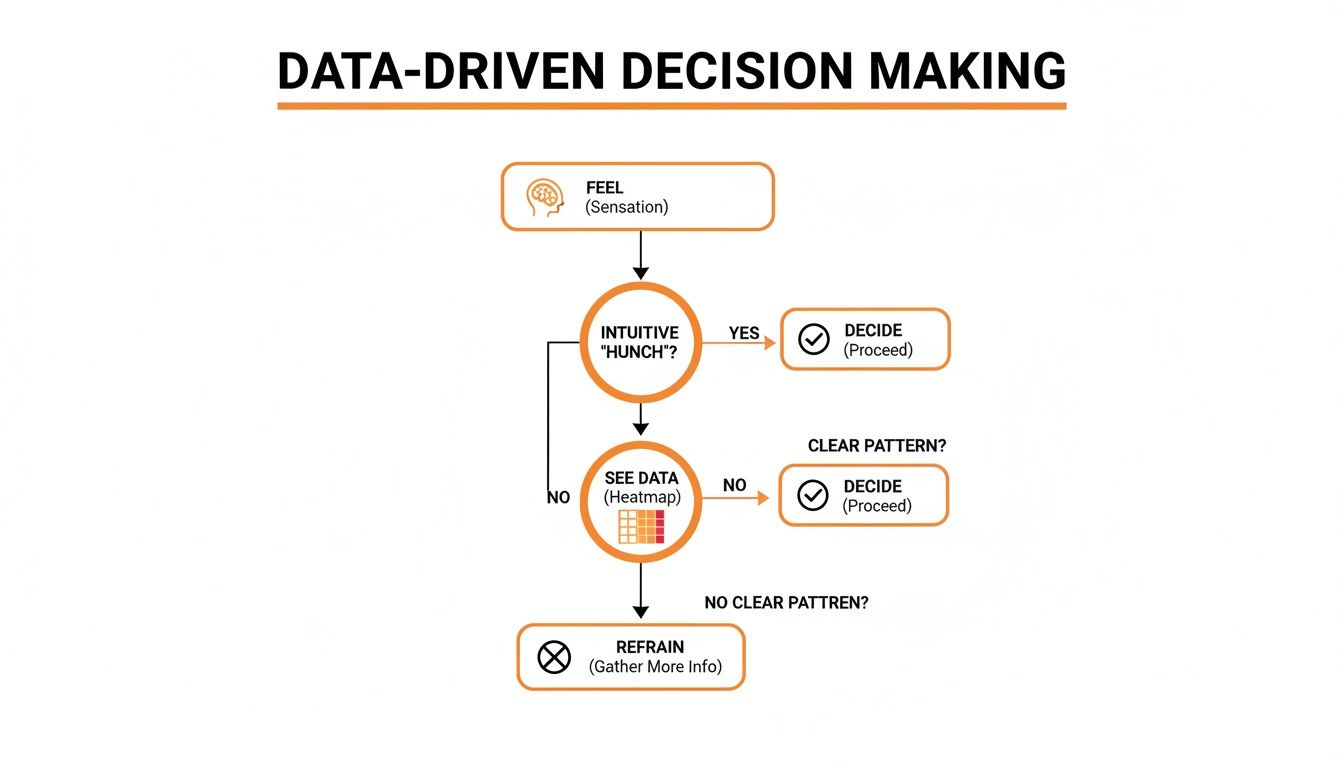
This visual guide is all about blending what your body is telling you with what the data is showing you, helping you make the smartest choice on the spot.
The Decision: This is a clear signal to rest and re-evaluate. That sharp, localized pain is your body's alarm bell for a potential injury.
- Stop Immediately: Never, ever try to "work through" a sharp pain. You’re just asking to turn a minor tweak into a major problem.
- Modify the Workout: Ditch any more pressing movements. You might be able to switch to something totally unrelated, like legs, as long as it doesn't aggravate your shoulder.
- Monitor Carefully: Keep a close eye on that shoulder for the next 24-48 hours. If the pain sticks around, gets worse, or you see swelling, it’s time to call a professional.
By using this kind of structured approach, you can learn to speak your body's language. This blend of data-driven insight and gut feeling helps you master the difference between productive soreness and problematic pain, keeping you healthy, consistent, and on the path to your goals.
Decision Matrix: Training with Soreness vs. Pain
Making the right call in the moment can be tough. This table breaks down common scenarios to help you navigate your training decisions based on what you’re feeling and what your data is telling you.
| Symptom Scenario | Self-Assessment Checklist | Built App Data Check | Recommended Action |
|---|---|---|---|
| Widespread, Dull Ache | Felt 24-72 hours post-workout. Muscles feel stiff but warm up with movement. No sharp, localized pain. | Heatmap shows muscle groups are red (highly fatigued) or orange (recovering). Recovery score is likely moderate to low. | PIVOT: Focus on active recovery (light cardio, stretching) or train a different, rested muscle group (green on heatmap). |
| Sharp, Localized Pain | Occurs suddenly during a movement. Pain is pointed and specific. Limits your range of motion. | Heatmap may show the area was already fatigued (yellow or orange), or it could be green. The key is the type of pain, not just fatigue level. | REST & ASSESS: Stop the exercise immediately. Do not work through it. Modify the workout to avoid the area entirely. Monitor for 24-48 hours. |
| General Fatigue & Low Energy | Not sore, just feeling drained and unmotivated. Lifts feel heavier than usual across the board. | Overall recovery score is low. Multiple muscle groups might be in the yellow or orange zones, indicating systemic fatigue. | REST: This is a signal from your central nervous system. Take a full rest day. Pushing through will only dig a deeper recovery hole. |
| Mild, Lingering Soreness | A slight ache remains 3-4 days after a workout. It doesn't hurt, but you know the muscle was worked. | Heatmap shows the area has returned to yellow or green. Your recovery score has likely bounced back. | PUSH (cautiously): It’s generally safe to train the muscle group again. Start with a thorough warm-up and listen to your body. Reduce intensity if needed. |
Using a systematic approach like this takes the emotion and guesswork out of the equation. It allows you to be objective, combining your body's feedback with reliable data to train smarter, not just harder.
Common Questions About Soreness and Pain
Figuring out the difference between muscle soreness and actual pain brings up some very real, practical questions in the gym. Getting the answers right is what allows you to apply everything we've talked about with confidence, making sure you're training smart and staying safe. Let's dig into some of the most common dilemmas we all face.
Is Intense Soreness After Every Workout a Good Sign?
Not really, no. While feeling some DOMS is a solid sign that you’ve challenged your muscles, chasing that can't-walk-down-the-stairs level of soreness after every single session is a fast track to trouble. It often leads to overtraining, tanks your performance, and seriously ups your risk of getting hurt.
Real, sustainable progress is built on consistency and progressive overload, not on a constant cycle of breaking your body down. A well-designed training plan knows when to push hard and, just as importantly, when to back off for recovery. This is where having objective data is a game-changer.
The goal is adaptation, not annihilation. If your soreness is constantly getting in the way of your daily life or your next workout, it’s a clear sign your training volume or intensity is outpacing your body's ability to recover.
Using a tool like the Built Workout app lets you see the whole picture by tracking both your performance and recovery over time. It helps you answer the critical question: are you actually getting stronger, or just getting more tired?
Can I Completely Prevent Muscle Soreness?
Trying to avoid muscle soreness completely isn't realistic, and honestly, it shouldn't be the goal. A manageable level of DOMS is just a natural part of the process that makes your muscles stronger and more resilient. What you can and should do, however, is take steps to manage how severe it gets.
A few key strategies can make a massive difference in keeping soreness from getting out of hand:
- A Solid Warm-Up: Spend 10-15 minutes doing dynamic stretches and some light cardio. Getting blood flowing to the muscles you're about to train prepares them for the work ahead.
- Gradual Progression: Don't make huge jumps in how much you lift or how many sets you do all at once. Introduce new exercises or heavier weights incrementally so your body has time to adapt.
- A Smart Cool-Down: Instead of just dropping the weights and leaving, take 5-10 minutes to bring your heart rate down with some light activity, followed by static stretching.
- Fuel and Hydrate: Getting enough protein is non-negotiable for muscle repair, and carbs are needed to restock your energy. On top of that, being dehydrated can make soreness feel way worse and drag out your recovery.
Think of these not as ways to dodge soreness, but as tools to keep it in a productive zone—a helpful signal of progress, not a roadblock to your next session.
Should I Stop Immediately If I Feel a Sharp Pain?
Yes. Absolutely. A sharp, sudden, or stabbing pain is your body's emergency brake. It’s fundamentally different from the dull, spread-out ache of muscle fatigue or DOMS. That kind of pain is a red flag for an acute injury to a muscle, tendon, ligament, or joint.
"Working through it" is one of the worst mistakes you can make. That’s how a minor tweak turns into a major injury that can sideline you for weeks or even months.
The second you feel that sharp pain, here’s what you do:
- Stop the exercise. Safely rack the weight and end the movement.
- Assess the situation. Don't try to "test" it with another rep.
- If the pain sticks around, or if you see swelling or can't move properly, your workout is over. It's time to get it checked out by a healthcare professional.
How Does an AI Coach Help Manage Soreness?
This is where technology can really step in. An AI coach, like the one inside the Built Workout app, takes all your personal training and recovery data and turns it into smart, practical advice. It goes way beyond just logging your reps and sets to give you real-time guidance based on how your body is actually feeling.
It analyzes things like your muscle recovery heatmaps and workout history to adjust your plan on the fly. For instance, if your heatmap shows your chest and triceps are still wiped out from your last push day, the AI might suggest swapping your next upper-body session for a leg day to give those muscles more time to heal.
This data-driven approach lets you dial your training intensity up or down based on real feedback, not just guesswork. It helps you push hard when your body is primed for it and ease up when you need more recovery, cutting down your injury risk while maximizing your potential for long-term, sustainable gains.
Ready to stop guessing and start knowing? Built Workout gives you the tools to visualize your recovery, understand your body's signals, and train smarter than ever before. Download the app for free and take control of your fitness journey.