Here’s the thing about getting stronger: the real work begins after you’ve put the weights down. Muscle recovery isn’t just about kicking your feet up and resting. It’s an active, biological process where your body repairs, rebuilds, and reinforces the muscle tissue you just broke down. This is where your actual gains are made.
Why Your Gains Happen After You Leave the Gym
It’s a common misconception that muscles grow while you're lifting. That’s just not how it works. Your workout is the catalyst—it creates microscopic tears in your muscle fibers. Think of it as controlled damage. This damage is what signals your body to kickstart a powerful healing and adaptation response.
This is also why you feel that familiar soreness a day or two later, which we all know as Delayed Onset Muscle Soreness (DOMS). While it can be uncomfortable, DOMS is actually a good sign. It's your body telling you, "Okay, the repair crew is on site!" It’s not something to fear, but a clear signal to double down on smart recovery.
From Breakdown to Buildup
Your training session is the stimulus. The recovery period is the adaptation. Without that second part, the first part is practically wasted.
Once the workout is over, your body gets busy. It floods the damaged muscles with nutrients and fluids to clear out metabolic waste and start rebuilding those torn muscle fibers. But it doesn't just repair them back to their original state—it builds them back stronger and more resilient than before. This entire cycle is the essence of getting bigger and stronger over time.
The real magic doesn't happen during your last rep; it happens in the hours and days that follow. Treating muscle recovery as an afterthought is like building a house and forgetting the foundation.
Turning Guesswork into a Strategy
For years, athletes had to rely on "feel" to know if they were recovered. This often led to a frustrating cycle of overtraining, undertraining, and plateaued progress. But we don't have to guess anymore. We now have tools that can turn recovery from a mystery into a data-backed strategy.
The Built Workout app, for example, gives you a clear visual of your recovery status. Using color-coded muscle heatmaps, you can see exactly which muscles are still recovering (showing up as red or orange) and which ones are fresh and ready to go (green). This takes the ambiguity out of the equation, letting you make smarter training decisions.
This data allows you to promote real growth instead of just piling on more stress. The app's AI coaching then takes this information a step further, suggesting what to train next based on your body's actual readiness. If you want to get really granular on this, check out our detailed guide on the muscle recovery time chart and what it means for your schedule. It’s all about making sure every single workout builds on the last one for steady, long-term gains.
Your Foundational Recovery Blueprint
You can’t build a stronger body on intense workouts alone. The real magic, the actual growth and adaptation, happens in the hours after you’ve left the gym. That's why having a solid, intentional recovery plan isn't just a good idea—it's everything. Let's map out your blueprint, focusing on the four pillars that are absolutely non-negotiable for effective muscle recovery: nutrition, hydration, sleep, and stress management.
This whole process follows a simple, powerful cycle that starts the moment you begin your workout.
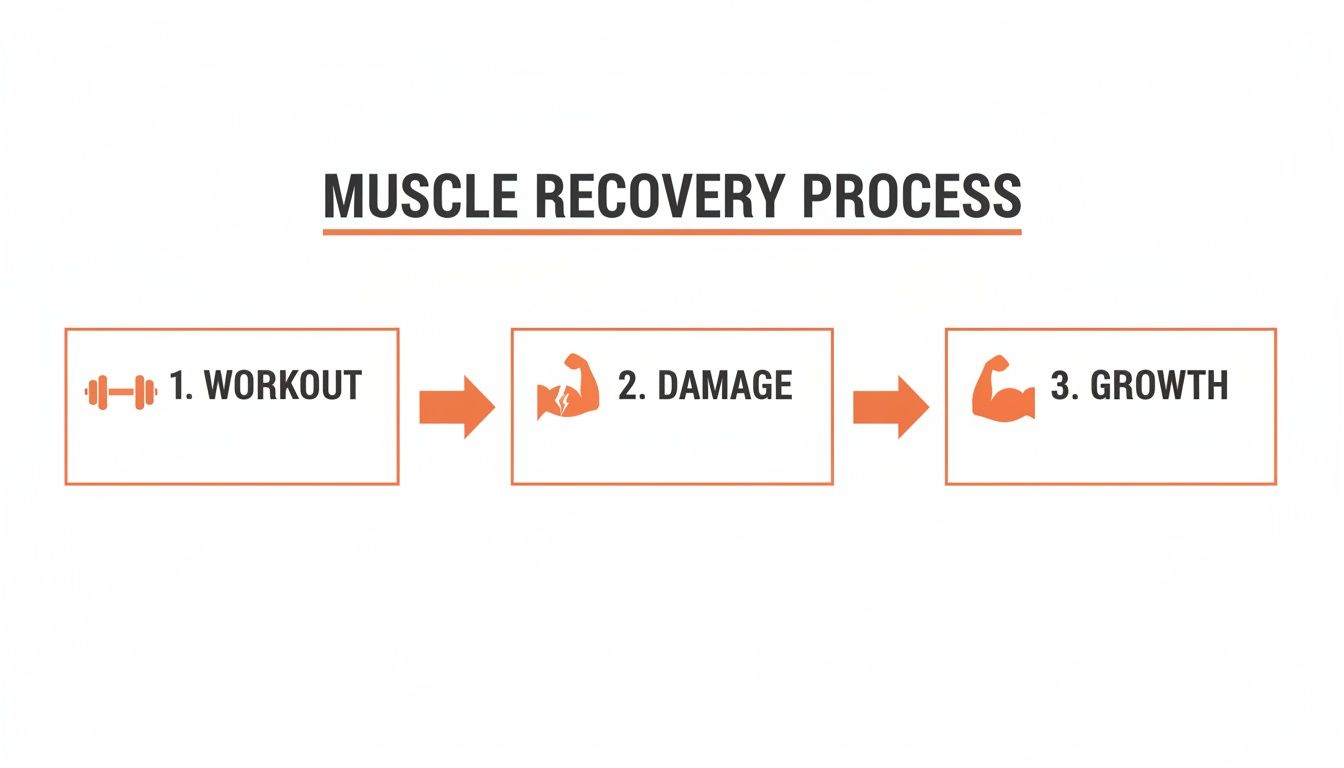
As you can see, the training itself creates the damage. This sends a signal to your body to repair the muscle and grow it back stronger. But here's the catch: it can only do that if you give it the right resources.
Fueling the Repair Crew
Think of your body after a tough session like a construction site. Your workout just put in the order for repairs, and now it's on you to deliver the materials. This is where your post-workout nutrition comes into play, and it all boils down to two key players: protein and carbohydrates.
Protein provides the amino acids—the literal building blocks—needed to patch up those microscopic muscle tears. Carbohydrates are just as crucial because they restock the muscle glycogen you burned for fuel. Skipping carbs is a classic mistake that leaves you feeling flat and puts the brakes on your recovery.
Timing matters. While the whole "anabolic window" concept isn't the mad 30-minute rush we once thought, aiming to get a solid meal with both protein and carbs within 1-2 hours post-workout is a smart, proven strategy to kickstart the repair process.
To give your body everything it needs, understanding the role of the best supplements for muscle recovery can be a game-changer. Supplements can round out a whole-food approach, especially when you're short on time.
To make this crystal clear, here’s a quick-reference guide for your post-workout meal.
Your Post-Workout Recovery Nutrition Blueprint
Use this table as a quick reference guide to optimizing your nutrition immediately after a workout. This simple plan helps kickstart muscle repair and glycogen replenishment.
| Nutrient | Optimal Timing | Recommended Amount | Food Examples |
|---|---|---|---|
| Protein | Within 1-2 hours post-workout | 20-40 grams | Whey protein shake, Greek yogurt, chicken breast, eggs |
| Carbohydrates | Within 1-2 hours post-workout | 40-80 grams (or more, depending on intensity) | Banana, oatmeal, sweet potato, white rice, quinoa |
| Fluids | Immediately and ongoing | 16-24 oz per pound of bodyweight lost | Water, electrolyte drink, chocolate milk |
Nailing this meal sets the stage for a much faster and more effective recovery.
Hydration: It's More Than Just Water
Being even slightly dehydrated can throw a massive wrench in your recovery. Water is the transport system that carries nutrients to your cells and flushes out all the metabolic waste you created during your workout. If you don't drink enough, you can expect more muscle soreness and a longer recovery time.
Here's a simple pro tip: weigh yourself before and after your workout. For every pound you lose in sweat, you need to drink about 16-24 ounces (that’s roughly 500-700 ml) of fluid to get back to baseline.
But it’s not just about the amount of water; it’s also about electrolytes.
Sodium: The key player in helping your body actually hold onto the water you drink.
Potassium: Essential for proper muscle contractions and nerve signals.
Magnesium: Helps with muscle relaxation and can even help prevent cramps.
After a really long or sweaty session, an electrolyte drink or a simple snack like a banana with a tiny pinch of salt can make a world of difference in how you feel the next day.
Sleep: The Ultimate Recovery Tool
If nutrition and hydration are the building materials, then sleep is when the construction crew shows up to do the work. It's during the deep stages of sleep that your body releases a huge surge of growth hormone, which is absolutely critical for repairing tissue and building muscle.
Consistently getting 7-9 hours of quality sleep is probably the single most powerful thing you can do for recovery. Skimp on sleep, and you'll see a rise in cortisol—a stress hormone that actually breaks down muscle tissue and fights against your progress.
Sleep isn't passive downtime. It's an active, powerful state of physiological repair. You need to prioritize it just as much as you prioritize your training.
Try to get into a rhythm. Going to bed and waking up around the same time, even on weekends, can drastically improve your sleep quality and, in turn, accelerate your recovery.
Taming Your Stress Levels
Finally, let's talk about stress. Whether it’s from your job, your personal life, or even from training too hard, chronic stress is a recovery killer. It keeps your body jacked up on cortisol, which is catabolic—meaning it breaks things down. A constantly stressed body struggles to flip the switch into "rest and digest" mode, which is where all the healing happens.
Our guide on how to prevent overtraining dives deeper into how stress and recovery are two sides of the same coin.
You don't need a week-long retreat to manage stress. Simple, daily practices can have a huge impact on your physical recovery.
Mindful Breathing: Just 5-10 minutes of slow, deep belly breaths can calm your nervous system right down.
Light Activity: A gentle walk outside does wonders for clearing your head and lowering stress hormones.
Meditation: Apps like Calm or Headspace are great for learning to disconnect from the daily grind.
When you manage your stress, you create an internal environment that’s primed for repair. This makes every other pillar of your recovery blueprint—nutrition, hydration, and sleep—work that much better.
Moving Your Way to Faster Healing
It’s an old myth that the best thing to do after a crushing workout is to collapse on the couch and not move a muscle. While rest is definitely part of the equation, the smartest path to faster muscle recovery after workout sessions actually involves gentle movement. This strategy is called active recovery, and it’s a game-changer for bouncing back quicker.
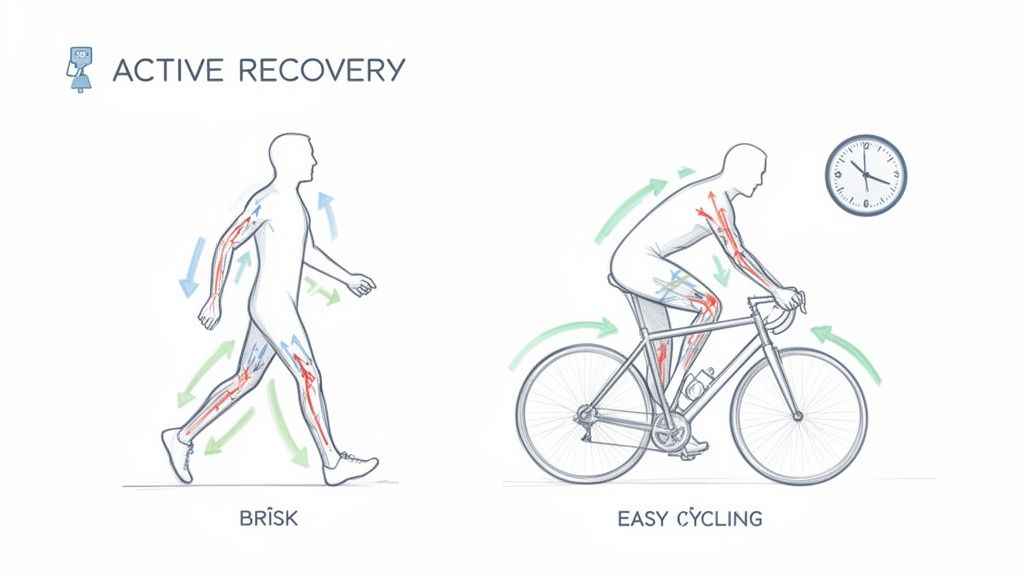
So what does active recovery look like? It’s simply low-intensity exercise done after a tough session. Think a brisk walk, a light spin on a bike, or some restorative yoga. The point isn’t to pile on more training stress; it’s just to get your body moving. This simple act boosts blood circulation, which is critical for shuttling nutrients to your damaged muscle tissue and flushing out metabolic byproducts like lactic acid that leave you feeling sore.
The research here is solid. Study after study shows that light activity following intense exercise beats sitting still every time. Active recovery helps your body return to a normal state much faster and has been shown to significantly lower the markers of muscle damage and fatigue.
Designing Your Active Recovery Session
The golden rule for active recovery is to keep the intensity low. Very low. You should be able to carry on a full conversation without getting breathless. A good benchmark is to keep your heart rate somewhere around 30-40% of your maximum.
Here’s a simple template for an effective active recovery day:
Light Cardio: A 20-30 minute session of easy cycling, walking on an incline, or hopping on the elliptical.
Dynamic Stretching: Focus on fluid movements like leg swings, arm circles, and torso twists to loosen things up.
Mobility Work: Gently work on improving the range of motion in your joints, especially in areas that feel tight after your last workout.
Foam Rolling: Spend some quality time with a foam roller on the major muscles you trained to help release tension.
The best time to slot this in is usually the day after a particularly tough workout. For instance, if you absolutely hammered legs on Monday, a 25-minute walk on the treadmill on Tuesday is a perfect example of active recovery. If you're wondering how to weave this into your weekly plan, our guide on cardio on rest days has you covered.
Using Data to Guide Your Movement
Instead of just guessing what to do, you can get strategic. How do you know which muscles to focus on or, more importantly, which to leave alone? This is where the Built Workout app’s muscle recovery heatmaps come in handy, giving you a clear, visual guide.
Your body is always giving you feedback. The heatmap is just a tool that helps you understand its language. A sea of red isn't a stop sign; it's a signal to choose a smarter path forward.
After each workout, the app visualizes your muscle fatigue. Bright red and orange areas are your muscles that are still deep in the repair process—they need a break from any direct, intense work. Green areas, on the other hand, signal fresh muscles that are good to go.
This data-driven approach means your light activity is genuinely restorative, not just more stress in disguise. By combining the visual data from your heatmap with smart, gentle movement, you create a powerful system for continuous progress. For those looking to push the envelope even further, advanced options like researching specific compounds such as peptides for healing and recovery can complement these foundational strategies.
Getting into Advanced Recovery Protocols
Once you have your basics—sleep, nutrition, and smart training—dialed in, it’s time to explore the techniques that give pro athletes their edge. These are the strategies you layer on top of a solid foundation to really accelerate healing, crush soreness, and get back into the gym feeling strong and ready to go.
Let’s get into two of the most effective methods you can add to your arsenal: cold therapy and soft tissue work. These aren't just about feeling good; they’re active interventions that create a better environment for your muscles to repair and rebuild. Used the right way, they can seriously cut down the time it takes to feel 100% again.
Embrace the Cold for Faster Healing
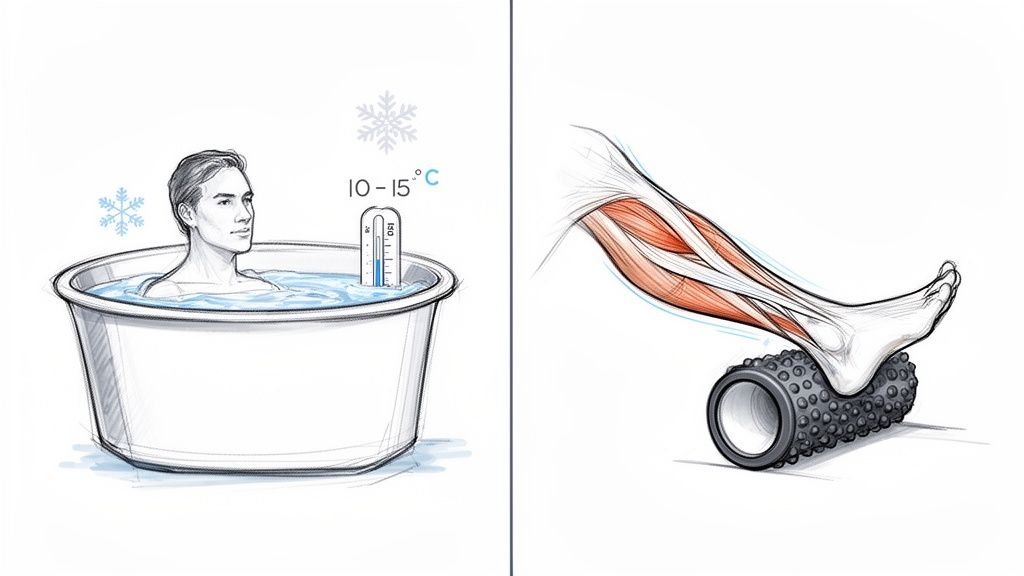
I get it—jumping into an ice bath after a brutal leg day sounds like the last thing you'd want to do. But the science and real-world results are just too compelling to ignore. The most common technique here is Cold Water Immersion (CWI), which works by constricting your blood vessels. This squeeze helps flush out all the metabolic junk that builds up in your muscles during hard training.
The real magic happens when you get out. Your blood vessels open back up, sending a rush of fresh, nutrient-rich blood to the area, which kickstarts the repair process. This rapid circulatory change is a fantastic way to tackle inflammation and take the edge off DOMS.
Plenty of research backs this up, showing CWI is one of the best ways to clear out markers of muscle damage. The sweet spot seems to be about 10-15 minutes in water around 10-15°C (50-59°F). For anyone using Built Workout, this is how you turn those angry red muscle heatmaps back to green a lot quicker. You can dig deeper into the science with this comprehensive analysis on how cold immersion boosts recovery.
Unlocking Muscles with Soft Tissue Work
The other pillar of advanced muscle recovery after workout is soft tissue work. This covers everything from a professional sports massage to using a foam roller or massage gun on yourself. The main goal here is to work out the muscle adhesions—those tender "knots"—that mess with your movement and cause pain.
By physically breaking up these restrictions, you improve flexibility and drive blood flow directly into those tight, overworked muscle fibers. This helps restore normal function and gets rid of that lingering stiffness that can hang around for days.
I tell my clients to think of foam rolling and massage as non-negotiable maintenance for their body. It's just like tuning up a performance car—you have to make sure all the parts are moving smoothly.
When you do your soft tissue work matters quite a bit.
Immediately Post-Workout: A few light minutes of foam rolling can help your nervous system chill out and get the recovery process started. Keep the pressure gentle.
24-48 Hours Post-Workout: This is the prime time for deeper work. The initial inflammation has calmed down, making it the perfect window to really dig in, relieve DOMS, and restore your range of motion.
When you layer these advanced methods on top of your core recovery habits, you build a seriously effective system. And if you're looking to integrate all of this seamlessly, technology can help. Our guide on how an AI fitness coach can personalize your plan shows how you can build these recovery protocols right into your weekly schedule, ensuring you’re always performing at your best.
Letting Data Drive Your Recovery Strategy
All the recovery protocols in the world won't help if you're flying blind. The biggest leap forward in modern training isn't some new supplement or stretching technique; it's the ability to use real, objective data to make smarter decisions.
This is where you stop guessing how you feel and start knowing what your body needs for optimal muscle recovery after workout sessions. We're moving from a vague sense of "I'm sore" to a clear, visual guide that informs what you do in the gym every single day.
How to Read Your Body Like a Pro
The muscle recovery heatmap is your new best friend for this. It's a simple, color-coded visual of your body showing the recovery status of every major muscle group. Think of it as an X-ray of your fatigue.
Bright Red: This muscle is cooked. It's in the middle of a heavy repair cycle. Training it directly is a big mistake.
Orange/Yellow: Things are getting better, but you're not at 100%. This muscle might handle some light, indirect work, but hitting it hard is asking for trouble.
Green: This is the green light you're looking for. The muscle is fully recovered, rested, and ready for you to train it hard again.
Let's say you crushed a heavy leg day on Monday. Tuesday morning, you open Built Workout and see your quads, hamstrings, and glutes are all glowing red. The old-school lifter in you might think, "I'll just tough it out." But the data is telling you a different, smarter story: those muscles need more time. This simple visual cue stops you from digging a deeper recovery hole and killing your gains.
Data doesn't guess. A heatmap showing bright red quads is your body's way of saying, "Give me a break." Listening to that is the fastest way to get stronger.
Let Your AI Coach Take the Wheel
The heatmap tells you what's recovered, but Built Workout’s AI Coach tells you what to do about it. It analyzes your recovery data in real-time and makes smart adjustments to your training plan on the fly.
So, when it sees those red quads, the AI Coach won't just tell you to skip leg day. It'll proactively suggest a better alternative. Maybe that's an upper-body push day, focusing on your fresh, green-lit chest and shoulders. This way, you stay productive without derailing your leg recovery. It might even suggest lowering your overall volume for the day if it detects signs of system-wide fatigue.
This is more than just injury prevention; it's about optimizing every single session. Our guide on using a gym workout tracker dives into how logging your workouts fuels these kinds of intelligent recommendations. You end up always working on what's ready, which is the key to consistent progress.
Beyond the Heatmap: Other Key Metrics
While muscle soreness is a huge piece of the puzzle, a truly data-driven strategy looks at the bigger picture. A few other key metrics can give you an early warning that you're pushing too hard, often before you even feel it in the gym.
One of the best is your Resting Heart Rate (RHR). A consistently elevated RHR right after you wake up is a classic sign your nervous system is stressed and hasn't fully bounced back. If your normal RHR is 55 bpm and you wake up three days in a row at 62 bpm, that's a red flag. Your body is telling you it needs more rest, better food, or less stress.
Similarly, tracking Heart Rate Variability (HRV)—the tiny variations in time between your heartbeats—gives you deep insight into your readiness to perform. Generally, a higher HRV is a sign of good recovery, while a downward trend can point to accumulated fatigue.
When you start connecting these dots—the heatmap, your RHR trend, and your AI coach's advice—you build a much more intuitive sense of your body’s limits. You stop just following a program and start truly training smarter.
Speaking of smart recovery, recent studies have shown just how powerful hands-on methods can be. Massage therapy, for instance, is a beast when it comes to fighting delayed onset muscle soreness (DOMS). One major meta-analysis found massage was the single most effective method for reducing DOMS and perceived fatigue. It even led to a noticeable drop in creatine kinase (CK) levels, a key marker of muscle damage.
This means that scheduling a foam rolling session or a real massage about 24 hours after a heavy workout could seriously speed up how quickly your strength and performance return. You can learn more about the findings on massage and muscle recovery here.
Your Top Muscle Recovery Questions, Answered
We’ve dug into the science, the strategies, and the data behind smart muscle recovery after workout sessions. Now, let’s get straight to the point and tackle the questions I hear most often. This is your go-to guide for clearing up any confusion and sharpening your recovery plan.
How Long Does Muscle Recovery Actually Take?
This is the classic "it depends" answer, and for a good reason. There’s no magic number. How quickly you recover is a moving target, influenced by everything from the intensity of your workout and the muscles you trained to your age and current fitness level.
As a general rule of thumb, smaller muscles like your biceps or calves might feel ready for action again in 24-48 hours. Larger, more demanding muscle groups—think your back and legs—often need a solid 48-72 hours to fully repair and get stronger.
But why guess? Instead of just following a rigid schedule, let your data tell you the real story. A quick glance at the Built Workout heatmap gives you a clear, visual answer. If your quads are still lit up in red two days after a tough leg day, they're telling you they need more time. Simple as that. Once they’re green, you’re good to go.
Should I Take Rest Days or Do Active Recovery?
You need both. It's not an either/or situation. They play different, but equally vital, roles in your training week.
Complete Rest Days: Think of these as a total system reset. They’re absolutely essential for your central nervous system to recover, for your hormones to find their balance, and just to give you a mental break. A full day off after a string of hard workouts isn't optional—it's necessary.
Active Recovery Days: These are your secret weapon for the day after a grueling session. Light activity, like a brisk walk, a gentle bike ride, or some stretching, is fantastic for reducing soreness. It gets the blood flowing to your muscles without piling on more stress.
A well-designed training plan weaves both in strategically. If your Built heatmap shows a sea of red and orange across multiple muscle groups, a complete rest day is probably the smartest move you can make.
I see it all the time: athletes think more is always better. The truth is, sometimes the most productive thing you can do for your progress is absolutely nothing.
What Are the Best Supplements for Muscle Recovery?
First things first: supplements are just that—supplemental. Your foundation should always be built on whole, nutrient-dense foods. But with that in place, a few key supplements can definitely give you an edge.
Here are the most battle-tested options with real science behind them:
Whey or Casein Protein: This is the gold standard for a reason. It delivers the essential amino acids your muscles are screaming for to rebuild and repair.
Creatine Monohydrate: Easily one of the most researched supplements available, creatine helps you replenish energy stores faster, which can directly translate to better strength and performance in your next workout.
Tart Cherry Juice: Sounds simple, but it contains powerful compounds that have been shown to help lower inflammation and take the edge off muscle soreness.
Electrolytes: If you're a heavy sweater, replenishing electrolytes is non-negotiable for proper rehydration and muscle function.
As always, it's a good idea to chat with a healthcare professional before adding new supplements into your daily mix.
Can I Train a Muscle If It Is Still a Little Sore?
This really comes down to the degree of soreness. Let's break it down.
If it's just mild stiffness—say, a 1 to 3 on a 10-point scale—and it seems to ease up as you get warm, you're probably fine to do some light training. In fact, it can sometimes help.
However, if you're dealing with moderate to severe soreness (a 4 or higher), training that muscle directly is just asking for trouble. You're risking turning those tiny micro-tears into a legitimate injury that could set you back for weeks. This is where the Built Workout AI Coach is a game-changer. It can automatically suggest different exercises that work around your fatigued muscles, so you can keep training consistently without gambling with your health.
Ready to stop guessing and start knowing exactly when your body is primed to perform? Download Built Workout today and use data-driven heatmaps and AI coaching to build a smarter, more effective recovery strategy. Get started for free.