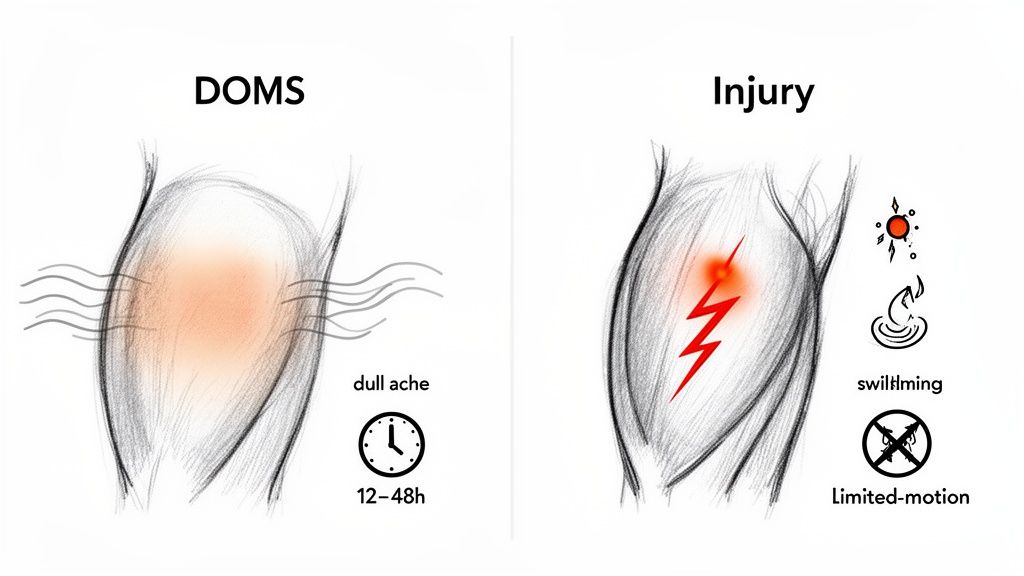
The real difference between muscle soreness and an actual injury comes down to the kind of pain you feel and when you feel it. Muscle soreness, the infamous DOMS, is that dull, widespread ache that shows up 12-48 hours after a tough workout. It’s actually a good sign—it means your muscles are adapting and getting stronger.
An injury, on the other hand, causes a sharp, localized pain that hits you suddenly while you're working out. It often brings friends, like swelling or a limited range of motion.
Distinguishing Normal Soreness From a Potential Injury
That ache you feel after a good gym session can be a bit of a mystery. Is it the rewarding burn of progress, or a warning sign to back off? Knowing how to tell the difference is absolutely key for training smart and recovering right. One feeling means you're building strength; the other means you need to stop and listen to your body.
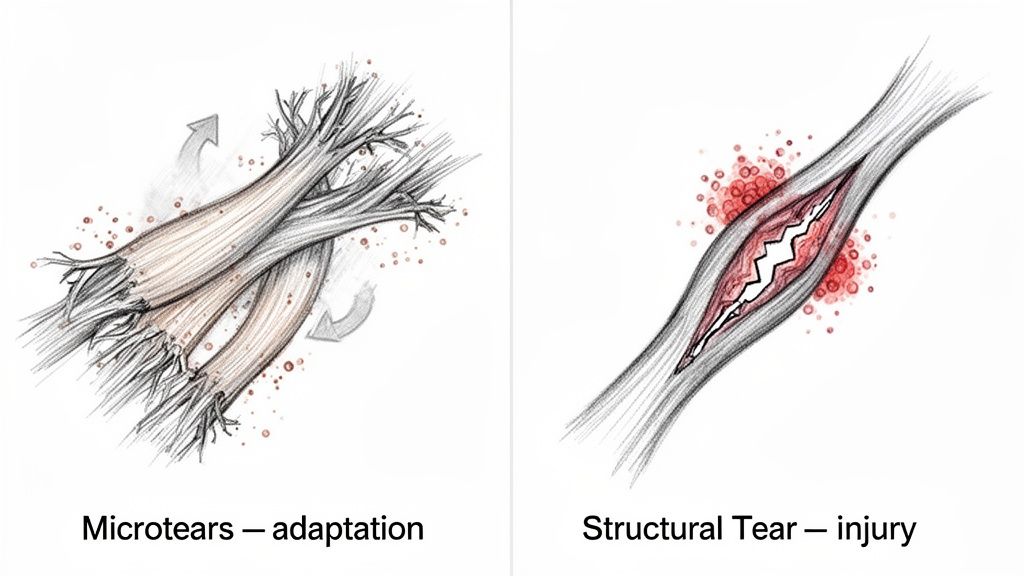
Most of the time, what you're feeling is Delayed Onset Muscle Soreness (DOMS). This is that classic tenderness that creeps in after you try a new exercise, ramp up the intensity, or really focus on eccentric movements (think the lowering part of a squat or bicep curl). It's a totally normal part of the muscle-building process, caused by micro-tears in the muscle fibers that heal back stronger.
An acute injury, however, is something else entirely. It happens when a sudden force or an awkward movement causes real damage to your muscles, tendons, or ligaments. This isn't a sign of progress—it’s a signal that something went wrong.
Key Differentiating Factors
When you're trying to figure out what's going on with your body, focus on these three things:
- How the Pain Feels: DOMS is more of a dull, achy, and stiff feeling spread out over an entire muscle group. An injury pain is usually sharp, stabbing, or shooting, and you can often point to the exact spot it hurts.
- When the Pain Started: The "delayed" part of DOMS is your biggest clue. The soreness almost never shows up right away, usually peaking 24 to 48 hours after you’ve finished your workout. Pain from an injury is almost always immediate—it happens the moment you make the wrong move.
- How Movement Affects It: With DOMS, some light movement and gentle stretching can actually make you feel a bit better by getting the blood flowing. If you're injured, movement typically makes the pain much worse.
To give you a clearer picture, here’s a simple breakdown of the main differences in the classic muscle soreness vs. injury debate.
Soreness vs Injury Symptoms At a Glance
This table offers a quick side-by-side comparison to help you identify what you're likely experiencing.
| Characteristic | Normal Muscle Soreness (DOMS) | Potential Muscle Injury |
|---|---|---|
| Pain Sensation | Dull, aching, tender, stiff | Sharp, stabbing, shooting, burning |
| Pain Location | Widespread across a muscle or group | Localized to a specific point |
| Onset Time | Appears 12-48 hours after exercise | Occurs immediately during activity |
| Duration | Substantially improves within 2-4 days | Lingers for days or weeks; may worsen |
| Impact on Function | Mild stiffness, full range of motion | Significant weakness, instability, swelling |
| Response to Rest | Improves with light activity and rest | Pain may persist even when resting |
By paying close attention to these signals, you can make much smarter calls about when it's safe to push and when you need to pull back. Truly understanding the nuances of muscle recovery after a workout is the foundation for making long-term progress without sidelining yourself with an injury.
The Science Behind Your Post-Workout Feelings
To really get to the bottom of muscle soreness versus an actual injury, we have to look at what’s happening inside your muscles on a microscopic level. That familiar ache you feel after a tough session isn’t random—it's a direct result of the hard work you put in at the gym. Training smart starts with understanding this process.
When you push your muscles with resistance training, especially by trying a new exercise or upping the intensity, you create tiny, microscopic tears in the muscle fibers. This sounds bad, but it’s a perfectly normal and essential part of building strength. This entire process is what we call Delayed Onset Muscle Soreness (DOMS).
These micro-tears kick off a natural, controlled inflammatory response. Think of it as your body’s repair crew rushing to the scene. They bring fluids and nutrients to clear out the damaged tissue and start rebuilding. It's this inflammation that leads to that well-known tenderness and stiffness, which usually peaks 24 to 48 hours after your workout.
A Tale of Two Pains: Renovation vs. Collapse
I’ve found that a construction analogy really helps clients grasp the difference. Think of DOMS as a planned, controlled renovation of a building.
DOMS is like a scheduled renovation. You strategically break down parts of the old structure (your muscle fibers) so you can build back something stronger and more resilient. The temporary mess and activity (inflammation and soreness) are just signs of productive work that will lead to a better, stronger result.
An injury, on the other hand, is an unplanned structural failure. It’s not a calculated part of getting stronger. It’s a sudden, severe event where the force on the muscle was just too much for it to handle, causing significant damage. This is like a wall unexpectedly collapsing—it requires immediate attention and a completely different, more intensive repair plan.
This is exactly why the recovery for soreness is so different from the recovery for an injury. With soreness, you're just trying to manage the discomfort while your body does its positive repair work. With an injury, the priority is damage control, stabilization, and getting a professional assessment to avoid making things worse.
The Purpose of DOMS: A Signal for Growth
That discomfort from DOMS actually serves a vital purpose. It’s your body's feedback loop, telling you that you’ve created the stimulus needed for adaptation. The repair process that follows is where the real magic happens. Your body doesn't just patch up the micro-tears; it overcompensates, building the muscle fibers back thicker and stronger than before so they can handle that kind of stress in the future.
This cycle of stimulus, breakdown, and repair is called supercompensation, and it's the fundamental principle behind getting stronger. Without it, your muscles would never adapt or grow.
Once you understand this, you can start to see soreness in a new light. It’s not a punishment for a hard workout; it’s confirmation that you're on the right track. But it's also a clear signal to let your body recover. Pushing those same sore muscles too hard, too soon, can interrupt this crucial rebuilding phase and turn those productive micro-tears into a real injury.
Knowing the right muscle recovery time based on your workout is key to balancing progress with prevention. This is where the whole "muscle soreness vs. injury" conversation becomes so critical for anyone serious about their long-term fitness.
Decoding the Signals Your Body Is Sending
Learning to listen to your body is probably the single most important skill for long-term success in training. After you’ve pushed your limits, you have to be able to answer one critical question: is this productive soreness, or is it an injury? The answer is usually right there in the signals your body is sending, you just have to know how to interpret them.
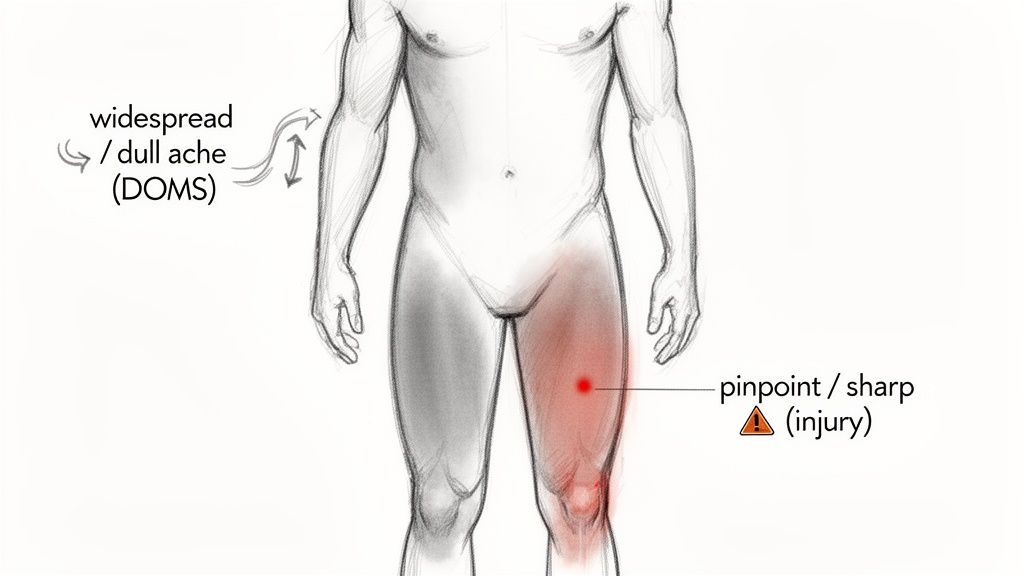
Telling the two apart really comes down to four things: what the pain feels like, where it is, when it started, and how long it sticks around. By looking at these clues, you can stop guessing and start making smart decisions about your recovery and your next workout.
Pain Profile: The Feel of the Discomfort
The first and most obvious clue is the sensation itself. Honestly, the difference between good old muscle soreness and an actual injury often feels like night and day.
- Muscle Soreness (DOMS): Think of this as a dull, aching, and tender feeling. Your muscles might feel tight or stiff, and the feeling is spread out across the entire muscle you just worked. It's a general ache, not a single point of pain.
- Potential Injury: This is different. Injury pain is usually sharp, stabbing, or shooting. It's intense enough to make you wince and stop what you're doing. You can almost always point to the exact spot that hurts.
For instance, that familiar, throbbing ache across both your quads the day after a brutal leg day? That’s classic DOMS. But a sudden, searing pain in your right hamstring while you’re sprinting? That's your body screaming that something just went wrong.
Location and Onset: Pinpointing the Source
Where you feel the pain and when it showed up give you crucial context. DOMS is that friend who shows up late and covers a wide area, while an injury is an immediate, localized problem.
A key differentiator is that DOMS rarely shows up during the workout itself. The hallmark of DOMS is its delayed nature, a sign that the inflammatory and repair process is underway. An injury, however, happens in a distinct moment.
You can usually settle the muscle soreness vs. injury debate by asking yourself two quick questions:
- Where does it hurt? Is it a general area, like your whole chest after benching, or can you point to one specific spot with your finger?
- When did it start? Did you feel it during a specific rep, or did you only notice it when you woke up the next morning?
This distinction matters. A widespread ache is your body’s way of saying, “We did a lot of work.” A pinpointed pain is a distress signal that says, “Something broke right here.” Knowing how to prevent overtraining can go a long way in keeping that general fatigue from turning into a localized injury.
Duration and Red Flags: How Long It Lasts
The timeline of your symptoms is the final piece of the puzzle. Normal muscle soreness follows a pretty predictable schedule, but injury pain has a tendency to linger or even get worse.
The American College of Sports Medicine (ACSM) states that DOMS usually appears about 12 hours after a workout, peaks around 24-48 hours, and is mostly gone within 3-5 days. Pain from an injury, on the other hand, often hits you right away, sticks around for more than 72 hours, and can feel worse when you try to move.
One of the defining characteristics is how it responds to light activity. A gentle walk or some light stretching can often ease the stiffness of DOMS by getting the blood flowing. But if you have an injury, that same movement will probably just make the sharp pain flare up.
You also need to be on high alert for specific red flags that scream "injury" and require immediate attention:
- Significant Swelling: Obvious puffiness around the painful area.
- Visible Bruising: Discoloration showing up at the site of the pain.
- Loss of Function: You can't put weight on a limb or move a joint through its full range of motion.
- Audible Pop: You actually heard or felt a "pop" when the injury happened.
- Instability: A joint feels like it's "giving way" or can't support you.
If you experience any of these, it's not a simple case of soreness anymore. It’s time to stop, start the R.I.C.E. protocol, and talk to a healthcare professional. Ignoring these signs is the fastest way to turn a minor issue into a major setback.
Using Objective Data to Guide Your Training
Relying on how you feel is often just a guessing game. Some days you might feel fantastic even when your body is under-recovered, and other times, a little bit of normal soreness can make you overly cautious. This is where objective data completely changes the game, shifting you from subjective guesswork to making truly informed decisions.
Instead of just asking, "How sore am I?" you can use technology to get a clear, visual answer. Tools that track your workouts in detail give you the raw data needed to understand what’s really going on with your body’s recovery.
Visualizing Your Recovery with Heatmaps
One of the most powerful ways to use data is through muscle recovery heatmaps, a core feature inside the Built app. These heatmaps give you a simple, color-coded chart of your body, showing the recovery status of every muscle group based on your logged training volume and intensity.
This turns complex data into something you can understand at a glance:
- Green muscles are good to go—fully recovered and ready to be trained.
- Yellow muscles are still in the process of recovering and should be approached with caution.
- Red muscles are fatigued and need more time to repair before you hit them with another tough session.
This data-driven view cuts through the ambiguity. You can instantly see which parts of your body have finished repairing and are primed for growth, and which are still in a delicate, fatigued state. For anyone serious about optimizing their training, a comprehensive gym workout tracker is the first step toward getting this kind of actionable insight.
The Built recovery heatmap offers a clear picture of muscle fatigue across the entire body.
This visual immediately tells a story: the chest and triceps are heavily fatigued (red), while the back and biceps are only moderately stressed (yellow). The smart move here is obvious—focus on other muscle groups today.
Distinguishing Soreness from Injury with Data
Heatmaps are especially useful when you're trying to figure out if you're dealing with widespread soreness or a localized injury. For instance, broad DOMS after a brutal leg day will light up your quads, glutes, and hamstrings in yellow or red. That’s totally expected. Over the next few days, you'll see those colors fade back to green as you recover.
An injury, on the other hand, leaves a very different data footprint.
If one specific muscle—like your right bicep or left calf—stays deep red for days while everything around it has already recovered, that’s a huge data-driven red flag. This kind of stubborn, isolated fatigue is a strong signal that the tissue is struggling to heal and might be injured, not just sore.
This objective signal tells you to investigate further instead of just trying to push through what you might have otherwise dismissed as a "stubborn knot." To get an even fuller picture, many people find it helpful to pair workout data with biometric feedback. Consulting a guide on the best smartwatch for health tracking can help you find a wearable that adds valuable metrics like heart rate variability (HRV) and sleep quality into the mix.
AI Coaching for Smarter Training Adjustments
Having the data is one thing; knowing what to do with it is another. This is where AI-driven coaching steps in to interpret your recovery data and give you real-time, practical advice. The AI coach in Built is like having a personal trainer who knows exactly how your body is feeling.
Based on your recovery heatmap, the AI might suggest things like:
- Workout Modifications: Your chest is still deep in the red from Monday's session? The AI might swap out your planned bench press for an overhead press to hit your recovered shoulders instead.
- Volume Adjustments: If it notices your lower back is consistently fatigued, the AI could recommend dialing back the total sets on deadlifts to prevent overtraining.
- Scheduled Rest: When multiple major muscle groups are lit up in red, the AI will recommend a rest day and explain why—that pushing forward would only hurt your recovery and spike your injury risk.
This kind of system ensures you’re always training in a way that’s in sync with your body’s real capacity to perform. It helps you walk that fine line between pushing hard enough for growth and going too far into the danger zone, making every single session both safe and productive.
Actionable Recovery Strategies for Soreness and Injury
So, you've figured out whether you're dealing with normal muscle soreness or something more serious. What's next? Your recovery plan depends entirely on that distinction. Treating a real injury like it's just DOMS can set you back weeks, while being too precious with standard soreness will stall your progress.
For Delayed Onset Muscle Soreness (DOMS), the goal is to gently manage the discomfort and give your body what it needs to repair itself. It's all about promoting blood flow and feeding those tired muscles.
Managing Normal Muscle Soreness
When that familiar, dull ache of DOMS sets in, the best thing you can do is move. I know it sounds counterintuitive, but light activity, or what we call active recovery, is your best friend. It gets blood circulating to those sore spots, delivering fresh oxygen and flushing out the metabolic junk left over from a tough workout.
Here are a few go-to options:
- Light Cardio: Think a brisk walk, a slow spin on the bike, or a light jog. The idea is to get your heart rate up just enough without adding more stress. You can get some great ideas for weaving cardio on rest days into your routine without hurting your recovery.
- Dynamic Stretching: Instead of holding deep, static stretches, focus on gentle, flowing movements. Think leg swings and arm circles to ease into your full range of motion.
- Foam Rolling: This is a fantastic way to work out some of that muscle tightness and boost circulation. It might not feel great in the moment, but you'll thank yourself later.
Of course, movement is only half the battle. You need to nail your nutrition and hydration, too. Make sure you're getting enough protein to supply the amino acids for muscle repair, and drink plenty of water to help your body run efficiently. To really dial in your approach, you can find solid tips on how to recover faster after workout.
Immediate Care for Suspected Injuries
If your symptoms are screaming "injury"—that sharp, stabbing pain, noticeable swelling, or the inability to use a joint properly—the playbook changes completely. This is not the time to "push through it." Your priority shifts from active recovery to immediate damage control using the time-tested R.I.C.E. protocol.
- Rest: Stop what you're doing. Seriously. Avoid any activity that puts stress on the injured area.
- Ice: Grab a cold pack and apply it for 15-20 minutes every couple of hours. This will help control swelling and numb the immediate pain.
- Compression: Lightly wrap the area with an elastic bandage. This gives support and helps keep swelling in check.
- Elevation: Prop the injured limb up so it's above your heart. This uses gravity to help drain excess fluid from the area.
Following these steps is the crucial first move you need to make when trying to solve the muscle soreness vs injury puzzle.
When to Seek Professional Help
Knowing when to call in the pros is a skill every athlete needs to develop. DOMS is a temporary nuisance, but ignoring a real injury can lead to chronic issues that plague you for years.
The real danger isn't the initial injury itself, but the risk of re-injury from returning to training too soon. Data from professional sports confirms this; in a study of NBA players, muscle strains caused 1.3 time-loss injuries per 1000 player-hours, double the rate of ankle sprains, leading to a significant injury burden of 569.5 days lost per 1000 hours. Read more about these findings on muscle strain impact here.
Run through this checklist if you're on the fence:
- Is the pain sticking around or getting worse after 72 hours?
- Can you not put your full weight on the affected limb?
- Is there major, obvious swelling or dark bruising?
- Did you hear a distinct "pop" or "snap" when it happened?
- Does the area look deformed or have a strange lump?
If you answered "yes" to any of these, it's time to make an appointment with a doctor or physical therapist. They can give you a proper diagnosis and get you started on a smart rehab plan.
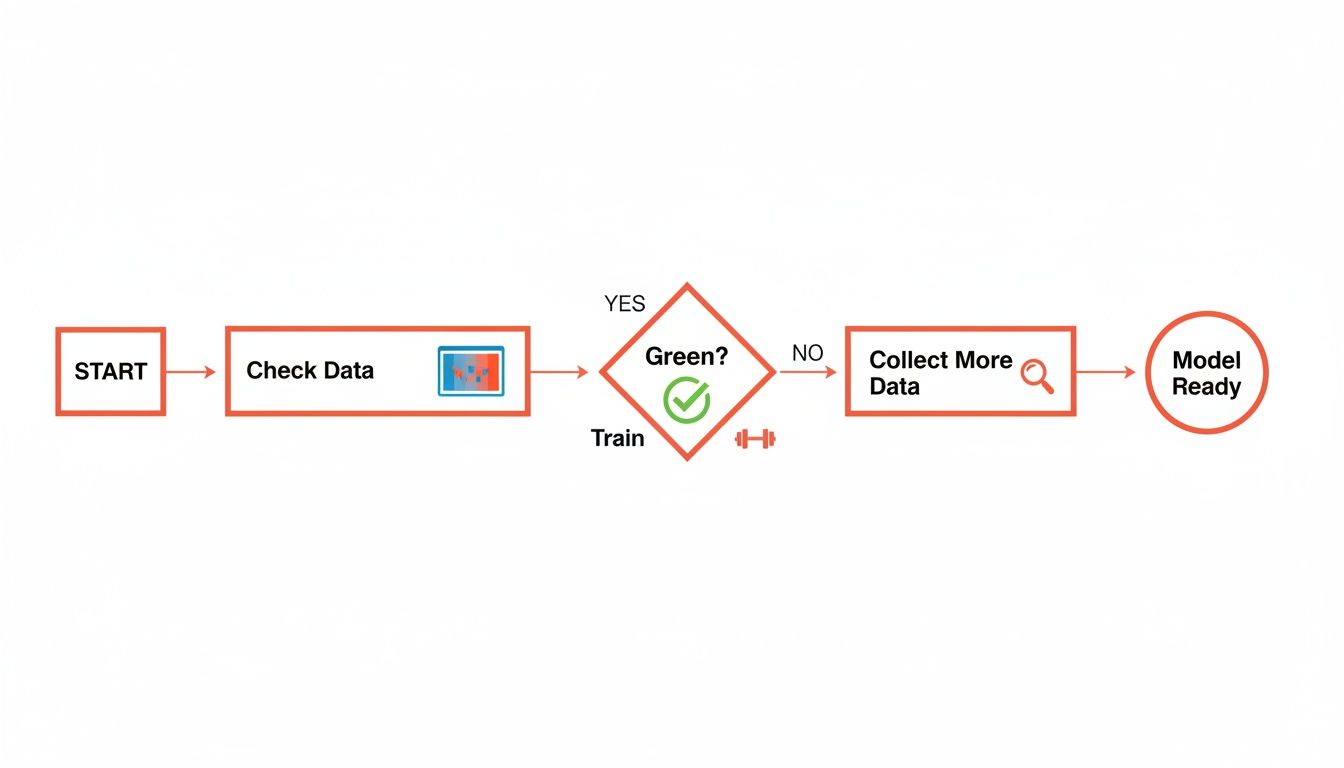
This workflow shows how objective data takes the guesswork out of your training decisions. When your recovery data gives you the green light, you can step into your workout knowing you're ready to perform safely and effectively.
Frequently Asked Questions
Let's clear up some of the most common questions that pop up when you're trying to figure out if you're just sore or actually hurt. Getting this right is key to making smart decisions about your training.
Can I Still Work Out With DOMS?
Absolutely. In fact, light activity is one of the best things you can do for delayed onset muscle soreness. This is called active recovery—think a gentle walk, a slow spin on a bike, or some dynamic stretching.
This kind of movement gets blood flowing to those achy muscles, which can help clear out metabolic waste and reduce stiffness. The key is to avoid hammering the same sore muscle groups with another high-intensity session. Instead, you can train other parts of the body that feel fresh and ready to go.
Should I Follow The "No Pain, No Gain" Philosophy?
This is probably one of the most dangerous and misunderstood sayings in fitness. The "pain" it's referring to is the dull, satisfying ache of DOMS—a sign that you've challenged your muscles enough to make them stronger. That's the good stuff.
Sharp, stabbing, or persistent pain is a different story entirely. That's not a signal for growth; it's a blaring alarm from your body telling you to stop what you're doing. Pushing through that kind of pain doesn't build character, it just digs a deeper hole and sets you up for a much longer time on the sidelines.
Training through the dull ache of soreness builds resilience. Training through the sharp pain of an injury builds a bigger injury. Knowing the difference is a critical skill for long-term fitness.
How Long Should I Rest a Suspected Injury?
There’s no one-size-fits-all answer here because it completely depends on what you’ve injured and how badly. A minor muscle strain might feel better after just a few days of taking it easy and modifying your movements.
On the other hand, a more serious tear or a bad sprain could easily take weeks or even months of dedicated rehab to heal properly. If you suspect an injury, your best bet is to get it checked out by a healthcare professional. They can give you a proper diagnosis and a realistic recovery plan. Trying to rush back into heavy training is the fastest way to get re-injured.
Ready to take the guesswork out of your recovery? Built Workout uses recovery heatmaps and AI coaching to show you exactly which muscles are ready for training and which need more time. Download the app to stop guessing and start building smarter. Find out more at https://www.builtworkout.com.