
Fixing muscle imbalances is all about restoring balance—strengthening the weak, underactive muscles while stretching and releasing their tight, overactive opposites. It’s a process of using unilateral exercises, smart mobility work, and better posture to bring your body back into alignment for a stronger, more resilient physique.
Why Your Body Feels So Out of Sync
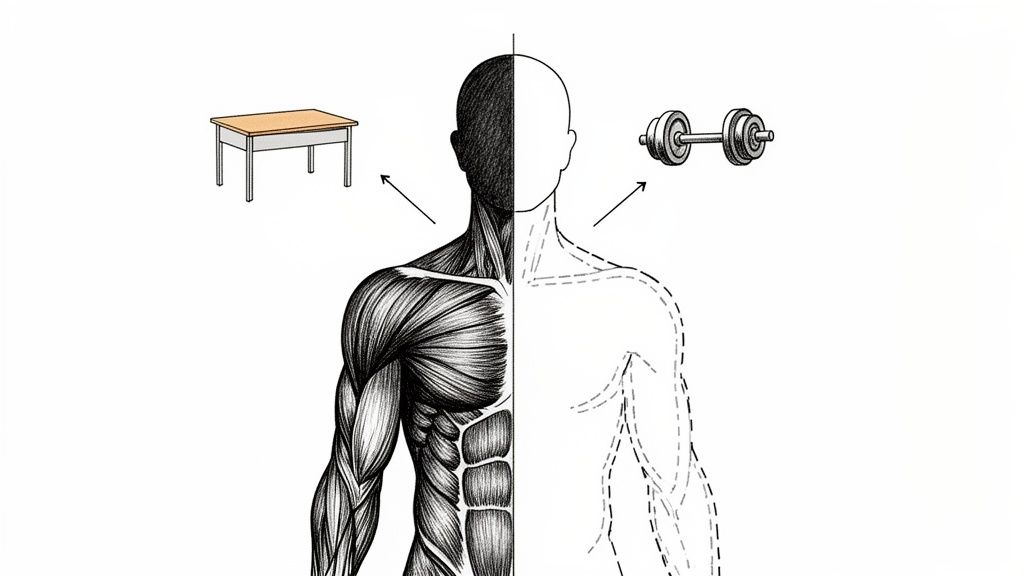
Ever feel like one side of your body is a total stranger to the other? Maybe your right bicep is noticeably bigger than your left, or you can balance on one leg for days but topple over instantly on the other. These aren't just quirks; they're classic signs of muscle imbalances, the silent saboteurs that can kill your progress and lead to nagging pain or serious injury.
These asymmetries pop up when one muscle group becomes stronger or tighter than its counterpart. I like to think of the body as a finely tuned machine with a system of pulleys and levers. If the muscles on one side of a joint are constantly pulling harder (like your chest), the muscles on the other side (your upper back) get stretched out and weak. Eventually, the whole system breaks down.
The Everyday Culprits Behind Imbalances
So, how do we get so lopsided? The causes are usually baked right into our daily routines and habits.
- Desk Life: Spending hours hunched over a keyboard is a fast track to "upper crossed syndrome." Your chest and neck get incredibly tight, while your upper back muscles become weak and overstretched.
- Repetitive Habits: Think about it. Do you always carry your bag on the same shoulder? Play a one-sided sport like tennis or golf? These repetitive motions create huge strength and mobility gaps over time.
- "Mirror Muscle" Training: We've all seen it—the person who only trains what they see in the mirror. Hitting chest, shoulders, and abs day after day without giving equal love to the back, glutes, and hamstrings is a guaranteed recipe for imbalance.
It’s a massive problem. Muscle imbalances are a leading cause of injuries that can put you on the sidelines for weeks, or even months. A huge percentage of people deal with lower back pain and spinal issues, and so many of these cases can be traced directly back to imbalances between the core, back, and hips. You can dig into more of the public health data on this over at Future Market Insights.
Moving Beyond the Guesswork
For a long time, correcting imbalances was based on simple observation and a bit of guesswork. While that can help, it often misses the deeper, more subtle issues. This guide is about ditching the guesswork for a more precise, data-driven strategy to find and fix these asymmetries for good.
By tracking your training and recovery the right way, you can finally build a body that’s balanced, powerful, and pain-free. This is also key to avoiding burnout, which often goes hand-in-hand with these issues. In fact, our guide on how to prevent overtraining is a great next read.
How to Assess Your Own Imbalances
Before you can fix an imbalance, you have to find it. This is the first, most important step. Think of yourself as a detective, gathering clues from how your body looks, moves, and feels. You don't need a fancy lab for this—just a little focused observation.
The simplest way to start? A good old-fashioned mirror check. Stand naturally and take a hard look. Are your shoulders even, or is one creeping up toward your ear? Check your hips—is one side hitched higher than the other? These little asymmetries are often the first tell-tale signs that something’s off.
Next, it's time to see how you move. Functional movements are fantastic for revealing where your body is cheating. The overhead squat is a classic for a reason. Have a friend film you from the front and the side as you perform a few reps. Do your knees collapse inward? That’s often a sign of weak glutes. Does your chest drop forward? Your hip flexors might be too tight and your core not firing properly.
Uncovering Clues During Your Workouts
Your training log is a treasure trove of data. Pay special attention during unilateral exercises—those movements where you work one side of your body at a time. This is where imbalances love to hide.
Can you bang out 10 clean reps of a dumbbell row on your right side but struggle to get 6 with your left? When you do Bulgarian split squats, do you feel like a rock on one leg but a wobbly mess on the other? These performance gaps aren't just frustrating; they're hard evidence of an imbalance that needs your attention.
A quick tip from my own experience: always start your single-sided exercises with your weaker side. If you always lead with your dominant side, you're getting a skewed picture because the weaker side is already a bit tired from stabilizing. Starting fresh gives you an honest look at its true strength.
To help you spot these patterns visually, here's a quick reference table for some of the most common issues I see.
Common Muscle Imbalances and Their Visual Cues
| Common Imbalance Pattern | What to Look For (Visual Cues) | Overactive (Tight) Muscles | Underactive (Weak) Muscles |
|---|---|---|---|
| Upper Crossed Syndrome | Forward head, rounded shoulders | Pectorals, Upper Trapezius, Levator Scapulae | Deep Neck Flexors, Rhomboids, Serratus Anterior |
| Lower Crossed Syndrome | Excessive lower back arch, protruding stomach | Hip Flexors, Erector Spinae (lower back) | Glutes, Abdominals |
| Pelvic Tilt (Anterior) | "Duck butt" posture, pronounced lower back curve | Hip Flexors, Quadriceps | Glutes, Hamstrings, Abdominals |
| Shoulder Elevation | One shoulder sits noticeably higher than the other | Upper Trapezius, Levator Scapulae (on the high side) | Lower Trapezius, Serratus Anterior (on the high side) |
This table is a great starting point, but visual cues only tell part of the story.
Leveraging Technology for Objective Data
While looking in the mirror and paying attention during workouts are crucial, they can be subjective. This is where technology can give you a serious edge, turning your educated guesses into concrete, objective data.
And let's be clear, this isn't some niche problem. The posture corrector market, which is all about addressing the symptoms of muscle imbalance, was valued at over USD 1.3 billion. That number, reported by Coherent Market Insights, shows just how many people are struggling with the consequences of our modern, often sedentary, lifestyles.
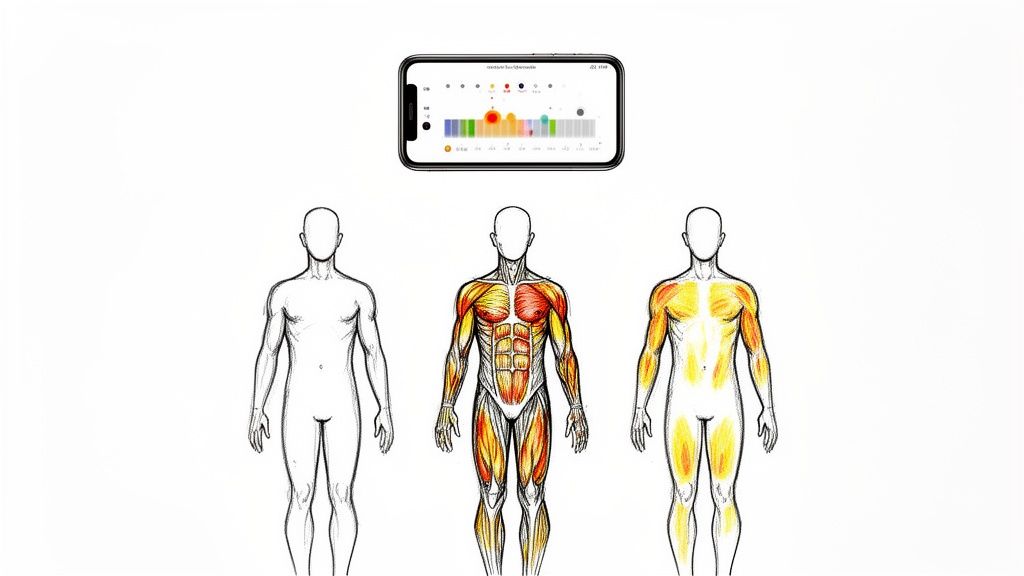
This is where tools like the Built Workout app really shine. The app logs every set and rep you do, automatically mapping the workload to the specific muscles you've trained. Over time, this data populates a personal muscle recovery heatmap.
Here’s what one of those heatmaps looks like after a few training sessions.
This kind of visual feedback is a game-changer. It instantly highlights which muscles you’re hitting hard (shown in red) and which ones you might be neglecting (in blue or green). For example, your heatmap might show that your right quad is constantly fried while your left glute is barely getting any work. That’s an undeniable sign of a compensation pattern you need to address.
To see exactly how this works in practice, you can check out our deep dive into the benefits of an AI fitness coach.
Building Your Corrective Action Plan
Alright, you've done the detective work and pinpointed the imbalances that are throwing a wrench in your training. Now for the fun part: fixing them. It's time to shift from assessing to acting with a smart, targeted plan.
The most effective framework I've seen and used over the years boils down to a simple, three-part sequence: Release the tight, overworking muscles, Activate the sleepy, weak ones, and then Strengthen everything together into a new, more balanced pattern.
This isn't about tacking on another hour to your gym time. We're talking about being strategic—using just a few minutes before and during your workouts to retrain your body to move the way it's supposed to. It's about getting to the root of the problem instead of just piling strength on top of dysfunction.
This visual flow shows the three core steps to understanding and addressing your imbalances, moving from observation to detailed analysis.
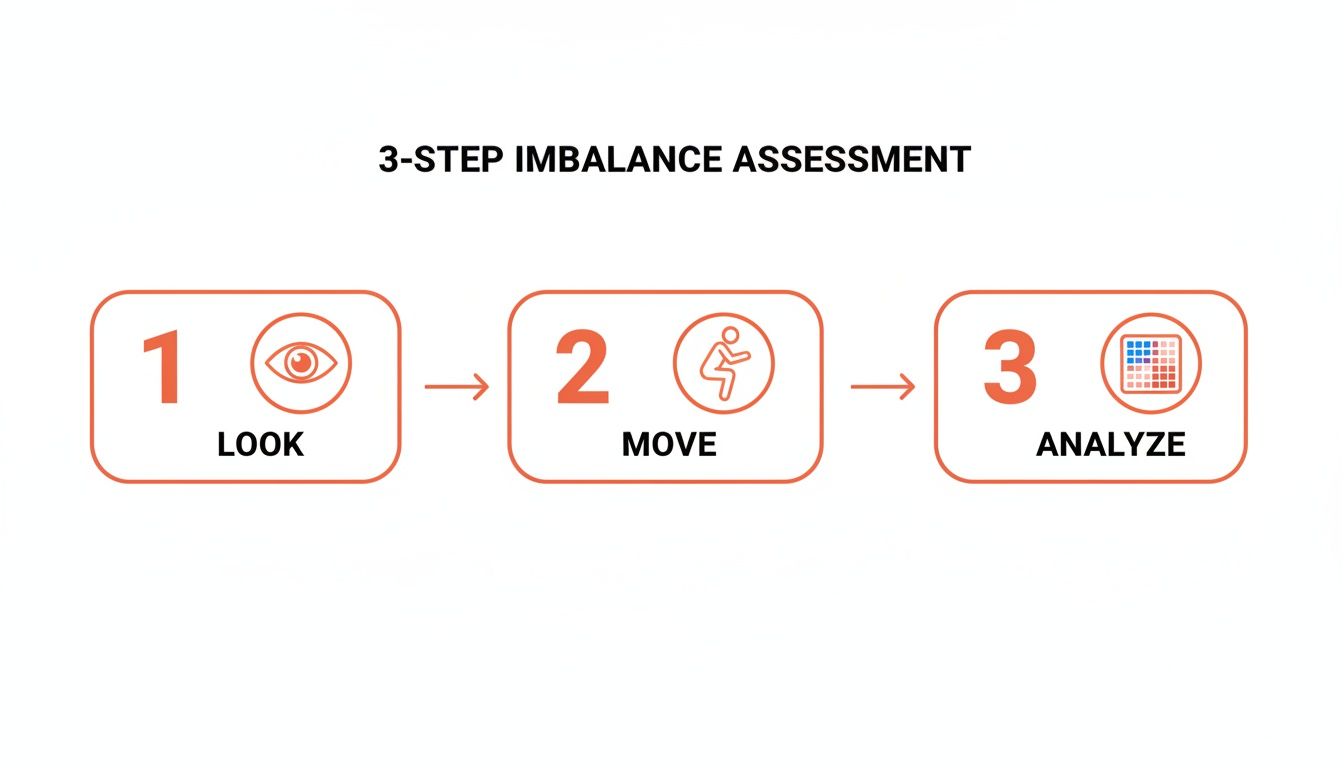
The process starts with simple observation and functional movement tests, but true precision comes from analyzing performance data to uncover hidden compensation patterns.
Phase 1: Release Overactive Muscles
First things first, you have to calm down the muscles that are doing too much work. These are the tight, dominant ones pulling your body out of whack and keeping their weaker partners from doing their job. Think of it like a tug-of-war where one side is pulling way too hard—you need them to ease up.
Self-myofascial release (SMR) is your go-to tool here. Grabbing a foam roller or a massage ball lets you apply direct pressure to those knots, helping to release tension and get some blood flowing.
- For Rounded Shoulders: If your chest is chronically tight from sitting at a desk, spend 30-60 seconds foam rolling your pecs before an upper-body day. This immediately helps open you up, making it way easier to feel your back muscles work.
- For Anterior Pelvic Tilt: Those overactive hip flexors are almost always the main suspect. A little time rolling the front of your hips can release that constant forward pull on your pelvis.
Phase 2: Activate Underactive Muscles
Now that the tight muscles have chilled out, you've created a small window of opportunity to wake up the muscles that have been sleeping on the job. This isn't about lifting heavy; it’s about rebuilding that mind-muscle connection with some light, focused activation drills. The goal is simple: get these muscles to fire before asking them to perform in a big lift.
These are usually bodyweight or light-band movements where the feel is everything.
- To Wake Up Weak Glutes: Before you even think about squatting, knock out a few sets of glute bridges or lateral band walks. At the top of each rep, give your glutes a hard squeeze. This "pre-activates" them, ensuring they show up to the party instead of letting your lower back and quads take over.
- To Engage a Weak Upper Back: You can't go wrong with face pulls or band pull-aparts for waking up the rhomboids and rear delts. Do 2-3 sets of 15-20 reps with a light band, really focusing on pinching your shoulder blades together.
A core component of building your corrective action plan involves incorporating targeted therapeutic exercises designed to restore balance and strength. These drills are the foundation of effective activation work.
Phase 3: Strengthen in a Balanced Way
Okay, you've released the tension and woken up the right muscles. Now it's time to lock in those changes by integrating this newfound balance into your actual strength training. This is where you make the new movement patterns permanent.
The secret weapon here is a heavy dose of unilateral exercises. We're talking single-limb movements like dumbbell presses, single-arm rows, and lunges. These are gold for correcting imbalances because they make it impossible for your dominant side to pick up the slack for the weaker one. A prime example is the lateral leg raise, a fantastic move for building hip abductor strength. You can learn more about the lateral leg raise in our article.
Here are a few practical rules to live by:
- Start with Your Weaker Side: Always begin any unilateral exercise with your weaker or smaller limb. This ensures it gets your best effort when you're fresh.
- Let the Weaker Side Set the Reps: If your left arm conks out at 8 reps on a dumbbell press, your right arm only does 8 reps, too. No ego lifting—we're chasing balance.
- Add a "Catch-Up" Set: For a little extra stimulus, consider adding one more set just for your weaker side to help it catch up in volume over time.
This three-phase plan—Release, Activate, Strengthen—is a cycle you can run through in every workout. It’s a proactive strategy that meets imbalances head-on. And with the right tools, it gets even easier. The Built Workout app’s AI coach, for instance, can look at your heatmap data and automatically recommend specific activation drills or unilateral moves to hit muscles that are under-recovered or lagging, building a truly personalized corrective plan just for you.
Programming for Symmetry and Strength
Pinpointing which muscles are out of whack is a great first step, but it’s just that—a first step. The real change happens when you translate that knowledge into a smart, structured training plan. It’s time to move beyond just throwing a few extra exercises at the problem and start programming your sets, reps, and frequency with purpose.
Think of it as creating a blueprint for your body. You wouldn't just toss building materials in a pile and hope a house appears. Your programming is that blueprint, laying out exactly how to bring up lagging muscles without sacrificing your main training goals.
Sets and Reps: The Corrective Formula
When you're programming for balance, the classic "3 sets of 10" doesn't always cut it. The goal dictates the method. For activation drills meant to wake up sleepy muscles like the glutes or serratus anterior, it's all about volume and connection, not raw weight.
This is where higher rep ranges—think 15-20 reps per set—really shine. Using a lighter load lets you zero in on the contraction, rebuilding that crucial mind-muscle connection without causing too much fatigue. The point isn't to chase a pump; it's to actually feel the right muscle firing correctly, maybe for the first time in a long time.
When it comes to strengthening your weaker side with unilateral work, the game changes. Here, we apply the same principle of progressive overload you'd use for any other lift. I typically recommend a rep range of 8-12 reps, a sweet spot for building strength and size. The golden rule? Let your weaker side set the pace.
If your left leg can only handle 8 solid Bulgarian split squats, then your right leg—even if it could do 12—also does only 8. It feels weird at first, but this prevents your stronger side from running away with all the gains and gives the lagging side a real chance to catch up.
Strategic Exercise Order and Volume
One of the simplest and most powerful programming tweaks you can make is to train your weak points first. Always hit the unilateral exercise for your weaker side when your energy and focus are at their absolute peak.
Let's walk through a common scenario: you've figured out your left glute is weaker than your right, causing a hip shift during your squats.
- The Old Way: You'd probably jump straight into heavy barbell squats, then maybe do some lunges at the end of the workout if you still have gas in the tank.
- The Corrective Way: You start your leg day with 3 sets of 10-12 reps of single-leg glute bridges, leading with the left leg. Then you move on to your lunges, again starting with the left. Only after you've "primed" those muscles do you get under the squat rack, ready to work with a more balanced foundation.
Another trick I use with clients is adding a single "catch-up" set for the lagging side. If the plan calls for 3 sets of 10 single-arm dumbbell rows, you'll do a fourth set just for your weaker arm. It’s a small, manageable increase in volume that compounds into significant progress over a few months. For athletes looking to optimize their body's mechanics, understanding how chiropractic care for athletes complements this process can be a game-changer for performance and injury prevention.
Integrating Corrective Work Into Your Split
You don't need to dedicate an entire workout to "imbalance day." The most sustainable and effective method is to weave these corrective movements into your existing routine. They fit perfectly into your warm-ups or as accessory work after your main lifts. If you're tackling issues like a weak posterior chain, our guide on how Nordic hamstring curls offers some great insights into specific exercises.
Let's put this into practice. Here’s a clear example of how to integrate corrective work into a standard push/pull/legs split for someone dealing with rounded shoulders and an anterior pelvic tilt.
Sample Weekly Corrective Exercise Integration
This table shows how to seamlessly blend corrective exercises into your workouts without adding a ton of extra time.
| Workout Day | Corrective Focus | Sample Integration (Warm-up/Working Sets) |
|---|---|---|
| Push Day | Rounded Shoulders (Tight Chest / Weak Back) | Warm-up: 2 sets x 30 sec chest foam roll. Accessory: 3 sets x 15 reps of band pull-aparts. |
| Pull Day | Rounded Shoulders (Weak Back) | Warm-up: 2 sets x 15 reps face pulls. Working Set: Add 1 extra set of single-arm rows for the weaker side. |
| Leg Day | Weak Glutes (Anterior Pelvic Tilt) | Warm-up: 2 sets x 15 reps glute bridges. Working Set: Perform Bulgarian split squats before heavy squats. |
By weaving these small adjustments into your program, you ensure consistency, which is the key to lasting change. Fixing imbalances isn't about a short-term, all-out assault; it's about making intelligent, consistent tweaks that rebuild your body for long-term symmetry and strength.
How to Track Your Progress and Make Smart Adjustments
Fixing a muscle imbalance isn't a one-and-done deal. Think of it more like an ongoing conversation with your body. You apply a stimulus, listen to the feedback, and adjust. The most effective muscle imbalance correction plans are alive—they evolve as you get stronger and your movement quality improves.
That’s why tracking your progress is non-negotiable. Without it, you’re just training in the dark and hoping for the best. Good tracking turns guesswork into a clear, intelligent strategy for building a truly balanced physique.
Go Beyond the Numbers: Combine How You Feel with Hard Data
A complete picture of your progress comes from two places: how you feel in your own body (the qualitative stuff) and the cold, hard numbers (the quantitative data). You absolutely need both.
Qualitative feedback is all about the real-world changes you notice day-to-day. This is often the most motivating part because you can actually feel the difference.
- Less Pain: That annoying twinge in your lower back during deadlifts is finally gone.
- More Confidence: Single-leg exercises that used to feel wobbly and weak now feel solid and powerful.
- Cleaner Form: You catch a glimpse in the mirror and see your hips are staying perfectly level during squats—a sure sign your glutes are finally pulling their weight.
But feelings can be fickle. That’s where objective data comes in to confirm what you’re sensing and keep you honest.
Never discount the power of just feeling better. Data is crucial for precision, but the mental win of moving without pain or restriction is what keeps you showing up. Lasting change is built on both physical adaptation and psychological reinforcement.
Using Data to See the Full Story
Quantitative data cuts through the noise. It tells you exactly what’s happening, confirming that your corrective exercises are actually doing their job. This is where modern tools can be a total game-changer.
For example, the Built Workout app does far more than just count reps. It logs the fine details of your workouts and translates that effort into a personal muscle recovery heatmap. Over weeks, this gives you an incredible visual story of your progress. You can literally see the colors on your body map start to even out.
This visualization makes it dead simple to see which muscles are getting hit hard and which are being left behind, allowing for immediate tweaks to your program. A muscle that was once weak and underworked (showing up as cool blue or green) will start glowing with healthy signs of work (yellow and orange). This is proof that your plan is working. Learning how to properly track your gym workouts with data is essential for anyone serious about this kind of targeted training.
Let AI Coaching Guide Your Next Move
Tracking is only half the battle; you have to use that information to make smart adjustments. As your body adapts, your program must adapt right along with it. An AI-driven coach offers a huge advantage here, acting as a dynamic guide that learns as you do.
The AI coach inside the Built Workout app constantly crunches your performance and recovery numbers to offer smart, timely recommendations. Its entire job is to keep you in that perfect zone of productive training.
- Smart Progressions: Once the app sees your weaker side is consistently getting stronger and recovering well, the AI might suggest bumping up the weight on your unilateral work or adding another set to keep the momentum going.
- Strategic Deloads: On the flip side, if your heatmap shows a muscle is becoming chronically fried—even a previously weak one—the AI could recommend a deload or a temporary volume cut to prevent burnout and allow for full recovery.
This constant feedback loop is the engine that drives real, lasting change. It ensures you’re always applying the right dose of training at the right time, turning your hard work into measurable symmetry.
Got Questions About Fixing Muscle Imbalances?
It's totally normal to have questions as you start digging into corrective exercise. This stuff can get pretty detailed, and it’s easy to feel a little lost in the weeds. I've put this section together to tackle the most common questions and myths I hear from clients, giving you straightforward answers so you can keep making progress.
Think of this as your go-to FAQ for building a more balanced, resilient body. We're getting into the practical, "what-if" scenarios that pop up once you start putting these ideas into practice.
How Long Does This Actually Take?
This is the big one, right? Everyone wants to know the timeline. But the honest answer is: it depends. The time it takes to fix an imbalance is directly tied to how severe it is, how long you’ve had it, and how consistently you stick with your plan. There's a world of difference between a minor strength gap you just noticed in your arms and a decade-old postural shift from sitting at a desk all day.
For smaller, more recent issues, you can often feel a real difference within 4-6 weeks of consistent, focused work. But for those deeper, more ingrained imbalances that have messed with your fundamental movement patterns—like a classic anterior pelvic tilt—you could be looking at 6 months to a year or more of patient, dedicated effort to truly resolve it.
The most important thing to remember is that progress isn't always a straight line, but it adds up. Consistency is king. Sticking with the plan day after day is what creates lasting change, not just a few heroic workouts here and there.
Can I Still Lift Heavy While Working on This?
Absolutely. But you have to be smarter about how you lift. The point of correcting imbalances isn't to stop training hard; it's to train better. You might need to temporarily dial back the weight on big bilateral lifts like the barbell squat or bench press. This isn't a step back—it's a strategic move to clean up your technique and stop your dominant side from always taking over the show.
This is actually a perfect time to really lean into your unilateral (single-limb) exercises. I'm talking about dumbbell presses, lunges, split squats, and single-arm rows. These movements are fantastic because they force each side of your body to carry its own load. Your weaker side has no choice but to get stronger, and you can still train with some serious intensity.
Should I Just Stop Training My Stronger Muscles?
Not usually, no. The idea isn't to completely ignore your stronger or tighter muscles. The goal is to bring the weak guys up, not to tear the strong guys down. It's all about shifting the balance of your training volume.
For instance, let's say your quads are overactive and your glutes are weak (a super common issue). You wouldn't just stop squatting. A better approach would be to swap your high-bar back squat for something like a box squat, which naturally shifts more of the load to your glutes and hamstrings. You're not cutting the quads out of the picture; you're just reprogramming the movement to give your posterior chain a bigger role.
The game plan stays the same:
- Release the tight, overactive muscle (e.g., foam roll your quads).
- Activate the sleepy, underactive muscle (e.g., hit some glute bridges).
- Integrate them into a better movement pattern (e.g., perform your box squats).
Are Free Weights or Machines Better for This?
Both have their place, and a good program will use both. It's not an either/or debate; it’s about using the right tool for the job.
Free weights, especially dumbbells and kettlebells, are phenomenal for exposing and correcting imbalances. When you're doing a single-arm dumbbell press, each side of your body has to stabilize its own weight. There's nowhere for a weak link to hide.
Machines, on the other hand, are great for isolating and strengthening a specific weak muscle in a very controlled way. If your hamstrings are seriously lagging, a lying hamstring curl machine lets you hammer them with targeted work without your lower back or glutes jumping in to "help." A smart program weaves both together for the best results.
Ready to stop guessing and start fixing your imbalances with a clear plan? The Built Workout app shows you your muscle recovery with personal heatmaps and uses AI coaching to build a corrective plan that adjusts to your body. Download it for free and start building a stronger, more balanced you.