Losing fat without losing muscle is the holy grail of body transformation, but it's not a mystery. The strategy is actually quite simple: you need to create a slight calorie deficit, keep your protein intake high (think 1.6-2.2 grams per kilogram of body weight), and never, ever skip your resistance training. This trifecta sends a clear signal to your body: burn fat for fuel, but keep the hard-earned muscle.
The Modern Blueprint for Body Recomposition
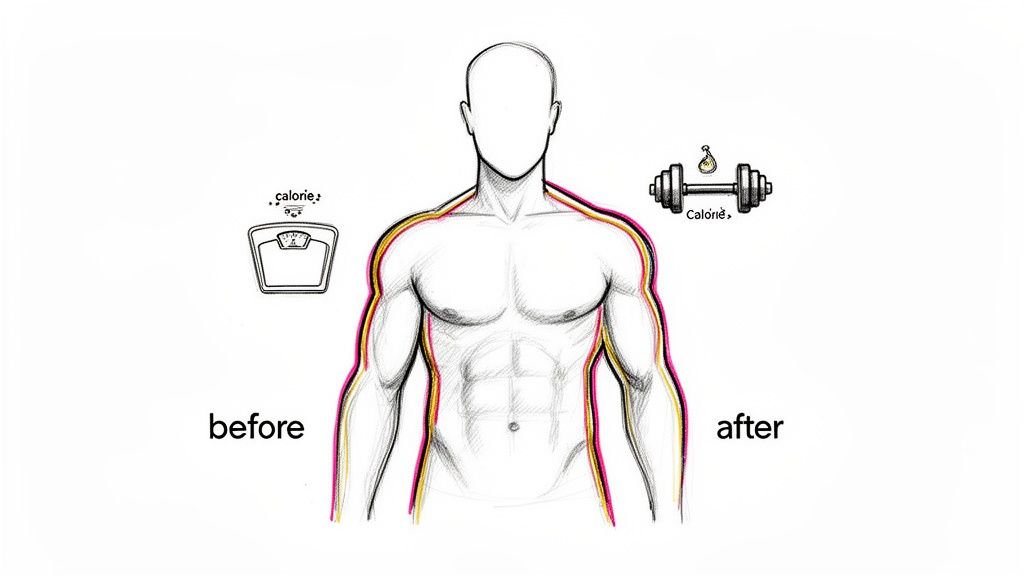
Let's be honest, the fear of losing muscle during a cut is what holds a lot of people back. It's a real concern, and it comes from seeing others make the classic mistake: chasing a number on the scale no matter the cost. This usually involves slashing calories and grinding out hours of cardio—a surefire recipe for torching both fat and muscle, leaving you weaker with a slower metabolism to boot.
But the real goal here isn't just weight loss; it's body recomposition. We're aiming to shift the ratio of fat to muscle, which is how you build a leaner, stronger, and more defined physique. Holding onto your muscle mass is non-negotiable.
Here’s why it matters so much:
- Your Metabolic Engine: Muscle is active tissue. The more of it you have, the more calories you burn just sitting around. This makes it worlds easier to keep the fat off for good.
- Strength and Performance: Keeping your muscle means keeping your strength. You won't feel weak and lethargic in the gym or in your day-to-day life, a common side effect of crash dieting.
- The Aesthetic Factor: Muscle is what gives your body its shape and contour. If you lose it along with the fat, you can end up with that "skinny-fat" look, even at a lower weight.
The Science of Holding On to Your Gains
For a long time, people just accepted that losing a good chunk of muscle during a diet was part of the deal. The data even backed it up, showing that with a typical weight loss of 8-10%, people could lose 2-10% of their muscle mass. That’s a tough pill to swallow.
But we know better now. A 2021 meta-analysis dropped a bombshell: a high-protein diet (1.2-1.6g/kg) during a calorie deficit helped people preserve an extra 400-800 grams of lean mass compared to those on standard protein diets. This is huge. It's concrete proof that with the right nutrition, you can absolutely lose fat without sacrificing muscle.
The secret is giving your body a compelling reason to keep its muscle. That reason is resistance training. Lifting weights provides the stimulus, and a high-protein diet provides the building blocks to repair and maintain the muscle you’ve fought for.
To get started on the right foot, you need to understand what your body requires. Before we dive into the nitty-gritty of training and meal planning, let's lay out the foundational pillars of this approach.
Key Pillars of Muscle-Sparing Fat Loss
This table breaks down the core components you'll need to master. Think of it as your quick-start guide to ensure you're firing on all cylinders from day one.
| Component | Why It Matters | Quick Action |
|---|---|---|
| Calorie Deficit | Essential for fat loss. A moderate deficit (300-500 calories) prevents muscle breakdown. | Use a body recomposition calculator to get a personalized starting point. |
| High Protein Intake | Provides the amino acids needed to repair and preserve muscle tissue during a deficit. | Aim for 1.6-2.2g of protein per kg of your body weight daily. Spread it across 3-5 meals. |
| Resistance Training | Signals your body to hold onto muscle. "Use it or lose it" is the golden rule here. | Train 2-4 times per week, focusing on compound lifts and progressive overload. |
With these pillars in place, you have a solid framework. This guide will show you exactly how to build upon it, but if you want to get a head start on workout design, our article on https://www.builtworkout.com/blog/training-frequency-for-hypertrophy offers some great insights into structuring your week.
Mastering Your Nutrition for Fat Loss
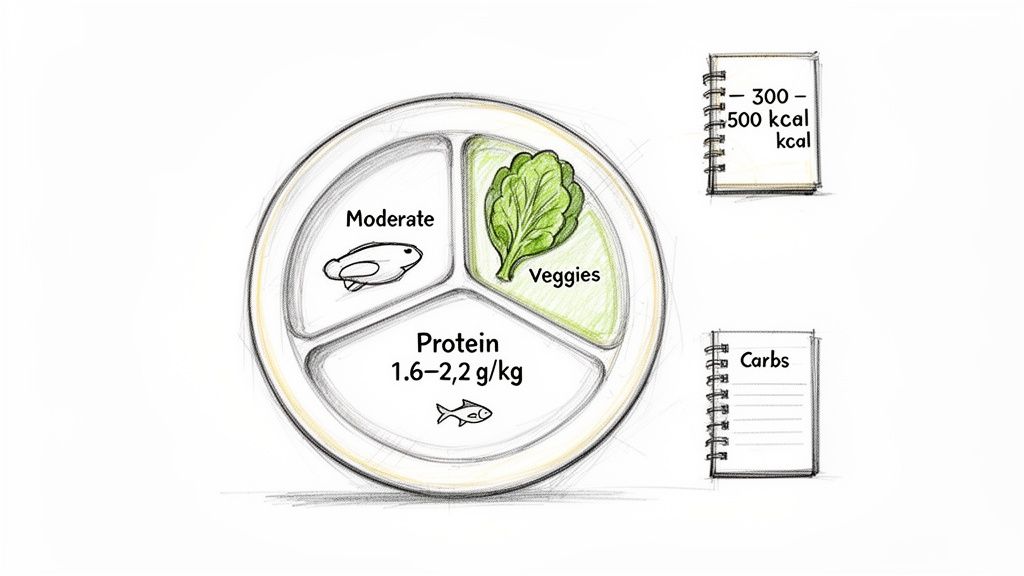
While your work in the gym tells your body to keep its muscle, your diet is what gives it the raw materials to actually do it. Think of your nutrition plan as the engine driving this whole operation. Get the fuel mix wrong, and the entire system just sputters out.
The game here is walking a fine line. You need enough energy to feel good and train hard, but you also need to create a calorie deficit that tells your body to burn fat for fuel, not your hard-earned muscle. This all starts with a smart deficit—not a drastic one.
Slashing your calories to the bone is one of the most common—and most damaging—mistakes you can make. It sends your body into a panic, making it far more likely to ditch metabolically "expensive" muscle for a quick energy fix.
Calculating Your Calorie Target
The sweet spot for a deficit that preserves muscle is usually between 300 to 500 calories below what you need to maintain your current weight. This gentle approach nudges your body to lose fat at a sustainable rate, somewhere around 0.5% to 1% of your body weight per week.
For a 200-pound person, that’s a realistic one to two pounds lost on the scale each week. Anything faster, and you're likely losing more than just fat.
A good starting point is to use an online TDEE (Total Daily Energy Expenditure) calculator to estimate your maintenance calories. Subtract 300-500 from that number, and you have your initial target. Just remember, this is an estimate. You’ll need to watch your progress and be ready to adjust.
Key Takeaway: How big of a calorie deficit you create determines what you lose. A small, controlled deficit prioritizes fat. A massive one forces your body to sacrifice muscle. Slow and steady really does win this race.
The Non-Negotiable Role of Protein
If your calorie deficit is the how, protein is the what. When you’re in a fat loss phase, protein becomes the single most important macronutrient on your plate. Hands down.
It provides the amino acids your body needs to repair and hold onto muscle tissue. When calories are low, your body starts looking around for energy, and a high protein intake essentially puts up a "do not touch" sign on your muscles.
To lose fat without losing muscle, you'll need to aim higher than the standard recommendations. A good target is 1.6 to 2.2 grams of protein per kilogram of body weight (that's about 0.7 to 1.0 grams per pound). Splitting this up over three to five meals throughout the day helps keep your muscles fed and also does wonders for keeping hunger at bay.
And there's a bonus: protein has the highest thermic effect of any macronutrient, meaning your body burns more calories just digesting it. It’s also incredibly filling, which makes sticking to that calorie deficit a whole lot easier.
Building Your Muscle-Sparing Meal Plan
Hitting your calorie and protein numbers doesn't mean you have to eat boring, complicated meals. The foundation is simple: focus on whole, nutrient-packed foods.
Here’s a practical way to structure your meals:
- Start with protein: Every single meal should be anchored by a quality protein source. Think chicken breast, turkey, salmon, tuna, eggs, Greek yogurt, or cottage cheese.
- Fuel with smart carbs: Carbs are not the enemy! They fuel your workouts and help you recover. Time them around your training and stick to sources like oats, quinoa, sweet potatoes, and brown rice.
- Add healthy fats: Fats are critical for hormone production. Get them from sources like avocados, nuts, seeds, and olive oil.
- Fill up with veggies: Load the rest of your plate with fibrous vegetables. They add a ton of volume to your meals, keeping you full for very few calories while delivering essential micronutrients.
Juggling all of this can feel like a lot, but this is where the right tools can make a huge difference. If you're looking for ways to simplify tracking and planning, take a look at our guide on the best fitness apps for iOS to find something that works for you.
Structuring Your Workouts to Preserve Muscle
Your diet creates the fat loss deficit, but your training is what convinces your body to keep its muscle. When you're running on less fuel, your body starts looking for things it can get rid of to save energy. Metabolically expensive muscle tissue is always at the top of that list.
Resistance training sends a loud and clear signal: "Don't touch this—we still need it!"
Without that signal, you're just dieting. With it, you're sculpting. The right workout structure is the difference between simply getting smaller and getting leaner, stronger, and more defined. But how you train during a cut isn't quite the same as when you're all-in on building mass. The goal shifts from chasing massive gains to fiercely defending what you've already built.
The Power of Resistance Training
What happens if you just diet and skip the weights? Your body has no reason to hold onto muscle. In fact, research shows that in typical weight management programs, a staggering 20-40% of the total weight lost can come straight from muscle. Yikes.
The game changes entirely when you add resistance training. One landmark study showed that lifters preserved up to 90% of their lean mass, losing only 0.5kg of muscle compared to a hefty 2.5kg in the diet-only groups over 12 weeks. Learn more about how to preserve muscle while losing fat on medpartnerstl.com.
This makes it crystal clear: strength training is non-negotiable. It's your primary tool for muscle preservation.
Prioritize Big, Compound Movements
When your recovery capacity is limited by a calorie deficit, you have to be smart with your energy. Your workouts should be built around big, multi-joint exercises that provide the most bang for your buck. These are the lifts that stimulate the most muscle fibers and trigger the strongest hormonal response to hang onto mass.
Your training staples should be built around these patterns:
- Squat variations: Barbell back squats, front squats, goblet squats.
- Hinge movements: Deadlifts, Romanian deadlifts (RDLs), good mornings.
- Pressing exercises: Bench press, overhead press, incline dumbbell press.
- Pulling movements: Pull-ups, chin-ups, bent-over rows, seated cable rows.
These lifts work multiple muscle groups at once, making your training both efficient and effective. While isolation exercises like bicep curls and tricep pushdowns have their place, they should always take a backseat to these foundational movements.
Redefining Progressive Overload for a Cut
In a surplus, progressive overload is all about consistently adding weight to the bar or grinding out more reps. During a deficit, the definition changes a bit. Your primary goal is to defend your current strength levels as fiercely as possible.
Instead of trying to hit a new one-rep max every week, your mission is to maintain your current working weights for the same number of sets and reps. If you can do that while your body weight is dropping, you are successfully getting stronger relative to your size. That sends the strongest possible signal to preserve muscle.
Don't get discouraged if your lifts stall or even dip slightly. It's a normal part of the process when calories are restricted. The real win here is fighting to maintain performance, not necessarily shattering personal records every single session.
Finding Your Training Frequency Sweet Spot
More is not better when you're cutting. Your ability to recover is compromised, so trying to train six or seven days a week is a recipe for burnout and muscle loss.
For most people, three to four full-body or split-body resistance training sessions per week is the sweet spot.
This schedule provides plenty of stimulus to tell your muscles to stick around while giving you adequate time to recover between sessions. You have to listen to your body here—if you feel constantly beaten down, sore, and weak, you may need to dial it back and add an extra rest day.
Use Cardio as a Tool, Not a Crutch
Cardio is a useful tool for increasing your calorie deficit, but it should never come at the expense of your lifting. Pounding out too much high-intensity cardio can create excessive fatigue and interfere with your recovery, potentially leading to muscle breakdown.
Think of it as a supplement, not the main event. Instead of grueling HIIT sessions every day, lean into low-intensity steady-state (LISS) cardio.
- Incline walking: A fantastic, low-impact option.
- Light cycling: Easy on the joints and great for active recovery.
- Elliptical training: A full-body, low-stress alternative.
Aim for 2-4 sessions of 30-45 minutes per week, ideally done on non-lifting days or after your weight training. This approach helps you burn extra calories without sabotaging your strength and recovery. To go deeper on this, check out our guide on whether you should be doing cardio on rest days.
Using Data to Track Progress and Recovery
Let's get one thing straight: if you're trying to lose fat without losing muscle, the number on the scale is one of the least useful tools you have. It's a blunt instrument. It tells you your total mass has changed, but it says nothing about what changed. Was it water? Fat? Or the hard-earned muscle you're fighting to keep?
Relying only on body weight is like trying to drive across the country with a broken compass. You're moving, sure, but you have no clue if you're actually getting closer to your destination. Real progress—the kind that matters—is measured in strength, body measurements, and how you look in the mirror.
Your True Measures of Success
Instead of getting hung up on daily weight swings, it's time to focus on the metrics that actually show you're preserving muscle while dropping fat. These are the real signs that your plan is working.
Here's what I have my clients track religiously:
- Strength Performance: This is your north star. Are you still able to move the same weight on your big lifts (squats, deadlifts, bench press) for the same number of reps? If your body weight is slowly trending down but your logbook numbers are holding steady, you are absolutely crushing it. That's the gold standard of a successful cut.
- Body Measurements: Grab a flexible tape measure and, every two to four weeks, track your waist, hips, chest, and arms. A shrinking waistline paired with stable arm or chest measurements is undeniable proof you're torching fat, not muscle.
- Progress Photos: A picture really is worth a thousand words—or in this case, a thousand weigh-ins. Snap some photos from the front, side, and back every month. Use the same lighting and posing if you can. The visual changes will reveal shifts in your body composition that the scale will completely miss.
This flowchart breaks down exactly how to think about your training priorities when your goal is to get leaner.
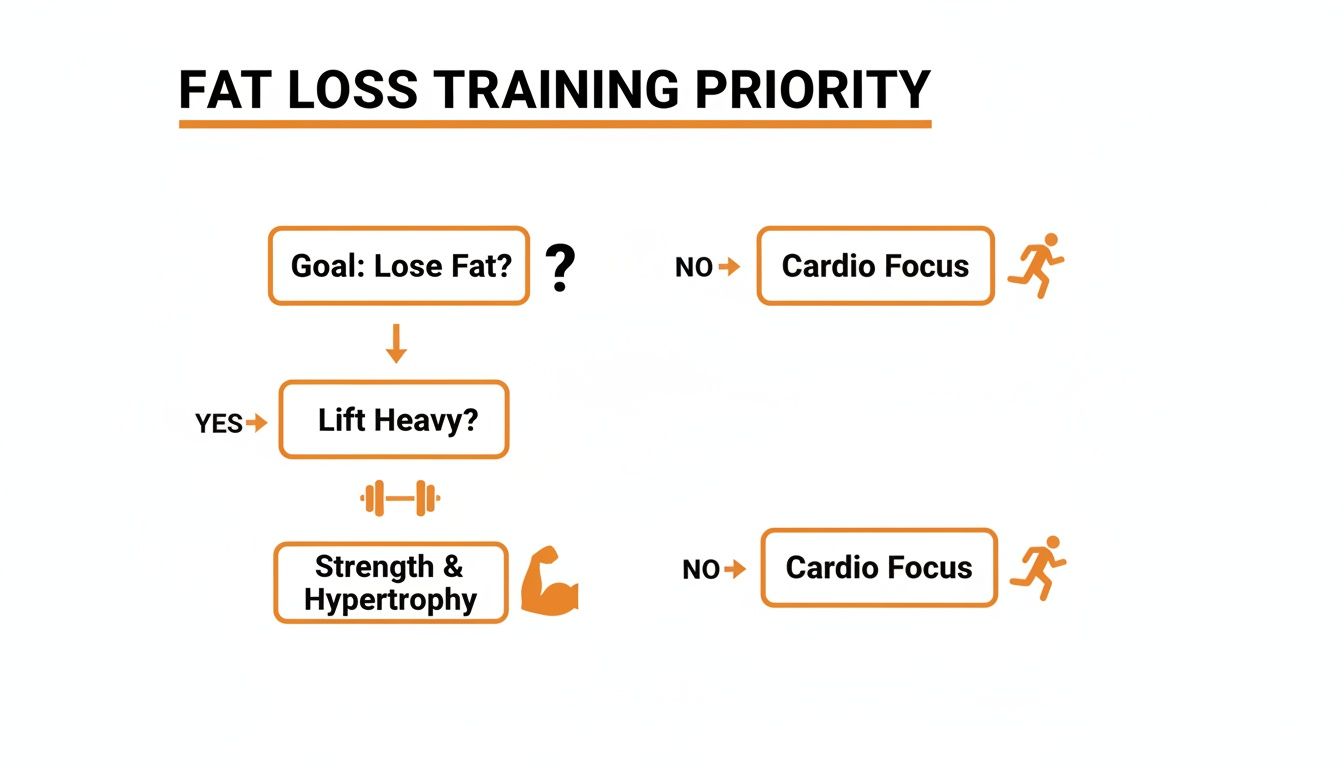
As you can see, when fat loss is the main goal, heavy resistance training isn't just an option; it's the foundation. It's the single most powerful signal you can send your body to hold onto its muscle.
Leveraging Technology for Smarter Training
Guesswork is the enemy of a successful cut. Your recovery resources are limited when you're in a calorie deficit, so every training decision counts. This is where modern fitness apps can give you a massive edge, turning vague feelings into hard data you can use.
Tools like the Built Workout app are perfect for this. It goes way beyond just logging your sets and reps. The app visualizes your training data to help you make smarter calls on the fly. For instance, its muscle recovery heatmaps show you which body parts are rested and ready to go, and which ones are still screaming for a break.
Here’s a real-world example: Say you have a heavy chest day planned, but you’re feeling a little run down. You check your recovery heatmap and see your pecs are still lit up in red from your last session. Instead of forcing it and having a terrible workout (or worse, getting hurt), you can confidently swap in a leg day. You see your quads and hamstrings are green and good to go, so you hit them hard, knowing you've made the most productive choice for that day.
This kind of data-driven feedback lets you adjust your plan in real-time. You're no longer just guessing—you know when to push hard and when it's smarter to ease up.
The science is crystal clear on this stuff. A massive review of 47 different trials showed that while losing weight through diet alone can cost you 2-10% of your muscle, adding resistance training drops that loss to less than 2%. Even better, it often improves strength.
Combine that with a high protein intake (1.6g/kg of body weight), and you can hang onto an extra 400-800g of lean mass compared to people on standard protein diets. This is exactly what a tool like Built Workout's AI coach is designed to do—it mimics these precise protocols by adjusting your training volume based on your recovery, helping you sidestep the muscle loss that plagues so many poorly planned cuts.
By meticulously tracking what actually matters, you can stop spinning your wheels and start making real, measurable progress. To get the most out of every single session, you can learn more about how to effectively track your gym workouts in our detailed guide.
Optimizing Sleep and Stress for Better Results
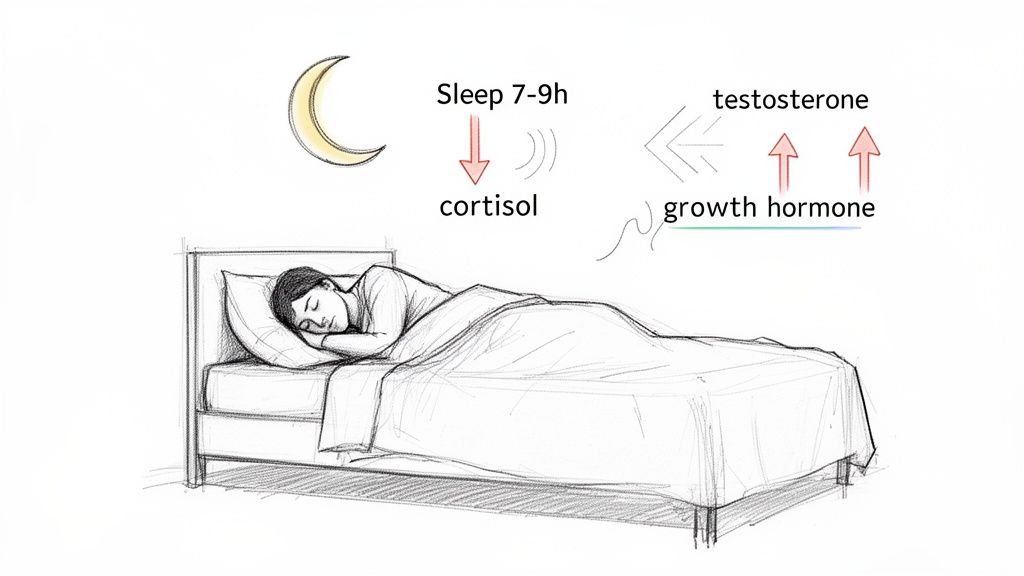
All the hard work in the gym and discipline in the kitchen sets the stage, but the real magic happens when you recover. Think about it: being in a calorie deficit is a stressor on your body. That makes high-quality sleep and smart stress management non-negotiable if you’re serious about losing fat without losing muscle.
Ignoring recovery is like trying to drive a performance car with flat tires and dirty oil. It doesn't matter how powerful the engine is if the support systems fail. In this case, your hormones are the support system, and they're profoundly influenced by how well you rest.
The Hormonal Havoc of Poor Sleep
When you're sleep-deprived, your body's internal chemistry starts working against you. Your hormonal environment can shift from one that protects muscle to one that actively breaks it down. Even one bad night can throw things off balance, creating a cascade of problems that undermine your goals.
For starters, not getting enough sleep causes cortisol, your primary stress hormone, to skyrocket. When cortisol is chronically high, it can signal your body to break down muscle tissue for energy—the exact opposite of what we want. At the same time, it can suppress testosterone and growth hormone, both of which are absolutely critical for repairing and holding onto lean mass.
One study showed that after just one week of sleeping only five hours a night, healthy young men saw their daytime testosterone levels plummet by 10-15%. That's a massive hit that can directly hamstring your ability to keep muscle and strength while dieting.
This hormonal chaos makes it incredibly difficult for your body to prioritize burning fat. Instead, it starts eyeing your hard-earned muscle as an easy energy source, all while making you feel hungrier and more likely to crave junk food.
Actionable Steps for Better Sleep
You don't need a complicated plan to improve your sleep hygiene. Small, consistent changes can make a world of difference in your recovery and results.
Here are a few practical strategies you can start tonight:
- Create a "Wind-Down" Hour: An hour before bed, dim the lights and put away your phone and laptop. The blue light from screens messes with melatonin, the hormone that tells your body it’s time to sleep.
- Optimize Your Bedroom: Your room should be a cave—cool, dark, and quiet. Blackout curtains, a white noise machine, or earplugs can be game-changers. The ideal temperature is on the cooler side, around 65°F (18°C).
- Stick to a Schedule: Try to go to bed and wake up around the same time every day, even on weekends. This simple habit reinforces your body's internal clock, making it easier to fall asleep and wake up feeling ready to go.
Managing Stress to Protect Your Gains
Just like sleep, stress management is a huge piece of the puzzle. Chronic stress keeps cortisol levels elevated, which can lead to stubborn belly fat and muscle breakdown. A demanding job, personal issues, or even the mental grind of a long diet can sabotage your progress if you let it.
The key is finding healthy outlets to bring those cortisol levels down. Learning to implement effective stress reduction strategies can have a direct, positive impact on your hormonal balance and body composition.
This doesn't have to be complicated. A 10-minute walk in nature, a short meditation session, or even just journaling can have a profound impact. While your workouts are a physical stressor, they can be a fantastic mental stress reliever. The goal is to balance the stress from training and dieting with proactive recovery and mental relaxation.
When you do this, you create a system where your lifestyle fully supports your fitness goals. If you want to dive deeper into balancing training stress with recovery, check out our guide on https://www.builtworkout.com/blog/how-to-prevent-overtraining, which ties directly into these principles.
How to Troubleshoot Common Fat Loss Problems
Even with the best plan in the world, hitting a wall is part of the game. The fat loss journey is rarely a straight, predictable line down. When progress grinds to a halt or you start feeling completely drained, don’t see it as a failure. See it for what it is: a signal from your body that it’s time for a smart adjustment.
The classic frustration point? The scale not moving for a week or two. Before you panic and start aggressively cutting calories, just take a breath. Weight can bounce around due to simple things like water retention, especially if you're stressed or had a saltier, carb-heavy meal. The real question to ask is what the other metrics are telling you.
The Scale Is Stuck But You Feel Good
Let's say the number on the scale hasn't budged, but your lifts in the gym are strong—maybe even going up—and your clothes are definitely fitting better. This is a classic sign of successful body recomposition. You're likely adding a bit of lean muscle while dropping fat, which is the ultimate goal. In this scenario, don't change a thing. Stay the course.
But what if the scale, your body measurements, and your progress photos have all been frozen for more than two weeks? Okay, now it's time to take action. This usually means your metabolism has adapted to your current calorie intake.
Here are a couple of solid ways to break through that plateau:
- Make a Small Calorie Tweak: Shave another 100-150 calories off your daily target. The easiest way to do this is by slightly reducing your carbs or fats. This small drop is often just enough to get the needle moving again without tanking your energy levels.
- Increase Your NEAT: This is a big one. Focus on your Non-Exercise Activity Thermogenesis, which is just a fancy term for all the calories you burn from daily movement that isn't formal exercise. Simply adding an extra 2,000-3,000 steps to your day can significantly boost your total energy expenditure without adding more stress from training.
You Feel Weak and Your Lifts Are Dropping
This is a bright red flag you can't ignore. A slight dip in performance is one thing, but if your strength is consistently trending downward, you are in the danger zone for muscle loss. Your body is screaming that the calorie deficit combined with your training load is more than it can recover from.
Just trying to "push through" the fatigue is the worst thing you can do here. You'll only dig yourself into a deeper hole.
Pro Tip: One of the most effective tools for this is a planned "diet break." Take one or two weeks and bring your calories back up to your maintenance level. The key is to prioritize carbs during this time to refill your muscle glycogen stores. This break reduces mental fatigue, helps reset key hormones, and lets you come back to your cut feeling refreshed and much stronger.
Another great strategy is the refeed day. Once or twice a week, you'll have a day where you significantly increase your carbohydrate intake. This can give a temporary bump to leptin (a key hormone for managing hunger and metabolism) and fully top off your energy stores for your most demanding workouts.
You Are Battling Intense Cravings
If you’re constantly fighting off powerful cravings, it's often a sign that your diet is a bit too restrictive or you're missing something important. It can also be a direct result of poor sleep, which throws your appetite-regulating hormones, ghrelin and leptin, completely out of whack.
Before you tear up your entire plan, run through this quick checklist:
- Are you hitting your protein goal? Protein is the king of satiety. If you're falling short, you'll feel hungrier and be much more susceptible to cravings.
- Is your fat intake too low? Dietary fats are essential for hormone balance and play a huge role in feeling full. Make sure you're getting at least 20% of your daily calories from healthy fat sources.
- Are you actually sleeping enough? You need 7-9 hours of quality sleep a night. Anything less is a proven trigger for increased hunger and intense cravings for junk food.
To make things even clearer, here's a quick reference guide for diagnosing and fixing the most common issues you'll encounter on your cut.
Troubleshooting Your Fat Loss Journey
| Problem | Potential Cause | Actionable Solution |
|---|---|---|
| Scale hasn't moved for 2+ weeks | Metabolic adaptation to lower calories. | Decrease daily calories by 100-150 OR increase daily steps by 2,000-3,000. |
| Feeling weak, lifts are declining | Calorie deficit is too aggressive, or recovery is poor. | Implement a 1-2 week diet break at maintenance calories. Or, add a weekly refeed day high in carbs. |
| Constant, intense cravings | Diet is too restrictive, low protein/fat, or poor sleep. | Ensure you're hitting your protein target, getting at least 20% of calories from fat, and prioritizing 7-9 hours of sleep. |
| Weight suddenly spiked overnight | High sodium/carb meal, stress, or poor sleep causing water retention. | Don't panic. Trust the process, stick to your plan, and focus on the weekly average. The water will flush out. |
| Feeling tired and unmotivated | Accumulating fatigue from sustained deficit and training. | Schedule a deload week with reduced training volume. Consider a diet break if fatigue is severe. |
Think of this table as your go-to field guide. When something feels off, consult it, make a single, calculated adjustment, and give it a week or two to see how your body responds. Fat loss is a dynamic process of listening to your body and adjusting fire as you go.
Answering Your Top Questions
How Fast Can I Realistically Lose Fat Without Losing Muscle?
Everyone wants to get lean yesterday, but patience is your best friend here. A smart, sustainable pace for fat loss is anywhere from 0.5% to 1% of your total body weight per week.
Pushing harder than that is a recipe for disaster. If you're 200 pounds, that means aiming for a loss of 1-2 pounds on the scale each week. Anything more, and you're practically forcing your body to start cannibalizing hard-earned muscle for energy. It's just not worth it.
Should I Completely Overhaul My Training for a Cut?
Absolutely not. This is one of the biggest mistakes I see people make. The workouts that built the muscle in the first place are the exact same ones that will convince your body to keep it.
Your mission in the gym during a cut is simple: defend your strength. Keep hitting your big compound lifts with intensity. The only tweak you might consider is a slight reduction in your total training volume—maybe dropping a set here or there on your accessory work. Your recovery capacity is lower in a deficit, so you have to be smart.
Don't fall into the trap of switching to high-rep, "toning" workouts. That light weight and high rep approach sends the wrong signal. It tells your body it no longer needs to support strong, dense muscle, which is the last thing you want.
Is It Possible to Build Muscle and Lose Fat Simultaneously?
Yes, it's a phenomenon known as body recomposition, and it's definitely possible—for some people. It’s most common in a few specific scenarios:
- You're brand new to lifting weights.
- You're getting back into training after a significant time off.
- You're starting with a higher percentage of body fat.
For those who have been training consistently for years, it's a much tougher game. At that stage, the goal shifts from building new muscle to protecting every ounce of the muscle you already have while the fat melts away. The primary objective becomes 100% muscle retention.
Ready to stop guessing and start making data-driven progress? Download the Built Workout app to visualize your muscle recovery, get AI-guided coaching, and train smarter. Get started for free at https://www.builtworkout.com.