
A solid workout routine isn't just a random list of exercises. Think of it as a living, breathing system that flexes with your goals, your energy on any given day, and how well you're recovering. This is about moving beyond rigid, static plans and embracing a smarter way to train—one built on clear goals, strategic exercise choices, and data-backed progress.
Your Blueprint for Smarter Training
Hitting the gym without a plan is like trying to build a house without a blueprint. Sure, you can nail some boards together, but you'll never end up with the strong, well-designed structure you imagined. A good workout routine is your guide, making sure every single session is a meaningful step toward where you want to go.
This idea of structured training is catching on, big time. The fitness world is exploding, and in the United States alone, gym memberships have climbed to around 64.2 million. That's over 20% of the population actively using a gym to better themselves. It's clear people are looking for a more intentional approach to their health.
The Pillars of an Effective Routine
A truly smart training system boils down to a few key principles. Grasping these concepts will shift your mindset from just "working out" to "training with a purpose."
Here’s what a smarter approach really looks like:
- Defining Your Target: What do you actually want? Is it raw strength, more muscle mass, better endurance? Get specific.
- Strategic Exercise Selection: Choosing the exercises that give you the biggest bang for your buck and align directly with your main goal.
- Balancing Effort and Recovery: This is huge. It’s about listening to your body and using feedback to know when to push the throttle and when to ease off.
- Consistent, Smart Progression: Using proven methods to make sure you're always creating a challenge and never hitting a dead end.
A great workout plan should never be set in stone. It needs to evolve as you get stronger, understand your body better, and maybe even change your goals. The whole point is to stop guessing and start making informed decisions.
Thankfully, modern tools are making this easier than ever. For instance, using a dedicated gym workout planner app like Built Workout completely changes the game by giving you real-time feedback. Instead of just wondering if your chest is recovered enough for another bench day, you can actually see its recovery status on a heatmap. This kind of data-driven approach, paired with tools like an AI coach, helps you make smarter choices, sidestep burnout, and make every single rep count.
Matching Your Goals to a Weekly Schedule
Before you even think about picking up a weight, you need a roadmap. A good workout routine starts by figuring out what success actually means to you and then building a weekly schedule that fits into your real life. Trying to cram a professional bodybuilder's 6-day-a-week plan into a busy work schedule is just a fast track to burnout, not results.
The name of the game is sustainability. Your primary goal—whether that's raw strength, building muscle (hypertrophy), or improving muscular endurance—will guide the style of your training. But it’s your personal schedule that dictates the frequency.
Choosing Your Training Split
A training split is just the fancy term for how you organize your workouts throughout the week. It’s how you decide which muscle groups to train on which days. The best split isn't the most complicated one; it's the one you can actually stick with week after week.
Let’s walk through a few common examples:
The Time-Crunched Professional: If you can only realistically make it to the gym 3 days a week, a Full Body routine is your best friend. Hitting every major muscle group three times a week provides a potent signal for growth and strength without demanding you live at the gym.
The Consistent Lifter: Got 4 days a week? An Upper/Lower split is a fantastic option. This lets you dedicate more volume and focus to specific muscle groups in each session—think all upper body on Monday, all lower body on Tuesday—while still training everything twice a week.
The Dedicated Enthusiast: For those who can commit 5 to 6 days, the classic Push-Pull-Legs (PPL) split is a powerhouse. It organizes your training by movement patterns (pushing, pulling, and leg movements), which allows for plenty of intensity while managing fatigue really well. Want to learn more? Check out our detailed guide on how to program a 5-day workout split.
Deciding on the right split can feel overwhelming, so I've put together a simple table to compare the most common options. Use it to find the one that best matches your schedule, experience, and what you're trying to achieve.
Choosing Your Weekly Training Split
| Training Split | Best For | Frequency | Example Schedule |
|---|---|---|---|
| Full Body | Beginners, time-crunched individuals, fat loss, or strength focus. | 2-3 days/week | Mon: Full Body, Wed: Full Body, Fri: Full Body |
| Upper/Lower | Intermediate lifters, balancing strength and hypertrophy goals. | 4 days/week | Mon: Upper, Tue: Lower, Thu: Upper, Fri: Lower |
| Push-Pull-Legs (PPL) | Intermediate to advanced lifters, maximizing muscle growth (hypertrophy). | 3-6 days/week | Mon: Push, Tue: Pull, Wed: Legs, Thu: Rest, Fri: Push... |
| Body Part ("Bro") Split | Advanced bodybuilders focusing on bringing up specific lagging muscles. | 5-6 days/week | Mon: Chest, Tue: Back, Wed: Legs, Thu: Shoulders, Fri: Arms |
Ultimately, the best choice is the one that aligns with your lifestyle. A "perfect" plan on paper is useless if you can't execute it consistently.
This simple decision path shows how it all flows together—from defining your main objective to planning the work and tracking your progress.
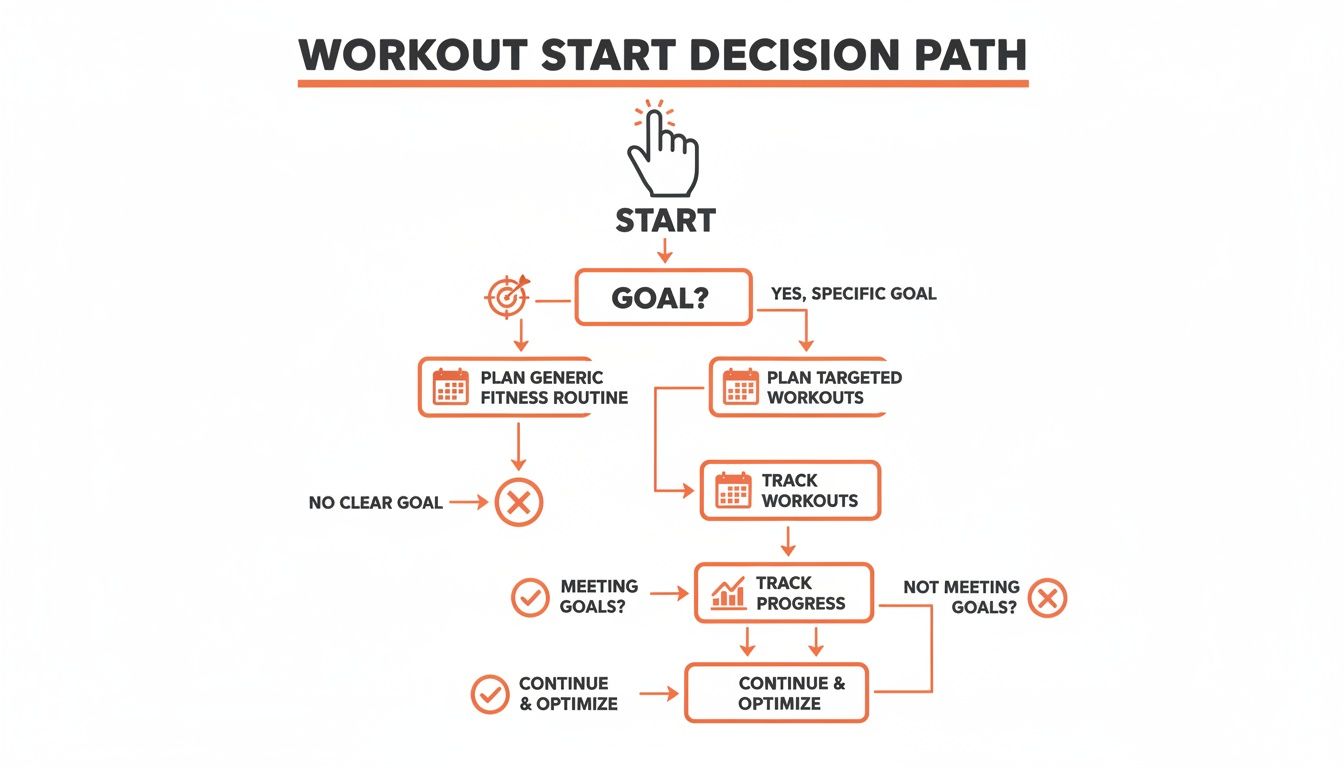
As the flowchart shows, a clear goal is the starting line. It informs your plan, which in turn dictates what you need to track.
Your training frequency isn't just about how many days you can go to the gym; it's about how many days you can recover from. The magic happens during recovery, not just during the workout itself.
Trust me on this: a 3-day full-body routine done with intensity and consistency will always beat a 6-day split that you only follow half the time. Be honest with yourself about your schedule, your energy, and everything else you have going on in life. Pick a frequency that feels realistic, and then find the split that fits. That practical approach is the foundation for a routine you can stick with for the long haul.
Selecting the Right Exercises for Your Goals
Okay, you've got your training split figured out. Now for the fun part: picking the actual exercises that will fill out each workout. This isn't about chasing the latest flashy move you saw on Instagram; it’s about building a solid foundation with exercises that have stood the test of time.
The backbone of any effective strength or muscle-building program is always going to be compound movements. I’m talking about the big, multi-joint lifts like squats, deadlifts, the bench press, and overhead presses. These are your heavy hitters. They recruit a ton of muscle all at once, giving you the biggest bang for your buck in terms of strength gains and overall growth.
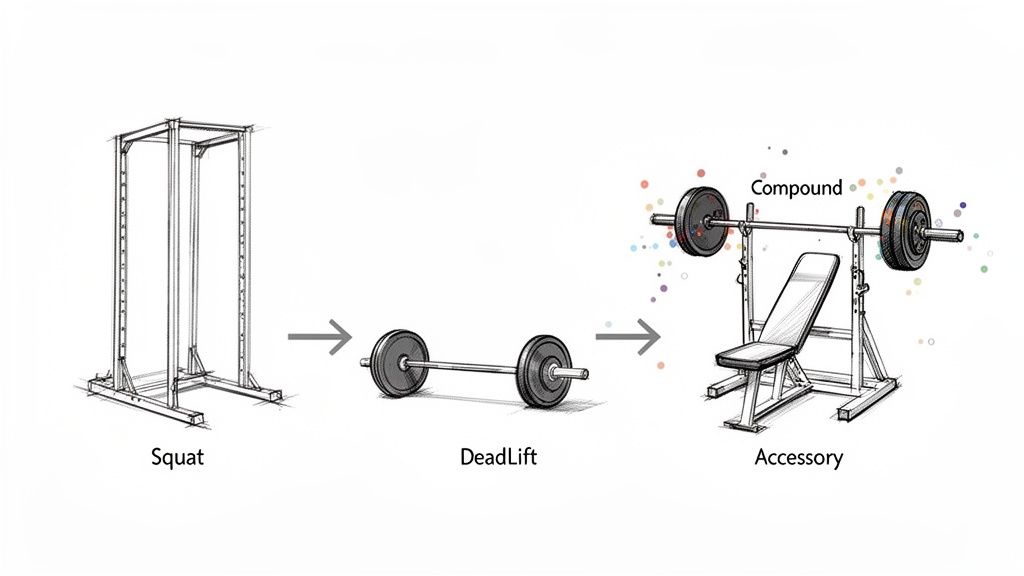
After you've programmed your main compound lifts, you can sprinkle in isolation exercises. Think bicep curls, leg extensions, or tricep pushdowns. These movements target a single muscle group, making them perfect for bringing up lagging body parts or just getting some extra work in where you need it most.
Structuring Your Workout Session
The order of your exercises can make or break a session. It's a simple but critical rule: always put your most demanding, heaviest compound lifts at the very beginning. Your energy levels and mental focus are highest when you first walk into the gym, and that’s when you want to tackle the lifts that require the most from you.
Ever tried to hit a new PR on squats after a bunch of leg extensions? It doesn't work. You’ll be gassed, your form will suffer, and you're just asking for trouble.
Let’s map out a classic "Push Day" to see how this works in practice:
- Primary Compound: Barbell Bench Press (Your main strength movement for the day)
- Secondary Compound: Incline Dumbbell Press (Still works multiple joints but is less taxing)
- Accessory/Isolation: Cable Flys (To really focus on the chest)
- Accessory/Isolation: Tricep Pushdowns (To finish off the triceps)
This structure lets you pour maximum effort into the exercises that drive the most progress. Of course, the bench press isn't for everyone—it can be tough on the shoulders. If that's you, we've put together a list of some great bench press alternatives that will still build a powerful chest.
A smart workout flows logically. You start with the exercises that are toughest on your nervous system and end with the simpler, single-joint stuff. This approach not only helps you lift heavier but also manages your fatigue so you can finish strong.
In the end, every single exercise in your plan needs to earn its spot. Don't add fluff just to make your workout longer. For each movement, ask yourself, "Why am I doing this? How does it get me closer to my goal?" That intentionality is what separates a routine that gets you results from one that just gets you tired.
How to Actually Make Progress Week After Week
Showing up to the gym consistently is a massive win, but it’s only half the battle. The real secret to changing your body lies in a principle called progressive overload. It’s a simple idea: you have to consistently make your workouts more challenging over time. This is what forces your muscles to adapt, grow, and get stronger.
Without it, your gym workout routine is just a list of movements. With it, it becomes a powerful driver for real change.
So many people stall because they fall into the trap of lifting the same weights for the same reps, week after week. Your body is smart and incredibly efficient. Once it adapts to a certain stress level, it sees no reason to change any further. You've hit a plateau.
This is a huge reason people get discouraged and quit. Despite gym memberships being more popular than ever, studies show that nearly 50% of new members throw in the towel within the first six months. When you don't see the results of your hard work, motivation tanks. It highlights the massive gap between just showing up and truly moving forward.
Smart Ways to Apply Progressive Overload
Progress isn't just about piling more plates on the barbell. There are a bunch of different ways to make an exercise harder and signal to your body that it's time to level up. To keep making gains and avoid getting stuck, you need to understand and apply effective training progressions.
Here are a few of the best ways to do it:
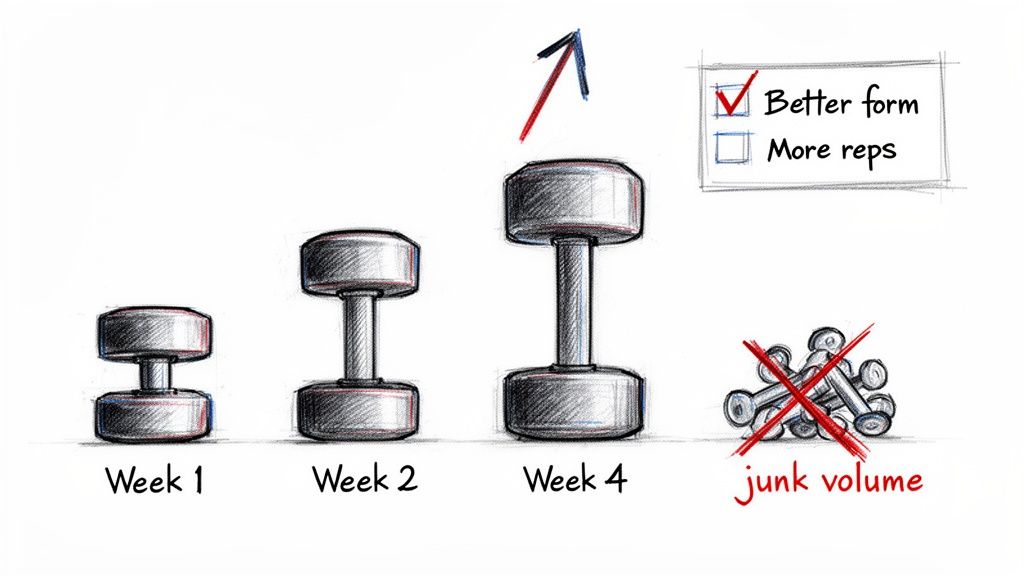
- Add More Weight: This is the most straightforward method. If you squatted 135 lbs for 8 reps last week, try for 140 lbs for 8 reps this week. Even a small jump is a win.
- Do More Reps: Can't quite add more weight yet? Add a rep. Benching 185 lbs for 6 reps is a clear improvement over doing it for 5 last time.
- Increase Your Sets: Adding an entire extra set to an exercise is a big jump in total workload (volume), which can be a powerful new stimulus for growth.
- Perfect Your Form: This one is underrated. Lifting the same weight but with better control, a deeper range of motion, and less body English is a massive form of progress.
The goal isn't just to do more; it's to do better. Avoid "junk volume"—mindlessly adding sets and reps just for the sake of it. Every addition should be intentional and productive, not just tiring you out.
Turning Progression Into a Science
This is where we stop guessing and start getting strategic. How do you know if you’re adding productive volume or just burning yourself out? You have to track your work. Seriously, tracking your workouts is non-negotiable for making smart decisions about your progress.
A purpose-built tool like the Built app completely changes the game here.
When you log every set, rep, and weight, the app automatically calculates your training volume. It doesn't stop there. It visualizes this data with muscle recovery heatmaps, giving you a clear picture of which muscles are fresh and which are still feeling it from your last session.
This insight is pure gold. Instead of guessing if you're ready for another heavy leg day, you can just look at your heatmaps and see that your quads are recovered but your hamstrings need another day. This lets you make calculated decisions, ensuring every challenge you add is one your body is actually prepared to handle and benefit from.
Making Sense of Your Recovery Data
The time you spend lifting weights is only half the story. The real progress—the muscle repair, growth, and strength gains you’re chasing—happens when you rest. If you ignore recovery, you're essentially trying to build a house on a foundation of wet cement. It’s a recipe for disaster.
Smart recovery is more than just getting enough sleep and eating right, though those are non-negotiable. It’s about learning to listen to your body with the help of objective data. This move away from guesswork is a huge shift in how people train, and it’s a big reason why the global online fitness market, valued at just over $6 billion in 2020, is on track to hit over $59 billion by 2027. People want smarter tools for their workouts. You can find more details on the rapid growth of the online fitness market on mirrorsdelivered.com.
A Visual Check-In on Your Body's Readiness
How can you be sure your chest is actually ready for another bench press session? Is it just a little sore, or is it genuinely under-recovered? Instead of guessing, technology can give you a clear, visual answer.
This is where something like the Built Workout app’s anatomical heatmaps comes in handy. It’s a simple, color-coded system that shows you exactly how fatigued each muscle group is.
- Green: Good to go. That muscle is fresh and ready for a tough workout.
- Yellow: Hold on. The muscle is still in the middle of its recovery process.
- Red: Stop. That muscle is beat up and needs more rest before you hit it hard again.
This kind of visual feedback removes all the ambiguity. If your quads are still showing up red two days after a heavy squat day, that’s a direct signal to back off. Pushing through would probably do more harm than good.
Your body sends you signals all the time. The difference between a good lifter and a great one is the ability to interpret those signals accurately. Data-driven tools act as your translator.
Let AI Be Your Spotter
Having this recovery data is one thing; knowing what to do with it is another. That’s where an AI coach can step in and act as a personal guide, making smart, real-time adjustments based on how your body is actually feeling.
Let's say you walk into the gym planning to do incline dumbbell presses, but the heatmap shows your upper chest is still in the red. The Built AI coach might pop up with a suggestion like: "Your upper pecs are still fatigued. Let's swap to a flat dumbbell press to target the middle chest, which is fully recovered. You'll still get a great stimulus without risking overtraining."
This isn't just about preventing injuries—it's about getting the most out of every single workout. By intelligently adjusting your routine to target fresh muscles, you can keep your training intensity high all week long without burning out. To get the most out of these insights, it's worth understanding the fundamentals, which you can learn more about in this A Practical Guide to Muscle Recovery After Workout. When you combine objective data with smart AI suggestions, you ensure every workout moves you forward.
Common Questions About Your Gym Workout Routine
Even when you have a great plan on paper, the real world throws curveballs. Let's dig into some of the most common questions and sticking points that come up once you start hitting the gym consistently. Getting these sorted out can be the difference between spinning your wheels and making real progress.
How Often Should I Change My Routine?
This is a big one. You’ve probably heard you need to constantly "confuse" your muscles, but that’s one of the most persistent myths in fitness. The real goal is progressive overload, which means getting consistently stronger on the same core set of exercises.
You should give any solid program at least 8-12 weeks before even thinking about a major overhaul. That’s enough time to really master the movements and see meaningful strength gains.
So, when should you make a change?
- You’ve hit a genuine plateau and haven't added weight or reps for several weeks, even with good food and sleep.
- An exercise starts causing joint pain or just doesn't feel right for your body.
- You’ve achieved your main goal and now want to shift your focus, maybe from strength to hypertrophy.
Small tweaks are a different story. Swapping out an accessory lift, like changing from a dumbbell curl to a cable curl, is perfectly fine. This is where tracking your recovery in an app like Built really shines—you can see which muscles are recovered and ready for action, helping you make smarter, data-driven swaps on the fly.
Am I Overtraining or Just Sore?
Learning to tell the difference between normal soreness and genuine overtraining is a skill every lifter needs.
That ache you feel 24-48 hours after a tough leg day? That’s Delayed Onset Muscle Soreness (DOMS). It’s a totally normal part of the muscle repair and growth cycle and usually subsides within a few days.
Overtraining, on the other hand, is a much bigger problem. It’s a state of chronic fatigue where your body just can't keep up with the stress you're putting on it. The symptoms go way beyond sore muscles—think persistent exhaustion, a sudden drop in your performance, irritability, and even trouble sleeping.
The real tell-tale sign is what happens when you get to the gym. If you're just sore, a good warm-up usually helps you feel better and you can still perform well. If you're overtrained, your strength will be down week after week, no matter how hard you try.
Can I Build Muscle and Lose Fat at the Same Time?
Ah, the holy grail of fitness: body recomposition. Yes, it’s absolutely possible, but it’s a lot easier for certain people. If you're new to lifting, coming back after a long break, or have a higher body fat percentage to start with, you're in a great position to do it.
To pull it off, you have to nail three things:
- Eat around your maintenance calories or in a very slight deficit. You can't be in a huge calorie hole.
- Keep your protein intake high. Aiming for around 1 gram per pound of your goal body weight is a solid target.
- Stick to a challenging strength training program. You need to give your body a powerful reason to build and hold onto muscle.
For lifters who have been at it for a while, it’s often more efficient to focus on dedicated bulking (muscle gain) and cutting (fat loss) phases. If you're tempted to double up on workouts to speed things up, make sure you understand the recovery demands by checking out the pros and cons of working out twice a day.
Ready to stop guessing and start training with precision? Built Workout combines workout tracking, muscle recovery heatmaps, and AI coaching to help you build a smarter gym workout routine. Download it today and see what your data can do for you. Get started with Built Workout.