The barbell bench press is often hailed as the king of upper-body exercises, but relying solely on this single movement can lead to frustrating plateaus, nagging shoulder pain, and imbalanced muscle development. To build a truly strong, well-rounded, and resilient physique, you need a diverse arsenal of exercises. This is where a strategic bench press alternative becomes essential. Integrating different movements can target chest fibers from new angles, improve stabilizer muscle activation, and reduce the repetitive strain that often leads to overuse injuries.
This guide goes beyond a simple list of exercises. We will explore nine powerful alternatives to the traditional bench press, providing detailed, actionable instructions for each one. You'll learn the specific muscles worked, step-by-step execution cues, common mistakes to avoid, and programming tips for both strength and hypertrophy. We'll also cover how to progress or regress each movement to fit your current fitness level. More importantly, we'll demonstrate how to select the right bench press alternative for your individual goals and use data-driven tools like Built Workout to track your performance, manage recovery, and ensure every set moves you closer to building a bigger, stronger, and healthier chest.
1. Dumbbell Bench Press
The Dumbbell Bench Press is a classic and highly effective bench press alternative that substitutes the barbell with a pair of dumbbells. This simple change introduces a significant stability challenge, as each arm must work independently to control its own weight. This unilateral demand forces smaller stabilizer muscles in the shoulders and chest to engage more actively, promoting greater overall joint health and functional strength.
Many lifters, from bodybuilding legend Arnold Schwarzenegger to modern physical therapists, champion this variation for its unique benefits. It allows for a more natural range of motion, as your hands aren't fixed in a single position, which can be more forgiving on the shoulder joints. This freedom of movement also helps identify and correct strength imbalances between your left and right sides, a common issue masked by barbell training.
Why It's a Great Alternative
This exercise is invaluable for both hypertrophy and injury prevention. The increased stabilization demand and potential for a deeper stretch at the bottom of the movement can stimulate new muscle growth. For those with shoulder impingement or discomfort, the ability to adjust grip and elbow path often makes dumbbell pressing a pain-free option when barbell pressing is not.
How to Implement It
- Execution: Lie on a flat bench with a dumbbell in each hand resting on your thighs. Kick your knees up to help bring the dumbbells to the starting position at your chest. Press the dumbbells up until your arms are fully extended but not locked out. Lower them slowly and under control, allowing for a deep stretch in the chest before pressing again.
- Programming: For hypertrophy, aim for 3-4 sets of 8-12 reps. For strength, work in the 4-6 rep range with heavier weight. Start with dumbbells that are 10-15% lighter than your equivalent barbell weight to master the new stability demands.
- Tracking Tip: Monitoring your progress is key to fixing imbalances. You can easily track your workouts and dumbbell progression to see if one side is lagging. If you notice a disparity, consider starting your set with the weaker arm to ensure it receives maximum effort.
2. Push-Up Variations (Standard, Deficit, Archer, Pseudo-Planche)
The push-up is arguably the most accessible and versatile bench press alternative, leveraging your own bodyweight to build formidable pressing strength and chest size. Moving beyond the standard version, variations like deficit, archer, and pseudo-planche push-ups introduce progressive overload without any external weight. This closed-chain movement promotes scapular health and core stability, translating directly to improved performance in other pressing exercises.
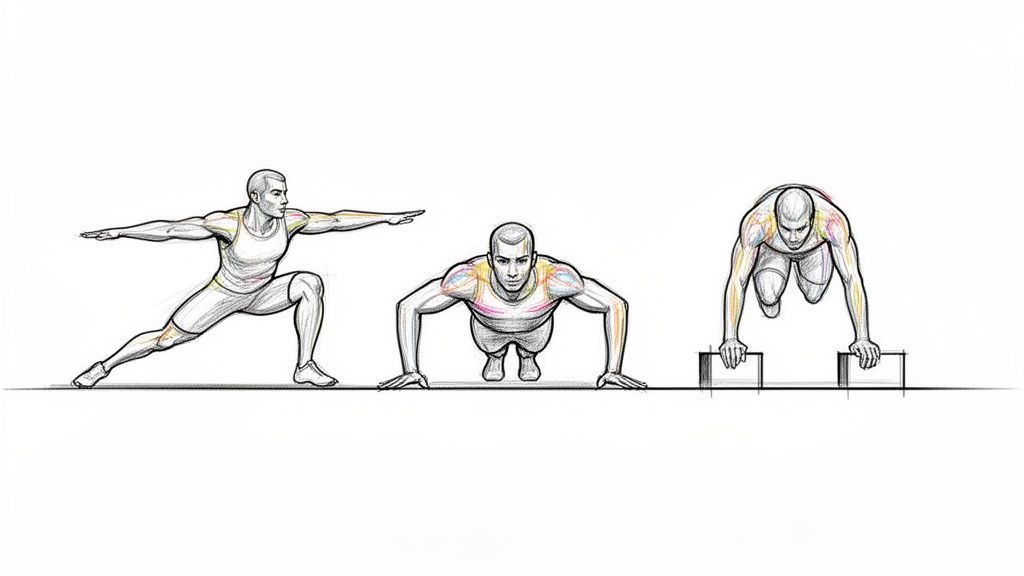
This exercise is a staple for military personnel, gymnasts, and calisthenics athletes who build incredible upper-body strength with minimal equipment. The progression from a simple push-up to a one-arm dominant archer push-up or a leverage-based pseudo-planche push-up creates a clear path for continuous improvement. Beyond traditional push-ups, exploring other bodyweight exercises for muscle building can offer diverse and effective chest-strengthening options without needing any equipment.
Why It's a Great Alternative
Push-up variations are unparalleled for developing relative strength and kinesthetic awareness. Advanced versions like the pseudo-planche push-up shift the emphasis heavily onto the shoulders and upper chest, mimicking an incline press. Deficit push-ups increase the range of motion, providing a deeper stretch and greater stimulus for hypertrophy. This makes them a fantastic tool for building a strong foundation or adding volume without heavy joint stress.
How to Implement It
- Execution: For a deficit push-up, place your hands on elevated surfaces like plates or blocks. For an archer push-up, widen your hands and shift your weight to one side, keeping the other arm straight. For a pseudo-planche push-up, place your hands near your hips with fingers pointed out or back and lean forward.
- Programming: For hypertrophy, aim for 3-4 sets close to failure (e.g., 10-20 reps). To build strength, focus on harder variations for lower reps (e.g., 3-5 reps of archer or pseudo-planche push-ups). You can balance your routine by learning more about optimal training frequency for muscle growth.
- Tracking Tip: Use an app to track your total push-up volume and monitor chest, shoulder, and triceps fatigue. If you notice an imbalance with archer push-ups, start with your weaker side to ensure it gets maximum effort and attention.
3. Machine Chest Press (Plate-Loaded, Hammer Strength, Smith Machine)
The Machine Chest Press is a powerful bench press alternative that uses a fixed-path machine to guide the movement. This category includes variations like plate-loaded Hammer Strength machines, selectorized stack machines, and the Smith machine. By constraining the movement to a predetermined trajectory, these machines eliminate the need for stabilization, allowing you to isolate the chest muscles and push them to their limit with consistent, controlled resistance.
This exercise is a staple in commercial gyms and bodybuilding culture for good reason. Its guided motion makes it an excellent tool for beginners learning proper pressing mechanics and for advanced lifters looking to add high-volume accessory work without the systemic fatigue of heavy free weights. Machines are also frequently used in rehabilitation settings for their safety and predictable movement patterns, allowing for a controlled return to pressing.
Why It's a Great Alternative
This exercise is fantastic for maximizing hypertrophy and minimizing injury risk. The stability provided by the machine allows you to focus entirely on contracting the pectoral muscles, making it ideal for high-rep sets and burnout finishers. For lifters with shoulder or wrist issues, the fixed grip and guided path can offer a pain-free way to train the chest when barbell or dumbbell variations are not tolerable.
How to Implement It
- Execution: Adjust the seat height so the handles are in line with your mid-chest. Sit with your back firmly against the pad and grasp the handles. Press forward until your arms are fully extended but not locked out, squeezing your chest at the peak of the contraction. Slowly return the weight to the starting position, maintaining control throughout the movement.
- Programming: For hypertrophy, use machines as a secondary pressing movement after your main compound lift. Aim for 3-4 sets of 10-15 reps. It's an excellent addition to a structured program, such as a 4-day push-pull workout routine, to accumulate extra volume.
- Tracking Tip: Treat machine work seriously. Unilateral Hammer Strength machines are perfect for identifying and correcting strength imbalances between your left and right sides. If you find a discrepancy, always start your set leading with the weaker arm to give it priority and focused effort.
4. Incline Press Variations (Barbell, Dumbbell, Machine)
Incline Press Variations are a fundamental bench press alternative designed to shift the emphasis of the movement to the upper portion of the chest, specifically the clavicular head of the pectoralis major, and the anterior deltoids. By performing the press on a bench set at an incline, typically between 30 and 45 degrees, you can strategically target an often-underdeveloped area of the physique. This adjustment creates a more vertical pressing path, which also heavily involves the shoulders.
This variation is a cornerstone in both bodybuilding and strength training. Bodybuilders utilize it to build a full, well-rounded chest with a prominent upper "shelf," while strength athletes incorporate it to bolster their overhead pressing power and strengthen the anterior deltoids. The versatility to use a barbell for maximum load, dumbbells for enhanced stability and range of motion, or a machine for controlled, isolated work makes it adaptable to any goal.
Why It's a Great Alternative
The incline press is an exceptional tool for aesthetic balance and functional strength. If your upper chest is a lagging body part, prioritizing incline movements is one of the most direct ways to stimulate growth and create a more proportional look. For individuals with shoulder issues, the altered angle can sometimes be more comfortable than a flat press, as it changes the glenohumeral joint mechanics. It serves as an excellent assistance exercise for improving the initial drive off the chest in a flat bench press.
How to Implement It
- Execution: Set a bench to a 30-45 degree angle. Whether using a barbell or dumbbells, lie back and plant your feet firmly. Press the weight upward in a path that finishes directly over your shoulders, not your chest. Lower the weight under control to your upper chest, keeping your elbows tucked at roughly a 45-60 degree angle to your torso.
- Programming: For hypertrophy, focus on 3-4 sets of 8-15 reps. For strength, use a lower incline (15-30 degrees) and work in the 4-8 rep range. Position this movement early in your workout when you are fresh, especially if upper chest development is your primary goal. Since this movement heavily engages the triceps, pair it with exercises from a well-structured mass-building tricep workout for synergistic results.
- Tracking Tip: Monitor your incline press performance separately from your flat press. A common guideline is to expect your incline press to be around 15-20% weaker than your flat press. If the gap is significantly larger, it's a clear indicator that your upper chest and front delts need more attention.
5. Resistance Band Chest Press (Standing, Anchored, Isometric Holds)
The Resistance Band Chest Press is a versatile and highly accessible bench press alternative that utilizes elastic bands to create resistance. Unlike free weights, which provide consistent tension, bands offer "accommodating resistance," meaning the tension increases as the band is stretched. This unique property maximally challenges your muscles at the end range of motion, which is crucial for building lockout strength and explosive power.
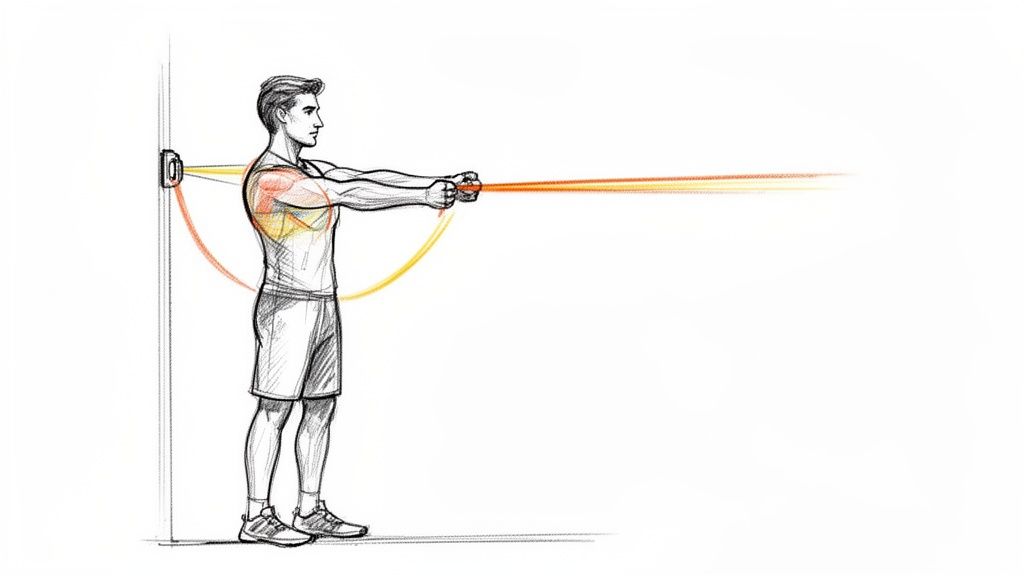
This method was popularized by institutions like Westside Barbell for training explosive strength in powerlifters and is now a staple for track and field athletes and functional fitness enthusiasts. Because of their portability, bands are also an excellent tool for remote workers or anyone training at home with limited equipment. The variable tension is also gentle on the joints, making it a go-to for physical therapists in shoulder rehabilitation protocols.
Why It's a Great Alternative
This exercise excels at developing power and muscular endurance. The increasing tension forces you to accelerate through the entire press, which directly translates to a more powerful barbell lockout. It's also an exceptional tool for metabolic stress and high-rep finishers, as the constant tension can induce a significant muscle pump. For those nursing shoulder injuries, the light starting resistance and smooth tension curve make it a safer way to activate the chest and triceps.
How to Implement It
- Execution: Anchor a resistance band at chest height to a stable object like a squat rack or door anchor. Grab the band with both hands and step forward to create tension. From a standing or half-kneeling position with a staggered stance, press the band forward until your arms are fully extended, squeezing your chest. Slowly return to the starting position, controlling the band's resistance.
- Programming: For power development, perform 3-5 sets of 6-10 explosive reps at the beginning of your workout. For hypertrophy or endurance, use it as a finisher for 2-3 sets of 15-25 reps to failure.
- Tracking Tip: Bands are notoriously difficult to quantify, but you can still track progress effectively. You can log the specific band color or thickness used and your reps in a workout tracker. Focus on improving rep quality and explosive speed over time, as these are key indicators of power development with this bench press alternative.
6. Cable Chest Fly (Single-Arm, Double-Arm, Low-to-High, High-to-Low)
The Cable Chest Fly is a phenomenal bench press alternative that isolates the pectoral muscles through a constant, fluid tension that free weights cannot replicate. Unlike dumbbells, where tension peaks at the top of the movement, cables maintain resistance throughout the entire arc of motion. This unique resistance profile creates a powerful metabolic stress in the chest, making it a cornerstone for muscle definition and hypertrophy.
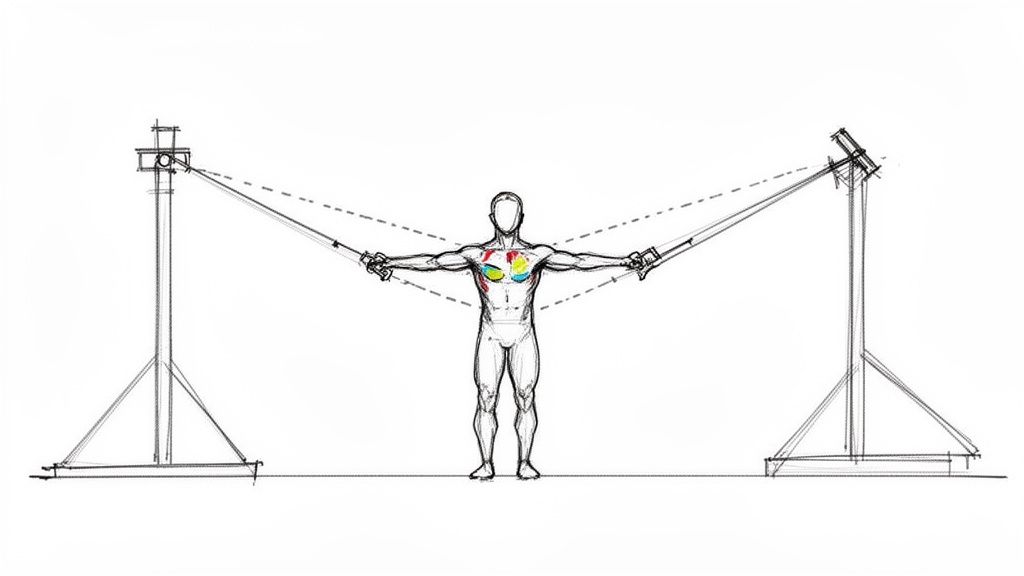
From classic bodybuilders like Arnold Schwarzenegger who used it to sculpt their iconic physiques to modern rehab specialists, the cable fly is celebrated for its versatility and joint-friendly nature. The ability to change the angle of the pull by moving the pulleys (low-to-high, mid-level, or high-to-low) allows you to target different fibers of the pectoral muscles for more complete development. Single-arm variations are also excellent for identifying and correcting strength asymmetries.
Why It's a Great Alternative
This exercise excels as a finishing movement to pump blood into the chest and stimulate growth after heavy pressing. The constant tension is fantastic for developing the mind-muscle connection, which is crucial for maximizing hypertrophy. For individuals whose joints cannot tolerate heavy pressing, cable flies offer a safe and effective way to directly train the chest muscles without compressive forces on the shoulder and elbow joints.
How to Implement It
- Execution: Set the pulleys on a cable crossover machine to chest height. Grab the handles, step forward to create tension, and stand with a slight forward lean and staggered stance. With a soft bend in your elbows, pull the handles together in a wide arc until they meet in front of your chest. Squeeze your pecs hard at the peak contraction before slowly returning to the start.
- Programming: Use cable flies after your main pressing movements. For hypertrophy, perform 2-3 sets of 12-15 reps. For metabolic stress, add them as a finisher with shorter rest periods.
- Tracking Tip: Alternate the cable height (low, mid, high) on a monthly basis to ensure balanced chest development. Use the single-arm version to pinpoint and address any side-to-side strength differences, focusing on your weaker side first.
7. Landmine Press (Single-Arm, Bilateral, Neutral Grip Variations)
The Landmine Press is a unique and highly versatile bench press alternative that uses a barbell anchored at one end. This setup creates a natural arcing movement path, which is often more forgiving on the shoulder joints than a standard vertical or horizontal press. The fixed pivot point provides stability, allowing the user to focus on generating force without the same stabilization demands as free weights.
Popularized by functional fitness coaches and modern strength and conditioning professionals, the landmine press is a staple for athletes looking to build pressing power in a more joint-friendly manner. It's frequently used in rehabilitation settings to safely re-introduce pressing mechanics and by athletes with shoulder discomfort who find the neutral grip variation to be a pain-free option.
Why It's a Great Alternative
This exercise is exceptional for developing upper-body pressing strength while minimizing stress on the shoulder capsule. The angled trajectory engages the upper chest, anterior deltoids, and triceps in a unique way that traditional presses cannot replicate. The single-arm variation is particularly effective for targeting core stability and correcting strength imbalances between the left and right sides of the body.
How to Implement It
- Execution: Stand or kneel facing the landmine attachment. Grip the end of the barbell with one or both hands at chest height. Brace your core and press the barbell up and away from your body until your arm(s) are fully extended. Lower the weight back to the starting position with control.
- Programming: For building strength and power, perform 3-4 sets of 5-8 reps. For muscle hypertrophy, aim for 3-4 sets of 10-15 reps. Start with a lighter weight to master the arcing motion before increasing the load.
- Tracking Tip: Use the Landmine Press as a primary pressing variation on days when barbell fatigue is high. You can track your Landmine Press progression separately to monitor angled pressing strength and use single-arm variations to address asymmetries identified in your performance data.
8. Floor Press (Barbell, Dumbbell, Neutral Grip)
The Floor Press is a powerful bench press alternative that strips the movement down to its raw upper-body components. By performing the press lying on the floor, the range of motion is intentionally shortened, with the elbows stopping when they touch the ground. This simple adjustment eliminates leg drive entirely and significantly reduces stress on the lower back and shoulder joints, making it a go-to for both strength athletes and those working around injuries.
Popularized by old-school strongmen and modern powerlifting coaches, the floor press is a formidable tool for building raw pressing power and addressing specific weaknesses. It's frequently used by athletes with lower back issues who need to continue training their press, as well as those looking to improve their lockout strength, as the shortened range of motion heavily emphasizes the triceps and deltoids at the top of the lift.
Why It's a Great Alternative
This exercise is exceptionally effective for overloading the triceps and building lockout strength, a common sticking point in the standard bench press. Because it reduces strain on the shoulder capsule by preventing excessive external rotation at the bottom, it's a safer option for lifters with shoulder discomfort. It’s also a fantastic teaching tool for beginners, as it forces proper elbow tuck and a stable upper back position without the complexity of leg drive.
How to Implement It
- Execution: Lie on the floor with your knees bent and feet flat. If using a barbell, unrack it from a low rack or have a partner assist you. For dumbbells, bring them to the starting position over your chest. Lower the weight until your triceps gently touch the floor. Pause briefly, then explosively press the weight back up to the starting position.
- Programming: For building lockout strength, use a barbell for 3-5 sets of 3-6 reps. For hypertrophy and stability, use dumbbells for 3-4 sets of 8-12 reps. You can alternate monthly between floor presses and bench presses to manage joint stress and vary the training stimulus.
- Tracking Tip: Monitor your progress to see how this targeted movement impacts your main lifts. If your bench press has stalled, it might be due to a specific weakness rather than overall strength. Tracking floor press performance can confirm if a weak lockout is the issue, and you can learn why your strength might be plateauing to address it directly.
9. Decline Press (Barbell, Dumbbell, Machine)
The Decline Press is a pressing variation performed on a bench angled downward, typically between 15 and 30 degrees. This angle shifts the mechanical emphasis of the movement, increasing the activation of the lower (sternocostal) portion of the pectoralis major and the triceps. It's a key bench press alternative for those looking to achieve complete, well-rounded chest development.
While less common than its flat and incline counterparts, bodybuilders and physique athletes have long used the decline press to specifically target and define the lower chest line. It offers a unique angle of attack that standard horizontal pressing cannot replicate, making it a valuable tool for addressing lagging muscle groups and creating a more proportional physique. The movement can be performed with a barbell, dumbbells, or a dedicated machine.
Why It's a Great Alternative
This exercise is excellent for isolating the lower chest and can often feel more comfortable on the shoulder joints than a flat or incline press. The declined angle reduces anterior deltoid involvement and decreases stress on the rotator cuff, making it a potentially safer option for some lifters. Using dumbbells further enhances this benefit by allowing a more natural range of motion.
How to Implement It
- Execution: Secure your legs at the end of a decline bench. Lie back and unrack the barbell or position the dumbbells at your chest. Lower the weight in a controlled manner to your lower chest, keeping your elbows tucked at a 45-degree angle. Press the weight back up powerfully to the starting position without locking out your elbows.
- Programming: Since this is a specialized movement, incorporate it less frequently than primary presses. Aim for 2-3 sets of 8-15 reps for hypertrophy. Use it to supplement your main chest work, often placed after your primary flat or incline pressing movements.
- Tracking Tip: Monitor your decline press strength separately from other pressing variations to gauge lower chest progress. If you notice high fatigue in your chest recovery heatmap, consider swapping this exercise for a less demanding one or reducing the volume to ensure proper recovery and growth.
Bench-Press Alternatives: 9-Option Comparison
| Exercise | 🔄 Complexity | ⚡ Resource Requirements | ⭐ Expected Outcomes | 📊 Ideal Use Cases | 💡 Key Advantages |
|---|---|---|---|---|---|
| Dumbbell Bench Press | Moderate — higher stabilizer and unilateral control required | Dumbbells + bench; easy to scale but limited max load | ⭐⭐⭐⭐ — Hypertrophy, imbalance correction, improved ROM | Bodybuilding accessories, rehab, unilateral strength work | Corrects asymmetries, deeper ROM, customizable grip |
| Push-Up Variations (Standard, Deficit, Archer, Pseudo-Planche) | Low → High — highly scalable progressions | Bodyweight (blocks/resistance optional) — minimal equipment | ⭐⭐⭐ — Stability, endurance, movement quality; limited absolute strength | Anywhere training, calisthenics, conditioning, military | Extremely accessible, low CNS fatigue, builds proprioception |
| Machine Chest Press (Plate‑Loaded, Hammer Strength, Smith) | Low — guided path reduces technique demand | Machine access required (plate‑loaded or selectorized) | ⭐⭐⭐⭐ — Safe hypertrophy, high‑rep volume, isolation | Beginners, rehab, high‑rep bodybuilding finishers | Safe, consistent ROM, easy loading/unloading, unilateral options |
| Incline Press Variations (Barbell, Dumbbell, Machine) | Moderate — angle and setup adjust difficulty | Bench with adjustable incline + chosen implement | ⭐⭐⭐⭐ — Targets upper chest and front delts; aesthetic development | Bodybuilders, shoulder‑friendly pressing, targeted upper‑chest work | Adjustable angle specificity, reduces some shoulder strain, varied loading |
| Resistance Band Chest Press (Standing, Anchored, Isometric) | Low — simple mechanics but harder to quantify load | Bands + anchor — very portable | ⭐⭐⭐ — Lockout strength, power & velocity focus; less max strength | Travel training, power accessory, rehab activation | Portable, accommodating resistance, low joint stress |
| Cable Chest Fly (Single‑Arm, Double‑Arm, Low→High) | Low — minimal stabilization, simple setup | Cable machine with adjustable pulleys | ⭐⭐⭐⭐ — Superior isolation and constant tension for hypertrophy | Bodybuilding finishers, rehab, high‑volume chest work | Constant tension, targeted fiber emphasis, single‑arm imbalance correction |
| Landmine Press (Single‑Arm, Bilateral, Neutral Grip) | Moderate — unique angle and anti‑rotation demand | Barbell + landmine attachment or corner anchor | ⭐⭐⭐ — Core engagement, shoulder‑friendly pressing; limited max load | Functional fitness, rehab, athletes with shoulder issues | Neutral grip reduces shoulder stress, strong anti‑rotation stimulus |
| Floor Press (Barbell, Dumbbell, Neutral Grip) | Low — limited ROM, simple setup | Barbell/dumbbells + open floor space | ⭐⭐⭐ — Lockout strength, reduced lower‑back and leg drive involvement | Athletes with lower‑back issues, lockout training, rehab | Eliminates leg drive, safer lower back, effective for lockout work |
| Decline Press (Barbell, Dumbbell, Machine) | Moderate — bench setup and inverted position considerations | Decline bench or decline machine | ⭐⭐⭐ — Emphasizes lower chest and triceps; lower ROM than flat | Bodybuilders targeting lower chest, tricep emphasis phases | Targets lower pectoral region, reduces anterior delt dominance |
How to Build Your Ultimate Chest Routine
The journey to building a powerful and well-developed chest doesn't begin and end with the barbell bench press. As we've explored, the world of pressing movements is vast and versatile. From the stability challenge of the Dumbbell Bench Press to the raw, functional strength built by Push-Up Variations, each exercise offers a unique stimulus. Moving beyond the barbell unlocks new avenues for muscle growth, injury prevention, and overcoming stubborn plateaus. The key is to stop thinking in terms of simple substitution and start thinking about strategic programming.
From Variety to a Cohesive Plan
A truly effective chest routine is a balanced ecosystem of different movements. Rather than randomly picking a bench press alternative, your goal should be to create a synergistic plan that targets the pectoral muscles from multiple angles and with varied resistance profiles.
A well-rounded weekly chest strategy might look like this:
- Primary Compound Press: Choose a heavy-hitter like the Incline Dumbbell Press or a Machine Chest Press to serve as your main strength-focused movement. This is where you'll focus on progressive overload.
- Secondary Compound Movement: Incorporate a different type of press that targets a weak point or offers a novel stimulus. The Landmine Press is excellent for shoulder-friendly pressing, while the Floor Press is fantastic for building lockout strength.
- Isolation and Accessory Work: Finish your session with movements like Cable Chest Flies or Resistance Band Presses. These exercises are crucial for isolating the pecs, driving blood flow to the muscle, and improving the mind-muscle connection without overloading your joints.
Making Intelligent, Data-Driven Decisions
This is where modern training tools can transform your approach. Guesswork is the enemy of progress. Instead of just "feeling it out," you can use data to make smarter choices before you even lift a weight. This is the core principle behind platforms like Built Workout.
Imagine this scenario: you're scheduled for a heavy incline press day, but you check your muscle recovery map and see your anterior deltoids are still heavily fatigued from a previous shoulder workout. Pushing through could lead to poor form, subpar performance, or even injury. The intelligent move would be to pivot. By selecting a bench press alternative like the Decline Press or a standard Floor Press, you can still train your chest effectively while giving your shoulders the time they need to recover. This real-time auto-regulation is what separates good training from great training. If you're ever unsure about proper form or how to structure these exercises, learning from the dynamics of personal training small groups can provide invaluable, expert-led insights.
By embracing this diverse toolkit of exercises and leveraging data to guide your decisions, you move beyond the limitations of a single movement. You build a more resilient, balanced, and ultimately more impressive physique. Your chest development will no longer be dictated by whether the bench is free, but by a precise, adaptable, and intelligent plan that you control.
Ready to stop guessing and start building with data? Download Built Workout today to access your personalized muscle recovery map, get AI-powered exercise recommendations, and turn every workout into a step toward your ultimate strength goals. Transform your training with the insights you need to build a stronger, more resilient chest.