If you're serious about building massive arms, you have to move past random exercises and old-school "bro splits." Getting those sleeve-splitting triceps isn't about luck; it’s about having a deliberate strategy, one that’s grounded in how your muscles actually work. A proper mass tricep workout targets all three heads of the muscle with the right exercises and volume, making sure every single rep counts.
Building Your Foundational Mass Tricep Workout
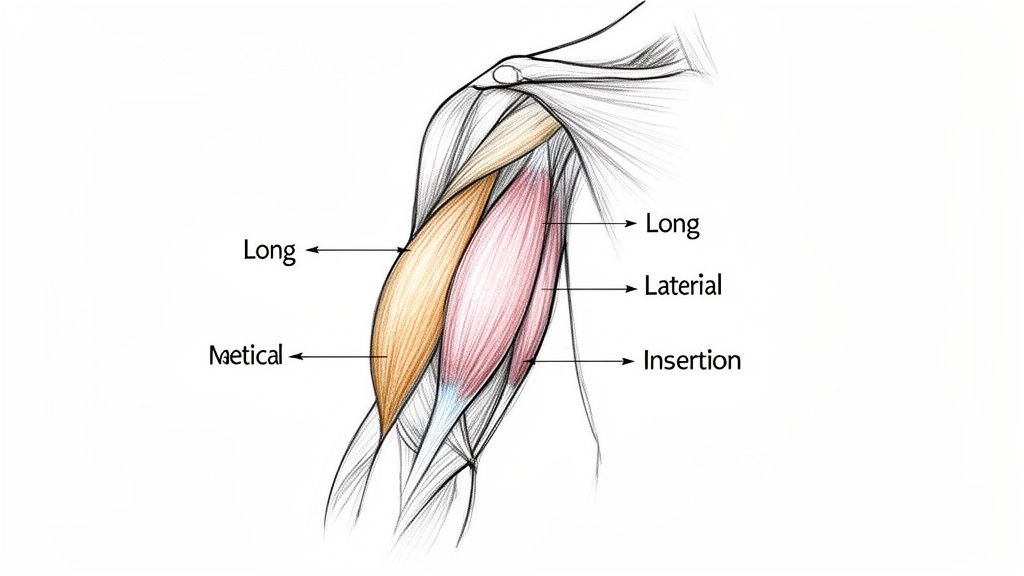
Before you even think about picking up a weight, let’s get on the same page about what we're training. The triceps brachii muscle makes up a whopping two-thirds of your upper arm mass. It’s not just one big muscle; it’s a group of three distinct "heads" that all work to extend your elbow.
Building truly impressive arms means giving them their own focus, not just throwing in a few sets of pushdowns after your chest workout. A dedicated mass tricep workout is built from the ground up, starting with anatomy.
Meet the Three Heads of the Triceps
To design a workout that actually works, you have to know the players. Each head attaches at a slightly different point, meaning certain arm positions and angles will hit one head more than the others.
- The Long Head: This is the big one. It runs all the way from your shoulder blade down to your elbow and is the largest of the three. Because it crosses the shoulder joint, the best way to smoke it is with overhead movements. Think skull crushers or overhead dumbbell extensions.
- The Lateral Head: This is the muscle on the outer side of your arm that gives you that classic "horseshoe" look when you flex. It really comes into play when your arms are down by your sides, like during dips or standard pushdowns.
- The Medial Head: Tucked underneath the other two, the medial head is a crucial stabilizer. While it’s active in pretty much every triceps exercise, you can really isolate it with reverse-grip movements or anything that demands a powerful lockout, like a close-grip bench press.
If you neglect any one of these, you’ll end up with imbalanced arms and leave a ton of potential growth on the table. A truly effective routine hits all three, every time.
The Core Principles of Triceps Growth
Muscle growth, or hypertrophy, isn't magic. It's a direct response to the specific stress you put on your muscles. When we're talking about a mass-building program, there are two principles you just can't ignore.
The most effective tricep workouts are built on two pillars: consistently applying mechanical tension through progressive overload and creating metabolic stress by pushing sets close to muscular failure.
First up is mechanical tension. This is simply the force your muscle generates when you lift a challenging weight. It's the number one driver of muscle growth. The key here is progressive overload—you have to consistently challenge your muscles by gradually adding weight, reps, or sets over time.
Then there's metabolic stress. You know that "pump" or burn you feel during a high-rep set? That’s it. It’s caused by the buildup of metabolic byproducts in the muscle, which sends a powerful signal to grow. This is where techniques like dropsets and supersets really shine.
By combining both of these stressors in your mass tricep workout, you create an incredibly powerful stimulus for growth. For a deeper dive into building bigger arms, check out our complete guide on how to get big arms for more programming insights.
Choosing the Best Exercises for Tricep Hypertrophy
Building a truly effective triceps workout comes down to one thing: smart exercise selection. Not all movements are created equal. If you want to build thick, dense arms, you have to pick exercises that trigger the most muscle activation and let you consistently add weight or reps over time.
This isn't just about "feeling the burn." It's about strategically choosing movements that are proven to create maximum mechanical tension across all three heads of the triceps.
What the Science Says About Triceps Activation
For years, lifters argued over which exercises were the "best." Then the American Council on Exercise (ACE) stepped in and did a landmark study using electromyography (EMG) to see what was actually happening inside the muscle. The results gave us a clear roadmap for what really works.
The study found one bodyweight exercise to be the undisputed king: triangle push-ups. They generated a massive 100% activation across the triceps. Dips and dumbbell kickbacks were close behind, clocking in at an impressive 87-88% activation.
Other gym staples like overhead extensions (76%) and rope pushdowns (74%) are still great, but they're clearly in a different league. This data is our starting point for building a program that actually delivers results.
When you're picking your go-to movements, it's helpful to see how they stack up. EMG studies give us a fantastic, unbiased look at which exercises are pulling their weight.
Top Triceps Exercises Ranked by Muscle Activation
The table below breaks down the top performers from the ACE study, showing not just their overall effectiveness but also which parts of the triceps they hit the hardest. Think of this as your cheat sheet for building a well-rounded routine.
| Exercise | Overall EMG Activation (% MVIC) | Primary Heads Targeted | Notes for Mass Building |
|---|---|---|---|
| Triangle Push-ups | 100% | All three (Long, Lateral, Medial) | The king for a reason. Its high activation makes it a non-negotiable for overall development. |
| Dips | 88% | Long & Lateral | A phenomenal compound lift. Perfect for adding serious weight and building foundational strength and size. |
| Dumbbell Kickbacks | 87% | Lateral & Medial | Excellent for peak contraction, but hard to progressively overload with heavy weight. Best used as a finisher. |
| Overhead Extensions | 76% | Long Head (Emphasis) | The single best move for isolating and stretching the long head, which adds the most overall mass to the arm. |
| Rope Pushdowns | 74% | Lateral & Medial | A staple for carving out the "horseshoe" shape. The rope allows for a strong squeeze at the bottom. |
Data adapted from the 2011 ACE-sponsored study on triceps activation.
As you can see, a mix of exercises is crucial. You need the high-activation moves for overall stimulus and the targeted ones to ensure no head gets left behind.
Top-Tier Exercises for Building Triceps Mass
Based on the science and what we see work in the real world, a few exercises should be the foundation of your training. These are your biggest bang-for-your-buck movements.
1. Triangle Push-Ups
As the #1 rated exercise for triceps activation, this one needs to be in your program. The narrow hand position forces the triceps to do almost all the work, hammering the long, lateral, and medial heads like nothing else.
- How to do it: Get into a plank, but put your hands directly under your chest. Touch your thumbs and index fingers together to make a triangle shape. Keep your elbows glued to your sides as you lower down, then press back up hard, squeezing your triceps at the top.
- Pro Tip: Can't do them on the floor yet? No problem. Start on an incline, like a bench or a bar in a Smith machine. As you get stronger, just lower the incline until you’re flat on the ground.
2. Dips (Parallel Bar)
Dips are an absolute beast for packing on size. They’re a compound movement that lets you overload your triceps with heavy weight through a deep range of motion—a perfect recipe for stimulating the long and lateral heads.
- How to do it: Grab the parallel bars with your arms straight. Keep your torso as upright as you can to keep the focus on your triceps (leaning forward brings your chest into it more). Lower yourself until your elbows hit a 90-degree angle, then drive back up.
- Making it harder: Once you can knock out sets of bodyweight dips easily, it’s time to add a dip belt and start hanging plates. This is how you apply progressive overload and keep growing.
Key Insight: The combination of a heavy compound movement like weighted dips and a high-activation exercise like triangle push-ups is a killer one-two punch. One builds raw strength and overall size, while the other ensures you're recruiting every last muscle fiber.
Essential Isolation Movements
Heavy compound lifts are the main course, but isolation exercises are what complete the meal. You need them to hit specific heads and build well-rounded, balanced arms.
Overhead Dumbbell Extensions
This is, hands down, the best exercise for targeting the long head of the triceps. Putting your arm overhead stretches the long head completely, which is a powerful trigger for muscle growth.
- Form Cue: Lock your elbows in place, pointing straight at the ceiling. The biggest mistake people make is flaring them out, which takes the tension off the muscle. Lower the dumbbell slowly behind your head until you feel a deep stretch, then extend back up.
Triceps Pushdowns (Rope Attachment)
A classic for a reason. The rope pushdown is fantastic for hitting the lateral head, which gives you that classic "horseshoe" look. The rope is great because it’s easy on the wrists and lets you pull the handles apart at the bottom.
- How to maximize tension: At the very bottom of the rep, pull the rope handles apart and squeeze your triceps as hard as you can for a solid second. This peak contraction is what really makes the lateral head pop. A slow and controlled negative on the way up will also crank up the metabolic stress and drive more growth.
Programming Your Workouts for Maximum Growth
Picking the right exercises is a solid start, but that's just one piece of the puzzle. The real secret sauce is in the programming—how you arrange those movements into a smart, progressive plan. This is what turns effort into actual, noticeable growth.
A well-built triceps program isn't just a random collection of exercises; it's a strategic blend of volume, intensity, and recovery. Let's dig into how to structure it all for the best results.
Sets and Reps for Building Mass
There's a reason the classic 8-12 rep range is king for hypertrophy. It’s been proven time and time again because it delivers the perfect mix of mechanical tension (lifting heavy enough) and metabolic stress (keeping the muscle working long enough) to spark growth. For your big compound lifts like dips or a close-grip bench, this range should be your foundation.
But to truly maximize growth, you can't just live in one rep range forever. You need to give your muscles different kinds of challenges.
- Heavy Strength Work (4-6 reps): Spending some time here, especially with your big compound lifts, builds a strong foundation. Getting stronger in this range means you can lift heavier weights for more reps in the 8-12 range. More weight for more reps is a surefire recipe for more muscle.
- High-Rep Finishers (15-20 reps): Capping off your workout with a high-rep isolation move like rope pushdowns is a fantastic way to create a ton of metabolic stress. This floods the triceps with blood, delivering nutrients and growth factors, and gives you that skin-stretching pump that we know contributes to growth.
The trick is to cycle through these different rep ranges over time. You might spend four weeks hammering the 8-12 range, then switch to a few weeks of heavier 4-6 rep work before coming back. This keeps your body adapting.
The Critical Role of Tempo
Most people completely ignore how they lift the weight, focusing only on getting from point A to B. But your tempo—the speed of each rep—is a hugely underrated tool for building muscle. If you want to shock your triceps into growing, you need to control every single inch of the movement.
For hypertrophy, the most important part of the rep is the eccentric, or the lowering portion. This is where you create the most muscle damage, which is a powerful trigger for repair and growth.
On exercises like skull crushers or overhead extensions, make a conscious effort to slow down the negative. A 2 to 3-second eccentric is a great place to start. For example, take one second to press the weight up, maybe pause for a beat at the top, and then take a full three seconds to lower it back down under complete control. You’ll feel the difference immediately.
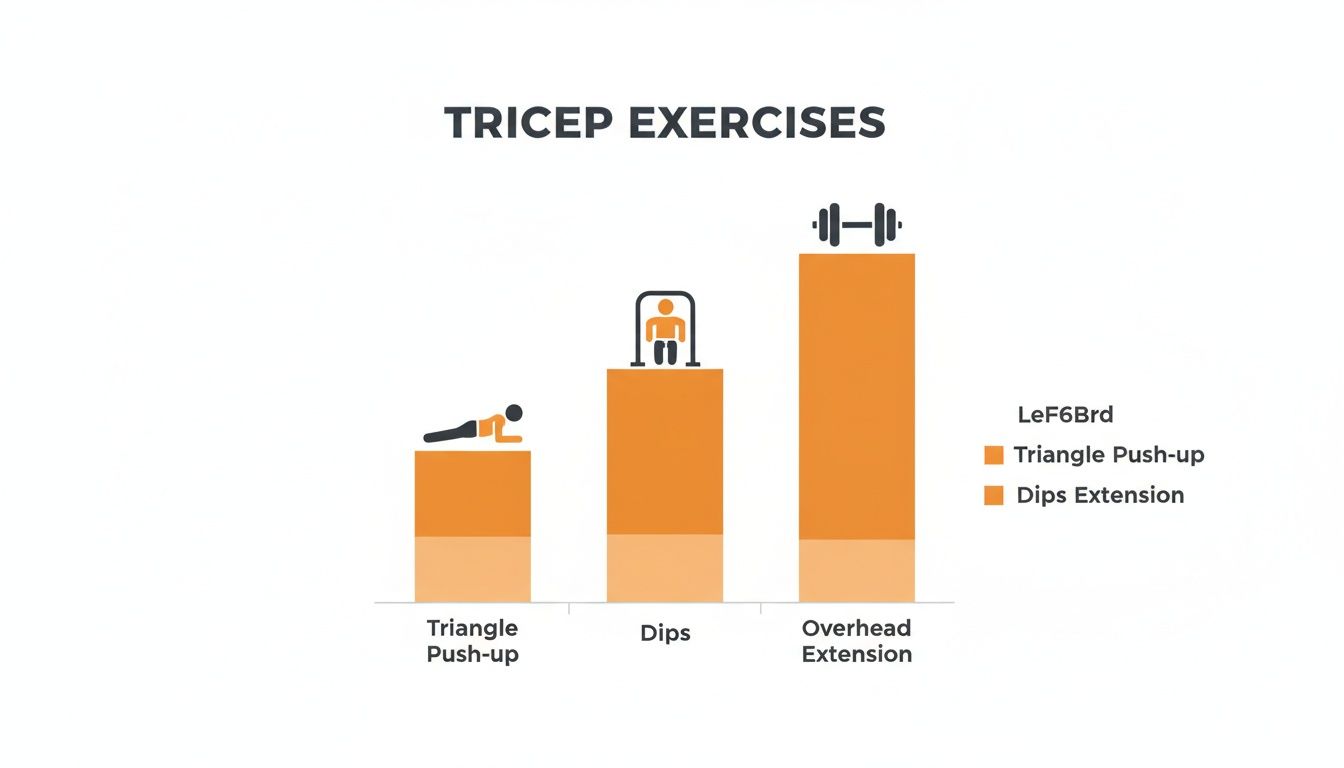
This just goes to show how vital it is to include a mix of different types of movements—compounds, bodyweight, and isolation—to hit the triceps from all angles.
Structuring Your Weekly Training
For most people looking to grow their triceps, hitting them directly twice a week is the sweet spot. This lets you train them hard, give them enough time to recover and grow (usually 48-72 hours), and then stimulate them again. If you want to dive deeper into this, check out our guide on training frequency for hypertrophy.
When it comes to total weekly volume, a solid guideline is 10-20 total working sets for your triceps per week. If you're just starting out, stick closer to the 10-12 set range to avoid overdoing it. As you get more advanced and your ability to recover improves, you can gradually push toward that 20-set mark.
Don't forget to count the work your triceps get from all your chest and shoulder pressing! That "indirect" volume adds up and absolutely counts toward your weekly total.
Advanced Techniques to Break Through Plateaus
Sooner or later, every lifter hits a wall. Those easy "newbie gains" start to dry up, and the standard three sets of ten just doesn't move the needle anymore. When that happens, it's time to upgrade your triceps workout with some advanced intensity techniques designed to shock your muscles into new growth.
If your progress has stalled, it's a clear signal that your triceps have adapted to the stress you've been throwing at them. The only way forward is to introduce a new, more intense stimulus that shoves them way outside their comfort zone. These methods are demanding, no doubt, but they are incredibly effective for busting through stubborn plateaus.
Unleash Intensity with Supersets
Supersets are a classic for a reason—they work. The idea is simple: perform two exercises back-to-back with little to no rest in between. This strategy dramatically increases the metabolic stress on the muscle, which floods your arms with blood and sends a powerful signal for growth.
You can mix and match supersets in a few effective ways:
- Pre-Exhaust Superset: This one is my personal favorite for pure hypertrophy. You start with an isolation move to completely fry the triceps, then immediately jump into a compound exercise. Think rope pushdowns right into a set of close-grip bench presses. Your triceps will be screaming.
- Compound Superset: Pair two big compound movements that hit the triceps from different angles. A truly brutal example is doing a set of weighted dips and then, with no rest, dropping to the floor for a set of triangle push-ups to failure.
- Antagonist Superset: This involves training opposing muscle groups, like triceps and biceps, back-to-back. Pairing overhead dumbbell extensions with barbell curls is a classic that not only saves time but also drives an insane amount of blood into your entire arm.
Pro Tip: When you’re supersetting, you'll almost certainly have to drop the weight on the second exercise. The goal here is intensity and muscular failure, not lifting your absolute max. Check your ego at the door and focus on perfect execution.
Push Past Failure with Dropsets
Dropsets are one of the most grueling yet effective ways to recruit every last muscle fiber in your triceps. The concept is straightforward: you perform a set until you can't possibly do another rep, immediately reduce the weight by 20-30%, and keep repping out until you fail again.
This technique is perfect for machines or cables where you can change the weight in a split second. Cable pushdowns are a prime candidate for this kind of torture.
Example Tricep Dropset:
- Set 1: Hit rope pushdowns with 100 lbs for 8-10 reps (to failure).
- Drop 1: Immediately drop the pin to 70 lbs and pump out as many reps as you can.
- Drop 2: Without stopping, drop it again to 50 lbs and go until you physically can't move the weight.
This massive increase in time under tension creates a level of metabolic stress that a normal straight set could never achieve. Just be smart about it—use dropsets sparingly, maybe on the last set of your final exercise, to avoid burning yourself out.
Master Rest-Pause and Partial Reps
Two other potent weapons for your arsenal are rest-pause training and partial reps. Both are designed to overload the muscle in unique ways that can spark new growth.
Rest-Pause Training lets you squeeze more reps out of a heavy weight than you could ever manage in a single, unbroken set. Pick a weight you can normally hit for 6-8 solid reps. Do your set, rack the weight, take just 10-15 deep breaths, then immediately un-rack it and grind out as many more reps as you can. That tiny rest period is just enough to replenish a little ATP, letting you get a few more growth-stimulating reps.
Partial Reps are fantastic for overloading a specific part of an exercise's range of motion. For instance, after you've hit failure on a set of skull crushers, you can keep the set going by performing small "pulses" in the top half of the movement. This keeps constant tension on the already-fatigued triceps, giving them one final stimulus to grow.
Using Smart Training Tech to Nail Your Recovery

The work you do in the gym is only half the battle. Lifting weights is the stimulus for growth, but the real magic happens when you’re resting. That’s when your body gets to work repairing the muscle fibers you’ve broken down, building them back bigger and stronger.
A truly effective triceps program is built on this foundation of smart recovery. Smashing your triceps into oblivion day after day without giving them time to heal is a surefire way to kill your progress. Overtraining doesn’t just stop growth; it invites injury. This is where modern training apps, like Built, can completely change how you approach your training.
See Your Triceps Fatigue with Recovery Heatmaps
Guesswork is the enemy of progress. Instead of just going by how sore you feel, you can now get a crystal-clear picture of your muscle fatigue. Imagine finishing a brutal triceps session and seeing a detailed map of your arm showing exactly how hard you worked it.
That’s what muscle recovery heatmaps do. After you log a workout, the app analyzes your volume and intensity and then spits out a simple, color-coded visual of your triceps' fatigue level.
- Red: Your muscles are cooked. This is a clear signal to back off and give them some serious recovery time.
- Yellow: You're in the recovery zone. The muscles are mending but aren't quite ready for another heavy beating.
- Green: All systems go. Your triceps are fully recovered and primed for another growth-inducing workout.
This heatmap essentially takes the ambiguity out of the equation, telling you precisely when your triceps are ready to be hit hard again.
Make Data-Driven Decisions with an AI Coach
Visuals are great, but turning that data into smart, actionable advice is where the real power lies. The Built app’s AI coach is like having an expert trainer in your pocket, constantly analyzing your performance and recovery to tell you what to do next.
This isn’t just random advice; it’s based on sound exercise science. For instance, a 2020 study on triceps pushdowns found that fast-tempo reps at 60% of a one-rep max (1RM) brought on fatigue more than 50% faster than slower reps at 30% 1RM. Why does this matter? Because that faster fatigue recruits more muscle fibers, which is a key trigger for hypertrophy.
The Built app can track this. It sees you logged explosive pushdowns, registers the fatigue spike on your heatmap, and then its AI can give you a concrete plan: "Triceps need 72 hours to recover. Your next session should aim for 65% 1RM to keep the progress going."
Instead of blindly following a generic template, the AI adjusts your triceps workouts on the fly, based on how your body is actually responding.
Let's say the app sees your triceps are still in the red from your last workout. The AI might suggest swapping your triceps day for a leg day, or maybe just doing some light, active recovery work. On the flip side, if you're recovering ahead of schedule, it might nudge you to add a little more volume or hit your triceps more frequently to speed up your gains.
This level of personalized programming used to be reserved for pro athletes with a team of coaches. To see how it works firsthand, you can dive into the features of an AI-powered workout app and see how it makes these advanced insights available to everyone.
By taking the guesswork out of the equation, this kind of tech ensures every workout is perfectly timed to maximize growth and keep you from spinning your wheels. It’s the key to finally breaking through plateaus and building the massive triceps you're after.
Got Questions About Building Bigger Triceps? Let's Clear Things Up.
Even when you've got a solid plan, you're bound to have questions. It happens to everyone. So, let's dive into some of the most common things people ask when they get serious about their triceps training.
Sorting through the noise and getting these answers right can make a huge difference in your results.
How Often Should I Actually Train My Triceps for Mass?
For just about everyone I've worked with, hitting triceps directly two times per week seems to be the magic number. This gives you enough stimulus to spark real growth without running yourself into the ground. It also leaves plenty of time for them to recover, which is usually around 48 to 72 hours.
Don't forget, your triceps are already putting in serious work on your big pressing days. Heavy bench presses, incline work, and overhead presses all hammer them, adding to your total weekly volume. You have to pay attention to how your body feels and track your recovery to really dial in what works for you.
Should I Train Triceps with Chest or Give Them Their Own Day?
Ah, the classic gym debate. Honestly, there's no single right answer here—both approaches can work wonders. It really boils down to your schedule, your overall training split, and what you're trying to accomplish.
Hitting triceps right after your chest workout is a time-saver. They're already fired up and warm from all the pressing, so you can get straight to the point with your isolation work. The obvious catch is that they’ll be tired, which can limit how much weight you can move.
On the other hand, giving triceps their own day (maybe with biceps for a classic arm day) lets you go in fresh. You can attack them with maximum intensity and weight, which is a massive plus for hypertrophy. If your triceps are a lagging body part, this is almost always the better way to go.
My Two Cents: If you're chasing overall strength and just want to be efficient, stick them at the end of chest day. But if your mission is to build the biggest, most impressive triceps you can, they absolutely deserve their own dedicated session.
What's Better: Free Weights or Machines?
Why not both? A smart triceps program should absolutely use a mix of free weights, cables, and machines. Each tool brings something different to the table, and combining them gives you a much more complete workout.
Free Weights (Dumbbells, EZ-Bars): Nothing beats these for building raw strength and stability. Lying extensions (skull crushers) and overhead dumbbell work force all those little stabilizer muscles to kick in, which builds a stronger, more resilient arm from the elbow up.
Machines & Cables: The big win here is constant tension. A cable keeps the muscle under load through the entire range of motion, something you just don't get with a dumbbell. This is incredible for creating metabolic stress and getting an insane pump.
A great way to structure this is to lead with a heavy free-weight movement when you're fresh. Then, move on to cables or machines to chase that pump, hit the muscle from different angles, and finish the job. You get the best of both worlds: strength stimulus and metabolic stress.
Ready to stop guessing and start building? The Built Workout app takes all the complexity out of your training. With AI-driven coaching and muscle recovery heatmaps, you'll know exactly when to push and when to rest, ensuring every single workout contributes to your goal of building bigger, stronger triceps. Download it for free and start your smarter training journey today.