A 5-day split is a training schedule that has you in the gym five times a week, with each workout hitting different muscle groups. This high-frequency style is a favorite among intermediate and advanced lifters because it lets you pack in a ton of weekly training volume—a non-negotiable for serious muscle growth.
Decoding the 5-Day Split
Think of a 5-day split like giving each part of your body its own dedicated workday. Instead of a full-body routine where you try to do a little bit of everything, you assign specific muscle groups to specific days. This means you can absolutely hammer your chest on Monday, knowing it gets a full week to recover before you train it again.
This laser-focused approach is precisely why it’s a go-to for so many experienced lifters. By isolating muscle groups, you can crank up the total amount of work—the training volume—that each muscle gets over the course of the week. And more volume, when backed by solid recovery, is the classic recipe for building both size and strength.
But let's be real: this schedule is demanding. Committing to five gym sessions every week takes a serious chunk of time and a rock-solid recovery plan. If you're just starting out, a 3 or 4-day routine is usually a much smarter, more sustainable way to build your foundation.
Who Should Use a 5-Day Split?
This training style isn't for everyone. It’s less about how many years you've been lifting and more about your consistency, your recovery habits, and what you're trying to achieve.
A 5-day split is probably right for you if:
- You have at least one year of consistent, serious lifting under your belt. Your body needs to be ready for the grind.
- You can genuinely get to the gym five times a week, every week. The magic of this split is in its frequency; skipping workouts throws the whole system out of whack.
- You're dialed in on recovery, especially sleep and nutrition. With fewer rest days, your body needs top-tier fuel and rest to repair itself and grow.
- Your main goal is muscle growth (hypertrophy). Dedicating entire workouts to one or two body parts lets you create a level of focus and volume that other splits just can't match.
The biggest mistake people make is jumping into a 5-day split too soon. The point isn’t just to survive the week—it’s to show up to each session strong and ready to progress. If you feel constantly run-down, that's a clear signal the volume or frequency is too much for you right now.
5-Day Split at a Glance: Pros vs. Cons
Before you rearrange your entire week, it's smart to weigh the good against the bad. A 5-day split can deliver incredible results, but it also brings challenges that can easily derail your progress if you're not prepared. Knowing both sides helps you decide if it truly fits your lifestyle and goals.
Here's a quick breakdown to help you see if it's the right move for you.
| Aspect | Pros (Advantages) | Cons (Disadvantages) |
|---|---|---|
| Volume & Hypertrophy | Lets you hit each muscle group with maximum weekly volume, which is crucial for building muscle. | High risk of "junk volume"—doing extra sets and reps that just add fatigue without actually stimulating more growth. |
| Time Commitment | Workouts are often shorter and more focused (around 45-75 minutes) since you're only hitting 1-2 muscle groups. | Requires a major weekly commitment of five gym sessions, which can be tough to juggle with a busy life. |
| Recovery | Each muscle gets a ton of recovery time (often a full week) before you train it directly again. | Can lead to system-wide fatigue and overtraining if your sleep, stress, and nutrition aren't on point. |
| Focus | Makes it easier to build a strong mind-muscle connection by pouring all your energy into one area. | Each muscle is stimulated less frequently compared to full-body or upper/lower splits. |
Ultimately, choosing a 5-day split is a big commitment. It offers a powerful tool for building an impressive physique, but it demands just as much from you in terms of dedication and smart recovery.
So, you've landed on a 5-day split. Smart choice. Now for the fun part: picking the right flavor for your goals. Not all five-day routines are built the same. Each one is a different blueprint for sculpting your physique or building raw strength.
Think of it like this: you have five workdays in the gym. How you schedule the work will completely change the final product. Let's dig into the most popular and effective variations to see which one clicks for you.
This decision tree can help you narrow it down at a glance, based on your training age, goals, and how well your body bounces back from tough workouts.
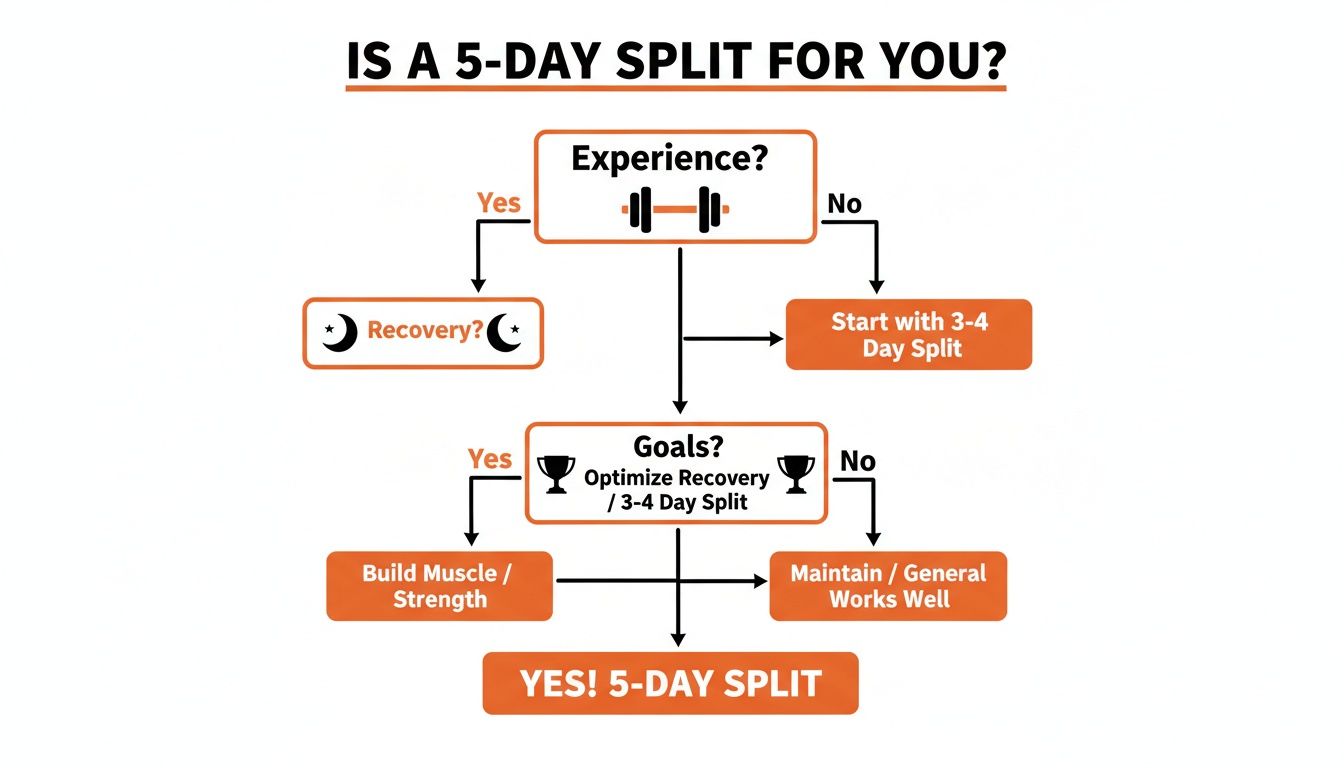
As you can see, what works for a bodybuilder chasing pure size might not be ideal for an athlete who needs to perform. Your personal situation is everything when it comes to picking the right split.
The Classic Body Part Split (a.k.a. The "Bro Split")
This is the one everyone pictures when they hear "5-day split". The logic is simple and time-tested: one major muscle group gets its own day in the spotlight.
A typical week looks something like this:
- Day 1: Chest
- Day 2: Back
- Day 3: Legs
- Day 4: Shoulders
- Day 5: Arms
The beauty of this setup is the incredible focus it allows. You can throw everything you've got at one muscle group, hitting it with tons of volume from every conceivable angle. This massive stimulus, followed by a full seven days of recovery, is a proven recipe for hypertrophy.
But here’s the catch: its greatest strength can also be its weakness. Training a muscle just once a week is a low-frequency approach. While the volume in that one session is huge, you miss out on stimulating muscle protein synthesis more frequently throughout the week.
The Upper/Lower Hybrid Split
If you're looking to hit muscles more often, the Upper/Lower split can be cleverly adapted into a five-day schedule. This hybrid model is a favorite for those wanting the best of both worlds: good volume and higher frequency.
The most common layout is three upper-body days and two lower-body days, like this: Upper, Lower, Upper, Lower, Upper. This setup guarantees every major muscle gets trained at least twice in a 7-day window, a huge plus for both strength and size.
One of the best things about this split is how it manages fatigue. By switching between upper and lower body, you're giving the muscles you just trained a form of active rest. You can walk into each session feeling much fresher.
The Push/Pull/Legs (PPL) Hybrid Split
The Push/Pull/Legs (PPL) split is another high-frequency workhorse that fits perfectly into a five-day routine. Instead of focusing on muscles, it organizes training around movement patterns.
- Push Days: All your pressing movements for chest, shoulders, and triceps.
- Pull Days: All your rowing and pulling movements for back and biceps.
- Leg Days: Everything for your quads, hamstrings, glutes, and calves.
A 5-day PPL routine usually runs through the cycle once and then starts over: Push, Pull, Legs, Push, Pull. This hits most of your upper body muscles twice a week, which is fantastic for building a powerful, well-rounded physique. If you like the PPL concept but need a bit less time in the gym, our guide on the 4-day push-pull workout routine is a great alternative.
The 5-Day Full-Body Split
Once seen as a bit out there, the 5-day full-body split has gained some serious respect, especially among athletes and lifters focused on pure performance. The idea is to train the entire body in every session, usually centered around one or two big compound lifts with intensity cranked up.
I know what you're thinking—that sounds like a fast track to overtraining. But when programmed correctly, it's incredibly effective. The secret is managing the daily volume. Each session is short and sharp, focused on stimulating growth and neural adaptations with maximum frequency.
The science is starting to back this up, too. While an older 2019 meta-analysis found similar growth between different frequencies when total volume was matched, newer studies tell a more compelling story. Researchers directly comparing a 5-day full-body split to a 5-day bro split found the full-body group packed on significantly more muscle pretty much everywhere. In that study, the full-body group scored a perfect 10.0 for hypertrophy, while the bro split came in at 8.8.
Ready-to-Use 5 Day Split Workout Templates
Theory is great, but getting results happens in the gym. Let's put the concepts into practice with three different 5 day split templates, each one built for a specific goal: packing on muscle (hypertrophy), building raw strength, or developing explosive power.
These aren't just random lists of exercises. I'm going to break down the "why" behind the exercise choices, the rep schemes, and even the rest periods. When you understand the logic, you can do more than just follow a plan—you can truly own it and make smart adjustments as you get stronger.
You can plug any of these templates right into an app like Built Workout to start tracking your lifts and see how your body is responding in real-time.
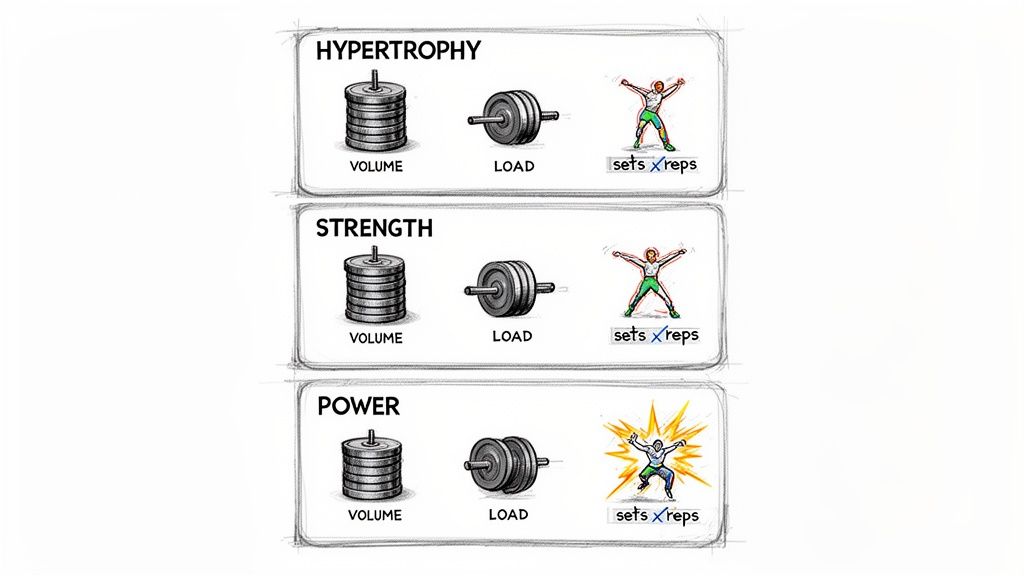
The Hypertrophy "Bro Split" Template
The classic "bro split" has stood the test of time for one simple reason: it works incredibly well for building muscle. The whole idea is to dedicate an entire session to annihilating one major muscle group. This high-volume approach creates a ton of metabolic stress and muscle damage, which are the primary signals for your body to grow bigger and stronger.
Here, the name of the game is time-under-tension and chasing that skin-stretching pump. We'll keep rest periods on the shorter side to ramp up fatigue and stick to that well-known 8-12 rep range that’s perfect for muscle growth.
This is what a typical week looks like. You’ll notice each major muscle gets its own day in the spotlight.
Example Hypertrophy 'Bro Split' Template
| Day | Focus Muscle Group | Sample Key Exercises |
|---|---|---|
| Day 1 | Chest | Barbell Bench Press, Incline Dumbbell Press, Cable Crossovers |
| Day 2 | Back | Barbell Rows, Lat Pulldowns, Seated Cable Rows |
| Day 3 | Legs | Squats, Leg Press, Romanian Deadlifts, Leg Extensions |
| Day 4 | Shoulders | Overhead Press, Dumbbell Lateral Raises, Face Pulls |
| Day 5 | Arms | Barbell Curls, Tricep Pushdowns, Hammer Curls, Skull Crushers |
It’s a straightforward and brutally effective layout. If you want to get more granular on setting up your back and arm days, our guide on building the perfect back and biceps workout routine is a great next step.
The Strength-Focused Powerlifting Template
When your number one goal is moving the heaviest weight possible, the entire workout philosophy shifts. This template is all about the "big three" powerlifting movements: the squat, bench press, and deadlift. Every other exercise is there to directly support these main lifts.
We're trading high volume for maximum intensity. Reps drop into the 3-6 range, and you'll take much longer rest periods. This isn't about getting a pump; it's about giving your nervous system enough time to fully recover so every single set is a high-quality effort.
When you're training for strength, rest isn't laziness—it's a critical tool. Taking 3-5 minutes between heavy compound sets is essential for replenishing the energy you need to perform at your peak.
Here's how a strength-focused week might be structured:
- Day 1: Heavy Bench & Chest Accessories
- Barbell Bench Press: 4 sets of 3-5 reps
- Close-Grip Bench Press: 3 sets of 6-8 reps
- Weighted Dips: 3 sets of 6-8 reps
- Day 2: Heavy Squat & Leg Accessories
- Barbell Back Squat: 4 sets of 3-5 reps
- Front Squats: 3 sets of 6-8 reps
- Glute-Ham Raises: 3 sets of 8-10 reps
- Day 3: Rest
- Day 4: Overhead Press & Shoulder/Tricep Work
- Standing Overhead Press: 4 sets of 3-5 reps
- Seated Dumbbell Press: 3 sets of 6-8 reps
- Heavy Face Pulls: 3 sets of 10-12 reps
- Day 5: Heavy Deadlift & Back Work
- Conventional Deadlift: 4 sets of 3-5 reps
- Pendlay Rows: 3 sets of 6-8 reps
- Lat Pulldowns: 3 sets of 8-10 reps
The Athletic Power Development Template
This one is for the athletes. If you need to be not just strong, but fast and explosive, this is your template. We're blending heavy strength work with dynamic, high-velocity movements to train your rate of force development. Simply put, we're teaching your muscles to fire with maximum speed and aggression.
The secret sauce here is intent. Every single explosive rep needs to be performed as fast and as violently as you can. Long rest periods are non-negotiable, as they ensure your central nervous system stays fresh for each explosive effort.
- Day 1: Upper Body Explosive Push
- Plyometric Push-ups: 5 sets of 3 reps
- Barbell Bench Press (focus on bar speed): 5 sets of 3 reps
- Medicine Ball Chest Throws: 3 sets of 5 reps
- Day 2: Lower Body Explosive Pull
- Power Cleans: 5 sets of 3 reps
- Romanian Deadlifts: 3 sets of 6-8 reps
- Broad Jumps: 3 sets of 5 reps
- Day 3: Rest
- Day 4: Upper Body Explosive Pull
- Medicine Ball Slams: 5 sets of 5 reps
- Weighted Pull-ups (focus on speed): 5 sets of 3 reps
- Bent-Over Barbell Rows: 3 sets of 6-8 reps
- Day 5: Lower Body Explosive Push
- Box Jumps: 5 sets of 3 reps
- Barbell Back Squat (focus on speed): 5 sets of 3 reps
- Kettlebell Swings: 3 sets of 10 reps
Be warned: this style of training is incredibly taxing on your system. Paying close attention to recovery isn't just a good idea; it's an absolute must.
Mastering Your Training: Volume, Intensity, and Frequency
To get real, lasting results from any 5-day split, you have to get a handle on the three dials that control your progress: volume, intensity, and frequency. Think of them as the fundamental ingredients in your recipe for building muscle. Nailing the balance is what turns a decent program into an exceptional one.
These three variables don't exist in a vacuum; they're constantly influencing each other. If you crank one up, you'll almost always need to dial another one back to compensate. The beauty of a 5-day split is that it gives you the structure to manipulate these dials with a ton of precision.
The Role of Training Volume
At its core, volume is just the total amount of work you're doing. The classic formula is sets x reps x weight. This is the single biggest driver for muscle growth, or hypertrophy. The logic is simple: more work, provided you can recover from it, generally sparks more growth.
A 5-day split is an incredible framework for racking up a ton of weekly volume. Since you're only hammering one or two muscle groups each day, you can hit them with a high number of quality sets without spending half your day in the gym or accumulating so much system-wide fatigue that your next workout suffers.
Dialing in The Right Intensity
Intensity is all about how heavy you're lifting. It’s usually talked about as a percentage of your one-rep max (1RM). Are you grinding out reps at 85% of your max, or are you pumping out a set of 12 at 65%? That’s intensity.
It’s the specific signal that tells your body how to adapt. Lifting heavy for low reps (high intensity) is your ticket to building pure, top-end strength. On the other hand, moderate weights for higher reps (moderate intensity) is the sweet spot for hypertrophy. A well-designed 5-day split gives you room to program dedicated days for both.
A common mistake is thinking intensity just means "going hard." In programming, it's a specific metric. A set of 5 heavy reps might feel less exhausting than a 20-rep set to failure, but the intensity is technically much higher.
Optimizing Your Training Frequency
Frequency is simply how often you train a muscle group within a given week. This is where a 5-day split really starts to separate itself from the pack, especially for lifters who've been around the block. A classic "bro split" hits each muscle just once per week, but modern 5-day setups like an Upper/Lower or Push/Pull/Legs hybrid can train muscles 2-3 times per week.
For experienced lifters, this higher frequency is a game-changer. Hitting a muscle more often seems to trigger more consistent growth, even when the total weekly volume is matched. This is likely because you're stimulating muscle protein synthesis more frequently. If you want to dive deeper, check out our complete guide on training frequency for hypertrophy.
This is also where modern tools can give you a serious edge. Fitness apps that track recovery, like Built Workout, can show you which muscle groups are primed and ready for another session. It takes the guesswork out of high-frequency training, ensuring you're hitting muscles when they're ready to grow, not just because the calendar says it's "chest day." You can learn more about this by exploring the research on StrongerByScience.com.
Getting a solid grasp on these three pillars is what empowers you to build a smarter, more effective 5-day split. When you thoughtfully adjust how much you lift, how heavy you go, and how often you train, you take the driver's seat on your own progress.
Prioritizing Recovery to Prevent Overtraining
Training five days a week is a serious commitment. It puts a ton of stress on your body, and with only two rest days, recovery stops being something that just happens and becomes an active part of your plan. On a 5 day split, the real progress isn't just made in the gym—it's locked in during those crucial hours you spend recovering.
Think of your body like a high-performance race car. Your workouts are you flooring it on the track, pushing the engine to its limits. Recovery—sleep, nutrition, and smart rest—is your pit stop. It's where the crew refuels the tank, changes the tires, and repairs any damage. If you skip or rush your pit stops, that engine is going to break down. It's not a matter of if, but when.
Listening to Your Body with Data
Guesswork is the enemy of long-term gains. Sure, you can feel "a little tired," but that's a world away from being on the edge of actual overtraining. This is where modern workout tracking becomes a total game-changer, turning those vague feelings into hard data you can actually use.
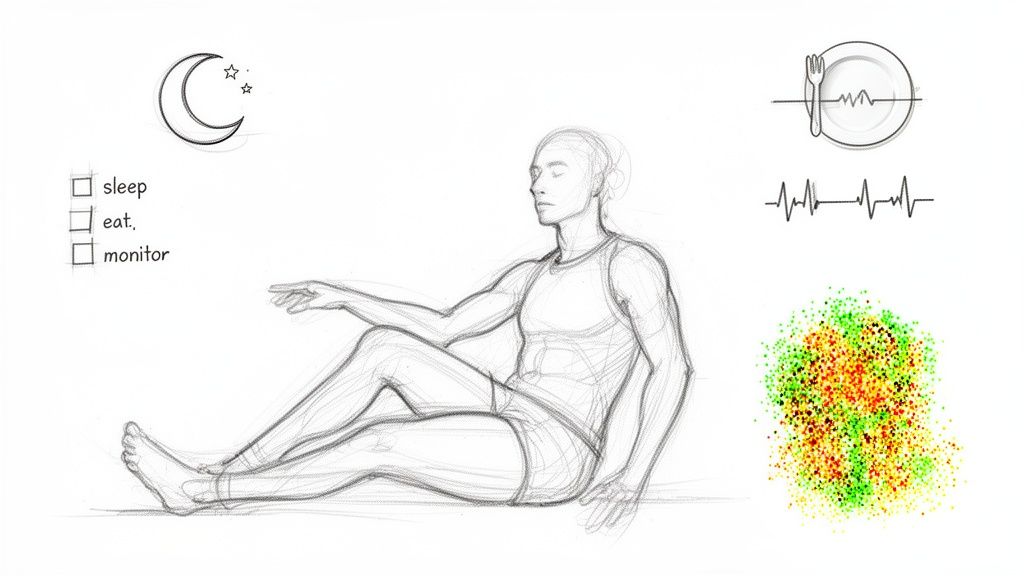
It all starts with logging your workouts meticulously. Every single set, rep, and pound you lift is a data point. Together, these points tell the story of the stress you’ve put on your body. An app like Built Workout takes all that raw information and turns it into a visual map of your muscle recovery.
Suddenly, abstract fatigue becomes something you can see and measure. Instead of just wondering if your chest is ready for another bench session, you can glance at a recovery heatmap and know for sure.
A Modern Workflow for Recovery Management
Using data to manage your recovery doesn't have to be complicated. In fact, it's a pretty simple and powerful feedback loop that helps you make smarter calls day in and day out.
- Log Your Workouts Accurately: This is the foundation. Be consistent and record every exercise, including sets, reps, and weight.
- Review Your Muscle Recovery Heatmap: Before you even walk into the gym, check your personalized heatmap. Muscles showing up in green are fresh and ready to go. Anything in the red is still seriously fatigued.
- Adjust Based on Feedback: Let’s say your shoulders are still glowing red from your last push day. It’s probably a good idea to swap that overhead press for an exercise that gives them a break. This simple, proactive adjustment is how you stop pushing a muscle group past its breaking point.
This data-driven approach is all about auto-regulation. It gives you the power to know exactly when to crank up the intensity and, just as importantly, when to pull back. This ensures every single workout is productive, not just another layer of fatigue. You can dive deeper into this topic in our detailed guide on how to prevent overtraining: https://www.builtworkout.com/blog/how-to-prevent-overtraining.
Overtraining doesn't happen in one bad workout. It’s the slow, creeping buildup of fatigue from consistently training harder than your body can recover. Data helps you spot the trend before it becomes a real problem.
The Non-Negotiable Recovery Pillars
While tech gives us some incredible insights, it can't replace the fundamentals. Your body's ability to repair itself and grow stronger always comes down to a few core pillars.
- Sleep: You absolutely must aim for 7-9 hours of quality sleep a night. This is prime time for your body to release growth hormone and get to work on muscle repair. Skimping on sleep is like trying to build a house without bricks.
- Nutrition: A high-protein diet is non-negotiable for rebuilding muscle tissue. You also need enough carbs to restock your energy stores (glycogen) and healthy fats to keep your hormones in check.
- Active Recovery: Your rest days aren't for being a couch potato. Light activity like walking, stretching, or foam rolling gets the blood flowing to your sore muscles, which helps clear out metabolic waste and ease soreness.
On top of these, weaving in some solid post-workout recovery tips can make a huge difference in keeping overtraining at bay.
When you combine these foundational habits with the smart, data-driven insights from a tool like Built Workout, you transform your demanding 5-day split from a burnout risk into a sustainable engine for long-term progress.
Common 5 Day Split Mistakes to Avoid
Even the most well-crafted 5 day split will stall out if you’re making some common execution errors. Committing to five training days a week is the easy part. The real challenge is making sure that time in the gym actually translates to real, measurable progress.
Let’s dig into the classic mistakes that can derail your gains and how to make sure you're not just spinning your wheels.
The most common trap I see people fall into is mindlessly chasing volume. They get stuck on the idea that more is always better, cramming in extra sets and exercises until they can barely move. This just leads to a ton of “junk volume”—work that adds fatigue but doesn't actually stimulate new muscle growth. The goal is to stimulate the muscle, not completely annihilate it.
Forgetting to Actually Progress
Another major pitfall is just going through the motions. Your workout plan isn't a to-do list you just check off day after day. It's a starting point you need to consistently build on. If you're lifting the exact same weight for the exact same reps every single week, you're giving your body zero reason to adapt.
This is where progressive overload comes in—it's the bedrock principle of building strength and muscle. And no, it doesn't always mean you have to pile more plates on the bar. You can drive progress in several ways:
- Adding Reps: Hitting one more rep than last time with the same weight.
- Adding Sets: Gradually increasing the total work you do for a muscle group.
- Improving Form: Lifting the same weight for the same reps, but with cleaner technique and better control.
- Decreasing Rest Time: Compressing your rest periods to make your workouts more metabolically demanding.
This is why tracking your workouts is non-negotiable. If you don't know what you did last week, you're just guessing this week.
Forgetting to progress is like showing up to work every day but never asking for a raise. You’re putting in the time, but you're not getting the rewards your effort deserves. True progress on a 5 day split is planned and intentional.
Skipping Deloads Until You Crash and Burn
Training five days a week is no joke. It builds up a ton of stress on your body, your joints, and your nervous system. Too many lifters just push, push, push until they hit a wall—they get sick, feel completely burnt out, or worse, get injured. That kind of forced time off is way more damaging to your progress than a planned recovery week.
A deload is a scheduled week of lighter training, usually programmed every 4-8 weeks. You’ll intentionally dial back the volume and intensity to let your body fully recover and come back stronger. Think of it as taking one step back to take two big steps forward. Pushing through without one is a surefire way to hit a plateau you can't break.
Common Questions About the 5-Day Split
Even the best-laid plans come with questions. Let's tackle some of the most common things people ask about running a 5-day split so you can walk into the gym with total confidence.
Is a 5-Day Split Good for a Beginner?
Honestly, it's probably overkill. While you could technically start with one, it’s not something I’d recommend for someone just getting their feet wet.
Beginners get incredible results from training just 3-4 days a week. Why? Because their bodies aren't yet adapted to the stress of frequent, intense lifting. A 5-day split requires a recovery capacity that you build over time. Jumping in too soon often leads to burnout, crippling soreness, and just feeling beat down. A much smarter play is to spend at least 6-12 months mastering a full-body or upper/lower routine first.
What If I Miss a Workout Day?
Life happens. Don't stress about it. The best approach is usually the simplest: just pick up right where you left off. If you missed Wednesday's shoulder day, just do that workout on Thursday and push the rest of the week back by one day.
If your weekly schedule is locked in, you can also just skip the missed day entirely and get back on track. The one thing you absolutely want to avoid is trying to smash two workouts into one day to "make up for it." That's just a recipe for a garbage workout and a surefire way to run yourself into the ground.
How Long Should My Workouts Take?
One of the best things about a 5-day split is that your sessions can be shorter and laser-focused. You're not trying to train your entire body, just one or two muscle groups, so you don't need to live in the gym.
A solid, well-programmed session should take you anywhere from 45 to 75 minutes. That’s the sweet spot to get enough high-quality work in to trigger growth without accumulating so much fatigue that it wrecks your next workout.
This is exactly why logging your training is so critical. Using a good gym workout tracker helps you see how long your sessions are taking and keeps you honest about your efficiency.
Stop guessing and start progressing. The Built Workout app visualizes your muscle recovery, tracks your progress with precision, and uses AI to guide you through every workout. Download it today and train smarter than ever before: https://www.builtworkout.com