A classic back and biceps workout is built around a simple, powerful principle: pulling. You’ll pair big, compound pulling exercises like rows and pull-ups with more focused isolation moves like curls. This "pull day" strategy is one of the most efficient ways to train because your biceps are already working hard during those heavy back movements, which lets you hit both muscle groups thoroughly in one go.
Why Training Back and Biceps Together Just Makes Sense
The "pull day" split is a gym staple for good reason—it’s designed around how your body naturally moves.
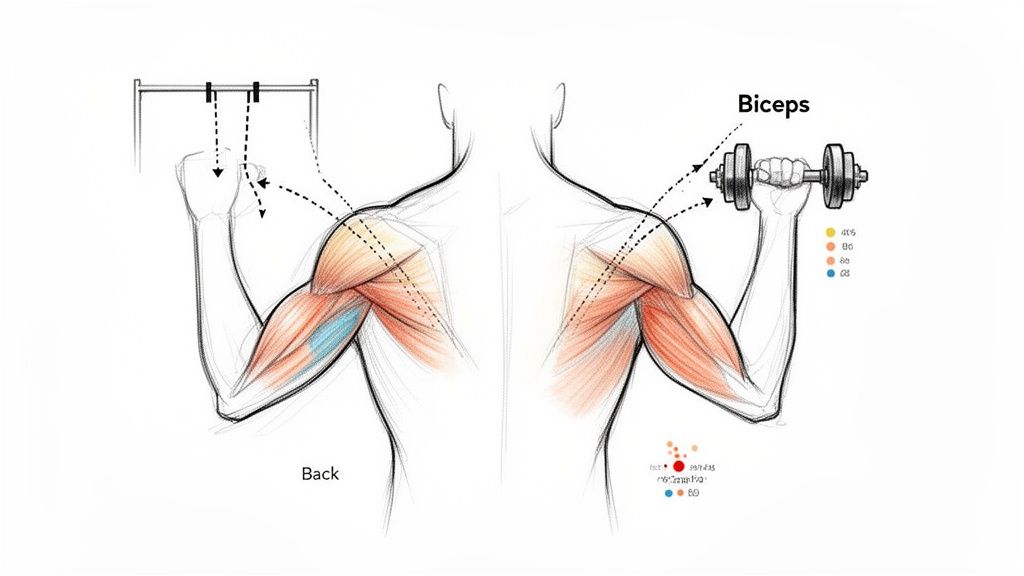
Think about any back exercise where you pull weight toward your body, whether it's a row or a chin-up. What's happening at your elbow? It's bending. And the primary muscle responsible for that is your biceps. They're a critical secondary mover in nearly every major back exercise.
This built-in synergy is exactly why pairing back and biceps is so effective. Instead of trying to isolate them on different days, you’re working with your body’s mechanics, not against them.
The Advantage of Pre-Fatigue
When you lead your workout with heavy back exercises, you’re also "pre-fatiguing" your biceps. They’re putting in serious work assisting your lats and rhomboids. So, by the time you get to your direct bicep curls, your arms are already primed and partially fatigued.
This can actually create a stronger training stimulus. You don’t need to hammer away with endless sets of curls to get a great pump and spark muscle growth. The heavy back work has already laid the foundation, allowing your bicep-focused exercises to be more targeted and intense.
A Smarter Way to Structure Your Week
From a practical standpoint, this pairing just makes weekly planning easier. Grouping synergistic muscles lets you build a balanced split that gives everything adequate time to recover.
A common setup might look like a back and biceps day on Monday, a push day (chest, shoulders, triceps) on Tuesday, and legs later in the week. This structure ensures you’re not overworking any single muscle group on back-to-back days.
Key Takeaway: Pairing back and biceps isn't just a random gym tradition; it's a strategy rooted in biomechanics. It capitalizes on natural movement patterns to make your workouts more efficient and easier to schedule for consistent, long-term progress.
This approach also smartly separates antagonist muscle groups (like chest and back), so fatigue from one workout won't sabotage the next. If you're looking for ways to organize your entire training week, our guide on structuring a 5-day workout split offers some great templates to get you started.
You can even see this synergy in action with tools like the Built Workout app. The muscle heatmap feature visually confirms that your rows are lighting up not just your lats, but your biceps too. It’s proof that every rep is pulling double duty, helping you reach your goals faster.
The Foundational Workout for Beginners
Jumping into the gym for the first time can feel like learning a new language. With so much equipment and conflicting advice, it's easy to get overwhelmed. That's why we're starting with the basics—a beginner-friendly back and biceps routine designed to build a rock-solid foundation.
This workout focuses on a handful of core movements that teach you how to properly engage your muscles, improve coordination, and build that crucial mind-muscle connection.
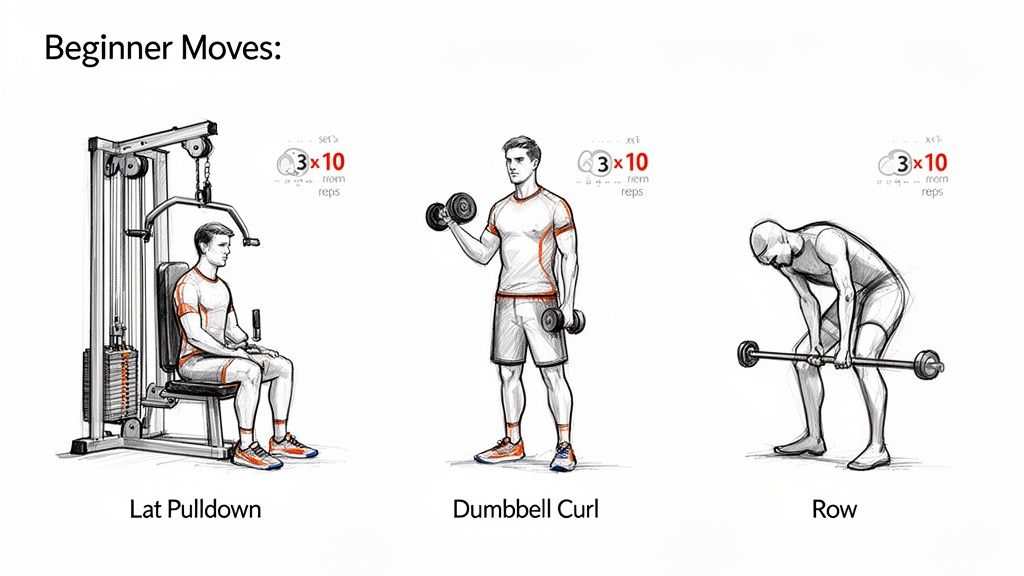
Forget about crazy techniques or trying to lift the whole weight stack for now. The goal here is simple: learn perfect form and establish a consistent routine you can build on for years.
The "Why" Behind This Beginner Routine
There's a method to the madness here. We're intentionally structuring this workout to hit the larger, more demanding back muscles first. These compound exercises recruit a ton of muscle fibers and get your biceps involved as secondary movers. Once the heavy lifting is done, we'll shift gears to isolation exercises for some focused bicep work.
The total volume is also strategic. For new lifters, aiming for 10 to 12 hard sets for your back per week is the sweet spot. It provides just enough stimulus to kickstart muscle growth without crushing your ability to recover.
Here’s the simple, effective plan to get you started.
| Beginner Back and Biceps Workout Routine |
|---|
| This structured routine outlines the essential exercises, sets, reps, and rest periods to build a strong foundation. The plan emphasizes controlled movements and proper form to establish a solid base for future progress. |
| Exercise |
| Lat Pulldown |
| Chest-Supported Row |
| One-Arm Dumbbell Row |
| Standing Dumbbell Curl |
| Exercise | Sets | Reps | Rest (seconds) |
|---|---|---|---|
| Lat Pulldown | 3 | 10-12 | 60-90 |
| Chest-Supported Row | 3 | 10-12 | 60-90 |
| One-Arm Dumbbell Row | 2 | 10-12 (per side) | 60 |
| Standing Dumbbell Curl | 3 | 10-15 | 60 |
This routine is your starting line. Focus on hitting these numbers with impeccable form before even thinking about adding more weight or exercises.
Executing the Exercises with Precision
At this stage, how you lift is infinitely more important than how much you lift. The goal is to feel the right muscles doing the work through a full, controlled range of motion.
1. Lat Pulldown
This is your go-to vertical pulling movement and a fantastic way to build the muscles required for pull-ups. It primarily targets the latissimus dorsi—the big "wing" muscles that give your back its width.
- How to do it: Grab the bar just wider than your shoulders. As you pull it down toward your upper chest, don't just use your arms. Instead, think about driving your elbows down and back. Squeeze your back muscles for a beat at the bottom, then let the weight return up slowly.
2. Chest-Supported Row
I love this exercise for beginners because it takes the lower back completely out of the equation. By resting your chest on a pad, you can put all your focus into pulling with your upper back muscles, like your rhomboids and traps.
- How to do it: Lie face down on an incline bench. Let the dumbbells hang, then pull them up by leading with your elbows. The key is to squeeze your shoulder blades together at the top. Avoid shrugging your shoulders toward your ears—that’s a common mistake.
3. One-Arm Dumbbell Row
This classic move lets you train each side of your back independently. It's a great tool for spotting and correcting any strength imbalances right from the get-go.
- How to do it: Place one knee and the same-side hand on a bench, keeping your back flat like a tabletop. Pull the dumbbell up toward your hip, not your shoulder. Control the weight on the way down and feel a good stretch in your lat at the bottom.
4. Standing Dumbbell Curl
Finally, we hit the biceps directly. The secret to a great curl is eliminating momentum. No swinging!
- How to do it: Stand with your elbows pinned to your sides. Curl the dumbbells up, focusing entirely on squeezing your biceps hard at the top. Lower the weight slowly and under full control; the eccentric (lowering) phase is just as important for building muscle.
Beginner's Tip: When picking a weight, be honest with yourself. If the plan calls for 10-12 reps, choose a weight you could probably manage for 15 if you had to. This ensures your form stays locked in as you get tired.
Why Tracking from Day One is a Game-Changer
The single most critical principle for getting stronger over the long haul is progressive overload. It just means you have to consistently make your workouts a little bit harder over time. But here's the catch: you can't progress what you don't measure.
This is where an app like Built Workout becomes your best friend from your very first session. Logging every set, rep, and pound you lift creates a roadmap of your progress.
Think about it. After a month of training, which scenario sounds better?
- Scenario A (No Tracking): You show up at the gym and try to remember what you lifted last week. You grab a weight that feels about right. Your progress becomes a guessing game.
- Scenario B (With Tracking): You open Built Workout and see you hit 10 reps with 50 lbs on the Lat Pulldown last Tuesday. Your mission is crystal clear: hit 11 reps or move up to 55 lbs. Progress becomes intentional.
Tracking removes the guesswork and gives you the objective data you need to ensure you're actually getting stronger. It turns effort into evidence, setting you up for success from the very start.
Level Up: The Intermediate Routine for Serious Mass
So you've put in the time, mastered the basic movements, and built a solid foundation. Now what? It's time to graduate from the beginner phase and start training for some serious size and strength.
This intermediate plan is where the real growth happens. We’re strategically increasing the intensity with heavier compound lifts and more overall volume to shock your muscles into new growth. This isn't just about lifting heavier; it's about lifting smarter.
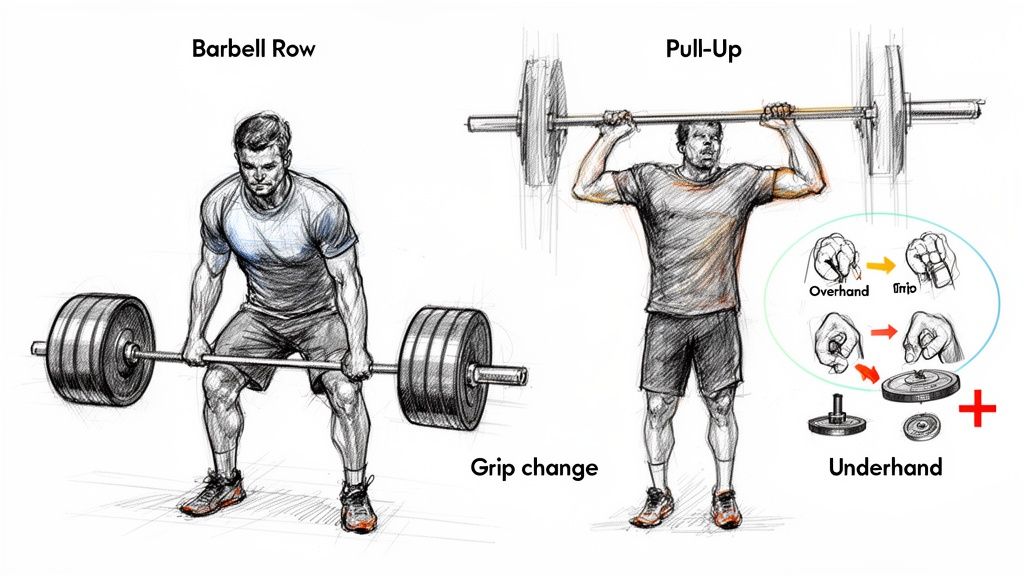
The focus now shifts to the kings of back development: heavy Barbell Rows and Pull-Ups. These are non-negotiable for building a thick, powerful back. They recruit a massive amount of muscle and build the kind of raw strength that translates directly into size. Once we’ve hammered the big back muscles, we’ll move on to more targeted isolation work to make sure your biceps pop.
Upping the Ante with Heavier Compounds
At this stage, your number one goal is progressive overload. This is the art of consistently making your workouts more challenging over time, and it's the secret to avoiding plateaus. It isn't just about slapping more plates on the bar, though. It’s also about perfecting your form, increasing your total volume, and pushing closer to true muscular failure.
This routine is built for that kind of progression. We're adding an extra set to our main lifts and dropping the rep range slightly. This forces you to use heavier weight, which is the primary driver for hypertrophy once those "newbie gains" start to fade.
| Intermediate Back and Biceps Workout |
|---|
| This plan is all about pushing past plateaus. It starts with heavy, strength-focused compound lifts for your back before shifting to high-rep, targeted bicep work to maximize the pump and stimulate growth. |
| Exercise |
| Pull-Ups (or Weighted Pull-Ups) |
| Barbell Row |
| Single-Arm Dumbbell Row |
| EZ-Bar Preacher Curl |
| Incline Dumbbell Curl |
| Exercise | Sets | Reps | Rest (seconds) |
|---|---|---|---|
| Pull-Ups (or Weighted) | 4 | 6-8 | 90-120 |
| Barbell Row | 4 | 6-8 | 90-120 |
| Single-Arm Dumbbell Row | 3 | 8-10 (per side) | 60-90 |
| EZ-Bar Preacher Curl | 3 | 8-12 | 60 |
| Incline Dumbbell Curl | 3 | 10-15 | 60 |
Mastering Intermediate Movements
As the weights get heavier, your form becomes more critical than ever. Sloppy reps won't build muscle—they'll just lead to injury. Here’s how to execute these lifts with precision.
Pull-Ups: Once you can nail 8 clean, bodyweight reps, it's time to add weight. Grab a dip belt or clench a dumbbell between your feet. If you're not there yet, keep working in the 6-8 rep range with just your body weight, focusing on a slow, controlled negative on every rep.
Barbell Row: This is your bread-and-butter horizontal pull. Hinge at the hips until your torso is at about a 45-degree angle, keeping your back dead straight. Drive your elbows back and pull the bar into your lower stomach, squeezing your lats like you’re trying to crush a walnut between your shoulder blades. No jerking the weight!
Single-Arm Dumbbell Row: Unilateral movements like this are fantastic for fixing strength imbalances between your left and right side. The key is getting a deep stretch in the lat at the bottom of the movement and then pulling the dumbbell toward your hip, not your chest, for a powerful contraction.
Pro Tip: A simple grip change can completely transform an exercise. If you flip your grip on a row from overhand (pronated) to underhand (supinated), you’ll dramatically increase how much your biceps are involved. It’s an easy way to turn a back-focused exercise into a serious back and bicep builder.
Fine-Tuning Your Biceps Training
With your back work done, it's time to zero in on your arms. We’ve learned a lot about hypertrophy in recent years, and modern research shows that biceps respond incredibly well to being trained 2-3 times per week in a rep range anywhere from 8-15 reps. Some lifters even push to 20 reps to chase metabolic stress. The one constant? Studies consistently show a supinated (palms up) grip elicits the greatest bicep activation.
This routine hits them with a one-two punch that covers all your bases.
EZ-Bar Preacher Curl: The preacher bench is great because it takes cheating out of the equation. It locks your upper arms in place, forcing your biceps to do all the work and building a nasty peak.
Incline Dumbbell Curl: Lying back on an incline bench puts your biceps in a pre-stretched position. This creates a unique growth stimulus, particularly for the long head of the bicep, which adds that coveted thickness to your arms.
When to Progress and How to Know for Sure
The biggest challenge for an intermediate lifter isn't a lack of effort—it's knowing when and how to push harder. Do you add weight? Another set? More reps? Guessing can lead to stalled progress or, worse, burnout and overtraining.
This is where tracking your workouts becomes your superpower. Using a tool like the Built Workout app’s AI Coach takes the guesswork out of progression entirely. The app learns your strength patterns by analyzing every set, rep, and weight you lift, and then tells you exactly when it's time to level up. For those ready to add another pull day, our 4-day push-pull workout routine is a perfect next step.
For example, once you consistently hit the top end of the 6-8 rep range on Barbell Rows for a couple of weeks, the AI Coach might send a notification prompting you to add 5 lbs to the bar. It turns your performance data into a simple, actionable command, ensuring your progress never stalls.
Hitting a Wall? Time for an Advanced Back & Biceps Annihilator
If you've been grinding in the gym for years, you know the truth: progress isn't linear. The newbie gains are long gone, and just adding another five pounds to the bar doesn't cut it anymore. Your body has adapted. It's smart. To break through a stubborn plateau, you need to give it a shock it can't ignore.
This advanced back and biceps routine is engineered for exactly that moment. It's for the seasoned lifter who has their form dialed in, a solid foundation of strength, and is ready to push their muscles into a new dimension of growth.
At this stage, the game changes. It's less about raw numbers and more about a strategic assault on your muscles through intelligent volume, brutal intensity, and meticulous fatigue management. We're talking advanced techniques like drop sets and rest-pause sets, designed to create a level of metabolic stress and muscle damage that forces your body to adapt and grow.
The Philosophy: Why Advanced Training is Different
An advanced lifter's body is a master of efficiency. It's become incredibly good at resisting the stress of heavy loads and high volume. To spark new growth, you have to introduce a stimulus so novel and intense that it has no choice but to respond.
This means getting comfortable with being very uncomfortable. We’ll use techniques that blast a set far beyond what you'd consider normal muscular failure, forcing your body to dig deep and recruit every last muscle fiber it has.
Key Insight for Advanced Lifters: The goal shifts from just lifting heavy to creating an overwhelming metabolic storm in the target muscle. You achieve this by strategically cutting rest and pushing past the point where your mind tells you to stop, triggering a powerful adaptive response.
The exercises here are also chosen for their nuance. We're using staples like Rack Pulls and Single-Arm Dumbbell Rows, but we’re going to focus on the subtle tweaks in execution that can completely transform the stimulus on your back.
The Advanced Back and Biceps Workout
Be warned: this workout is a beast. It’s long, it’s demanding, and it requires your absolute focus on every single rep. Make sure you’re fueled, hydrated, and have gone through a thorough warm-up before you even think about touching the first weight.
| Advanced Workout for Hypertrophy |
|---|
| This routine blends heavy compound lifts with high-intensity finishers. The entire session is designed to maximize muscle fiber recruitment and metabolic stress, kickstarting new growth. |
| Exercise |
| Rack Pulls |
| Weighted Pull-Ups (with Rest-Pause) |
| Single-Arm Dumbbell Row |
| Dumbbell Pullover |
| Incline Dumbbell Curl (with Drop Set) |
| Cable Hammer Curl |
| Exercise | Sets | Reps | Rest (seconds) |
|---|---|---|---|
| Rack Pulls | 4 | 5-8 | 120-180 |
| Weighted Pull-Ups | 3 | To Failure | 120 |
| Single-Arm Dumbbell Row | 3 | 8-10 (per side) | 90 |
| Dumbbell Pullover | 3 | 10-15 | 60-90 |
| Incline Dumbbell Curl | 3 | 8-12 + Drop Set | 90 |
| Cable Hammer Curl | 3 | 10-15 | 60 |
Executing with Advanced Intensity
The magic isn't in the exercise list; it's in the execution. Here’s how to apply these intensity techniques to get the most out of every set.
Rack Pulls: Set the barbell in a power rack just below your kneecaps. This shortened range of motion is your ticket to overloading the upper back, traps, and lats with poundages you simply couldn't handle off the floor. Focus on an explosive, powerful pull and a controlled negative.
Weighted Pull-Ups (with Rest-Pause): This is where things get serious. For each of your three sets, go to absolute failure. Rack the weight, take 15-20 deep breaths (about 15-20 seconds), and immediately get back on the bar for another set to failure with the same weight. That entire sequence is just one set.
Single-Arm Dumbbell Row: The goal here is a massive stretch and a violent contraction. Let the dumbbell pull your shoulder blade down and forward at the bottom to really lengthen the lat. Then, drive your elbow up and back, squeezing your lat at the peak of the movement for a full one-second count.
Incline Dumbbell Curl (with Drop Set): Time to finish off the biceps. On your final set only, push to absolute failure. As soon as you can't complete another rep, immediately grab a pair of dumbbells that are about 30-40% lighter and, without any rest, crank out as many more reps as you can until your arms give out completely.
Don't just take my word for it. Research has repeatedly shown the power of training beyond failure. One study found that when lifters used drop sets for biceps curls, their maximum voluntary contraction shot up by 39% in the left arm and 33% in the right over just one month. Muscle diameter grew significantly, too, proving that this kind of intensity is a potent catalyst for growth.
Volume and Recovery: The Pro's Balancing Act
When you train this hard, recovery isn't a suggestion—it's a requirement. More is not better. The sheer intensity of this workout generates a massive amount of systemic and local fatigue. Trying to run this session too often is a surefire way to burn out, not grow.
So, what's the right frequency? A back and biceps workout this demanding should only be performed once per week. Your total weekly volume and your ability to recover from it are everything. For a deeper dive, our guide on training frequency for hypertrophy breaks down exactly how to structure your split for maximum gains.
This is where objective data becomes your best friend in the gym. Your body is always giving you feedback, but interpreting "soreness" versus "damage" can be tricky. This is exactly why we built tools like the ones in the Built Workout app.
Instead of guessing, you can look at the app’s recovery heatmaps and see exactly how fatigued your lats, traps, and biceps are. If your back is still lit up in red three days after this workout, that's your sign to hold off. The AI coach might even recommend a light recovery session or hitting a different muscle group, ensuring your next workout is perfectly timed to your body's readiness. It helps you avoid overtraining before it ever becomes a problem.
Fueling Your Growth with Smart Nutrition and Recovery
What you do in the gym is only half the story. The reps and sets are the spark, but the real muscle growth happens in the hours and days after you’ve left. Think of it this way: skipping recovery is like planting seeds and forgetting to water them. You just won’t get the results you're grinding for.
A tough back and biceps session creates tiny micro-tears in your muscle fibers. Your body's repair process is what makes them grow back bigger and stronger. But this repair process isn't free—it demands two key things: the right fuel and enough rest.
Dialing in Your Nutrition for Muscle Gain
You can't build a house without bricks, and you definitely can't build muscle without protein. It's the core nutrient for repairing and building new tissue.
For real, consistent growth, you should be shooting for at least 1.6 grams of protein per kilogram of body weight (or 0.73 grams per pound). This isn't just a random number; it's a well-researched target for anyone serious about maximizing muscle protein synthesis.
On top of that, you need a slight calorie surplus. This just means eating a bit more than your body burns daily, giving it the extra energy to build muscle. A good starting point is an extra 250-500 calories above your maintenance. This sweet spot helps you pack on muscle while keeping fat gain to a minimum.
This journey from beginner to beast is a marathon, not a sprint, involving mastering movements and building capacity over time.
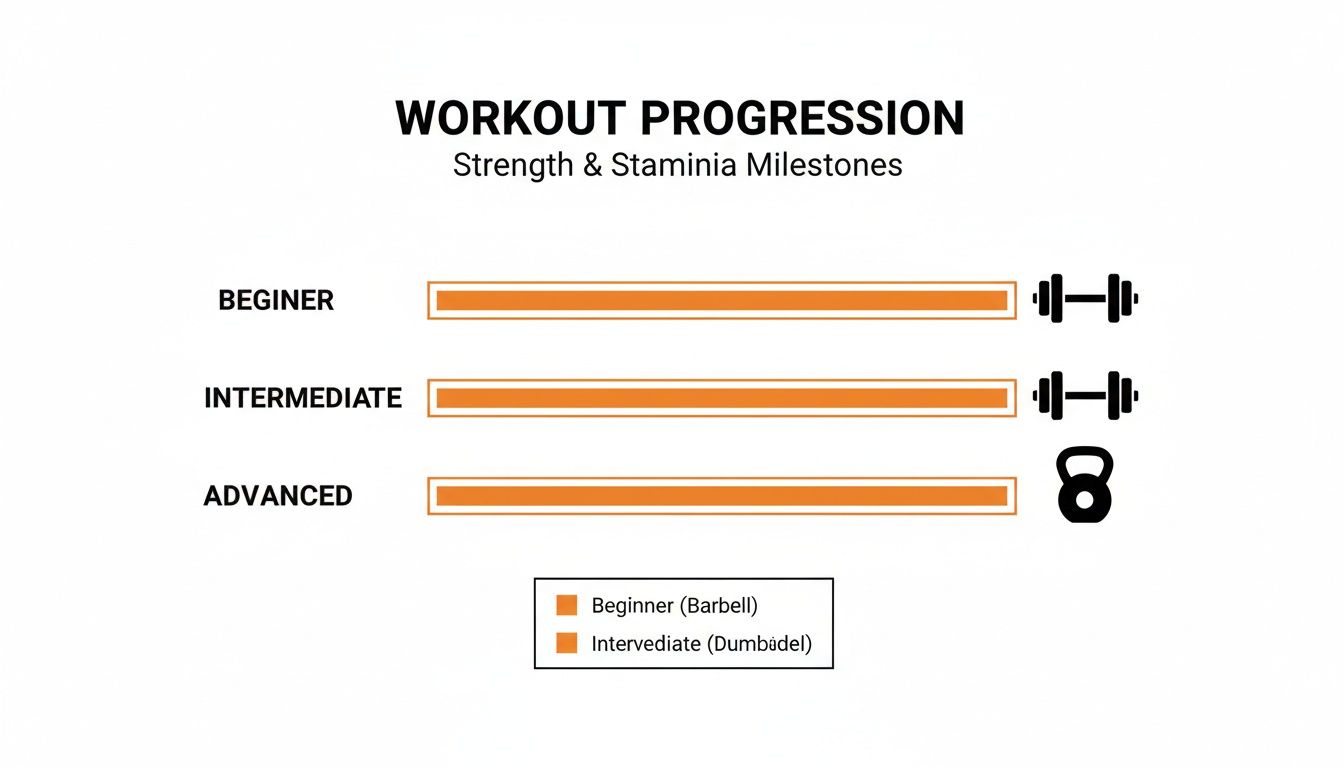
As the image shows, real progress is about more than just lifting heavier—it’s about getting better at more complex exercises and building a bigger work capacity.
The Underrated Power of Smart Recovery
Beyond the kitchen, your recovery habits are what truly separate good results from great ones. Your body can't properly use all that good food if it's not getting quality rest.
You don't get stronger during the workout. You get stronger when your body adapts to the stress of the workout. That adaptation is 100% dependent on recovery.
Here are the pillars of a solid recovery game plan:
- Own Your Sleep: Aim for a solid 7-9 hours of quality sleep each night. This is when your body releases growth hormone, a crucial player in muscle repair.
- Try Active Recovery: On your off days, don't just sit on the couch. Light activity like a long walk or some gentle stretching gets blood flowing to sore muscles, which helps flush out waste products and speed up repairs.
- Work on Mobility: Spend a few minutes on mobility drills for your lats, thoracic spine, and biceps. It doesn't just help you feel better; it improves your range of motion, which means better form and more muscle activation next time you train.
This is where you can see the direct link between your lifestyle and your training. For example, in the Built Workout app, you might see that your back’s recovery heatmap is still in the red an extra day after a night of bad sleep. That’s not a coincidence. It's hard data showing you exactly how your life outside the gym affects your readiness inside it. Use that info to push when you’re ready and pull back when your body tells you it needs a break.
Got Questions About Your Back and Biceps Workouts?
Even with the best plan laid out, you're going to have questions. Tweaking your routine and figuring out what works for you is part of the process. Let's tackle some of the most common hurdles I see people face when training their back and bis.
How Often Should I Be Training Back and Biceps?
For most lifters, hitting back and biceps once or twice a week is the money spot. If you're just starting out, stick to one solid session a week. This gives your body plenty of time to recover and adapt, which is absolutely crucial for building that initial foundation of strength and muscle.
Once you’ve been training consistently for a while, you can introduce a second day to spur new growth. But—and this is a big but—you have to listen to your body. If you're constantly sore, your lifts are stalling out, or you're just dreading your workouts, those are all red flags. It likely means you need more rest, not more volume.
This is where having some objective data can be a lifesaver. When you track your recovery in an app, you can actually see if your muscles are primed for another beating or if you’re better off taking another day off. It takes the guesswork out of the equation.
Free Weights vs. Machines: Which Is Better?
Honestly, you need both. A smart routine uses a mix of free weights and machines to get the best of both worlds.
Barbells and dumbbells are the undisputed champions for building raw, functional strength. They force all those tiny stabilizer muscles to fire up, building a rock-solid foundation that you just can't replicate on a machine. Think of heavy rows and pull-ups as the bedrock of your training.
Machines, however, are brilliant for isolation. They let you put a specific muscle under constant tension and are a much safer way to push to failure, especially when you’re already gassed from your big compound lifts. A classic, proven approach is to kick off your workout with heavy free-weight movements and then finish off with machines or cables to chase a pump and add that extra volume safely.
Why Can't I Feel My Back Muscles Working?
Ah, the classic mind-muscle connection problem. Don't worry, nearly everyone struggles with this at some point. The fix usually involves swallowing your pride, dropping the weight significantly, and slowing everything way down.
Your new goal is to feel the target muscle doing the work on every single rep. Instead of just yanking the weight, try to think about pulling with your elbows. A deliberate one-second pause at the peak contraction—where you squeeze the muscle as hard as you can—can be a complete game-changer. I also recommend adding some simple activation drills like Band Pull-Aparts into your warm-up to "wake up" your lats and rhomboids before you even touch a weight.
Is It Okay to Swap Out Exercises?
Absolutely. In fact, you should. The best routine is the one you can do consistently and without pain. If an exercise feels off, causes joint pain, or you just don't have the equipment for it, swap it out.
The trick is to make a smart substitution. You want to replace an exercise with another that targets the same muscles in a similar way.
- Can't do Pull-Ups? The Lat Pulldown is the perfect stand-in.
- Barbell Rows bugging your lower back? A Chest-Supported Dumbbell Row takes all the stress off your spine.
- No access to a cable machine? Grab a pair of dumbbells for your curls instead.
Just keep the main movement pattern the same. Replace a vertical pull with another vertical pull, and a horizontal row with another horizontal row. This keeps your routine balanced and ensures you’re still hitting everything you need to.
Ready to stop guessing and start building? With Built Workout, you can track every lift, visualize your muscle recovery with heatmaps, and get AI-powered coaching to ensure you're always progressing. Download the app and train smarter today.