More than just looking good, building strong glutes is the key to unlocking functional strength, boosting athletic power, and protecting your body from injury. It all comes down to a smart combination of targeted exercises, consistent progressive overload, and the right fuel.
Your Glutes Are Your Body’s Powerhouse
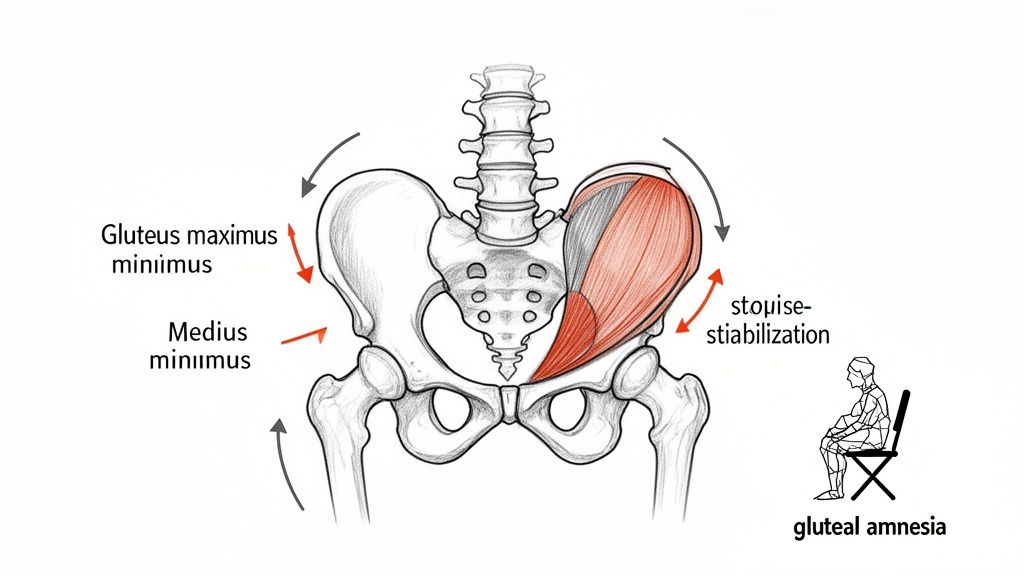
Most people think of the glutes as one big muscle, but that's a common mistake. They're actually a sophisticated system of three distinct muscles. Each one has a critical job in how you move, stay stable, and generate power. Getting to know this trio is the first real step toward building them effectively.
Meet the Team: Your Three Glute Muscles
Your gluteal complex is a team of three, and they work together to control just about every move your lower body makes. Let’s do a quick breakdown of the key players:
- Gluteus Maximus: This is the big one—the largest muscle in your entire body. It's the primary mover you see and feel, responsible for powerful hip extension. Think standing up from a deep squat, jumping high, or breaking into a sprint.
- Gluteus Medius: Tucked away on the side of your hip, this muscle is your stability champion. It’s what keeps your pelvis level when you walk or run and is key for moving your leg out to the side.
- Gluteus Minimus: As the smallest of the three, the gluteus minimus sits underneath the medius. It quietly assists with hip stability and helps rotate your thigh.
These three muscles coordinate to stabilize your pelvis, support your spine, and produce explosive force. When your glutes are strong, your entire body just works better.
How Modern Life Works Against Your Glutes
Unfortunately, our modern, chair-bound lifestyles are the natural enemy of strong glutes. Sitting for long stretches can lead to what some trainers call "gluteal amnesia," where your glutes essentially forget how to activate properly.
Your body is a master of compensation. When the glutes don't fire, other muscles—like your lower back and hamstrings—are forced to pick up the slack. This is a fast track to dysfunction. In fact, weak glutes are a major factor in a staggering 70% of lower back pain cases tied to prolonged sitting.
Training your glutes isn't just about building muscle; it's a direct fix for these modern-day problems. It improves your posture, stabilizes your knees, and takes a massive strain off your spine. This focus on core and glute strength is a cornerstone of performance training and injury prevention, a trend that experts see continuing through 2026. You can dive deeper into these functional fitness trends on ResearchAndMarkets.com.
Key Takeaway: Strong glutes aren't just for show. They're the engine for athletic movement, the anchor for good posture, and your best defense against chronic lower back and knee pain.
This guide will give you a complete system to wake up your glutes and reverse the effects of inactivity. We'll cover everything from smart exercise selection and programming to the nutrition and recovery that make it all happen. Once you understand the "why" behind glute training, you'll be much better equipped to build lasting strength and crush your goals.
The Essential Exercises for Glute Development
Alright, you know the anatomy. Now it’s time for the fun part: putting that knowledge into practice where real growth actually happens. Your journey to stronger, more developed glutes is all about a smart selection of exercises that hit the gluteus maximus, medius, and minimus from every possible angle.
We can break these movements down into two main camps: the heavy-hitting compound lifts and the more targeted isolation exercises.
Think of compound lifts as the foundation of your house. They're the big, multi-joint movements that recruit tons of muscle, letting you move serious weight and create the main stimulus for overall size and strength. For building a powerful backside, these are completely non-negotiable.
Isolation exercises, on the other hand, are the finishing touches. They let you zero in on specific parts of the glutes, helping to sculpt a well-rounded shape, wake up sleepy muscles, and strengthen the smaller stabilizers that the big lifts might not hit as hard. A truly effective program needs both.
The Powerhouse Compound Lifts
These three movements are the holy trinity of glute building. If you want to add size and strength fast, your first priority should be mastering their form.
Barbell Hip Thrust
If one exercise has become synonymous with building great glutes, this is it. The hip thrust allows you to achieve maximal hip extension under a heavy load, putting direct, consistent tension on the gluteus maximus through its entire range of motion.
- How to do it: Sit on the floor with your upper back pressed firmly against a stable bench. Roll a padded barbell across your hips. Plant your feet flat on the floor, about shoulder-width apart, with your knees bent.
- The movement: Drive hard through your heels, lifting your hips toward the ceiling until your body forms a straight line from your shoulders to your knees. Your shins should be vertical at the top. Squeeze your glutes like you’re trying to crack a walnut between them and pause for a beat.
- The return: Lower the weight back down with control. Don’t just let your hips drop.
The biggest mistake I see here is people arching their lower back to lift more weight. Don't do it. Instead, focus on a slight posterior pelvic tilt (think about tucking your tailbone under) to keep all that glorious tension right on your glutes.
Romanian Deadlift (RDL)
The RDL is a pure hip hinge movement that absolutely torches the hamstrings and glutes. It’s one of the best for developing the "glute-ham tie-in" (that little shelf where your glutes meet your hamstrings) and building serious eccentric strength as you control the weight on the way down.
- How to do it: Stand with your feet about hip-width apart, holding a barbell or dumbbells right in front of your thighs. Keep a soft bend in your knees—they should be unlocked, not locked out.
- The movement: Start by pushing your butt straight back, as if you’re trying to close a car door with it. Keep your back completely flat and let the weight trace a path down your shins. Lower it until you feel a deep, intense stretch in your hamstrings.
- The return: Drive your hips forward with power and squeeze your glutes at the top to return to a standing position. Think of it as a horizontal push, not a vertical lift. Your back isn't doing the work; your hips are.
Squat Variations
While many people think of squats as a quad-dominant lift—and they are—certain tweaks can shift the focus significantly to the glutes. The key is getting deep and using the right form. A Sumo Squat, for example, uses a much wider stance with the feet turned out, which brings the glute medius and adductors into the party in a big way.
But squats are just one piece of the puzzle. Relying on them alone won’t build well-rounded glutes and often leaves other crucial muscles underdeveloped. To see how these lifts fit into a complete lower-body day, check out our full guide to build leg muscle.
Here's a quick look at the top glute-building exercises and what makes each one so effective.
Top Glute-Building Exercises
| Exercise | Type | Primary Glute Target | Key Benefit |
|---|---|---|---|
| Barbell Hip Thrust | Compound | Gluteus Maximus | Allows for maximum load and peak contraction at the top of the movement. |
| Romanian Deadlift | Compound | Gluteus Maximus, Hamstrings | Excellent for building strength in a stretched position (eccentric overload). |
| Sumo Squat | Compound | Gluteus Maximus, Gluteus Medius | The wide stance increases activation of the side glutes and inner thighs. |
These core lifts are your bread and butter for building a strong foundation.
Targeted Isolation Exercises
Once you’ve put in the heavy work with your compound lifts, it’s time for some precision targeting. Isolation moves are fantastic for finishing off the glutes at the end of a session, ensuring no muscle fiber gets left behind.
Glute Kickbacks
This movement hits the gluteus maximus directly through pure hip extension, taking other large muscles out of the equation. It's the perfect exercise for really feeling that mind-muscle connection.
- How to do it: Use a cable machine with an ankle strap attached. Face the machine and strap it to one ankle, then take a small step back to create tension.
- The movement: Keep your core braced and your standing leg slightly bent. Squeeze your glute to kick the working leg straight back behind you, focusing on moving only from the hip.
- The return: Pause for a second at the top, then slowly and with control, bring your leg back to the starting position. No swinging!
Hip Abduction
So many people skip hip abduction, but it’s critical for strengthening the gluteus medius and minimus. These are the muscles on the side of your hips that create that fuller, rounder "shelf" look and are vital for pelvic stability.
- How to do it: You can do this on a dedicated machine, standing with a cable, or lying on your side with a resistance band.
- The movement: The goal is simple: move your leg away from the center of your body. On a machine, you’ll press your legs outward. With a band, you can do clamshells (driving your top knee up while keeping feet together) or lateral band walks.
With these isolation exercises, the mind-muscle connection is everything. The weight will be lighter, so you have to be intentional and focus on squeezing the target muscle with every single rep. Logging these workouts in the Built app helps you track more than just weight and reps—it lets you note the quality of your sets, ensuring you're making the kind of progress that truly matters.
Putting It All Together: Your Glute Training Blueprint
Knowing which exercises to do is half the battle. The other half—the part that actually delivers results—is weaving those exercises into a smart, consistent program. A list of movements isn't a plan. Let's build you a real plan.
The absolute cornerstone of muscle growth, not just for glutes but for everything, is progressive overload. It’s the simple, non-negotiable rule that you must consistently challenge your muscles to do more than they’re used to.
This doesn't always mean just piling on more plates, though that's a great way to do it. Progressive overload can look like:
- More Weight: The most obvious one. Going from 135 lbs to 140 lbs on your hip thrust.
- More Reps: Hitting 10 reps with a weight you could only do 8 with last week.
- More Sets: Adding an extra set to increase your total workload for the day.
- Better Form: This is an underrated one. Executing each rep with deliberate control and feeling the target muscle work is a form of progression.
- Less Rest: Shaving 15-30 seconds off your rest periods makes the same weight and reps more challenging.
This is where logging your workouts is a game-changer. The Built app essentially automates this. By tracking every set, rep, and pound you lift, its AI can give you a nudge when it’s time to add 5 lbs to your RDLs or push for one more rep, making sure you never get stuck in a rut.
How Often and How Much Should You Train?
One of the first questions I always get is, "How many days a week should I train glutes?" It's a great question because the answer isn't "every day." Overtraining is just as bad as undertraining.
For most people, hitting your glutes 2-3 times per week is the sweet spot. This gives them enough stimulus to grow and just enough time—at least 48 hours—to recover and come back stronger for the next session.
Within those sessions, what really moves the needle is your total weekly volume—basically, the total number of hard sets you do. Here’s a good rule of thumb based on your experience level:
- Beginner (less than a year of serious lifting): Aim for 10-12 total sets for glutes per week.
- Intermediate (1-3 years): You can handle a bit more, so shoot for 12-16 total sets per week.
- Advanced (3+ years): Your body is well-adapted, so you'll need 16-20+ total sets to keep seeing progress.
You'd just split that volume across your workout days. For example, a beginner doing two glute days might do 6 sets on Monday and another 6 on Thursday. If you want to dive deeper into this, we have a whole guide on training frequency for hypertrophy.
A well-structured program is what separates exercising from training. Exercising is just activity. Training is activity with a specific goal and a plan to get there. We're here to train.
Structuring Your Weekly Glute Workouts
Okay, let's make this tangible. A great glute workout isn't just a random collection of exercises. It's a strategic mix of heavy compound lifts to build the foundation and targeted isolation work to shape and sculpt.
Think of it like this:
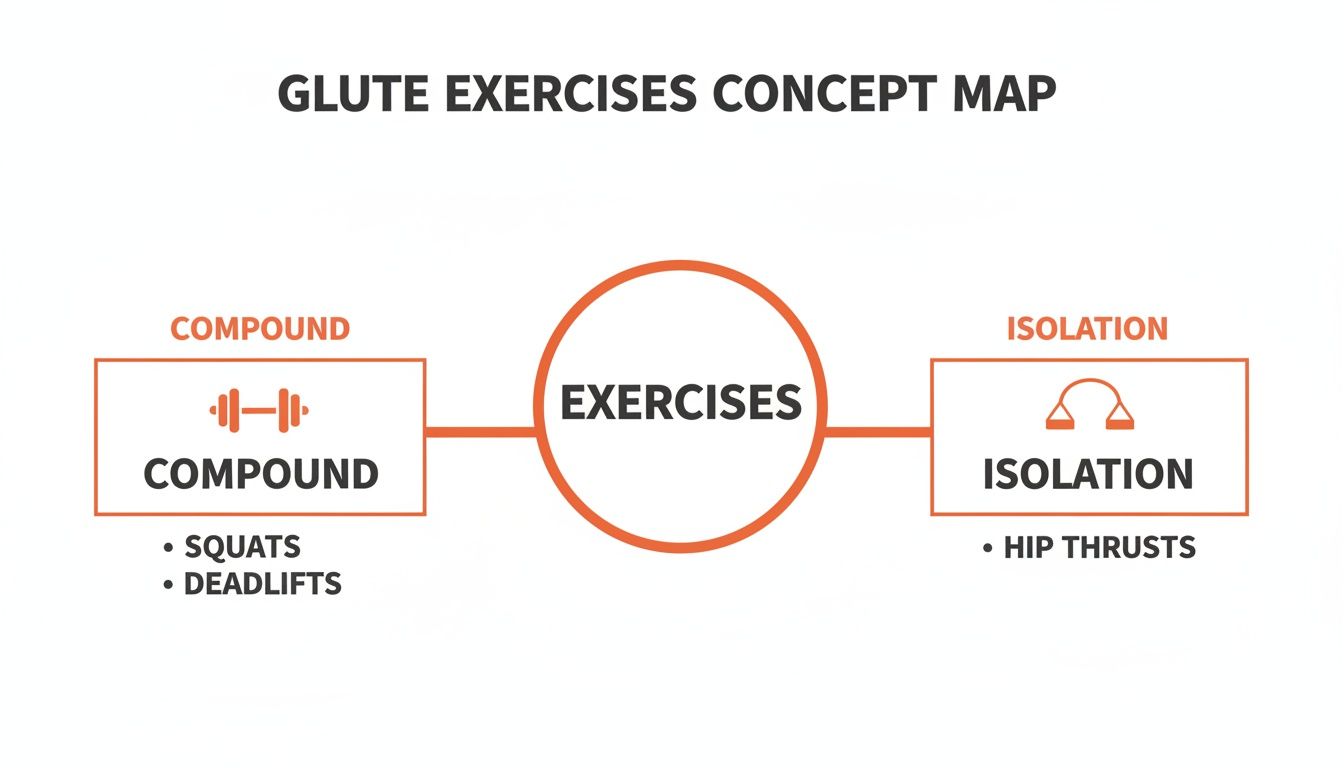
You want to lead with the big, heavy hitters and finish with the pump-focused isolation moves.
Here’s what that could look like for a beginner training glutes twice a week.
Sample Beginner Split (2 Days/Week)
- Day 1: Lower Body Strength
- Barbell Hip Thrusts: 3 sets of 8-12 reps
- Sumo Squats: 3 sets of 10-15 reps
- Glute Kickbacks: 2 sets of 15-20 reps per side
- Day 2: Full Body w/ Glute Focus
- Romanian Deadlifts: 3 sets of 8-12 reps
- Glute Bridges: 2 sets of 15-20 reps
- Banded Hip Abductions: 2 sets of 20-25 reps
This simple split clocks in at 15 total sets, which is right in the money for a beginner. It's balanced and gives you plenty of time to recover.
When you stick to a solid program, the results follow. It's not uncommon to see a 10-20% increase in glute size in just 8-12 weeks of consistent, progressive training. This is where smart tech like Built’s AI coaching shines—it prompts you to lift in that effective 70-85% one-rep max range and helps you read your recovery data, taking the guesswork out of growth.
Remember, any program is just a starting point. Think of it as a living document. Pay attention to how your body feels, track your progress, and don't be afraid to make small adjustments. That's how you build a powerful physique that's truly your own.
Fueling and Recovering for Optimal Muscle Growth
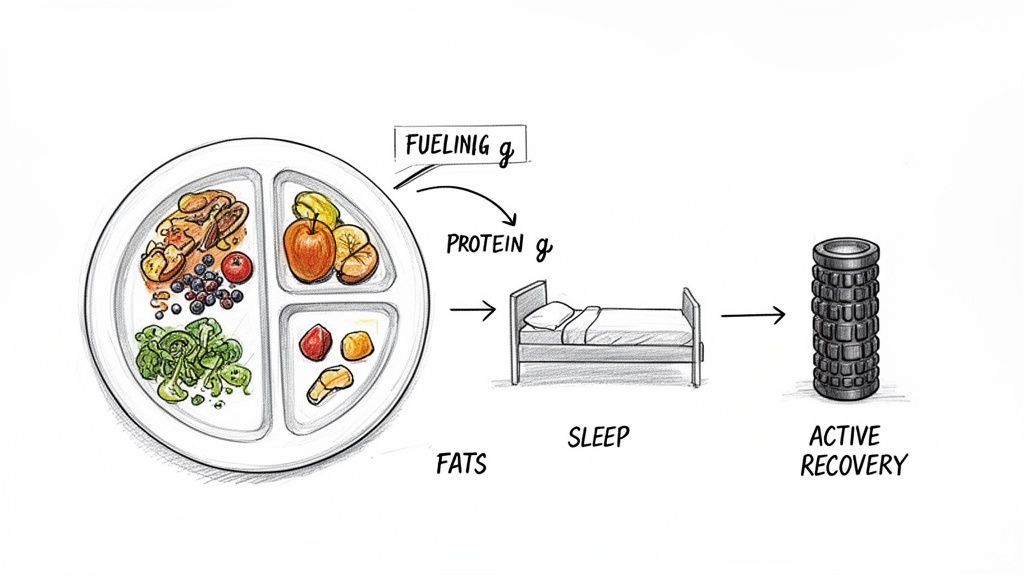
Crushing your workouts with perfect form and progressive overload is only one side of the muscle-building coin. The other, equally important side is what you do during the 23 hours you’re not in the gym. Without a smart approach to nutrition and recovery, even the best training program will fall flat.
Think of it this way: your workouts are the stimulus that signals your body to build muscle, but the actual growth happens when you rest and provide your body with the right building blocks. Getting this right is how you turn all that hard work into visible, lasting results.
Dialing In Your Glute-Building Diet
You can't build a house without bricks, and you can't build bigger glutes without the right nutrients. It doesn't have to be complicated, but it does need to be intentional. Let's break down the big three macronutrients that matter most for muscle growth.
Protein: The Building Block
Protein is the undisputed king of muscle repair. After a tough glute workout, your muscle fibers are broken down. Dietary protein provides the amino acids needed to patch them up and rebuild them bigger and stronger.
A solid target for active people looking to build muscle is 0.7–1.0 grams of protein per pound of body weight each day. So, if you weigh 150 pounds, that’s between 105 and 150 grams daily, ideally spread across several meals.
Pro Tip: Don’t just hit your total protein number for the day. Spacing your intake out—aiming for 20-40 grams per meal—can help maximize muscle protein synthesis, the actual biological process of building new muscle.
Carbohydrates: The Fuel Source
Carbs often get a bad rap, but for high-intensity training, they are your primary energy source. They replenish the muscle glycogen stores that get torched during your glute workouts. Well-timed carbs can be the difference between a weak final set and a strong, powerful finish.
Focus on complex carbohydrates for sustained energy:
- Oats
- Brown rice
- Sweet potatoes
- Whole-wheat pasta
Eating carbs after your workout doesn't just refill your energy tank; it also helps shuttle protein into your muscle cells more effectively, kickstarting the recovery process.
Fats: The Hormonal Support
Healthy fats are non-negotiable. They're essential for overall health and the production of hormones, like testosterone, that play a role in muscle growth. Sources like avocados, nuts, seeds, and olive oil also support joint health and help manage inflammation—both critical for staying consistent with your training long-term.
The Science of Smart Recovery
Recovery isn't just about taking a day off. It's an active process where your body adapts to the stress of your workouts. Ignoring recovery is the fastest way to hit a plateau or, even worse, get injured.
Sleep Is Non-Negotiable
This is where the magic happens. During deep sleep, your body releases Human Growth Hormone (HGH), a key player in repairing damaged muscle tissue. Skimping on sleep completely short-circuits this process. Most research points to 7-9 hours of quality sleep per night as the gold standard for anyone serious about building muscle.
Active Recovery and Mobility
On your rest days, you don't have to be a couch potato. In fact, you shouldn't be. Active recovery can significantly improve blood flow, reduce muscle soreness, and get you ready for your next big session.
- Foam Rolling: Spend 10-15 minutes rolling out your glutes, hamstrings, and quads to release muscle tightness.
- Stretching: Gentle static stretching can improve flexibility and get rid of that stiff, locked-up feeling.
- Light Cardio: A 20-30 minute walk or an easy bike ride boosts circulation without piling on more training stress.
This is where the recovery visualization in the Built app really shines. The color-coded muscle map shows you exactly which parts of your glutes are fatigued, so you can target your foam rolling and stretching with laser precision. It helps ensure you’re fully recovered and ready to go for your next workout.
Advanced Techniques for Breaking Through Plateaus
Sooner or later, every single one of us hits a wall. The weights that once felt like a battle are now just a warm-up, but adding even five more pounds feels like an impossible jump. This is a training plateau. While it’s definitely frustrating, it’s also a sign that your body has adapted to the work you've been doing. To keep growing, you need to give it a new reason to change.
Once you’ve nailed the fundamentals of building your glutes, it's time to get a little more creative. These advanced techniques are all about introducing new challenges to shock your muscles into growth, forcing them to get stronger.
Smart Ways to Increase Training Intensity
If piling on more weight isn't working, you can still crank up the intensity by changing other variables in your workout. These methods create a ton of metabolic stress on the muscle, which is a huge driver for growth.
- Pause Reps: This one is simple but absolutely brutal. At the toughest part of a lift—think the bottom of a squat or the peak contraction of a hip thrust—just hold still for a solid 2-3 second count before finishing the rep. It completely kills any momentum and makes your glutes work overtime.
- Drop Sets: This is my go-to finisher for just about any exercise. Once you've hit failure on your last heavy set, immediately strip 20-30% of the weight off and pump out as many more reps as you can. It pushes your glutes way past their normal quitting time.
- Accommodating Resistance: Try adding resistance bands or chains to your barbell exercises. As you lift, the tension increases, making the top of the movement (where you're strongest) much harder. This is a fantastic way to match the glutes' natural strength curve.
Here's a pro tip: Don't just throw all these techniques into every single workout. That's a recipe for burnout. Instead, pick one and apply it to one or two exercises at the end of your session for a few weeks. It’s enough to spark new progress without wrecking your recovery.
Troubleshooting Common Progress Killers
Sometimes a plateau isn't about your program being too easy; it's about something else holding you back. Before you tear up your entire plan, take an honest look at a few common culprits that can quietly sabotage your gains.
A major one is form breakdown when you're tired. Your first couple of reps might be textbook-perfect, but as fatigue sets in, your body starts to cheat. You might notice your lower back taking over on RDLs or your quads doing all the work at the end of a squat set.
Inconsistency is another huge roadblock. Skipping workouts, especially your heavy compound days, completely disrupts the progressive overload cycle. Remember, consistency is the engine of all progress. A "good enough" workout you do every week is infinitely better than a "perfect" one you only do once a month. To see how to structure your week for consistency, check out our guide on the best 5-day workout split.
The Strategic Deload Week
The idea of taking it easy for a week can feel totally wrong when you’re chasing big goals, but a deload is one of the most powerful tools you have for long-term progress. It's simply a planned week of lighter training to let your body and nervous system fully recover.
Here’s how a deload week usually looks:
- Cut Your Volume: Slash your total number of sets in half. If you normally do 4 sets of hip thrusts, just do 2.
- Lower the Intensity: Drop the weight on everything to about 50-60% of what you’d normally lift.
- Focus on Form: Use the lighter weight as a chance to really dial in your technique and that all-important mind-muscle connection.
Think of it as taking one step back to take two giant leaps forward. A well-timed deload every 4-8 weeks can wipe out accumulated fatigue, heal nagging aches, and get your body ready to smash through old plateaus when you return to heavy training.
The fitness world has definitely taken notice of the demand for better glute training. The market for specialized gear like the Glute Hamstring Developer hit USD 500 million in 2023. We're also seeing more gyms add dedicated glute zones, which not only attracts members but also helps reduce injury by promoting core stability. This trend fits right in with the 84% spike in Pilates bookings, which is especially popular with the 40+ crowd for promoting longevity. You can find more insights on this growing market over at ArchiveMarketResearch.com.
Got Questions About Glute Training? We’ve Got Answers.
It's one thing to have a plan, but it's another to feel confident putting it into practice. Questions are bound to pop up. Let's tackle some of the most common ones I hear, so you can stop second-guessing and start training with total focus.
"How Long Until I Actually See Results?"
This is always the first question, and for good reason! While everyone's body is different, here’s a realistic timeline based on what I’ve seen time and time again. You'll likely feel stronger within just a few weeks. Those initial gains are mostly your nervous system getting smarter and more efficient at recruiting your glute muscles.
As for visible growth? Be patient. Most people start noticing real, visible changes in shape and size around the 8-12 week mark, assuming they're training consistently and eating enough. The best sign you're on the right path is that your numbers in the gym are going up. If you're adding weight to your hip thrust, growth is happening.
"Can I Build a Great Butt at Home?"
You absolutely can. Your glutes respond to tension, not to a specific location or piece of fancy equipment. The fundamental rule of muscle growth—progressive overload—is just as achievable in your living room as it is in a commercial gym.
You just have to get a little creative to keep things challenging.
- Loop a resistance band around your knees for bridges and squats.
- Slow everything down. Try a 4-second negative (the lowering part) on your reps.
- Add more reps or an extra set to your workouts over time.
Don't underestimate what you can do with movements like single-leg glute bridges and Bulgarian split squats. They are humbling.
"How Often Should I Be Hitting Glutes?"
For most people, aiming for 2-3 dedicated glute sessions per week is the money spot. This gives your muscles enough of a kick-start to grow without sacrificing the recovery they desperately need.
Remember, you don't build muscle in the gym; you build it when you rest. Two focused, high-intensity workouts will always beat four or five half-hearted, sloppy sessions. Quality over quantity, every single time.
"I'm Worried Lifting Heavy Will Make Me Bulky."
This is probably the biggest myth in fitness, and it holds so many people back from seeing the results they truly want. Let me be clear: getting "bulky" is incredibly difficult. It takes years of intense, dedicated training combined with a serious, consistent calorie surplus. It does not happen by accident.
For 99% of people, lifting heavy won't make you bulky. It will build dense, strong, and shapely muscle that creates a powerful, athletic look. Heavy lifting is the fastest way to get that toned, defined physique you're probably picturing. So please, don't be afraid to push yourself and get strong.
Stop guessing and start building. With Built Workout, you can track every lift, visualize your muscle recovery, and get AI-driven coaching to ensure you’re always making progress. Download the app and start training smarter today at https://www.builtworkout.com.