If you're serious about building bigger legs, you need a plan. It’s not just about squatting heavy and hoping for the best. Real, proportional growth comes from a smart combination of heavy compound lifts, targeted isolation work, and a relentless focus on progressive overload. You also can't forget nutrition and recovery—they're just as crucial as the work you do in the gym.
This isn’t about random workouts. It’s about following a proven blueprint to strategically build your quadriceps, hamstrings, glutes, and calves.
Your Blueprint for Powerful Legs
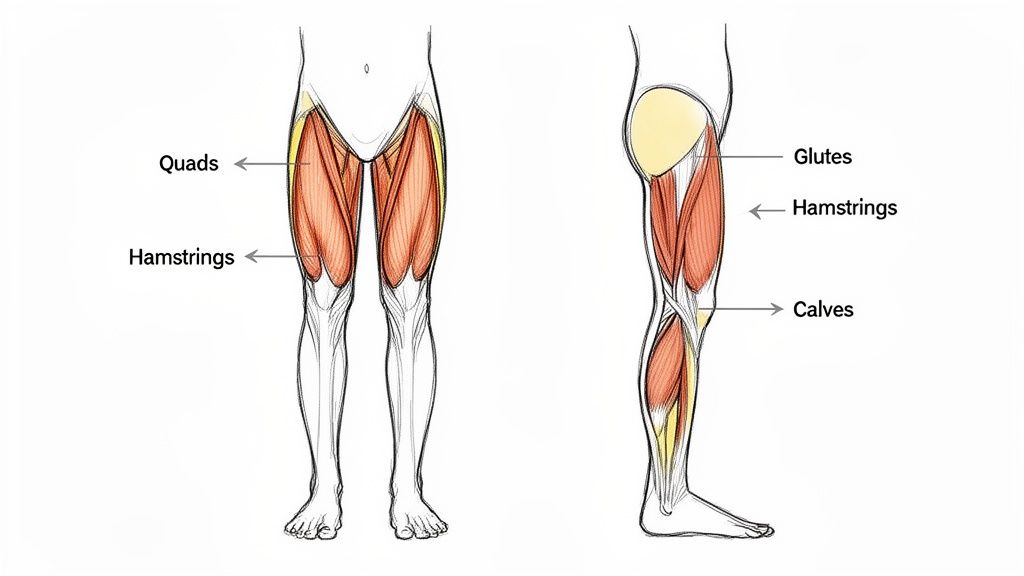
Let’s be honest: building a powerful, well-defined lower body is about more than just surviving a brutal leg day once a week. It’s a process that demands a solid grasp of anatomy, training principles, and recovery. It helps to think of your legs not as one big muscle, but as a complex system where each part has a specific job.
This guide is designed to give you that complete blueprint, moving past the generic "squat more" advice. We're going to break down the science into practical steps, showing you exactly how to build a routine that gets you measurable results. It's time to stop guessing and start training with intention.
The Major Leg Muscle Groups
To build your legs efficiently, you can't just focus on one or two favorite exercises. A lopsided approach doesn't just look strange; it can set you up for injury down the road. A truly effective program hits all the major players:
- Quadriceps: These are the four big muscles on the front of your thigh responsible for straightening your knee. They do most of the work in movements like squats and leg presses.
- Hamstrings: On the back of your thigh, this group of three muscles bends the knee and extends the hip. They're absolutely critical for deadlifts, sprints, and overall power.
- Glutes: Your glutes (maximus, medius, and minimus) are the engine of your lower body. They drive hip extension and keep your pelvis stable and strong.
- Calves: The gastrocnemius and soleus muscles in your lower leg might seem small, but they’re key for ankle stability and providing that explosive pop for jumping.
A smart program gives each of these groups the attention they deserve. It's all too common to see people neglect their hamstrings, which is a huge mistake that will eventually stall both strength and size gains.
A classic mistake is "quad dominance." This happens when lifters get so focused on squats that their hamstrings and glutes fall behind. It doesn't just throw off the aesthetic balance of your legs—it can seriously compromise knee stability.
Core Principles for Growth
As we go, we'll keep coming back to the fundamental principles that fuel all muscle growth. You simply can't ignore these if you're serious about your goals. We’ll cover how to apply progressive overload consistently, forcing your muscles to adapt and get bigger and stronger every week. We'll also get into how you structure your training week, a topic we explore more deeply in our guide to the 5 day workout split.
Beyond the basics, we'll show you how to use modern tools to train smarter, not just harder. The Built Workout app can act like a digital coach in your pocket, turning these complex training principles into simple, clear guidance. By tracking your performance and showing you how your muscles are recovering, it helps you build leg muscle with precision and finally break the frustrating cycle of trial and error.
The Essential Exercises for Maximum Leg Growth
Building a powerful set of legs isn't about finding the “perfect” secret exercise. It’s about committing to the handful of movements that have proven, time and again, to deliver results. The most effective leg workouts are always built on a solid foundation of heavy, multi-joint compound lifts, polished off with targeted accessory work to ensure no muscle gets left behind.
Forget the flashy, unstable exercises you see on social media. True progress comes from mastering the basics. Let’s break down the non-negotiable lifts that should form the core of your training.
Foundational Compound Lifts
Compound lifts are your bread and butter. These are the multi-joint movements that recruit a massive amount of muscle, trigger a powerful growth response, and let you move the most weight. You should always tackle these first in your workout, right after your warm-up, when your energy and focus are at their peak.
- Barbell Squats: There's a reason they call it the king of leg exercises. A proper squat is a full-body effort that hammers your quads, glutes, and adductors, while your hamstrings and core fire like crazy to keep you stable. The key is controlling the descent, keeping your chest up, and actively driving your knees out so they don't collapse inward—a common and dangerous fault known as knee valgus.
- Deadlifts (and Variations): The deadlift is simply unparalleled for building raw power through your entire posterior chain—glutes, hamstrings, and lower back. If you really want to zero in on your hamstrings, the Romanian Deadlift (RDL) is unbeatable. It’s all about the hip hinge, creating an intense stretch and powerful contraction right where you need it.
- Lunges: Whether you prefer walking lunges with dumbbells or stationary split squats in a rack, this single-leg work is incredible for ironing out strength imbalances between your legs. They also introduce a stability challenge that hits your quads and glutes from a completely different angle than a two-legged squat.
Your first priority must be mastering the form on these big lifts. Going heavy with sloppy technique is a fast track to injury, not growth. Film yourself from the side or ask a knowledgeable lifter for a form check. Nail the mechanics before you start chasing big numbers.
Targeted Accessory Movements
If compound lifts are the heavy-duty tools that build the frame, accessory exercises are what you use to add the finishing touches. These isolation movements let you focus all your effort on a specific muscle, which is perfect for bringing up a weak point or adding more volume to a muscle you want to grow.
You'll typically do these after your main compound work, usually for higher reps. Think of them as the detail work that creates a complete, well-rounded physique.
Here's a quick breakdown of how these two types of lifts fit together in a smart leg day program.
Compound vs Accessory Lifts for Leg Development
| Lift Type | Primary Goal | Key Muscles Targeted | Optimal Rep Range (for strength/hypertrophy) |
|---|---|---|---|
| Compound | Build overall strength and mass | Quads, Hamstrings, Glutes, Adductors, Core | 4-8 Reps |
| Accessory | Isolate and fatigue specific muscles | Quads, Hamstrings, Glutes, or Calves | 8-15+ Reps |
This one-two punch of heavy, low-rep compound work followed by lighter, high-rep accessory work is a classic and highly effective strategy. It attacks muscle growth from multiple angles by targeting different types of muscle fibers and growth pathways.
Key Accessories for a Complete Routine
Once you’ve put in the hard work on your squats or RDLs, it’s time to isolate individual muscles to make sure your development is balanced and complete.
- Leg Press: This is a fantastic tool for loading up your quads and glutes with serious weight without the stability demands or lower back stress of a barbell squat. You can even shift the focus by changing your foot position: place your feet higher on the platform to hit the glutes and hamstrings more, or lower to emphasize the quads.
- Hamstring Curls: An absolute must for directly isolating the hamstrings. Both seated and lying versions are great for building the "bicep" of the leg, which most people neglect in favor of their quads. The key here is a hard, deliberate squeeze at the peak of every single rep.
- Leg Extensions: As a pure quad isolation movement, nothing beats the leg extension for getting a massive pump at the end of a workout. Use a smooth, controlled tempo—no kicking—and focus on squeezing your quads as hard as you can at the top.
- Calf Raises: Don’t be the person who builds massive upper legs only to have them sitting on top of skinny calves. Standing calf raises will target the big, diamond-shaped gastrocnemius muscle, while seated raises hit the soleus muscle that lies underneath it. You need both for well-rounded lower legs.
The science backs this approach. We know that focusing on heavy lower-body training in the 1 to 6 repetition range can boost your one-rep max by an average of 17.4%. Other research confirms that hitting your lower body twice per week tends to be the sweet spot for strength gains. You can dive deeper into the data by reading the full research on strength adaptations. This all points to the same conclusion: a smart combination of heavy compounds and strategic programming is the most effective way to build serious leg muscle.
Smart Programming for Consistent Muscle Gain
Consistent growth in the gym never happens by accident. It's the direct result of a smart, structured plan that forces your muscles to adapt over time. Just showing up and going through the motions with the same old workout will land you squarely on a frustrating plateau.
The real engine driving all muscle gain is a principle called progressive overload.
Put simply, you have to give your muscles a reason to grow. When you challenge your legs with a stress they aren't used to, they have no choice but to respond by getting bigger and stronger to handle that new demand.
The Art of Progressive Overload
Most people hear "progressive overload" and just think "add more weight to the bar." While that's part of it, it's a pretty narrow view. True progressive overload is about systematically increasing the demands you place on your body in a variety of ways. The best programs mix these methods to keep your body guessing and growing.
- More Weight (Intensity): The classic. If you squatted 135 lbs for 8 reps last week, you might aim for 140 lbs for 8 reps this week. It's straightforward and effective.
- More Reps (Volume): Sticking with that 135 lbs, maybe this week you push for 9 or 10 reps instead of the 8 you did last time.
- More Sets (Volume): Did 3 sets of squats last workout? Doing 4 sets with the same weight and reps is a fantastic way to increase your total workload.
- Better Form (Technique): Sometimes progress isn't about numbers. It’s about doing the same weight for the same reps but with perfect control, a deeper range of motion, or a slower, more deliberate tempo. This increases time under tension and often stimulates more growth.
This is how you ensure every workout builds on the last, creating the non-stop stimulus needed to build leg muscle week after week.
Training for Hypertrophy The Right Way
For muscle growth—what we call hypertrophy—how you perform your sets is just as critical as which exercises you choose. It’s not just about heaving weight around; it’s about generating maximum muscular tension and metabolic stress. This means pushing your sets close to failure, but not always to failure.
Training to absolute failure, where you physically can't squeeze out another rep with good form, is a powerful tool. But it’s also incredibly taxing. A detailed analysis found that for building muscle, training within 0-5 reps short of failure gives you the best bang for your buck, maximizing growth while keeping injury risk low.
Key Takeaway: You don't need to grind out every single set until you can't move. Aim to finish most working sets with 1-3 quality reps left "in the tank." This sweet spot provides plenty of stimulus for growth without piling on so much fatigue that it wrecks your next workout.
This flow chart gives you a simple but powerful blueprint for structuring your leg day. You start with the big, demanding compound lifts and finish with more targeted accessory work to really drive growth.
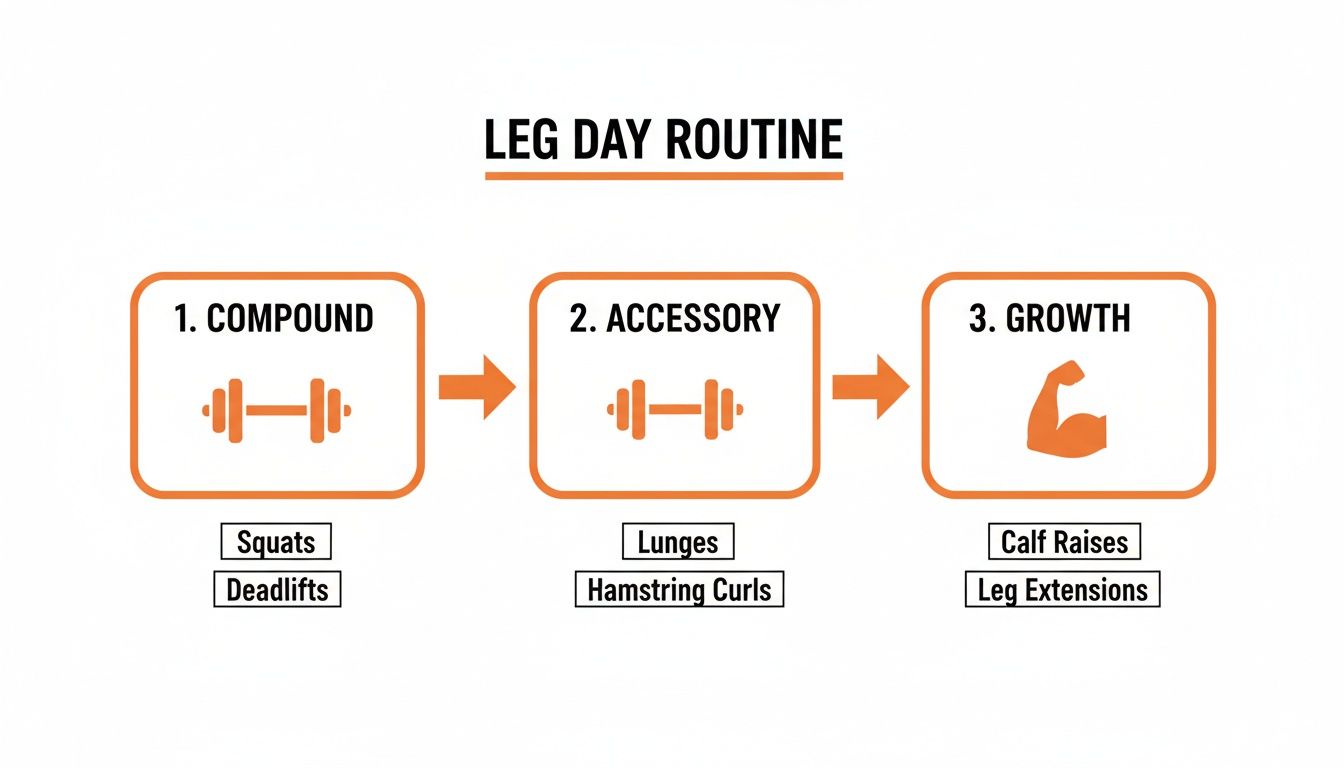
This structure is popular for a reason: it ensures you’re hitting your foundational movements when you're fresh and have the most energy, then you can isolate specific muscles to finish the job.
Sample Weekly Splits for Every Level
How often you train legs and what those workouts look like will change as you get more experienced. What works for a beginner would be completely inappropriate for an advanced lifter, and vice versa.
Beginner (Full-Body Focus, 2-3x per week)
At this stage, your main goal is to master the movements and build a solid foundation. Hitting your legs more frequently with lower volume in each session is the way to go.
- Workout A: Barbell Squats (3x8), Dumbbell Lunges (2x10 per leg), Leg Curls (2x12)
- Workout B: Romanian Deadlifts (3x10), Leg Press (3x10), Calf Raises (3x15)
Intermediate (Upper/Lower Split, 4x per week)
You can handle more volume now, so dedicated leg days become much more effective.
- Lower Body Day 1 (Quad Focus): Barbell Squats (4x6), Leg Press (3x10), Leg Extensions (3x12), Standing Calf Raises (4x12)
- Lower Body Day 2 (Hamstring/Glute Focus): Deadlifts (4x5), Hip Thrusts (3x10), Lying Leg Curls (3x12), Seated Calf Raises (4x15)
Advanced (Specialized Leg Day, 1-2x per week)
Here, the focus shifts to bringing up weak points and carefully managing recovery from high-intensity, high-volume sessions.
- Leg Day: Heavy Squats (5x5), Romanian Deadlifts (4x8), Bulgarian Split Squats (3x10 per leg), Leg Extensions (4x15), Hamstring Curls (4x12), Calf Raise Superset (4x10 standing/15 seated)
Figuring out the right training frequency is a huge piece of the puzzle. If you want to dive deeper, we break it all down in our guide on choosing the best training frequency for hypertrophy.
This is also where the Built Workout app shines. The AI Coach analyzes your logged performance, and when it sees you’re consistently hitting your targets, it will intelligently suggest adding weight or reps. It basically automates the principle of progressive overload, keeping you on the fast track to growth without the guesswork and risk of burnout.
Fueling Growth with Strategic Nutrition and Recovery
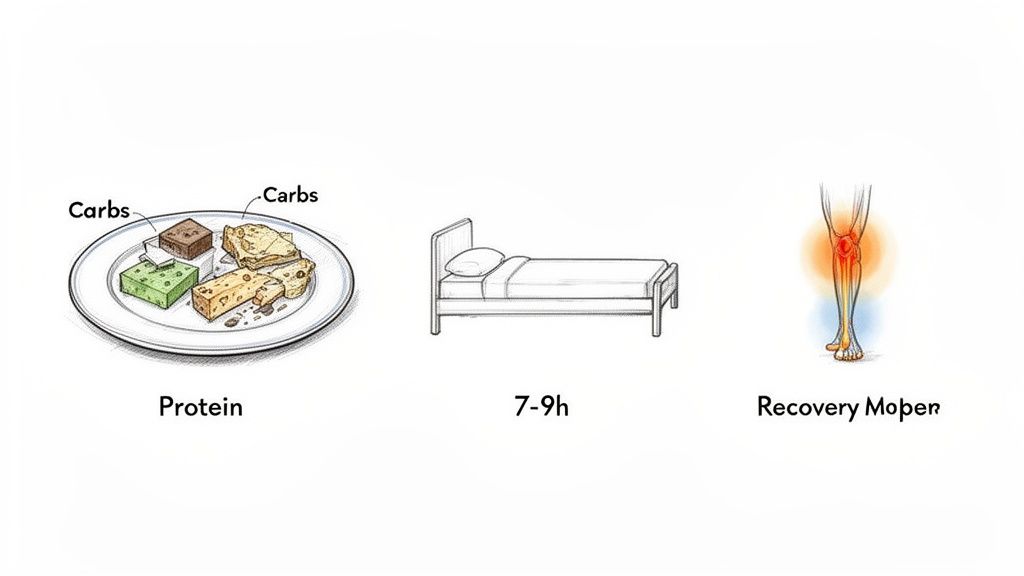
The intense, muscle-tearing work you do in the gym is only half the battle. Here’s the reality: your legs don’t actually get bigger during your workout. They grow in the hours and days that follow, but only if you give them the right raw materials and environment to do so.
Without a smart approach to nutrition and dedicated recovery, even the most brutal training sessions will fall flat. You’re just breaking down muscle without giving it what it needs to rebuild bigger and stronger. Think of your training as digging the foundation for a house—nutrition and recovery are the concrete and lumber you use to actually build it.
The Nutritional Pillars of Leg Growth
You can't build a brick wall without bricks, and you absolutely can't build leg muscle without protein. It's the essential building block for repairing the microscopic damage you create during training. A solid rule of thumb for anyone lifting seriously is to consume 1.6 to 2.2 grams of protein per kilogram of body weight every day.
For an 80kg (176lb) person, that’s about 128-176 grams of protein. Spreading this out over several meals keeps your muscles supplied with a steady stream of amino acids, which is exactly what they need for consistent repair.
But don't forget carbohydrates. Carbs are your body's high-octane fuel, replenishing the muscle glycogen you torched during those heavy squats and deadlifts. Getting enough carbs ensures you have the energy to perform at your peak and even helps shuttle protein into your muscle cells. They aren't the enemy; they're your allies.
Turning Recovery from a Guess to a Metric
For too long, recovery has been treated as a passive activity—something that just happens when you’re not training. But what if you could actually measure it? What if you knew for sure whether your quads were repaired and ready for another beating?
This is where you can stop guessing and start using objective data. The muscle recovery heatmaps inside the Built Workout app do just that, turning that vague feeling of "am I ready?" into a clear, visual metric.
- Red Zone: This shows high fatigue in a recently trained muscle group. It’s a loud and clear signal to either rest that area or focus on other body parts.
- Yellow Zone: The muscle is on the mend. Light activity or active recovery might be okay here, but another intense session is probably a bad idea.
- Green Zone: You're good to go. Your muscles are fully recovered and primed for another productive workout. This is your green light to hit it hard again.
Using this data lets you make smarter decisions. Instead of just hoping you're recovered, you can glance at the heatmap and know with certainty that your hamstrings need another day off while your quads are ready to roll.
The human body's capacity for muscle growth is incredible. Consider that the median total leg muscle volume of a 15-year-old is nearly five times larger than that of a 5-year-old. This massive expansion shows the natural, biological potential for skeletal muscle development when conditions are right. You can dive deeper into these developmental growth trajectories to appreciate the body's amazing ability to adapt and grow.
Actionable Recovery Strategies
Beyond tracking, your daily habits have a huge impact. Quality sleep is probably the most powerful recovery tool you have, period. During deep sleep, your body releases human growth hormone, which is absolutely critical for tissue repair. Aiming for 7-9 hours of quality sleep per night isn't a luxury; it's a non-negotiable for anyone serious about building muscle.
Active recovery can also be a game-changer. On your off days, don't just melt into the couch. Light activities like walking, stretching, or foam rolling boost blood flow to sore muscles. This helps flush out metabolic waste and deliver fresh, nutrient-rich blood to the recovering tissues, which can speed up the repair process and take the edge off soreness.
Putting It All Together with Built Workout
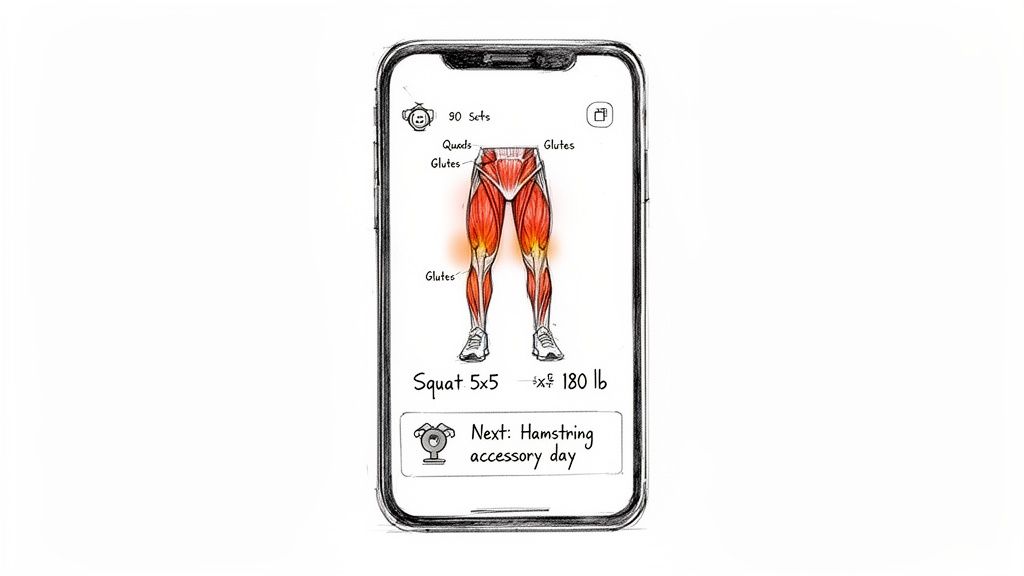
All this theory is great, but the real gains happen when you apply it. Let's walk through a real-world scenario to see how you can use objective data to build leg muscle more intelligently. This is where you graduate from just training hard to training smart.
Picture this: you've just finished a killer, high-volume squat session. You're wiped out, but how much stress did your muscles actually take on? Instead of just guessing, you pull out the Built Workout app and log what you did.
It's as simple as entering the details: 4 sets of Barbell Squats at 225 lbs, hitting reps of 8, 8, 7, and 6. You throw in your leg presses and extensions, too. The second you hit "save," the app starts crunching the numbers, turning that raw volume into clear, actionable recovery data.
From Feeling Sore to Seeing Data
This is where you leave guesswork behind. The app instantly updates your personal muscle heatmap, and suddenly your quads and glutes are glowing bright orange. This isn't just for show; it's a data point that screams "significant muscle fatigue."
That soreness you feel is no longer just a feeling—it's been quantified. You now have a reliable, visual gauge of your recovery status. Instead of just hoping you’re recovered enough for the next leg day, you actually know.
This is the critical shift: You stop making decisions based on subjective feelings, which can be all over the place, and start using personalized recovery metrics. Your training becomes proactive, not reactive.
The AI Coach in Action
So, the next day rolls around, and you might be tempted to hit legs again. But before you do, Built Workout’s AI Coach has already analyzed your heatmap and performance logs. It sees that your quads are still deep in the red zone and flags that they need more time to repair and grow.
You might get a notification that looks something like this:
“Your quads and glutes are showing high fatigue from yesterday's squats. To maximize recovery and avoid overtraining, let's make your next lower body day hamstring-focused. A workout centered on Romanian Deadlifts and Leg Curls will let your quads recover while you still make progress.”
This is intelligent programming happening in real-time. The app doesn't just record what you've done; it guides you on what to do next. If you want to dive deeper into the tech, you can learn more about our AI-powered workout app features.
Learn from the Community
Sometimes, the best motivation comes from seeing what others are doing. If you're stuck in a rut or just looking for new ideas, you can hop onto the social feed. Here, you can see the exact workouts your friends and other athletes are logging.
You get a behind-the-scenes look at their exercise choices, volume, and even their muscle recovery heatmaps. It's like having access to a massive library of proven routines and strategies, perfect for finding new ways to challenge yourself and bust through plateaus.
Common Questions About Building Leg Muscle
Once you start getting serious about leg day, a lot of practical questions pop up on the gym floor. It's easy to get lost in the weeds with sets, reps, and soreness, but getting clear answers is what keeps you on track and making real progress.
Let's dive into some of the most common questions people have when they're trying to build bigger, stronger legs.
How Long Does It Realistically Take to See Leg Muscle Growth?
This is the big one, isn't it? Everyone wants to know when they'll see their hard work pay off. While everyone's body is a bit different, you can usually expect to see some noticeable changes in leg size within 8-12 weeks of consistent, tough training and good nutrition.
The cool part is that strength gains show up much faster. You'll likely feel stronger and see the numbers on your lifts go up in just 2-4 weeks. That initial jump is mostly your nervous system getting better at firing up the muscle you already have.
Of course, things like genetics, how hard you train, what you eat, and how well you recover all play a massive role. If you're new to lifting, you'll often see faster results—the classic "newbie gains." The main thing to remember is that real, lasting growth is a long game played over months, not weeks.
Are Squats Essential or Can I Just Use Machines?
Squats are called the "king" of leg exercises for a reason, but no, they aren't absolutely mandatory. You can build some seriously impressive legs with a smart combination of machines like the leg press, hack squat, leg curls, and extensions.
The real magic of a barbell squat is the full-body stability it requires, forcing your core and all those little stabilizer muscles to work in a way that machines just can't match.
But here’s the bottom line: the most important thing for muscle growth is progressive overload, not one specific exercise. If a machine like the leg press lets you safely move heavy weight with a great mind-muscle connection and less back strain, then it's a fantastic tool for you. The "best" exercise is always the one you can do safely and consistently get stronger at over time.
My Quads Are Growing but My Hamstrings Are Lagging
This is probably one of the most common imbalances out there. Think about it—so many of our daily movements and go-to gym exercises are quad-dominant, which can leave the hamstrings and glutes lagging behind. Fixing this just takes a little strategic shift in your workouts.
To give your hamstrings the attention they deserve, try this:
- Hit Them First: Start your leg day with a big hamstring-focused lift, like Romanian Deadlifts (RDLs). Do them when you're fresh and have the most energy, not as an afterthought at the end.
- Do More Work: Bump up the total weekly volume for your hamstrings. That could mean adding an extra set to your RDLs or throwing in another exercise like lying leg curls.
- Nail the Form: When you're doing RDLs or leg curls, really focus on squeezing your hamstrings and glutes to start the movement. Control the lowering (negative) part of each rep to keep the muscle under tension for longer.
This is the perfect spot where having some real data can make a huge difference. The muscle heatmaps in the Built Workout app can actually show you if your hamstrings are getting as much work as your quads, so you can stop guessing and start making targeted changes to your routine.
How Do I Know if I Am Overtraining My Legs?
It’s a tricky balance. You have to push hard enough to grow, but not so hard that you can't recover. The classic signs of overtraining are pretty clear: deep, persistent soreness that never seems to go away, your performance on lifts dropping, feeling wiped out all the time, and just not wanting to go to the gym.
On the flip side, if you're never sore and your lifts have been stuck for weeks, you're probably leaving gains on the table. This is where objective data takes all the guesswork out of the equation.
The muscle recovery heatmap in the Built Workout app was designed for this exact problem. It gives you a simple, visual look at how recovered your muscles are:
- Red/Orange: This means a muscle group is still pretty fatigued. It's a clear sign to give it more time to recover before you hammer it again.
- Green: You're good to go. The muscle is fully recovered and ready for another tough session. This is your green light to push for more weight or reps.
By glancing at your heatmap, you can confidently decide whether to go ahead with that heavy squat day you planned or maybe switch to a lighter session to help with recovery. It ensures every single workout is actually productive.
Ready to stop guessing and start building? With Built Workout, you can see your muscle recovery, get AI-powered coaching, and track every lift with total precision. Download the app and take the guesswork out of your training. Get started with Built Workout today!