If you're serious about getting big arms, you need a plan. It's not about finding one magic workout; it's about a smart, systematic approach built on strategic exercise selection, progressive overload, and consistent recovery. The real secret is understanding that you have to target all the major muscles—the biceps, the brachialis, and especially the triceps, which make up most of your arm's size.
The Blueprint For Bigger Arms
Let's cut through the noise. Building a set of impressive arms is a science, not a lottery, and it demands a real blueprint that covers every variable, from the exercises you pick to the food on your plate.
So many people just spin their wheels in the gym, mindlessly cranking out endless curls with zero strategy, then wondering why their sleeves never get any tighter. The truth is, arm growth is predictable if you just follow the right principles. This guide is that exact blueprint. We’re going to move past just listing exercises and get into the core pillars that actually drive muscle hypertrophy.
Understanding the Core Pillars
To get bigger arms, you have to master a few key concepts. Each one is a crucial piece of the puzzle, working together to stimulate and rebuild muscle tissue for more size and strength.
- Strategic Exercise Selection: You need the right tools for the job. This means picking a mix of compound and isolation movements that hammer the biceps, the underlying brachialis (which adds that coveted thickness), and all three heads of the triceps.
- Progressive Overload: This is the absolute, non-negotiable engine of muscle growth. You have to consistently challenge your arms to do more over time—whether that’s by lifting heavier, squeezing out more reps, or adding more total volume.
- Intelligent Programming: Random workouts get you random results. A well-designed program carefully balances training volume, intensity, and frequency to maximize growth while keeping you from burning out. Our guide on training frequency for hypertrophy digs deep into how often you should be hitting your arms for the best gains.
- Non-Negotiable Recovery: Your arms grow outside the gym, not in it. Proper sleep, nutrition, and managing stress are what give your muscles the chance to repair and come back bigger and stronger.
The desire for bigger, more defined arms is so universal that the triceps implants market is projected to grow at a steady CAGR of 4.6% from 2025 to 2035. That's a powerful trend, driven by a simple fact: the triceps make up roughly two-thirds of your upper arm mass.
To make this crystal clear, here’s a quick breakdown of what truly matters.
Arm Growth Pillars At a Glance
| Principle | Focus Area | Why It Matters For Big Arms |
|---|---|---|
| Exercise Selection | Biceps, Brachialis, Triceps | Ensures all parts of the upper arm are stimulated for balanced, complete development. |
| Progressive Overload | Increasing Weight/Reps/Volume | Forces muscles to adapt and grow; without it, you're just maintaining. |
| Smart Programming | Volume, Frequency, Intensity | Prevents overtraining and optimizes the stimulus-to-recovery ratio for consistent gains. |
| Dedicated Recovery | Sleep, Nutrition, Stress | Provides the raw materials and hormonal environment for muscle repair and hypertrophy. |
Think of these four pillars as the legs of a table—if one is missing, the whole thing comes crashing down.
The bottom line is this: You can't expect significant growth without a plan that respects all these pillars. If you crush your training but ignore your recovery, your progress will hit a wall. It's that simple.
This is where modern tools like the Built Workout app can be a game-changer. They take the guesswork out of the equation. By logging every exercise, seeing your muscle recovery on heatmaps, and getting real-time feedback from AI coaching, you can turn a haphazard effort into a precise, data-driven mission to build bigger arms.
The Best Exercises For Arm Mass and Definition
If you want bigger arms, you can't just wander into the gym and bang out a few half-hearted sets of curls. Building real mass and carving out sharp definition comes from a more calculated approach—picking the right tools for the job. We're talking about specific exercises that target each muscle in the upper arm with precision.
It’s not just about mindlessly lifting weight; it’s about strategically applying tension to stimulate growth. When you understand the "why" behind each movement, your workout transforms from a simple checklist into a targeted assault on your muscle fibers. This is what separates people with average arms from those whose arms really stand out.

Building Biceps For A Massive Peak and Thickness
When most people picture big arms, they immediately think of a towering bicep peak. To build that impressive mountain, you need to hit both the biceps brachii (the muscle that creates the peak) and the underlying brachialis (which adds thickness and pushes the bicep up).
A well-rounded approach is key.
- Barbell Curls: This is your bread and butter for raw mass. It lets you load up the most weight, creating the intense mechanical tension needed for growth. Focus on a full range of motion, from a complete stretch at the bottom to a powerful squeeze at the very top.
- Dumbbell Curls: Going with dumbbells lets each arm work on its own. This is fantastic for ironing out any strength imbalances and really honing your mind-muscle connection. Make sure to supinate your wrist (twist your pinky towards the ceiling) at the top of the curl to get a wicked contraction.
- Hammer Curls: This is the secret weapon for adding overall thickness to your arms. The neutral grip hammers the brachialis, and a well-developed brachialis gives your arms a denser, more substantial look from every angle.
My go-to tip for dumbbell curls is to perform them alternating. While one arm works, the other gets a very brief rest. I've found this often lets me grind out an extra rep or two per set, and those extra reps are pure gold for hypertrophy.
For those wanting to blend bicep training into a bigger split, pairing them with your back day is a time-tested, brutally effective strategy. You can find a killer routine in our guide to the ultimate back and biceps workout.
Triceps: The Real Secret to Arm Size
Biceps might get all the glory, but your triceps make up roughly two-thirds of your upper arm mass. If you're ignoring them, you're making the single biggest mistake in your quest for bigger arms. To build truly impressive triceps, you have to train all three heads: the long, lateral, and medial.
Each head responds best to a different angle of attack, so variety is non-negotiable.
- Close-Grip Bench Press: This compound lift is an absolute powerhouse for building overall tricep mass and strength. It smashes all three heads and allows you to move serious weight, which is the cornerstone of progressive overload.
- Skull Crushers (Lying Triceps Extensions): This is arguably the single best exercise for hitting the long head, which is the biggest part of your triceps. Because the long head crosses the shoulder joint, it gets the best stretch and activation when your arms are in an overhead position.
- Triceps Pushdowns: A classic for a reason. This isolation move is perfect for targeting the lateral head—the part that gives you that distinctive "horseshoe" look from the side. Grab a rope or straight bar and focus on a hard, deliberate squeeze at the bottom.
The Top 10 Arm Exercises For Mass and Definition
To make things simple, I've compiled my top 10 go-to exercises for complete arm development. If you're serious about growth, these movements should be the foundation of your arm training.
| Exercise | Primary Muscle Target | Key Benefit |
|---|---|---|
| Barbell Curl | Biceps (Short & Long Head) | The ultimate mass builder for biceps. Allows for maximum overload. |
| Dumbbell Curl | Biceps (Short & Long Head) | Corrects imbalances and allows for wrist supination to maximize the peak. |
| Hammer Curl | Brachialis, Brachioradialis | Builds arm thickness and forearm size for a fuller look. |
| Preacher Curl | Biceps (Short Head) | Isolates the biceps by preventing cheating, creating an intense peak contraction. |
| Concentration Curl | Biceps (Long Head) | A true isolation movement for sculpting the bicep peak. |
| Close-Grip Bench Press | Triceps (All 3 Heads) | Best compound lift for overall triceps mass and strength. |
| Skull Crusher | Triceps (Long Head) | Stretches and targets the largest part of the triceps for maximum size. |
| Triceps Pushdown | Triceps (Lateral Head) | Essential for developing the "horseshoe" shape on the side of the arm. |
| Overhead Dumbbell Ext. | Triceps (Long Head) | Puts the long head under a deep stretch for significant growth stimulus. |
| Dips | Triceps (All 3 Heads) | A bodyweight powerhouse that builds mass and functional strength. |
Mixing these exercises into your routine ensures you're not leaving any gains on the table. You're hitting the arms from all angles, targeting both peak and thickness for the biceps, and developing all three heads of the triceps. That's the formula for truly impressive arms.
Perfect Form Is Everything
Choosing the right exercises is only half the job. Executing them with rock-solid form is what actually triggers growth and keeps you from getting sidelined with an injury. Ego lifting is the fastest way to kill your arm gains. Loading up too much weight just forces other muscles to take over, stealing the tension right from your biceps and triceps.
Always prioritize a full range of motion and a deep, controlled muscle contraction over the numbers on the side of the dumbbell. It’s the quality of the reps, not the quantity of weight, that builds muscle.
Your Weekly Arm Workout Plan
Knowing the best exercises is half the battle. The other half—the part that really separates slow progress from serious results—is weaving those exercises into an intelligent plan. Random workouts get you random results. If you want bigger arms, you need a structured program telling you exactly what to do and when.
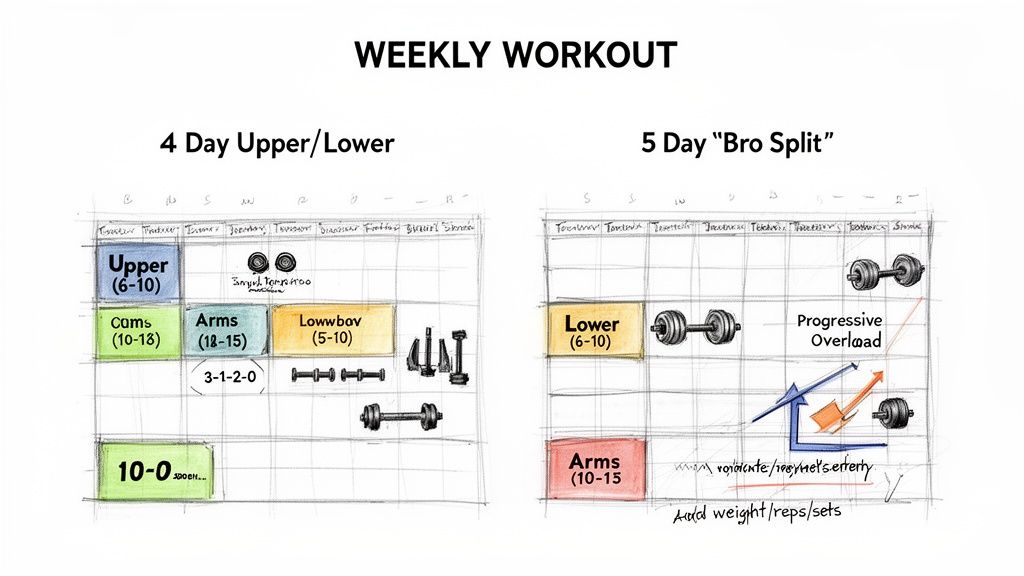
This is where the rubber meets the road. We're going to break down two incredibly effective, hypertrophy-focused training splits. Both are designed to add size to your arms, but they cater to different schedules and personal preferences. Find the one that fits your life and stick with it.
Option 1: The 4-Day Upper/Lower Split
This split is a powerhouse for anyone who wants to hit every muscle group twice a week—a proven frequency for packing on muscle. Your arms get trained right alongside your other upper body muscles, meaning they get both direct isolation work and indirect stimulation from your heavy pressing and pulling. It's a fantastic recipe for well-rounded growth.
Here’s what the week looks like:
- Monday: Upper Body Strength (Compound Focus)
- Tuesday: Lower Body Strength (Compound Focus)
- Wednesday: Rest
- Thursday: Upper Body Hypertrophy (Isolation Focus)
- Friday: Lower Body Hypertrophy (Isolation Focus)
- Saturday & Sunday: Rest
This setup ensures your arms are worked hard on both upper body days while still giving them plenty of time to recover and grow.
Option 2: The 5-Day Body Part Split
If you love the idea of having one day dedicated to absolutely annihilating your arms, the classic "Bro Split" is your ticket. This old-school approach lets you pour every ounce of energy and focus into your arms, which can be a game-changer for breaking through plateaus.
A typical 5-day routine is structured like this:
- Monday: Chest
- Tuesday: Back
- Wednesday: Shoulders
- Thursday: Legs
- Friday: Arms (Biceps & Triceps)
- Saturday & Sunday: Rest
Friday becomes your arm-building sanctuary. You can go all-in on biceps and triceps without worrying about saving energy for another muscle group.
The Engine of Growth: Progressive Overload
It doesn’t matter which split you pick; if you aren't applying progressive overload, you're just spinning your wheels. This is the non-negotiable cornerstone of building muscle. It's simple: you have to consistently challenge your muscles to do more than they're used to.
You don't get bigger and stronger by doing the same thing every week. You force your body to adapt by giving it a reason to. Progressive overload is that reason.
So, how do you actually do it?
- Add More Weight: The most obvious path. If you curled 30 lbs for 10 reps last week, grab the 35s and aim for 8-10 reps this week.
- Do More Reps: Can't jump up in weight just yet? Squeeze out more reps. If you hit 10 reps last week, fight for 11 or 12 this week with the same weight.
- Add Another Set: Increasing your total training volume is a huge driver of growth. If you've been doing 3 sets of skull crushers, try adding a fourth set.
This is why tracking your workouts is so critical. Using a tool like the Built Workout app to log every set, rep, and pound lifted removes all the guesswork. You can pull up last Friday's arm session and know exactly what numbers you need to beat.
Sample Hypertrophy Arm Day Workout
Let's plug this into a real-world workout for that dedicated arm day in the 5-day split. Pay attention to the sets, reps, and tempo. Tempo is noted as four digits (e.g., 3-1-2-0), which stand for the time in seconds for the lowering, bottom pause, lifting, and top pause phases of the lift.
| Exercise | Sets | Reps | Tempo |
|---|---|---|---|
| Close-Grip Bench Press | 4 | 6-10 | 3-0-1-0 |
| Skull Crushers | 3 | 10-15 | 3-1-1-0 |
| Triceps Pushdowns | 3 | 12-15 | 2-0-1-1 |
| Barbell Curls | 4 | 8-12 | 3-0-1-0 |
| Dumbbell Hammer Curls | 3 | 10-15 | 2-0-1-0 |
| Preacher Curls | 3 | 12-15 | 3-1-1-0 |
Why this layout is so effective:
- It kicks off with heavy compound movers (Close-Grip Bench, Barbell Curls) to build a solid foundation of strength and raw mass.
- Next, it transitions to targeted isolation work (Skull Crushers, Preacher Curls) to hammer specific muscle heads and chase a massive pump.
- The rep ranges stay in the sweet spot for hypertrophy—lower for the heavy stuff and higher for isolation moves to create metabolic stress.
This isn't just a random list of exercises; it's a strategic blueprint. Follow a structured plan like this, diligently apply progressive overload, and you'll be on the fastest path to getting the bigger arms you're after. It's time to stop guessing and start building with intent.
Fueling Growth Through Nutrition and Recovery
Let’s get one thing straight: your biceps and triceps don't actually grow while you're grinding out that last set of curls. The real magic happens hours and even days later, when your body is resting, repairing, and rebuilding the muscle fibers you just punished.
You can have the most brutal arm workout in the world, but without a solid nutrition and recovery plan to back it up, it’s all for nothing. Think of your training as digging the foundation for a house. Nutrition and recovery are the concrete and steel you use to build it bigger and stronger. Neglect them, and you’re just left with an empty hole.
Dialing in Your Nutrition for Arm Growth
To build muscle, your body needs two things above all else: enough energy and plenty of protein. This isn’t complicated, but it does require some intention. You can't just wing it and hope for the best.
First, you need a slight caloric surplus. This just means eating a bit more than your body burns each day. A modest surplus of 250-500 calories above your maintenance level is the sweet spot to fuel muscle growth without packing on a ton of unwanted body fat.
Next up is protein, the literal building block of muscle tissue. For optimal hypertrophy, you should be aiming for 1.6 to 2.2 grams of protein per kilogram of body weight daily. This ensures your muscles have a constant supply of the amino acids they're screaming for after a tough workout.
The bottom line is simple: you can't build something from nothing. A caloric surplus provides the energy, and adequate protein provides the raw materials. Nail these two things consistently, and you've created the perfect environment to get bigger arms.
This quest for arm growth fuels a massive industry. Research shows that fitness enthusiasts chasing bigger biceps and triceps buy 3.6 more products on average than general shoppers. This trend has pushed sales for supplements like creatine to over $500 million annually in major markets by 2023. You can explore more about these consumer trends to see just how big the market is.
The Recovery Powerhouses: Sleep and Stress
You can have the perfect diet, but if you're not sleeping enough, you are actively sabotaging your gains. During deep sleep, your body releases crucial muscle-building hormones like growth hormone while simultaneously suppressing the catabolic (muscle-wasting) hormone cortisol.
Make it a priority to get 7-9 hours of quality sleep per night. Anything less, and you're kneecapping your body's ability to recover. This is non-negotiable for growth.
On that same note, chronic stress keeps cortisol levels elevated, which can halt muscle growth and encourage fat storage. Finding ways to manage that stress—whether it’s meditation, taking a walk, or just unplugging for a bit—is a vital piece of the recovery puzzle.
Using Data to Take the Guesswork Out of Recovery
For years, recovery was a guessing game. You’d blast your arms and then guess when they were ready for another session. Go too soon, and you risk overtraining; wait too long, and you miss a valuable opportunity for growth.
This is where the Built Workout app becomes a game-changer. By logging every rep and set, the app tracks the exact stimulus you place on each muscle. It then visualizes that data with simple, color-coded recovery heatmaps.
- Red: The muscle is highly fatigued and needs more time to recover.
- Yellow: It's partially recovered but maybe not ready for another all-out assault.
- Green: The muscle is fully recovered and primed for your next workout.
Imagine finishing a tough arm day. The next morning, you can check your heatmap and see your biceps and triceps glowing red. As the days pass, you can literally watch them shift from red to yellow, and finally to green. This data-driven insight tells you the precise moment your arms are biologically ready to be trained again, helping you maximize your growth cycles and avoid burnout.
The Biggest Mistakes Holding Back Your Arm Growth
So you’ve got the perfect workout plan, you’re hitting the gym like clockwork, but your arms just aren’t growing. What gives? Before you start adding more work, it's time to troubleshoot. More often than not, the problem isn’t a lack of effort—it’s one of a few common mistakes that are quietly killing your gains.
Fixing these is often the key to unlocking new growth. Let's get into what might be holding you back and how to get back on track.
You're Lifting With Your Ego, Not Your Muscles
This is, without a doubt, the number one killer of arm gains: ego lifting. It’s that all-too-common urge to load up the bar or grab the heaviest dumbbells, turning a controlled bicep curl into a jerky, full-body heave. When you swing the weight using momentum, you’re not just risking injury—you're literally taking the tension off the very muscles you're trying to grow.
Instead of your biceps and triceps doing the work, your lower back, shoulders, and pure momentum take over. It might feel like you're moving impressive weight, but you're getting almost zero quality stimulation where it actually matters.
Here’s a simple truth: Your muscles don't know what number is on the dumbbell. They only know tension. A lighter weight moved with deliberate, perfect form will always build more muscle than a heavy weight slung around with bad technique.
If you need an honest, real-time form check, the AI Coach inside an app like Built Workout can be a game-changer. It gives you objective feedback on your reps, forcing you to focus on quality contractions instead of just moving from point A to B.
You're Forgetting About Two-Thirds of Your Arm
Walk into any gym, and you'll see it: endless sets of bicep curls in pursuit of that coveted "peak." Triceps work, if it happens at all, is often just an afterthought tacked on at the end. This is a massive mistake.
Here's the anatomical reality: your triceps make up roughly two-thirds of your upper arm mass. If you are serious about adding real size to your arms, you absolutely have to prioritize your triceps. Ignoring them not only caps your overall arm-size potential but also leads to a weird, disproportionate look.
Do a quick reality check on your routine:
- How many direct sets are you doing for your biceps each week?
- Now, how many are you doing for your triceps?
- If that ratio is skewed heavily toward biceps, it’s time to rebalance your program.
You're Constantly "Program Hopping"
Jumping on a new, flashy workout you saw on social media every week feels like you're keeping things fresh, but it's one of the worst things you can do for growth. This constant "program hopping" denies you the single most critical driver of muscle gain: progressive overload.
Muscles grow when they're forced to adapt to a consistent stress over time. By switching exercises every workout, you never give your body the chance to get truly strong and efficient at a movement. You're just spinning your wheels. Find a solid program and stick with it for at least 8-12 weeks. That's where the real magic happens.
Finally, you have to find the sweet spot with your training volume. Too little work, and your muscles have no reason to grow. Too much, and you'll burn out and stall. This is where tracking your recovery becomes so important. A tool like a recovery heatmap can give you a visual snapshot of how recovered your arms are, helping you decide if they're truly ready for another session. It helps ensure your training volume is productive, not just destructive.
How to Track Your Progress and Stay Fired Up
Let's be real: grinding away in the gym is only half the battle. The other half is knowing for a fact that your hard work is actually paying off. If you’re not tracking your progress, you're just guessing, hoping that all those curls and pushdowns are adding up to something.
There's an old saying in business that works just as well in the weight room: what gets measured gets managed. This simple idea is what turns your efforts from a shot in the dark into a predictable process for building bigger arms. When you can see the proof, motivation pretty much takes care of itself.
Old-School Methods That Still Crush It
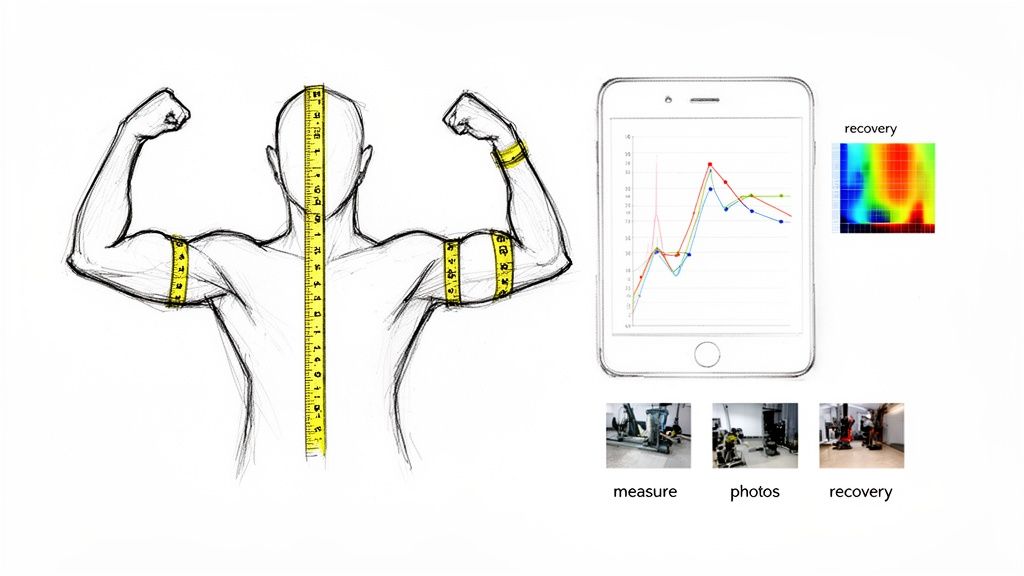
Long before smartphones existed, lifters had two incredibly effective tools: a simple tape measure and a camera. Honestly, they’re still some of the best ways to get an objective look at how far you've come.
To get reliable numbers, take your measurements every 4-6 weeks. Here's how:
- Relaxed Arm: Just let your arm hang loose at your side. Wrap a soft measuring tape around the thickest part of your upper arm, right about halfway between your shoulder bone and elbow.
- Flexed Arm: Now, make a fist and flex your bicep as hard as you can. Measure around the very peak of the bicep.
Progress photos are just as crucial. The mirror can lie to you because you see yourself every day, making slow changes impossible to notice. But when you snap a few photos from the front, side, and back every month (in the same lighting!), the side-by-side comparison tells the real story.
Using Tech as Your Smart Training Partner
While a tape measure shows you the result, a good workout app shows you the process that got you there. It's the ultimate accountability partner, making sure you’re consistently doing what it takes to grow.
This is where an app like Built Workout really comes into its own. It's more than just a digital notebook; it gives you insights that help you build bigger arms, faster.
Your logbook is your most powerful tool. It’s not just a record of what you’ve done; it’s a roadmap for what you need to do next to force your muscles to grow.
By logging every set, rep, and pound you lift, you create a crystal-clear history of your performance. This data is the lifeblood of progressive overload. You can pull up last week's arm workout in seconds and know the exact numbers you need to beat. No more guesswork.
Data-Driven Motivation and Learning from the Community
The real magic of a modern fitness app is how it helps you make sense of all that data. The AI Coach in Built Workout, for instance, analyzes your logged sessions and recovery status to give you smart, real-time advice. It might tell you to push for an extra set, suggest a weight increase, or even tell you to back off if its recovery heatmaps show your triceps are still fried from your last push day.
This isn't just about being held accountable; it's about making smarter training decisions.
Plus, features like a social feed let you see what other real people are doing in the gym. You can check out how others structure their arm days, the exercises they're using, and the weights they're hitting. It’s an endless source of inspiration and new ideas. Staying driven is key, and our guide on gym motivation tips can give you even more strategies to keep that fire lit.
When you combine old-school measurements with smart workout data, you create a powerful feedback loop. You see the number on the tape measure go up because you see the numbers in your app go up. That direct connection is all the motivation you'll ever need.