When it comes to picking the best cardio machine for weight loss, there's no single magic bullet. The real secret is finding the right tool that fits your body, your goals, and your ability to stick with it. It’s all about striking a balance between torching calories and choosing something you can do consistently, which means considering things like joint impact and which muscles you're working.
For most people looking to drop pounds, a treadmill or a rowing machine often gives the biggest bang for your buck.
Choosing the Right Cardio Machine for Your Goals
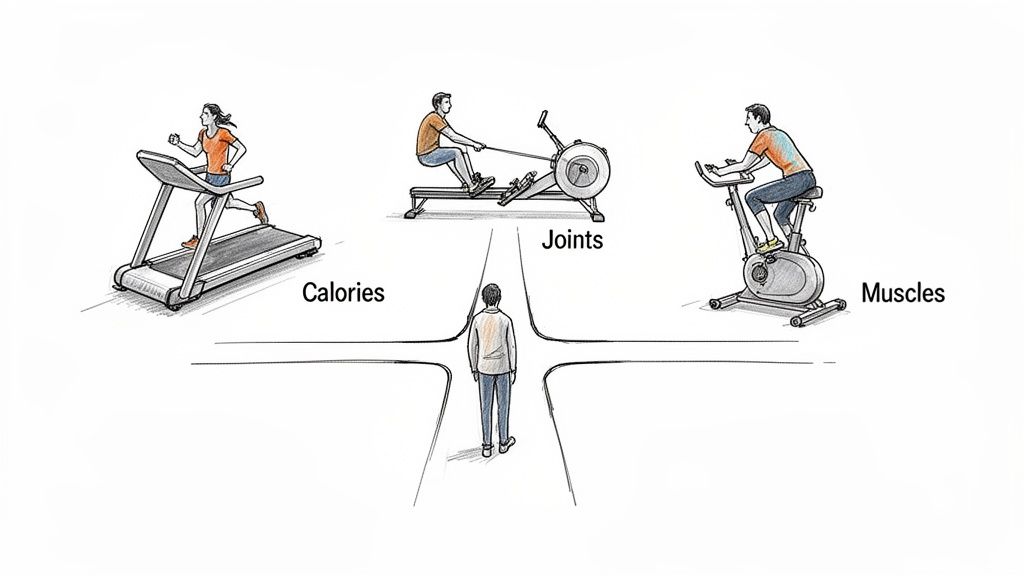
Walking onto the gym floor and seeing a sea of cardio equipment can feel a bit overwhelming. Every machine promises to deliver results, but how they actually help you lose weight is a different story. To make a smart choice, you have to look past the flashy calorie counter and understand the metrics that really matter.
This guide is designed to cut through the noise with a clear, data-driven comparison of the most common cardio machines. We’ll go beyond a simple pros and cons list and dig into how each piece of equipment truly affects your fat-loss journey.
Key Evaluation Criteria
To fairly compare these machines, we need a consistent set of rules. Here’s what we’ll focus on:
- Metabolic Impact: This is all about how many calories you burn—not just during the workout, but in the hours that follow.
- Muscle Engagement: The more muscles you use, the more energy your body has to expend. Simple as that.
- Joint Stress: We’ll look at the impact on your knees, hips, and ankles, because this directly impacts how often you can train without risking injury.
Take the treadmill, for instance. It’s a high-impact, weight-bearing exercise, which makes it an absolute beast for burning calories. On the other hand, the rower provides a killer full-body workout with virtually no impact, making it fantastic for metabolic conditioning without pounding your joints. That’s a crucial difference, especially when planning a sustainable workout week. You can learn more about how to prevent overtraining to ensure you stay on track.
Choosing a machine isn’t just about the highest number on the calorie display. It’s about finding the most effective and sustainable option for your body, ensuring you can show up consistently without burnout or injury.
Understanding the Equipment
You might hear the term "ergometer" thrown around the gym. Many modern cardio machines are technically ergometers—devices that measure the work or energy you're putting out. As you weigh your options, understanding what is an ergometer can give you a better grasp of how these machines track your performance.
| Machine Attribute | Treadmill | Rowing Machine | Stationary Bike |
|---|---|---|---|
| Calorie Burn | Very High | High | Moderate |
| Joint Impact | High | Low | Low |
| Muscle Focus | Lower Body | Full Body | Lower Body |
Ultimately, how you weave cardio into your overall plan is what counts. The Built Workout app makes this easier by letting you log your sessions and monitor muscle recovery. This ensures your cardio work supports—rather than sabotages—your strength training and fat loss goals.
The Undisputed Champions of Calorie Burn
When your main goal is to incinerate calories, some machines just get the job done better. While any cardio is good cardio, the treadmill and the stair climber consistently come out on top for pure energy expenditure. The reason? It all comes down to a simple, powerful force: gravity.
These are weight-bearing exercises, which means you’re fighting to move your own body weight with every single step. On a treadmill or stair climber, you’re not just moving; you're actively resisting gravity, forcing the biggest muscles in your body—your glutes, quads, and hamstrings—to fire on all cylinders. That high level of muscle engagement is exactly what jacks up your heart rate and kicks your metabolism into overdrive.
Why Treadmills and Stair Climbers Dominate
The treadmill’s secret weapon is its versatility. You can walk, jog, or run, but the real magic for fat loss happens when you crank up the incline. Running on even a slight grade forces your posterior chain to work significantly harder, leading to a massive spike in calorie burn compared to running on a flat surface.
The stair climber is just as relentless. It mimics one of the most challenging things we can do: climb stairs, over and over again. This constant vertical push gives your lower body zero breaks, keeping your heart rate pegged in the effective zone for the entire workout. It's this sustained effort that torches calories and drives real results.
And it’s not just gym wisdom; the science backs it up. One study comparing various machines found the treadmill produced the highest calorie burn, oxygen consumption, and heart rate—in some cases, up to 20-44% higher than machines like stationary bikes. The stair climber wasn't far behind, cementing its spot as a top-tier fat-loss tool. You can dive into the numbers yourself and explore the detailed research on energy expenditure.
Gauging Your Effort for Optimal Results
Pushing yourself is key, but training smart is what brings long-term success. Going beast mode every single session is a fast track to burnout and injury. A much more effective strategy is to manage your intensity using the Rated Perceived Exertion (RPE) scale.
Think of RPE as your internal effort meter, on a simple scale of 1 to 10. A 1 is you sitting on the couch, and a 10 is an all-out sprint you can only sustain for a few seconds. For most of your fat-loss cardio, you’ll want to live in the 6-8 range—that sweet spot where you're working hard and breathing heavy, but could still manage to spit out a few words.
Key Insight: Learning to use RPE is like developing a superpower. It’s a biofeedback tool that teaches you to listen to your body, so you can adjust your intensity on the fly without being glued to a heart rate monitor. This self-awareness is what separates short-term results from lasting change.
Turning Subjective Effort into Actionable Data
While RPE is a feeling, you can turn that feeling into hard data. When you log your cardio sessions in an app like Built Workout, you can note your average RPE for the session.
This is where things get interesting. Over time, you'll start to see patterns emerge:
- Progress Tracking: Maybe that run that felt like an RPE 8 a month ago now feels like a solid 6 at the same speed and incline. That’s a crystal-clear sign your fitness is improving.
- Recovery Insights: On the flip side, if a normally easy workout suddenly feels like a 9, it might be your body telling you it’s under-recovered. That's your cue to ease up and avoid overtraining.
By tracking RPE, you’re adding crucial personal context to your workout data. It ensures you’re pushing hard enough to make progress but not so hard that you sabotage your recovery. It’s the smarter, more sustainable path to hitting your weight loss goals.
Comparing Cardio Machines for Effective Fat Loss
When it comes to picking the right cardio machine for weight loss, it's about more than just which one has the flashiest calorie counter. The best choice is the one that fits your body, your fitness level, and, most importantly, the one you'll actually use consistently.
This comparison breaks down the seven most popular machines, looking at them through four critical lenses that really matter for shedding fat:
- Calorie Burn Potential: How much energy you can expect to burn during a solid workout.
- Muscle Groups Engaged: More muscle worked equals a bigger metabolic boost.
- Joint Impact: A huge factor for long-term consistency and avoiding injury.
- Skill Requirements: How tricky is it to use the machine correctly and safely?
Looking at these factors helps explain why a machine like a rower, which might show a slightly lower peak calorie burn than a treadmill, could be a better overall tool for metabolic conditioning thanks to its full-body engagement.
The Breakdown: Machine by Machine
Let's get past the generic pro/con lists and dig into what makes each piece of equipment unique. Understanding these differences is key to making a smart decision for your goals.
The chart below gives you a quick visual on the calorie-burning potential of a few of the top contenders.
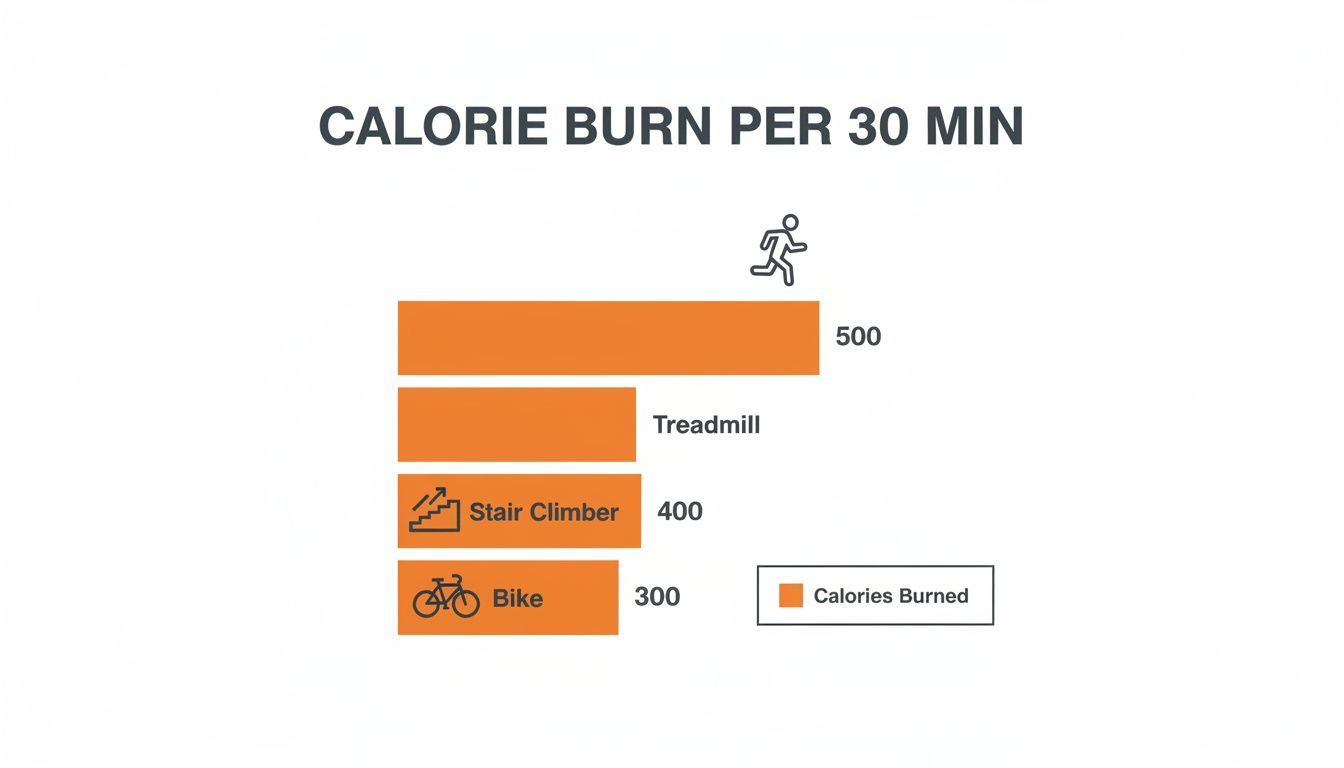
As you can see, weight-bearing activities like running on a treadmill or climbing stairs generally force your body to expend more energy than non-weight-bearing options.
Treadmill
The treadmill is a classic for a reason. It's a weight-bearing exercise, meaning your body has to fight gravity with every single step. This forces the big, powerful muscles in your lower body and core to fire up just to keep you stable.
That high level of muscle activation is exactly why it's a calorie-torching machine. It consistently ranks at the top for fat loss because it demands so much from your quads, glutes, hamstrings, and calves—the largest muscle groups in your body—to support and move your entire body weight.
Stationary Bike
Stationary bikes are a fantastic low-impact option, making them a go-to for anyone with sensitive joints or for those programming in an active recovery day. While the standard upright and recumbent bikes focus on the lower body, the air bike (often called an Assault Bike) is a completely different animal.
Air bikes bring your upper body into the fight, using a fan for resistance that gets harder the more you push. This creates a brutal, full-body workout that's perfect for high-intensity interval training (HIIT). Many people get stuck choosing between the two classics; this detailed guide on Treadmill Vs Stationary Bike Weight Loss can help you decide which one aligns better with your goals.
Balancing Impact with Intensity
Ultimately, your choice often comes down to this: how hard can you push versus how well can your body recover? High-impact machines might burn more calories minute-for-minute, but low-impact machines often allow you to train longer and more frequently without beating up your body.
The real difference lies in weight-bearing vs. non-weight-bearing exercise. Weight-bearing machines like the treadmill and stair climber force your muscles and skeleton to work against gravity, which is great for building bone density and ramping up your metabolism. Non-weight-bearing machines like the bike and rower take the stress off your joints, letting you go all-out without the pounding.
Elliptical
The elliptical is hugely popular because it gives you a running-like motion without the jarring impact. Since your feet stay on the pedals, it’s much kinder to your knees, hips, and ankles.
It’ll work your quads, hamstrings, and glutes, and if you get the handles moving, you'll engage your chest, back, and arms, too. The catch? The machine supports a lot of your body weight, so the calorie burn is usually lower than a treadmill's at the same level of perceived effort.
Rower
The rowing machine is arguably the king of full-body cardio. A single, powerful stroke engages an estimated 85% of your muscles, hitting everything from your legs and core to your back and arms.
This total-body recruitment makes it incredibly efficient for building both cardiovascular fitness and muscular endurance at the same time. While a max-effort sprint might not burn as many calories as one on the treadmill, its ability to condition your entire body makes it a powerhouse for improving your overall fitness and metabolic health.
Specialty Machines for Targeted Work
Beyond the big four, you have specialized machines like the stair climber and SkiErg that offer unique advantages for a well-rounded fat loss plan.
Stair Climber
Just like the treadmill, the stair climber is a weight-bearing monster that melts calories by making you lift your own body weight, step after step. It puts a ton of demand on your glutes, quads, and calves, making it one of the best tools out there for building serious lower-body strength and endurance. The continuous climbing motion keeps your heart rate jacked up, making it lethal for both steady-state sessions and intense intervals.
SkiErg
The SkiErg is another low-impact, full-body option, but with a major emphasis on your upper body and core. It mimics the motion of cross-country skiing, forcing you into a powerful pulling motion that lights up your lats, triceps, abs, and glutes. It’s an amazing tool to complement leg-dominant cardio, helping you build a more balanced and athletic physique while delivering a killer cardiovascular workout.
Cardio Machine Comparison for Weight Loss
To help you see everything side-by-side, here’s a quick-glance table breaking down each machine based on what matters most for weight loss.
| Machine | Avg. Calorie Burn (per hour) | Primary Muscles Worked | Joint Impact | Best For |
|---|---|---|---|---|
| Treadmill | 600-1200 | Glutes, Quads, Hamstrings, Calves, Core | High | Maximum calorie burn, improving run performance |
| Stair Climber | 600-900 | Glutes, Quads, Hamstrings, Calves | High | Lower body strength, high-intensity cardio |
| Air Bike | 500-1000 | Full Body (Legs, Chest, Back, Arms) | Low | HIIT, metabolic conditioning, full-body training |
| Rower | 500-900 | Full Body (Legs, Back, Core, Arms) | Low | Total body conditioning, building endurance |
| SkiErg | 500-800 | Back, Arms, Core, Glutes, Hamstrings | Low | Upper body focus, HIIT, complementing leg days |
| Elliptical | 450-750 | Glutes, Quads, Hamstrings, Upper Body | Low | Joint-friendly cardio, active recovery |
| Stationary Bike | 400-700 | Quads, Hamstrings, Glutes, Calves | Low | Sustained cardio, beginners, active recovery |
At the end of the day, the best cardio machine for weight loss is the one you don't hate using. Find one that feels good for your body, keeps you challenged, and makes you want to come back for more. That’s the real secret to consistency.
How to Structure Your Cardio for Maximum Weight Loss
Picking the right cardio machine is a great first step, but it’s only half the battle. The real secret to torching fat lies in how you use it. Just mindlessly plodding along for 30 minutes won't cut it if you're serious about results. You need a game plan.
That's where a structured approach comes in, one that uses proven training methods to crank up your metabolism and improve your overall fitness. The two most powerful strategies in your toolbox are High-Intensity Interval Training (HIIT) and Low-Intensity Steady-State (LISS). They’re polar opposites in practice, but when you learn how to combine them, they become an unstoppable force for fat loss.
High-Intensity Interval Training (HIIT) Explained
HIIT is all about going hard, then backing off, over and over again. Think short, explosive bursts of maximum effort followed by brief periods of active recovery. The workouts themselves are surprisingly short—often just 15-20 minutes—but don't let that fool you. The intensity is what makes it so brutally effective.
When you push yourself into those all-out intervals, your heart rate skyrockets, and your body is forced to work anaerobically (without enough oxygen). This creates a massive metabolic ripple effect called Excess Post-exercise Oxygen Consumption (EPOC), better known as the "afterburn." Your metabolism stays revved up for hours after your workout is over as your body works overtime to recover. That means you’re still burning calories long after you’ve hit the showers.
Key Takeaway: HIIT is the ultimate workout for the time-crunched. It delivers a serious metabolic advantage in a fraction of the time of traditional cardio. The magic isn't just what you burn in the gym, but the calories you incinerate for hours afterward.
Sample Treadmill HIIT Workout
Ready to give it a try? This workout is designed to push your limits and get that afterburn effect going strong. Just make sure to warm up properly with about 5 minutes of light jogging first.
- Warm-Up: 5 minutes of light jogging (about a 4-5 on a 1-10 scale of perceived effort).
- Work/Rest Intervals: Repeat this cycle 10-15 times.
- 30 seconds Sprint: Run hard. We're talking an 8-9 effort level. You should be breathless.
- 60 seconds Recovery: Slow down to a walk or very light jog (3-4 effort) to catch your breath.
- Cool-Down: 5 minutes of walking, gradually bringing your pace and heart rate back down.
Low-Intensity Steady-State (LISS) Explained
On the other end of the spectrum, we have LISS. This is the exact opposite of HIIT. It involves maintaining a low-to-moderate intensity for a longer duration, usually somewhere between 40-60 minutes. The goal here is to keep your heart rate in that "fat-burning zone," which is roughly 60-70% of your max heart rate or a 4-5 on the perceived exertion scale.
During a LISS session, your body has plenty of oxygen and prefers to pull energy from its fat stores. While it doesn't give you that big afterburn like HIIT, it burns a substantial number of calories during the workout itself. Plus, it's much easier on your body and central nervous system. This makes LISS an incredible tool for active recovery, helping to flush out soreness and improve blood flow without adding more stress. Thinking about using it this way? We have a great guide on cardio on rest days.
Sample Elliptical LISS Workout
This is the perfect workout for a lower-impact day when you want to focus on burning fat without beating yourself up.
- Warm-Up: 5 minutes at an easy, comfortable pace (3/10 effort).
- Main Set: Settle in for 40-50 minutes at a consistent, moderate pace.
- Keep your effort at a 4-5 out of 10. You should be able to hold a conversation without gasping for air.
- To keep things interesting, you can slightly adjust the resistance or incline every 10 minutes, but make sure your effort level stays the same.
- Cool-Down: 5 minutes at a slow, easy pace to finish up (2-3/10 effort).
Combining HIIT and LISS for Best Results
Here’s the thing: you don't have to choose a side. The most effective programs for weight loss actually use both. A smart weekly schedule might include two HIIT sessions and two to three LISS sessions, strategically placed around your strength training.
For instance, you could smash a HIIT workout after an upper-body lifting day and then use a LISS session as active recovery the day after a tough leg day. This setup gives you the best of both worlds—the metabolic boost from high-intensity work and the steady fat burn and recovery benefits from low-intensity cardio.
Of course, the machine you choose can make a big difference, especially for your HIIT days. Research sponsored by ACE has shown that weight-bearing machines like treadmills and stair climbers are calorie-burning kings. In fact, treadmills can burn up to 50% more calories than other machines simply because you have to support your own body weight. You can read more about these cardio machine findings to help pick the best tool for the job.
Making Your Cardio Count with Built Workout
Picking the right cardio machine is a great start, but it's only one piece of the weight-loss puzzle. The real secret is understanding how that cardio session fits into your entire week of training. It’s all about training smarter, not just harder, by using data to strike the right balance between torching calories and letting your body recover.
When you log your cardio sessions right alongside your strength workouts, you get the full picture of your training load. This simple habit helps you avoid a classic mistake: letting your cardio sessions cannibalize your recovery and muscle growth. Seeing everything in one place reveals the true demands you’re placing on your body.
Use Heatmaps to See Your Recovery
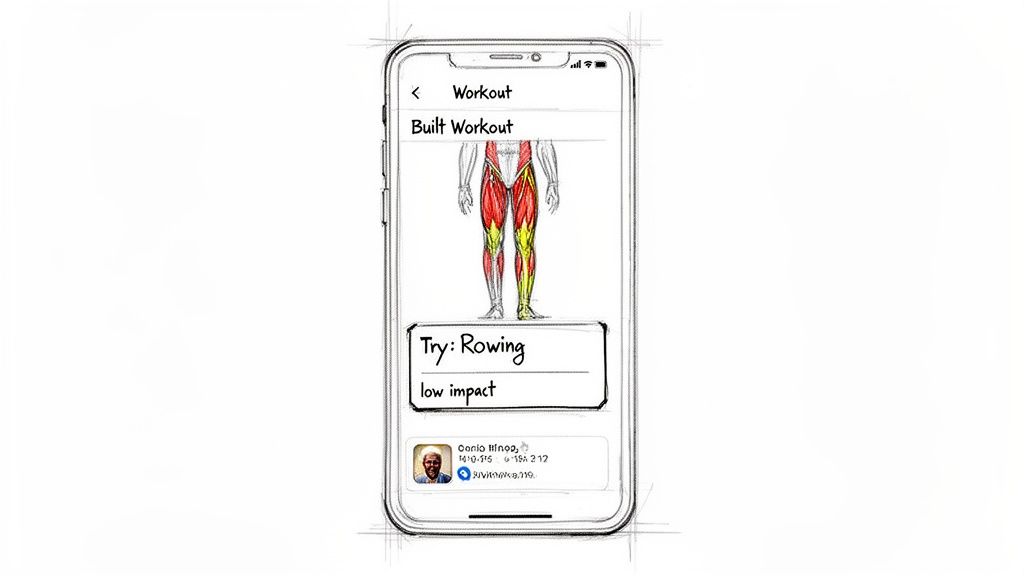
One of the most effective ways to train smarter is to actually see your muscle fatigue. The Built Workout app generates muscle recovery heatmaps, giving you a clear visual of which muscles are ready to go and which are still fried from a previous workout. This data is a total game-changer for planning your cardio.
Let's walk through a real-world scenario:
You just finished a monster leg day, setting new personal bests on squats and lunges. The next morning, you open the Built app and your heatmap is lit up bright red across your quads, glutes, and hamstrings. They're clearly overworked and need a break.
Without that insight, you might have instinctively jumped on the treadmill for a high-impact run, hammering those already-sore muscles and jacking up your injury risk. But with the app's data in hand, you can make a much better call.
Situational Recommendation: When the heatmap shows a muscle group is fatigued, the goal is to burn calories without causing more strain. This is the perfect time to choose a low-impact machine that targets different muscles or takes the load off the overworked ones.
The app's AI can analyze your recovery status and suggest a smart alternative. For instance, it might recommend a rowing or SkiErg session, which puts the emphasis on your back and arms while still delivering a massive calorie burn. This way, you stick to your cardio goals without derailing the progress you made on leg day. To learn more about this approach, check out our complete guide to using a gym workout tracker.
Find Your Next Workout with Real-World Data
Let's be honest, sometimes the hardest part of training is just boredom. Seeing how other people program their cardio can be a huge source of motivation and fresh ideas. This is where a community-driven approach makes all the difference.
Think of Built Workout’s social feed as a living, breathing workout playbook. It's not about gym selfies; it's about sharing real, actionable training data. You can see the exact cardio workouts other users are logging, including details like:
- Machine Choice: Notice what equipment people are using the day after a big strength session.
- Workout Structure: Find new HIIT protocols, like a brutal 20-minute air bike workout using a 1:2 work-to-rest ratio.
- Performance Metrics: See actual numbers for duration, average heart rate, and estimated calories burned.
For example, you might scroll through and see that an advanced lifter always does a low-intensity elliptical session the day after their heaviest deadlift workout. That’s a practical, real-world template you can borrow and adapt for yourself. It helps you discover effective, high-calorie-burn routines you might never have thought of, turning your workout planning from a guessing game into a data-backed strategy.
Common Questions About Cardio for Weight Loss
When you're trying to drop fat, the world of cardio can feel a bit overwhelming. Everyone seems to have a different opinion, and it's easy to get bogged down in the details. Let's clear the air and tackle some of the most common questions with practical answers you can actually use.
How Often Should I Do Cardio for Weight Loss?
The honest answer? It depends. Your ideal cardio frequency hinges on your overall training schedule, how hard you're pushing, and how well your body is recovering. But for most people aiming for sustainable fat loss, there's a sweet spot.
Aim for three to five cardio sessions per week. This is a solid, achievable goal that lets you mix up intensities without running yourself into the ground, especially if you're also hitting the weights.
Here’s one way to structure your week:
- 2 High-Intensity Sessions: Think HIIT workouts on non-consecutive days, like a Monday and Thursday.
- 2-3 Low-Intensity Sessions: LISS or steady-state cardio works perfectly on your other days (e.g., Tuesday, Friday, and Saturday) and can even double as active recovery.
Should I Do Cardio Before or After Lifting Weights?
Ah, the classic debate. The truth is, if your only goal is to lose weight, the order doesn't matter nearly as much as just showing up and putting in the work. But if you're trying to optimize your results, the answer gets a lot clearer.
If building strength and muscle is your top priority, always lift first. You need all your energy and mental focus to move heavy weight safely and effectively. Doing a tough cardio session beforehand can sap the glycogen your muscles need for those powerful contractions, short-changing your strength gains.
On the flip side, if your main goal for a specific workout is to improve cardiovascular endurance, it makes sense to tackle that first while you're fresh.
Practical Guideline: For a well-rounded fat loss plan, do your strength training first to maximize the muscle-building stimulus. Follow that up with your cardio. This strategy lets you get the best of both worlds without sacrificing your performance in the weight room.
Can I Lose Weight with Only Low-Impact Cardio?
Absolutely. It’s easy to get fixated on the machines that promise the highest calorie burn per minute, but the real secret to weight loss is consistency. Low-impact options like the elliptical, stationary bike, and rower are fantastic for shedding pounds.
The biggest advantage they offer is being kinder to your joints. This means you can often work out longer and more frequently without the aches, pains, and potential overuse injuries that can come with high-impact exercise. A solid 60-minute session on an elliptical can burn a serious number of calories without the jarring stress of a treadmill run.
At the end of the day, the best cardio is the type you'll actually stick with. If low-impact machines let you train consistently and pain-free, they are an excellent path to your weight loss goals.
Ready to stop guessing and start training with precision? Built Workout uses muscle recovery heatmaps and AI-driven insights to help you perfectly balance your strength and cardio sessions for maximum fat loss. Download the app today and discover the smarter way to train. Find out more at https://www.builtworkout.com.